The Carpenter and the Angel

For a change of pace, I would like to share this charming folktale from Kagoshima Prefecture, Japan, of a sort traditionally told to small children.

We originally posted this little story about a year ago, but subsequently some pesky pixies seem to have pulled it down, so we are re-publishing it today for Japan’s Labor Thanksgiving Day holiday and because Tengo was such a great workman (or at least labor producer).

I have included photo extracts from the Kasuga Gongen Genki E (春日権現験記絵) scrolls painted in 1309 on silk using silver and gold paints, showing carpenters working on the Kasuga Shrine jobsite in Nara back in the day.

My children and I enjoyed this story. Perhaps you and yours will too.

The Tale of Tengo and Tenjin

Once upon a time there was a very good carpenter. But he was sad because he lived alone, so he asked the prettiest girl in the village to be his bride.

She did not want to marry, but to put him off without hurting his feelings, she decided to charge him with an impossible task. 

“If you will build me a big house with 60 tatami mats in a single day, then I will marry you.” (60 tatami mats = approx 99 square meters = 1065 sqft based on the standard modern tatami mat) 

The carpenter was shocked by this demand, but because he wanted her for his bride, he boldly accepted the challenge saying: “I will build you this house in one day.” 

His voice rang with confidence as he said this, but he despaired in his heart knowing he could not build such a large and beautiful house in one day. He thought to himself  “ What shall I do, what shall I do?”

But never fear, because as you have probably guessed, our carpenter was no ordinary fellow to give up easily. Before long he came up with a plan.

He made 2,000 dolls out of straw and breathed on each while casting a magical spell transforming them all into human carpenters. 

The carpenter and his 2,000 man crew then went to work.

Images from the “Kasuga Gongen Genki E,” completed in 1309. At the top of this image, the Master Carpenter and his helper use a water trough as a water level for layout. He uses a vertical string of a fixed length with a plumb bob attached to check the high stringline’s height above the water’s surface to adjust the line to be approximately level. At the center-right, A crew of 3 workmen excavate a hole and compact the soil at the intersection of two low stringlines installed by the Master Carpenter in preparation for placing a natural foundation stone, probably intended to support a main post. Notice the shovel: a wooden blade and handle fitted with a joined “T” handle and with a steel or iron cutting edge affixed. Bleeding-edge technology at the time.
The carpenter and his young helper in the drawing’s upper half use a sumitsubo (inkpot) to snap a straight line on a timber in preparation for splitting it into boards. At the lower right, the master carpenter uses his sumitsubo inkline as a plumbline to orient his steel square to vertical against the log’s end. At the same time, he directs his mellow-looking partner at the opposite end to make a matching vertical line using a steel square with a bamboo pen wet with ink from the reservoir of his classic split-tail sumitsubo. Notice how he used an adze to keep the log from rolling away as they fiddle with their squares and inkpots.
The carpenters in the upper right use chisels to split timbers, while the other workers use adzes to dimension and clean split boards. Unusual for ancient Japan, this appears to be an ethnically-diverse crew with one workman apparently being of African persuasion (ツ). Notice the classic carpenter’s toolbox at the far left with a leaf-blade saw secured to the lid and a wooden mallet laying next to it on the ground
At the top of this image you can see two carpenters, one shaping the end of a round column with a spear-plane (yariganna) and another sawing what appears to be a kumimono bracket with a leaf-shaped saw as he jabbers at his buddy a hundred miles an hour. In the center, more carpenters use spear planes to smooth adzed boards and a round column. Notice the wood shavings curling from the curved blades, some being pushed and others pulled. Spear planes were used in Japan long before blade-in-block planes became common. The guy working on the board’s right hand end appears to have his thumb stuck in his eye. I hate it when that happens!
Carpenters erecting a building’s structure in a later century. No ginpoles, hardhats, shoes, or tie-offs are in sight. Probably no hardhats either. And the scaffolding is a death trap! Tisk, tisk! What would OSHA say?
A diagonal view of the coved & coffered ceiling at the family room.
A corner view of the family room coved & coffered ceiling. Notice the coped joints. This work is typically performed by joiners, not carpenters.
Related image
The living room has an even more elegant coved & coffered ceiling with “kumimono” brackets.
The living room’s coved & coffered ceiling in hinoki wood with a carved “rainbow beam” in the foreground. Nice work!

With the assistance of his 2,000 helpers, the the carpenter completed building his bride-to-be’s house before the sun went down that day,

Overjoyed, the carpenter flew to his bride-to-be’s house to tell her of his success. “I have finished the house you asked for. Please marry me now!”

“Truly?” she asked. Upon inspecting the work she found a big, beautiful house with 60 tatami mats, just as she had stipulated. “I will marry you.” she said.

And thus the prettiest girl in the village became the carpenter’s bride.

The carpenter and his bride then moved into their happy new home.

Afterwards, the 2,000 magically-created workers scattered throughout Japan to build houses, temples and bridges and teach many other carpenters how to build beautiful things for many years.

After several happy years had passed, the bride said to her husband “I have been silent up to now, but the time has come to tell you the whole truth. I am not really a human being, but an angel named Tenjin. I came down to earth from the kingdom of heaven. But the time has now come for me to return to heaven.”

The carpenter replied: “Ah, well, now that you mention it, I’m not actually a regular being either, but a carpenter god named Tengo. Let’s both return to heaven together.”

So Tengo and Tenjin rose high into heaven where they still live happily ever after.

The End

YMHOS

If you have questions or would like to learn more about our tools, please use the “Contact Us” form located immediately below. Please share your insights and comments with all Gentle Readers by using the form located further below labeled “Leave a Reply.” We aren’t evil Google, incompetent facebook, or twitchy Twitter and so won’t sell, share, or profitably “misplace” your information.

← Back

Thank you for your response. ✨

The Matsui Precision Notched Straightedge

Matsui Precision Bevel-edged Straightedge with notch

You cannot teach a crab to walk straight.

Aristophanes

This post is about a tool that looks quite ordinary but is in fact extraordinary in subtle ways.

Why Do Woodworkers Need a Good Straightedge?

When woodworking we need to be able to mark and measure straight lines and examine the precision of edges and surfaces. There are several ways and tools available to accomplish these tasks, but the steel straightedge is efficient and the quickest tool in the case of shorter distances, assuming one’s straightedge is up to the job.

For most woodworking tasks we don’t need a precision straightedge. But for those few activities where it is necessary, nothing can take its place. So what are some of those activities? I can suggest a few from my experience:

  1. I use a precision straightedge as a “Standard” to check that my working straightedges and squares (the ones that are used and abused daily) are truly straight and square. This is necessary because, during use, Murphy governs all operations, while pernicious Iron Pixies dance among the piles of dandruff on his shoulders. Due to their malicious ministrations, measuring and marking tools are easily damaged, wear-out, and lose tolerance so I need a reliable “Standard” to check them against regularly. Of course, you can’t check for straight or square unless you have a truly straight line/surface to index from. It would be silly to imagine that the edge of one’s tablesaw top or jointer table are perfectly straight without first checking it against a reliable standard;
  2. I use a precision straightedge to examine the soles of my handplanes to help me keep them straight, flat and free of wind because it’s very difficult to plane a flat surface with a screwy plane. No matter how much time I invest in truing my planes, I’ve found the results are never better than the straightedge I use.
  3. Check that lapping plates and the float-glass plate I use for truing stones and plane soles remain within tolerances. Yes, they wear out too.
  4. Check that the tables of stationary equipment such as tablesaws, bandsaws, jointers, and planers are true, and that infeed/outfeed soles of handheld electrical planers are properly aligned;
  5. Check that surfaces of wooden components of special projects requiring extra precision are true.

Do you ever need to accomplish any of these tasks?

Tasks for Which the Matsui Precision Straightedge is Not Ideally Suited

The Matsui Precision Straightedge is not an expensive tool, but since it is one I rely on, it is most cost-effective to protect it from premature wear and damage, so the following are tasks for which I use a less-expensive and less-protected “working straightedge” instead of my Matsui precision straightedge:

  1. I don’t use it for checking sharpening stones. The Matsui straightedge can do this job with style, but after a few years of being pressed against (and dragged over) abrasive stones, the tool’s precision would be degraded. Better to use a less-expensive straightedge for this job, and check it occasionally against the Matsui Precision Straightedge to confirm it’s still straight. If it isn’t, fix or replace it.
  2. I don’t use it for daily general woodworking tasks. Once again, the Matsui straightedge can do general jobs with style, but after a few years of being pressed against (and dragged over) wooden surfaces, the tool’s precision would become degraded prematurely. Instead I use a “working straightedge” that has been checked against my “Standard” Matsui Precision straightedge;

How To Use a Precision Straightedge for Checking Tools and Surfaces

Neither the human hand nor eye can measure a straight line or a true plane with any precision unaided, but there is one technique older than the pyramids all woodworkers must be proficient at, namely to place a truly straight, simple straightedge on-edge on a surface to be checked, be it a board, a jointer outfeed table, or the sole of a plane, and shine a light source at the gap between the straightedge and the surface being examined. If gaps exist, light will pass between the edge of the thin straightedge and the surface being checked confirming the surface is not straight and/or flat. The human eye can detect even a small amount of light this way and both quickly and effectively judge how flat the surface being checked is with a surprising degree of accuracy.

Feeler Gauge

Another technique that yields more precise values without relying on Mark1 Eyeball is to place the straightedge’s beveled edge against the surface to be checked, and insert feeler gauges into gaps between the straightedge and the surface. If the feeler gauge selected won’t fit, then one replaces it with thinner gauges until one that just fits is found.

Once you know the value of the gap between your straightedge and the area of the board you need to true, for instance, you can divide the measured thickness of the shaving your planes takes in a single pass (easily checked with a caliper) to calculate how many passes it will take to true the high-spots on a board, thereby eliminating a lot of the guesswork that makes precise woodworking difficult at times.

To reliably perform these checks, we need a truly straight straightedge. Straight is a relative thing, but straightedges sold for woodworking are seldom straight because purveyors rely on purchasers to not bother, or even know how, to check the quality and precision of the straightedges they sell.

Another reason honest, precision straightedges are relatively rare among woodworking tool collections is that making a high-tolerance piece of hardened steel that is straight, and will stay that way, is hard work that most woodworkers are neither inclined to appreciate nor bother to check, much less pay for. Is ignorance bliss? I believe it is in the exalted natures of our Gentle Readers to always strive to improve the quality and efficiency of their work. A high-quality precision straightedge is an essential tool in undertaking that blissful quest.

Challenges & Solutions

The dilemma of the straightedge is that it must be thick and rigid enough to prevent warping and flopping around in-use, but reasonably lightweight and not too bulky, otherwise it will be clumsy. At the same time, it must not be so thick as to block out most of the light passing between its edge and work-piece making it useless.

Another challenge the straightedge faces is the constant threat of damage. If the delicate edge is too soft, it will become dinged and deformed instantly becoming inaccurate. And if the straightedge rusts (the bane of all steel), precision will suffer.

What are the viable solutions? They are obvious and proven, but seldom implemented well. Here is how Matsui Precision does it.

1. Stainless Steel Construction

First, they use high-quality stainless steel to prevent corrosion. If you work in humid conditions or if you will admit to perspiring salt-laden moisture at times, then this is important, but not rare.

2. Properly-sized, Precision-ground & Polished

This straightedge is not an insignificant piece of stainless steel. It is available in various lengths, but in the case of the Matsui’s 400mm straightedge (a handy, reasonably-priced length), the blade is 34mm wide and 3mm thick, enough to keep the blade rigid in use and prevent warping, but not so wide or thick as to feel heavy or clumsy. It weighs 320gm (11 ounces), a nice, and unusual, balance of rigidity and weight.

In many countries, thick and heavy are viewed as hallmarks of quality. The Japanese people of course, value quality highly, but where they differ is a strong dislike of needlessly heavy, clunky tools, seeing the extra weight and bulk as signs of inefficient design and careless manufacturing. Their love of slim, compact lightweight tools made efficiently from quality materials permeates Japanese sensibilities.

What is more rare is the fact that Matsui then precision-grinds and precision polishes the stainless steel (not the same thing) so the tool is as straight and flat as machinists require, because this is a tool designed to the higher standards of machinists, not just woodworkers, who are by default typically consigned second-rate tools falsely misrepresented as being “high-precision.”

Hardened & Trued

Matsui also hardens the stainless steel to ensure the tool is rigid and will resist wear and damage over its long useful lifespan.

During heat treating and grinding metal warps slightly. After stress-relieving, Matsui inspects each tool one-by-one and corrects irregularities or rejects those that cannot be sufficiently corrected. It’s called quality control, something that never happens in China, India, Vietnam, or Cambodia.

Beveled Edge

To make it easy to see light passing between the straightedge and surface being checked, one edge is beveled. The importance of this detail cannot be overstated.

The Notch

The Matsui Precision Straightedge being used to check the sole of a 70mm finish handplane with a blade by Sekikawa-san. The notch fits over the cutting edge so one can check the sole with the blade protruding as it will be in-use. In this photo the blade has been extended waaay too far out of the mouth to make it easy to see the cutting edge. Please notice the light showing between the straightedge and the sole indicating that something is not right. The wedging pressure of forcing the blade to project this ridiculous amount has warped the block so that the most important part of the sole, the area directly in front of the mouth, is not touching. The point is that the notch makes it possible to check the sole with the blade projecting the intended distance, a job simply not possible with an ordinary straightedge.

In the case of the tool we are introducing here, Matsui cuts a small semi-circular notch in the beveled edge of the blade to provide clearance for irregularities in the surface being checked, such as welds, or in the case of woodworking tools, the cutting edges of the blades of handplanes, electrical planers and electrical jointers. This is an important and unique feature.

Why is this notch so useful? The problem with using a metal straightedge to check/true the sole of a handplane has always been that, in order to correctly check for flatness/wind, the blade must be set to project from the plane’s mouth the same amount it will when the plane is being used, because in the case of Japanese planes the wedge-shaped blade applies slightly different pressures on the wooden block at different depths in the block, producing variable degrees of deflection.

But if the blade is projecting from the mouth the same amount it will when in use, then the straightedge will ride on top of the cutting edge preventing a proper examination, and at the same time, will possibly dull the blade and gouge the straightedge. The solution has always been to adjust the blade to not actually project, but to be just in-line with the sole, a fiddly process that has resulted in many dulled blades, scratched straightedges, and inaccurate examinations. Don’t ask me how I know this (シ)

With the elegant Matsui Precision straightedge, however, the notch fits directly over the projecting blade avoiding the irritating and time-wasting fiddling normally required to get the blade in the exact position, one that often yields an imperfect reading.

If you need to maintain handplanes, electrical woodworking tools, or do precision woodworking and need an accurate, reliable, lightweight, durable, reasonably-priced straightedge to help take the guesswork out of these jobs, this product is just what you need. I have been using one for years and couldn’t get by without it.

If you are interested, send us a message using the form below.

YMHOS

Links to Articles About Other Matsui Precision Tools:

If you have questions or would like to learn more about our tools, please click the “Pricelist” link here or at the top of the page and use the “Contact Us” form located immediately below.

Please share your insights and comments with everyone by using the form located further below labeled “Leave a Reply.” We aren’t evil Google, fascist facebook, or thuggish Twitter and so won’t sell, share, or profitably “misplace” your information. If I lie may I never be see a straight line again.

← Back

Thank you for your response. ✨

Leave a comment

Toolchests Part 14 – Repairability

https://freaktography.com/wp-content/uploads/2020/04/abandoned-indigenous-church-2020-19.jpg
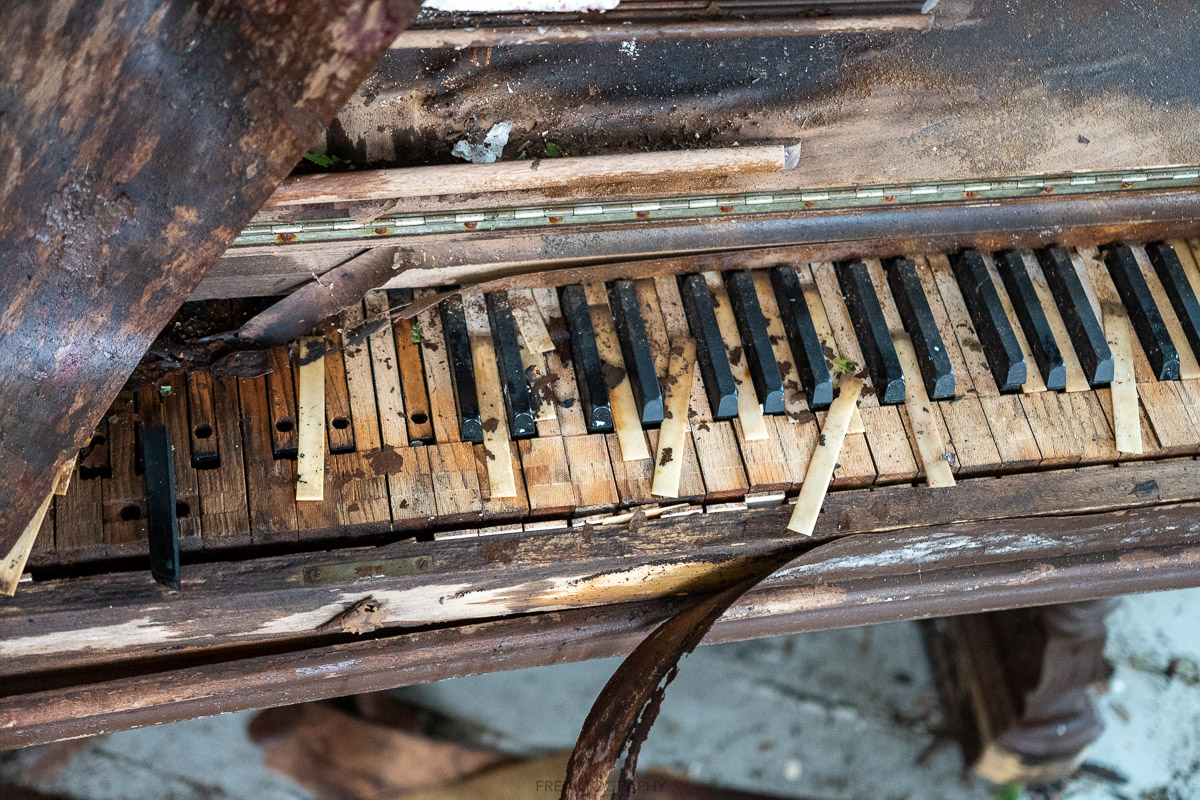
A wet grand piano. Dave, Freaktography.com

The time to repair the roof is when the sun is shining.

John F. Kennedy

This article is based primarily on an online discussion with Gary, a truly Beloved Customer, regarding his wise observation about the need to make a toolchest easily repairable, especially if one intends it to be useful for 200 years. I preached about durability, longevity and the joys of bubble-wrap in previous articles in this series but failed to address the subject of repairability, so in this article I will try to clarify a few points relevant to this subject.

Categories of Repairability

There are several types of repairs that a faithful toolchest may require during it’s lifetime if it is to remain useful, but I think the two main categories are (1) cosmetic and (2) mechanical.

So what did your humble servant do to facilitate Moby Dick’s “repairability,” and what would I change to improve it in this regard? Perhaps you may learn from, or at least giggle at, my mistakes. Soft giggles only, please.

Planning Repairability

It’s just a wooden box, but it would be wasteful to make it quickly and cheaply, get it out the door, receive payment, and hope cheap materials, crappy hinges, sloppy tolerances and loose joints won’t matter because, with a target useful lifespan of 200 years, “Poor Quality Equals Miserable Failure.”

In my experienced professional opinion the most effective way to ensure quality is to actively plan for it during the design phase, but I admit I did not give this subject special consideration at the time.
Cosmetic Repairability

This is one aspect of my toolchest that caused the pooch to walk funny for a few days because I screwed it good. But wait, there’s more to this tale of shame. When I realized my mistake and tried to remediate it some years later, I only compounded it. Poor sore Poochie!

You, Gentle Reader, have of course never suffered this sort of humiliation, but in the interest of sad and abused toolchests everywhere, I bow my shiny bald head, place my hand over my heart (it’s rattling around here in my chest somewhere, although my wife frequently disagrees) and humbly confess all. One or two teardrops fall, …

When new, my toolchest was striking in appearance, with highly figured solid mahogany wood panels (not veneer) exposed on the lid under a clear, high-gloss, rubbed-out catalyzed varnish finish. It was a thing of beauty, but not a joy forever because, after several years of use in drafty, dusty, pixie-infested garage shops combined with several long-distance moves and more than a few months of exposure to wind and sun it was scratched, dinged and crazed.

In my foolish vanity I repaired it using what I thought were sound techniques and quality materials, but which eventually proved to be inadequate.

I’m a highly-edumacated fella, you know, and during my studies at the University of Stoopid, School of Hard Knocks (Lower Outhouse Campus) where I earned an MD degree (Master Dipstick, Summa Cum Loudly) I learned that catalyzed varnish was not tough enough. Out of an abundance of well-earned humility I don’t display my UoS graduation certificate on my “I Love Me Wall,” so please don’t ask to see it.

Drawing upon my training at UoS, I next refinished the toolchest with a brushed-on spar-varnish finish. Not as pretty, but it was more flexible and more resistant to scratches and UV rays. But ultimately, it too failed. Poochie wept!

As the wise Nigerian Prince Musa Adebayo once told me (in exchange for a small wire transfer to his bank in Abuja, of course), “ Time destroys all things.” This eternal truth definitely applies to woodwork finishes, but I didn’t realize at the time the Prince was talking about credit ratings!

A decade or so later the toolchest (aka “Moby Dick”) was as scratched and gouged on the outside as its fishy-smelling namesake such that no translucent finish could conceal the repairs, forcing me to seek a more practical solution, one that would spare long-suffering Poochie further indignity.

On that bright day I said to myself: “Self,” (of course, I don’t address myself as “Mr. Covington” when deliberating with myself, because that would be insane), “Would you wear a bespoke tuxedo with handmade alligator skin dress-shoes to a muddy jobsite to perform a foundation rebar inspection?” I had to think about it for a while because, as you know, fashion is my life, but with a sigh of resignation I eventually answered myself, because that’s the only polite thing to do. The response was a resounding “No.”

In my supervisory role, I’m obligated to perform periodic construction jobsite inspections as part of quality control measures to ensure compliance with plans and regulations, but I wouldn’t wear a black tuxedo and delicate loafers to a jobsite any more than I would wear board-shorts and flip-flops. Instead I dress in tougher clothes that protect my legs and don’t instantly tear if they get hung-up on a rebar cage, and that won’t look filthy if they get a little muddy. And when the paparazzi’s cameras aren’t rolling (they seem to follow me everywhere, donchano (ツ)) I prefer sturdy leather boots that actually protect the tasteful glitter-varnish finish decorating my fuzzy pink toes.

With greater age and experience I finally concluded that, in the vanity of youth, I had erred by trying to make a toolbox look like pretty furniture. Feel free to mock the fool if you must but no tossing of rotten eggs, please!

So, determined to not make the same mistake a third time, I conducted more research on finishes that might get the job done. In the end I rejected the extremely tough but expensive and difficult-to-repair industrial solutions such as Imron and Polane and settled on a cheaper, friendlier and easier-to-repair solution; I sanded my toolchest down to bare wood and refinished the exterior with distressed milkpaint per Mr. Dunbar’s recommendations, as discussed in a previous post, and shellac on the inside.

When cured, milkpaint contains oodles of hard mineral solids with few volatiles to evaporate over the years to cause shrinkage and cracking (unless you want it to craze). It is not as flexible as latex paint but much tougher long-term than any clear finish. UV protection is absolute.

Like a Tabasco Sauce stain on camo pants, repairs are nearly invisible, indeed they even improve the chest’s character. With a bit of primer, milkpaint completely concealed the bondo I used to repair the cuts, scratches, and dings incurred during international moves, the ravages of rabid forklift attacks, and even injuries received from the slings and arrows of outrageous fortune (yes, here at C&S Tools we quote literary giants such as Shakespeare and Red Green). Latex paint works too, but milkpaint looks better and it’s far tougher.

But Gentle Reader you are no doubt wondering what this rambling has to do with “repairability.” The point is that repairs to a distressed milkpaint finish are easily accomplished and don’t look like repairs even when made to localized spots, they just give the overall finish more “character” making it look more interesting. No other finish I am aware of looks better with age and wear. Now that’s true repairability.

I only regret it took so long to stumble upon this excellent solution. So does Poochie.

Mechanical Repairability: Hinges & Screws

Hinges always wear out. The historical record shows that artistic iron hinges secured with iron staples, clinched nails, or small steel screws, while inexpensive and “historically correct,” always fail, usually sooner than later, as Murphy dictates. And when they fail, Murphy also ensures that they cause interference and maximize secondary damage.

Would you use flimsy sheet-metal kitchen-cabinet hinges to attach the tailgate of your pickup truck knowing that one day you may see that same tailgate in your rear-view mirror scattering festive sparks as it skates over the highway behind you? Why, then, would you put them on your toolchest?

Being in the construction industry I know the solution to hinge durability is to use more, bigger, corrosion-proof hinges because larger internal bearing/wear surfaces free of abrasive iron oxide wear slower and keep things tighter. Think stainless-steel or brass door hinges. Commercial ball bearing door hinges are good too, but the thrust bearings are oriented for an axial load, not a side load, so the cost-benefit analysis of bearings in this application is weak.

But I digress. How does one plan for repairability in the case of hinges? The answer is simple: “R&R,” as in “remove and replace.” Let’s look at “replacement” first.

Unless you or your descendants (assuming the chest stays in the family, which it should) intend to have replacement hinges custom-made when the original set wears out (funded by the generous cash inheritance you will no doubt bequeath them and the voracious tax maggots will graciously leave un-chewed) I recommend you plan for the original hinges to be quality products matching industry-standard specifications that will be easy to procure even in a century or two.

Consider the wisdom of using custom-forged hinges that look “antiquey” but that aren’t a standard dimension for which replacements are easily purchased. I double-dog dare you. A toolchest ain’t a little jewelry box, after all.

I recommend you use door hinges in standard sizes so they can be easily replaced without hiring a machinist or blacksmith when the time comes, a day that certainly will not fall within your lifetime if you heed the advice in the previous paragraphs. This is the essence of the “replace” aspect of “R&R” as it applies to hinges, IMO.

Moving on to the “remove” aspect of R&R, what else can go wrong with hinges? That’s right, those pesky screws.

If you use the skinny, short, cheap screws that are packaged with store-bought hinges, sure as eggses is eggses they will begin to dance the reverse macarena after a decade or four. I promise you that when that inevitable day comes, replacing them and repairing their worn-out holes will be a pain in the shorts. And what happens to the wobbly lid before you or your great-grandkids get around to fixing those idiot screws?

But wait, it gets worse (stay away Poochie, stay far away!). What happens when the hinges wear-out or fail but you can’t remove the blasted screws to replace them because they have broken-off in their screwholes during the removal attempt? That’s right, weeping, wailing and gnashing of teeth will ensue because a suitable replacement will be difficult to secure, or may never be secured, turning a weak two-hinge chest into a lop-sided one-hinge chest. Why would you give Murphy the satisfaction?

The best way to improve the “remove” factor in R&R therefore is to use oversized, extra-long, stainless steel grade 18-8 screws actually made in America, Canada, Europe, or Japan.

The tensile strength of fasteners made from 18-8 stainless steel is quite high, but not as high as those made from grade 5 carbon steel, but that’s alright because tensile strength is not a concern so long as the screw is properly made and lacks those internal defects typical of Chinese products which promote rupture. But besides exhibiting much greater corrosion resistance, the ability of fasteners made from this metal to bend and mold without losing durability makes 18-8 screws uniquely useful for cabinetry work subject where tensile strength is less important than corrosion-resistance and durability.

“Oversized” because screws larger in diameter than cheapo screws are tougher and more durable.

“Extra-long” because the deeper a strong screw is embedded in the wood, the more resistant to the reverse macarena it will be.

“Grade 18-8” because this industrial specification tells you something about a screw’s quality, reducing doubt. They cost more, but are worth it when you consider what will happen when a cheaper screw, one made to no quality standards beyond outward appearance, breaks off in the hole when it comes time to remove/replace it.

“Stainless steel” because brass is too weak, and a rusty carbon-steel screw will become a loose screw over time.
Made in America, Canada, Europe or Japan because, while Chinese-made screws are cheap (often sold under false pretenses as “quality fasteners”) one must always assume they are made of counterfeit materials with no quality control, they are defective, and they will fail sure as Santa wears green boxer shorts. Indeed, it’s not a matter of “ if” they’ll break but only “when.“ Murphy won’t need to lift a finger.

If an inexpensive stainless-steel screw is sold at a big-box retailer, even if it’s represented to be Grade 18-8, assume it’s made by Godless, bait-n-switch commies. No, not the gangsters that burned down Los Angeles, Portland, Seattle, Kenosha and Minneapolis, nor the well-coiffed despots in the pockets of the drug cartels that rule and plunder the coastal hell holes between Tijuana and Seattle, but the murderers in Beijing.

Reputable marine supply stores or specialty industrial fastener retailers may be the best source for quality stainless steel screws.

I also encourage you to prep the hinge plates by countersinking the screw holes to the correct depth and at the correct angle to ensure solid, maximum contact between screwheads and plates.

Prep the screw holes in the wood too. Drill pilot holes the right size and right depth, and put epoxy or glue in the holes just before inserting the screws to penetrate the wood and reinforce the threads the screws cut into the wood.

And if a screw becomes loose, figure out why and repair it immediately instead of just screwing it in tighter and tighter until it strips out.

Remember: History always calls an optimist who didn’t prepare for the worst eventuality a careless nitwit.

Mechanical Repairs: Tray Sliding Surfaces

Besides hinges the other things in a toolchest that always wear out and need repair are the surfaces that support the trays and on which they slide. This normal wear is easily remedied by planing the old, worn surfaces flat and gluing in durable hardwood wear strips. The lower the coefficient of friction the better. I have installed six replacement strips to the ledges of my toolchest. In retrospect, it would have been better to rabbet and glue these in-place when new so they would be easier to remove & replace when necessary.

Knowing these surfaces would wear and need replacement, however, your humble servant had the foresight to use screws to fasten the ledges that support the trays to the chest’s interior sides so they could be removed and easily worked on with handplanes instead of gluing/doweling them in-place. I highly recommend this design detail.

Adhesives

The subject of “reversible adhesives” such as hide glues and starch glues is interesting, and relevant to repairability because such adhesives make non-destructive disassembly of wood joints possible. Unfortunately I have no experience with hide glue and so cannot comment.

A renowned master joiner taught me his philosophy on the subject of glue, however, and it has stuck with me (pun intended). He held that it’s the craftsman’s job to make his work as strong and durable as possible when new, therefore obligating him to use the strongest reasonably practicable glue available to him to ensure that, if repairs are necessary, it won’t be because the glue failed.

He learned the trade when the only available woodworking adhesives available in pre-war Japan were “nikawa” hide glue, or starch glues made from rice, so he knew all about reversible adhesives. But when I knew him, he used PVA glue.

When I once mentioned I had read that rice glue should be used for fine joinery work to make repairs easier, he looked at me like there was a wriggling cockroach’s leg hanging out of my mouth, and turned away in disgust. Nuff said.

Conclusion

Thank you for reading this series of posts about toolchests. I hope you found it interesting, or at least amusing.

I would like to conclude with a Japanese saying relevant to the subject of this article: 「石橋を叩いて渡る」pronounced “ishibash wo tataite, wataru.” A direct translation of this idiom is “Strike a stone bridge before crossing,” meaning to “take every precaution.” I have a similar saying that goes: “Belt, suspenders, safety harness.” I encourage Gentle Readers to consider this principle when designing and constructing toolchests for their personal use.

YMHOS

A sturdy old stone bridge. Best to kick it a few time to makes sure it won’t fall down while crossing. After all, you never know…

If you have questions or would like to learn more about our tools, please click the “Pricelist” link here or at the top of the page and use the “Contact Us” form located immediately below.

Please share your insights and comments with everyone in the form located further below labeled “Leave a Reply.” We aren’t evil Google, fascist facebook, thuggish Twitter or the Congressional IT department of the Democrat Party and so won’t sell, share, or profitably “misplace” your information. If I lie may my belt break, my suspenders snap, and my safety harness become wrapped around my stupid neck as I dangle from a stone bridge.

← Back

Thank you for your response. ✨

Leave a comment

The Varieties of Japanese Chisels Part 16 – High-speed Steel Atsunomi

I am past scorching; not easily can’st thou scorch a scar.”

Herman Melville, Moby-Dick or, the Whale

Your humble servant has previously presented 15 varieties of Japanese chisels for Gentle Reader’s kind consideration in this series so far. In this article we will examine a specialized version of the Atsunomi previously presented in Part 8 of this series, one made from high-speed steel.

The C&S Tools High-speed Steel Atsunomi

The chisel in question is made by Mr. Usui Yoshio of Yoita-cho, Nagaoka City, Niigata Prefecture, under his brand name of Sukemaru. The shape of this tool is identical to his standard atsunomi, the only significant differences being the type of steel used and the bright appearance of the blade.

This is not a small chisel but a professional-grade, rugged tool with an overall length of approximately 300mm (12″). It is an indispensable tool in some situations.

If you need a smaller, handier, and more economical HSS chisel, please take a look at our HSS Oiirenomi also by Sukemaru.

What is High-speed Steel?

So just what is high-speed steel (HSS)?

HSS is a tool steel developed for manufacturing commercial cutters, dies, etc. In this case, Usui-san uses a high-speed steel designated SKH51 in Japan, the equivalent to M2 in the USA, BM2 in the UK, HS6-5-2 in Germany, and Z85WDCV06-05-04-02 in France. This is the most popular HSS formula in the world. If you own router bits without carbide cutters, and not made in China, you own this steel.

This variety of HSS contains buckets-full of tungsten, molybdenum and chrome, with a stout vanadium chaser.

After oven heat-treat, these chemicals make the steel tougher, more abrasion-resistant, and more resistant to softening (aka “temper-loss”) when subjected to high-temperatures than regular high-carbon steel. Its nickname of high-speed steel comes from the tendency of cutters made from this steel to retain their hardness even when worked so hard blade temperatures become hot enough to draw the temper of standard steel cutters, softening and making them useless.

The chemical composition is listed below, just in case you are interested. You can see what I mean about “buckets.”

CMNSiCrWMoV
0.85%0.28%0.30%4.15%6.15%5.00%1.85%
Chemical composition of SKH51/M2 HSS Steel

Why Use High-speed Steel?

No doubt a question jumping up and down and screaming in Gentle Reader’s mind at this point is “what are the properties of high-speed steel and what difficulties can a chisel made from this special steel help me overcome?”

Toughness and Shock Resistance

Perhaps the most significant property of high-speed steel is its toughness. SKH51 (M2) steel is the most shock-resistant of the high-speed steels, making it especially suitable for use in a chisel that may impact hard objects in daily use but must survive without chipping or breaking. This toughness provides huge benefits in the situations described further below.

Abrasion Resistance

Abrasion resistance goes hand-in-hand with toughness, but it is a different characteristic many misunderstand. It does not mean a cutting edge will be sharper than a cutter made of high-carbon steel, only that it won’t wear and become dramatically rounded-over as quickly. In the case of chisels, a blade made from highly abrasion-resistant tool steel will reach a certain level of sharpness (or dullness) and remain at that level a relatively longer time allowing a cutter to keep on cutting without becoming useless. But the quality of the cut will decrease, and energy necessary to motivate the blade will of course increase as the blade dulls. No free lunch, sorry to say.

Abrasion resistance is not typically considered overly important in blades where great sharpness is high-priority, but it is extremely important when the blade is used to cut materials such as exotic hardwoods that contain silica crystals, or Engineered Wood Products that contain hard adhesives and/or highly-abrasive particles such as silicon carbide deposited by sandpaper, or dirty wood contaminated with sand, grit and other contaminants that will literally destroy the cutting edge of a plain high-carbon steel blade making it useless.

Just as a low-revving high-torque truck would be at a hopeless disadvantage in a Formula One race, a screaming McLaren MP4/6 with all its speed, power and agility couldn’t tow a heavy trailer 100 yards through the mountains. Horses for courses.

Engineered Wood Products

One major challenge the HSS atsunomi excels at overcoming is modern wood products called Engineered Wood Products (EWP)

Commercial carpenters and cabinet makers nowadays have no choice but to use modern EWP such as plywood, MDF, HDF, OSB, LVL, glulams, etc.. Unlike new, clean, solid lumber cut with saws and planed with knives to final dimensions, engineered wood products are comprised of wood veneer, chipped wood and/or sawdust glued together by hard adhesives that will harm standard steel tool blades. HSS handles these difficult adhesives easily.

A bigger problem associated with EWP is the extremely hard abrasive particles left embedded in them by the sanding belts used to dimension and smooth them, particles much harder than any heat-treated steel, and that will quickly destroy a good high-carbon steel chisel. Being much tougher and more abrasion resistant than high-carbon steel, HSS can handle this abrasive residue without being destroyed. That does not mean abrasive particles do not scratch and dull HSS atsunomi cutting edges; After all, silica carbide particles are harder than high-speed steel. It just means HSS blades won’t chip or break and will keep on cutting longer than HC steel blades.

Restoration & Remodeling Work

Another type of work this HSS atsunomi excels at is restoration work, remodeling work, and chisel work around concrete and masonry.

In the case of restoration work, the job usually involves cutting wooden structural members and finish materials that are old and dirty and contain hard abrasive dirt, sand, small stones and of course hidden nails and screws that will not only dull a chisel blade but may badly chip it. 

For instance, a Beloved Customer who is a timber-frame carpenter in the Czech Republic was tasked with splicing segments of new timber to replace rotted-out sections of a large number of 300 year-old rafters during the ongoing restoration of the Grand Priory Palace located in Prague (constructed from 1726 to 1731), an ancient city with many beautiful, old structures.

Grand Priory Prague
Grand Priory Prague
Grand Priory Prague Roof Frame Restoration

The wood was dirty and full of gravel and broken-off nails that chowed down on standard chisels without even pausing for a drop o’ Tabasco Sauce. But our HSS atsunomi chisel made it possible for him to cut and fit the timber splices while working on the steeply-slanted roof far above cobble-stone streets without chipping the blade and without stopping the work for frequent resharpenings beyond an occasional touchup with a belt sander.

In the case of remodeling work, one must routinely cut precise holes through existing wood contaminated with abrasive dirt and hiding screws and nails, as well as lathe, plaster and drywall containing abrasive sand, and in close proximity to mortar and concrete which contains sand and gravel aggregates that will dull, chip and even destroy a standard chisel in two shakes of a lamb’s tail. 

If you have ever done remodeling work or an installation requiring chiselwork, you know the despair one feels when gazing upon the damage done to a beloved tool.

Likewise, during installations, cabinetmakers must make precision cuts in abrasive engineered wood products such as plywood, OSB and MDF. Our HSS atsunomi chisel, as well as our HSS oiirenomi chisel excel at this job being far more durable than standard chisels with high-carbon steel blades.

Jigane

The jigane Usui-san uses for his HSS Atsunomi is a harder version of the standard low-carbon steel he uses for his standard atsunomi. It is not stainless steel, however, and can corrode.

Likewise, the furniture (katsura (hoop) and kuchigane (ferrule)) are made from mild steel, not stainless steel, despite the bright appearance, and will exhibit corrosion over time. As an option, these two parts can be ordered blackened creating a two-toned chisel some people find attractive.

Heat-treat and Hardness

To prevent chipping, the HSS blade is heat-treated in a special computer-controlled oven following a specific temp/time curve to achieve a hardness of Rc63, intentionally a little softer than the maximum hardness of Rc64 listed for this steel. Even then, this is harder than nearly all currently-produced Western chisels we are aware of. 

The blade’s bevel angle is 30°, the standard angle for Japanese woodworking chisels. To reduce denting you may want to increase the angle to 35° if you will be cutting through hard materials.

Resharpening in the Field

Another huge advantage of Sukemaru’s HSS chisels is that they can be quickly resharpened to a usable cutting edge in the field using angle grinders and belt sanders without losing temper and softening so long as one is careful to keep temperatures below 650°C (1200°F), not difficult to do if one pays attention. Don’t underestimate the efficiency this feature will bring to your work some days.

The compromise with HSS chisels is that, while they can be made extremely sharp using stones and proper technique, they will never become as sharp as our hand-forged high-carbon steel chisels. Moreover, they will take twice as long to sharpen by hand using conventional wetstones and waterstones.

Sharpening time can be reduced dramatically by using aggressive diamond plates or diamond stones.

We have personally tested these chisels to failure and resharpened them. We are confident of their quality and performance.

If you need an exceptionally tough chisel that can “take a lickin and keep on tickin” even in conditions that would utterly destroy a regular chisel, then the HSS Atsunomi, or where a smaller tool is required, its tough little sister the HSS Oiirenomi, will get the job done for you.

If you would like to know more about these chisels, please drop a note in the form below titled “Contact Us.”

YMHOS

If you have questions or would like to learn more about our tools, please click the see the “Pricelist” link here or at the top of the page and use the “Contact Us” form located immediately below.

Please share your insights and comments with everyone in the form located further below labeled “Leave a Reply.” We aren’t evil Google, fascist facebook, or thuggish Twitter and so won’t sell, share, or profitably “misplace” your information. May a thousand bot flies make a home in my eyebrows if I lie.

← Back

Thank you for your response. ✨

The Kiridashi Kogatana Knife

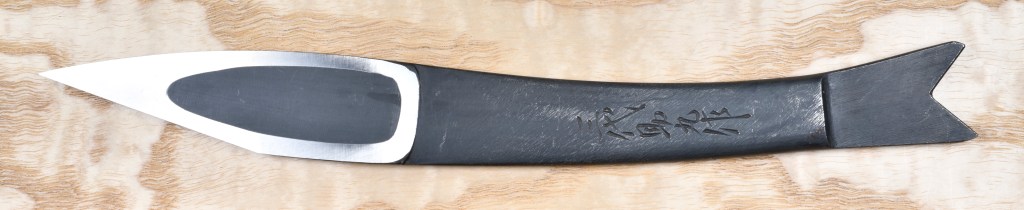
A kiridashi in the shape of, and actually named for, a small, tasty fish much beloved by Japanese fishermen called the “Ayu,” or “Sweet Fish.” Often copied, this design was first developed by the father of Mr. Yoshiro Usui, the current “Sukemaru” blacksmith. Sadly, those who stole his design never give him credit for this beautiful little knife.

Only the knife knows the heart of the pumpkin.

Simone Schwarz-Bart

In this post I would like to introduce a uniquely Japanese tool, a handy and extremely sharp little knife called the Kiridashi Kogatana.

Introduction

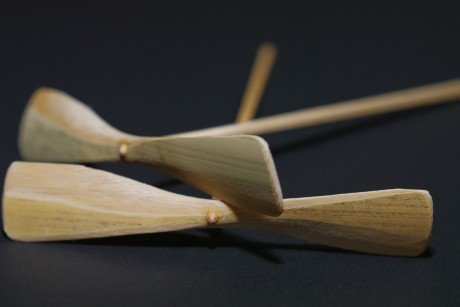
Taketombo helicopter toys made with a kiridashi knife.

The Kiridashi Kogatana is a handy, general-purpose knife traditionally used by craftsmen in many trades in Japan. It was once a standard tool in every Japanese child’s school bag for sharpening pencils and carving toys such as taketombo before willfully-ignorant nanny-state paranoia equated small useful tools in the hands of children with machine-guns wielded by mentally-deranged murderers.

Your humble servant won’t presume to speak for others, but it may be that, like me, Gentle Reader frequently needs a sharp knife not just for opening boxes, sharpening pencils and occasionally fending of hordes of snaggle-toothed zombie lawyers (an especially smelly variety of ambulance-chaser), but for serious woodworking tasks such as carving gennou handles, carrying molding details around the inside corners of casework and joinery, carving Buddhist statuary, and whittling toys for children. For refined woodworking nothing beats a super-sharp kiridashi kogatana knife.

In this article we will examine this traditional and uniquely Japanese tool.

Definitions

This tool’s name is pronounced kee/ree/dah/shee koh/gah/tah/nah, often shortened to “kiridashi,” and written 切り出し小刀 in Kanji. It translates directly as “small cutout sword.”

This simple but sophisticated tool is used, without exception, by all woodworkers in Japan including carpenters, joiners, wood carvers, cabinetmakers, sashimonoshi, bamboo workers, umbrella makers, printers, glazers and many other trades.

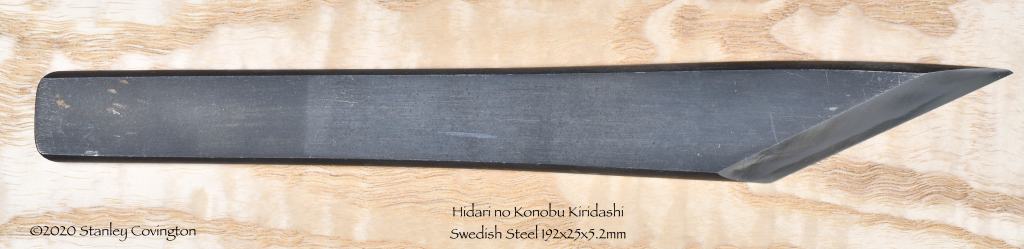
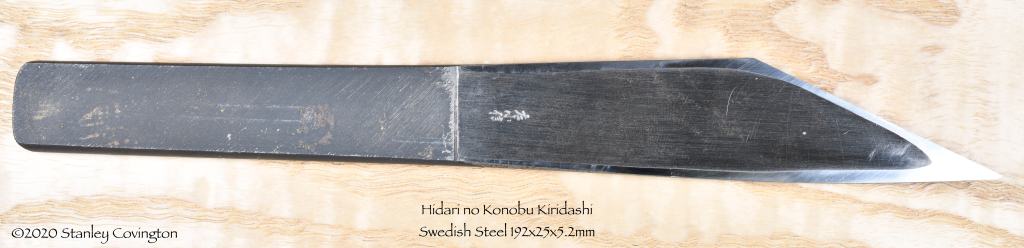
A kiridashi kogatana made to C&S Tools’ specifications by Hidari no Konobu, a famous Tokyo blacksmith, from Swedish Steel. An excellent tool well-suited to serious work.

Performance Criteria

Gentle Reader may wonder why Japanese professional craftsmen insist on using a tool made from expensive and difficult materials requiring advanced blacksmithing techniques instead of an inexpensive, disposable, Chinese-made utility knife. The short answer is that they have strict performance criteria that tool-shaped landfill-stuffing simply can’t satisfy. Let’s examine some of those criteria, shall we?

One characteristic a useful woodworking knife needs is rigidity without bulk. Flexible, floppy blades cannot easily be directed by our minds. Their cuts tend to wander. This is typical of utility knives, box cutters, and knives with replaceable blades. Utility knives are especially hopeless in this regard, having floppy blades and fat handles, not to mention garbage steel.

Another important characteristic needed in a woodworking knife is the ability to get one’s fingers close to the cutting edge and point without leaking red sticky stuff; You need your fingers.

In the case of the kiridashi, while it lacks a long cutting edge for slicing and dicing veggies, it also lacks a long cutting edge that would prevent the craftsman from choking up on the knife to maximize control. That’s because it’s a woodworking knife, not a kitchen or skinning knife.

The kiridashi lacks the fat, fancy handles that are so popular nowadays. Handles look cool and may feel comfortable when making a cob salad, but are bulky and get in the way when woodworking, preventing the craftsman from getting his fingers close to the cutting edge for maximum control. I don’t know about you, Gentle Reader, but as for your humble servant and thousands of Japanese craftsmen, we prefer to spend our money on an excellent blade capable of hard work and precision cuts without a handle rather than a bulky, pretty handle with a sucky blade attached. Do you share these priorities?

But of all the performance criteria the professional woodworker needs to consider when evaluating a woodworking knife, absolute sharpness is the most important, followed by ease of sharpening, two things at which the kiridashi is superior to every other small knife or cutter ever invented.

If you suppose your humble servant is exaggerating, remember that I have used kiridashi to shape wood for 40+ years, and at times they were critical to feeding the wife and babies. Of course, sharpness ultimately depends on the quality of the knife’s blade, and the skills of the sharpener, but the fact that the kiridashi can be made sharper quicker than any type of woodworking knife ever made is a big advantage for those who need a sharp blade for their work.

Let’s next examine those troublesome materials and blacksmithing techniques and consider what benefits they provide to the woodworker.

Materials & Forge-welded Lamination

Let’s begin with an explanation of the materials and techniques involved in making the traditional hand-forged kiridashi. We will look at cheap consumer-grade kiridashi in a separate section below.

Quality kiridashi are made using a traditional blacksmithing technique called “forge-welding” to laminate a layer of high-carbon steel called “Hagane” in Japan (mostly either Hitachi Yaguki Shirogami No.1 (White Label Steel), Aogami No.1 (Blue Label steel), or Swedish Steel (Asaab SK120) to an iron or low/no-carbon iron body called “Jigane” similar to that used for blades of Japanese planes, chisels, scythes, and even many styles of traditional kitchen knives. C&S Tools’ kiridashi are hand-forged in the traditional manner to maximize the performance required by our Beloved Customers that work wood professionally.

Inexpensive kiridashi knives are made from SK steel, another variety of Japanese high-carbon steel but of lower purity used for many commercial and agricultural products. This is an inexpensive and useful tool steel, but due to the additional impurities it contains, unavoidably produces an inferior-quality crystalline structure negatively impacting cutting and edge-retention performance.

Because kiridashi kogatana are relatively narrow, thin knives, Aogami steel is often preferred by blacksmiths over Shirogami or Swedish Steel because it tends to warp and crack less during heat treatment yielding fewer rejects.

C&S Tools’ kiridashi are made from Shirogami No.1 steel.

Let’s briefly examine why this lamination is necessary below. For more details, please read the longer articles on this subject linked to above and below.

The C&S Tools’ Kiridashi Kogatana, hand-forged to our specs from Hitachi’s White Label No. 1 Steel

The Hollow-ground Ura

Most kiridashi kogatana have a hollow-ground Ura, just like Japanese chisel and plane blades. The advantage of the Ura is that it makes it easy to quickly sharpen the exceptionally hard steel that forms the blade’s cutting edge. There are some inexperienced people who mistakenly imagine the ura is unnecessary, so allow me to clarify why it is critical.

To begin with, the layer of cutting steel in the kiridashi, or at least C&S Tools’ kiridashi, is hardened to Rc65~66, substantially harder than woodworking blades in the West. This hardness, combined with the excellent crystalline structure made possible through proper hand-forging and heat-treating by an experienced blacksmith produces a blade that meets the following essential requirements of a professional woodworking tool:

  1. The cutting edge can be made extremely sharp;
  2. The cutting edge will stay sharp a relatively long time;
  3. The cutting edge won’t easily chip, crumble, roll or break; and
  4. The knife is easily and quickly sharpened.

Items 1~3 above are normally satisfied when an experienced blacksmith skillfully forges and properly heat-treats high-quality high-carbon steel, but because the steel in the finished product is so hard, satisfying the fourth criteria focused on sharpening becomes difficult without some innovation.

The conundrum the blacksmith must resolve is that, in accordance with materials science, given a fixed area of steel (measured in square millimeters, for instance), the harder the steel is, the more difficult and time consuming it will be to sharpen. The solution is to hollow-grind the hardened steel lamination to effectively reduce the square millimeters of hard steel touching the sharpening stone and that must be abraded thereby reducing the time, elbow grease and sharpening stone mud expended in maintaining the blade. This detail is called the “Ura” in Japanese and is explained in more detail in the article at this link. If your time is worth anything, then this feature is worth every penny.

Another problem one faces when trying to sharpen a large area of flat, hard steel is that, over many sharpening sessions the perimeter of the flat area always wears faster than the center, eventually resulting in a high spot at the center of what was once a flat area. This too is a fact some inexperienced folk dispute; We wish them many joyful hours popping their pink bubble wrap while drinking Sunny Delight from sippy cups.

This unintentional high spot matters because it makes it more difficult to keep the flat at the cutting edge in tight contact with the sharpening stone, which in turn makes it more difficult to cleanly and quickly polish away the burr. Clearly the flat side of the blade needs to be reasonably flat if we are to quickly and consistently achieve a sharp edge. The Ura solves this problem.

And finally, since it would be time consuming and financially inefficient to abrade a bevel of uniformly hardened steel, the lamination replaces most of the hard steel exposed at the bevel with soft, easily abraded iron.

Despite this knife’s simple appearance, it’s a very clever and sophisticated design.

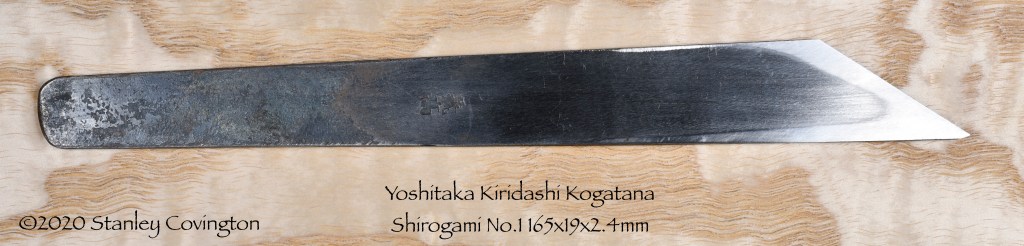
An inexpensive Yoshitaka brand kiridashi, a hand-forged but thin knife I have used for many years. It’s a minimalist tool never intended for heavy cutting, but a sharper, handier little knife you will never find. I only wish I could get more of them.
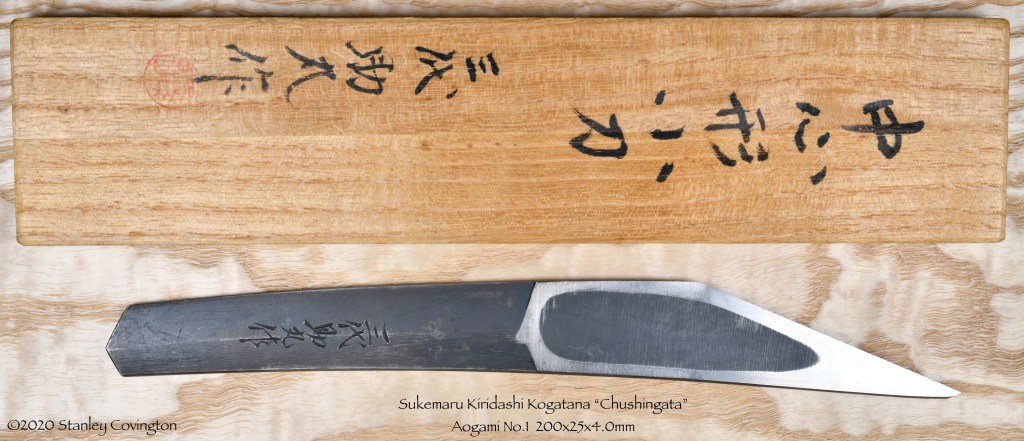
Another knife by Sukemaru. This is perhaps my favorite kiridashi and one I use every time I work wood. Notice the sharp point and long cutting edge that, while more fragile than the knives pictured above, and less suited to making powerful cuts, is better suited to other types of work. The shape is unusual because Sukemaru made it in imitation of a knife made from the tang of a recycled wakizashi sword with its double-angle tail terminus and a fuller groove cut into the right hand side. The idea of recycling the last remnant of a sword is appealing to your humble servant.

Pre-laminated Steel & Mass Production

Except for those sold by C&S Tools, most kiridashi kogatana sold nowadays are made from pre-laminated steel called “rikizai,” (利機材) or “fukugozai” (複合材) a material invented for mass-producing consumer-grade kitchen knives inexpensively and in high-volume. Dies and presses in factories are used to cut blanks from strips and sheets of this laminated steel/iron which are then ground and sanded by automated machines and heat-treated in large lots in ovens. The result is a knife that is cheap to produce (despite the high price often charged to unaware consumers) and quite usable, but since the blade has not been forged through multiple heats, or been normalized and subjected to multiple quenches, the crystalline structure of the cutting edge is inferior such that the knife cannot be made as sharp, it will dull quicker, and may be harder to sharpen. Such kiridashi kogatana also tend to be thinner, like kitchen knives, and are not as comfortable in the hand for hard work over long hours.

We prefer the performance and ease of use of hand-forged traditional kiridashi, so this is the only type we sell. Along with most professional woodworkers in Japan, we feel they are worth the extra cost. But if you decide to try a cheaper mass-produced kiridashi, please be careful you are not sold a pimped-out mass-produced blade at the price of a more labor-intensive, skill-intensive hand-forged traditional knife. Caveat emptor baby.

Another Sukemaru kiridashi kogatana in my collection. He named this one “Tomoshobi” meaning “ light,” as in “lamp.” I’m not sure why he selected this name, but I like to imagine it was because the blade looks like a lit candle. This knife too has a raised Hagane lamination for ease of sharpening. An elegant, scholarly little knife with a beautifully-shaped black ura I have owned for many years but never used. I can imagine an author setting down his hand-written draft manuscript and taking up this little knife to sharpen his pencil or quill as he seeks his muse.

Right & Left

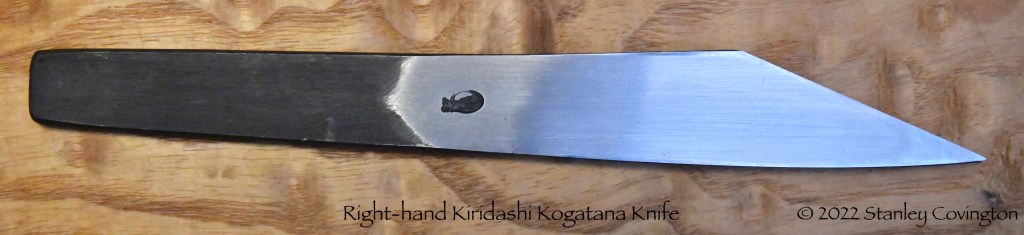
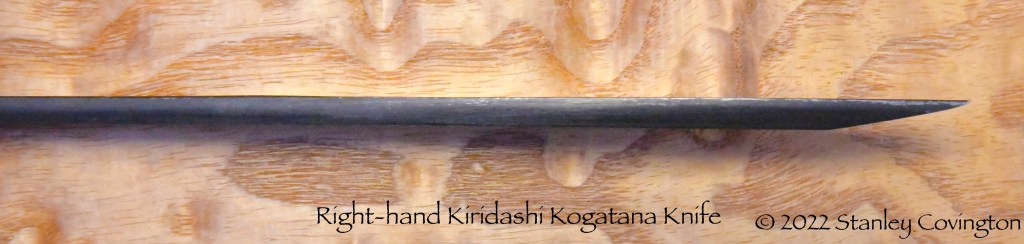
Kiridashi kogatana come in right-hand and left-hand configurations, with the right-hand variety being most common. To differentiate a right-handed knife from a left-handed one simply hold the knife with the cutting edge facing downward. The bevel of a right-handed knife will be on the right side as seen from above.

Craftsmen in many trades, especially cabinetmakers, shashimonoshi, joiners and woodcarvers will often own both left and right-hand versions because the type of work they do requires a different bevel orientation for some jobs particularly when shaving wood contrary to the grain, for example when shaping the inside corners of curved wooden components.

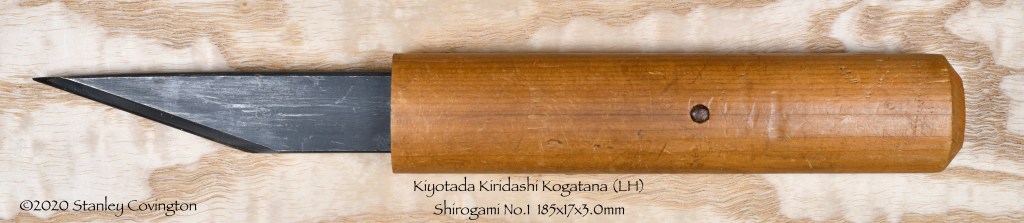
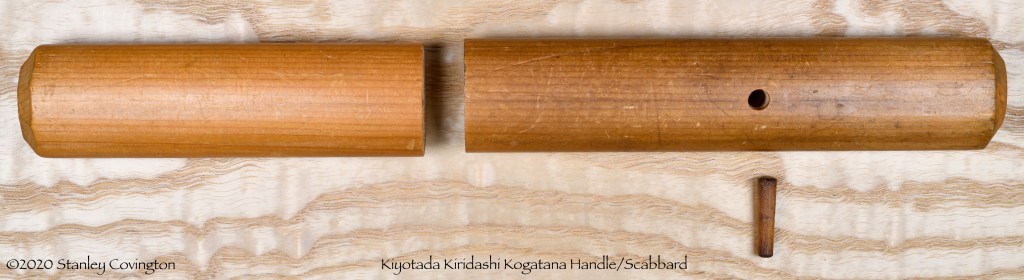
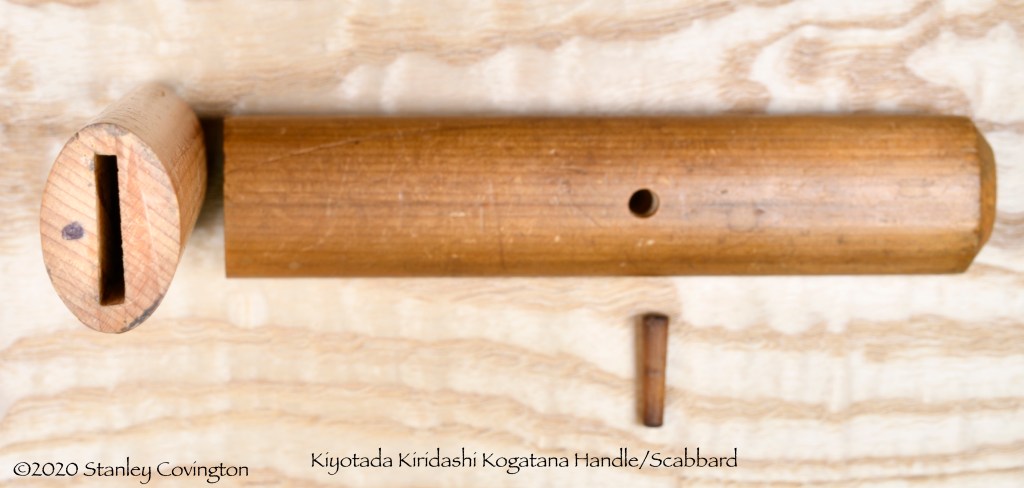
A left-handed kiridashi by Kiyotada I have owned and used for many years, an essential tool for high-end joinery work in the Japanese tradition because it can shave wood in directions a right-handed knife cannot without digging into the wood and creating tear-out. The hole in the handle is not original but one I added to facilitate securing the knife in its handle/scabbard (pictured below) with a tapered bamboo peg. The angle of the cutting edge and shape of the point is intentionally somewhere between the hard-working Konobu blade, and my favorite, pointier, more delicate wakizashi knife pictured above. Horses for courses.

Blade Width & Thickness

The width and thickness of the blade and the angle of the cutting edge to the centerline of the blade are matters of individual preference. Generally speaking, a wider blade is easier to grip than a narrower blade, and is also easier to power through cuts. On the other hand, if too wide, it will feel clumsy in the hand, it will not rotate as dexterously when making inside-corner cuts, and may not fit into tight spaces as well.

Likewise a thicker blade is easier to grip and easier on the hand when making high-pressure cuts for long periods of time than a thin blade. On the other hand, a thicker, wider blade weighs more and may take longer to sharpen.

It’s worth figuring out which style works best for you.

The Point

The angle of the cutting edge (not the bevel angle) is easily adjusted to personal preference within limits. In general, a steep angle forming a relatively oblique tip is better suited to making deep, powerful cuts, while a shallower angle provides a more slender, pointer tip that is preferred by many for finer cuts, especially long diagonal slices, in narrow spaces. 

The downside to the slender pointy knife is that the point tends to be more fragile, it’s more difficult to apply heavy pressure to, and it’s more difficult to sharpen. The C&S Tools kiridashi has a cutting edge at a medium angle suited to a wide range of cuts.

Shapes

Despite its simple appearance, the kiridashi kogatana is a sophisticated and unusually effective knife. There are, however, many examples of kiridashi with artistic and even anthropomorphic shapes such as vegetables, and even fish in the knife pictured at the top and end of this article. 

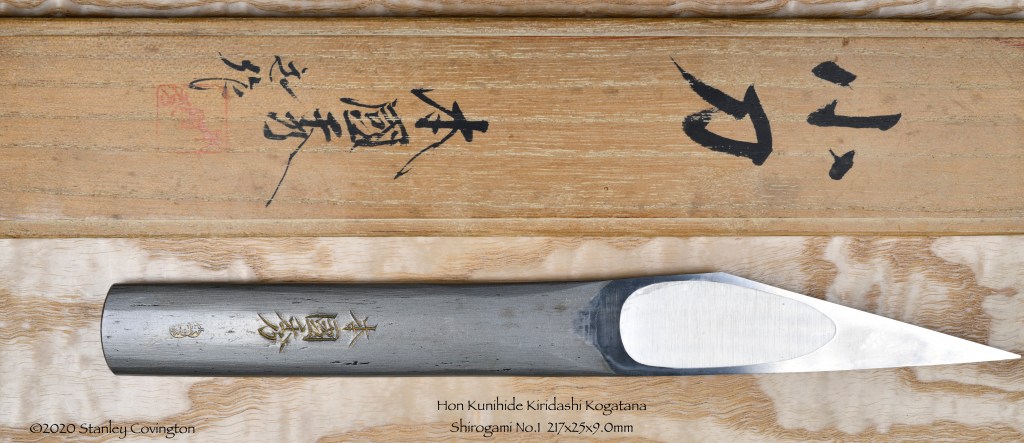
A large, thick, presentation-style kiridashi by Kunihide (“Hon Kunihide.”) A littler flashier than I prefer, but excellent work nonetheless. Notice the raised and bright ura.

We are not opposed to fanciful shapes and some decorative surface treatments on condition they don’t reduce the tool’s functionality nor make the tool appear less attractive over many years of hard use, difficult conditions to satisfy.

Handles and Scabbards

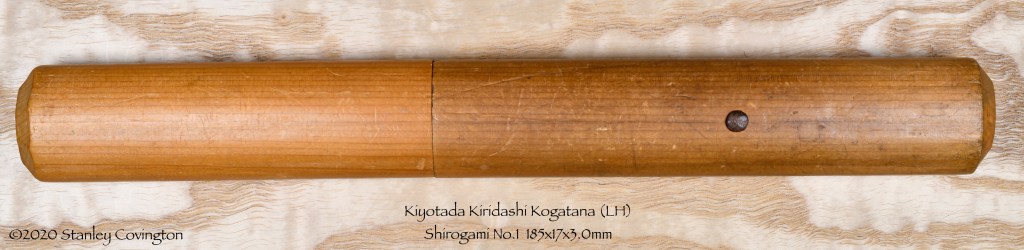
The Kiyotada kiridashi pictured above encased in its handle/scabbard. This style of handle/scabbard is simple, convenient, and clever.

Some people prefer a kiridashi with a handle of sorts, although most professional craftsmen, in our experience, prefer the bare metal.

A wise craftsman will have some means to protect the blade from becoming damaged when not in use, and to protect other tools and fingers from its frightfully-sharp cutting edge. A no-cost, thin scabbard or sheath can easily be made from cardboard or plastic, but the wooden combination handle/scabbard pictured above is a clever solution taught to me many years ago by a master joiner of great renown.

In a future post we will discuss how to make a convenient combination handle and scabbard for the kiridashi kogatana.

Decorative Finishes

There was a time in Japan when kiridashi knives with fancy surface finishes were very popular. Nowadays there are few blacksmiths left with the skills required to forge high-quality kiridashi knives, much less apply fancy-nancy surface treatments.

In general, your humble servant has always viewed pimped-out tools with a jaundiced eye dripping yellow goo. Why? First, because with few exceptions, decorative surface treatments contribute absolutely nothing to a tool’s functionality; and second, they almost always look nasty as a roadkill rat after a bit of hard use. Woodworking tool should be long-term possessions that serve well and age well, not like flashy but fragile hooker heels.

“But, whisky tango foxtrot!” I can almost hear some Beloved Customers and Gentle Readers sputter with exquisite gentility, “doesn’t C&S Tools sell a kiridashi knife with a tsuchime finish!” An astute observation indeed. Allow me to relate a brief explanation.

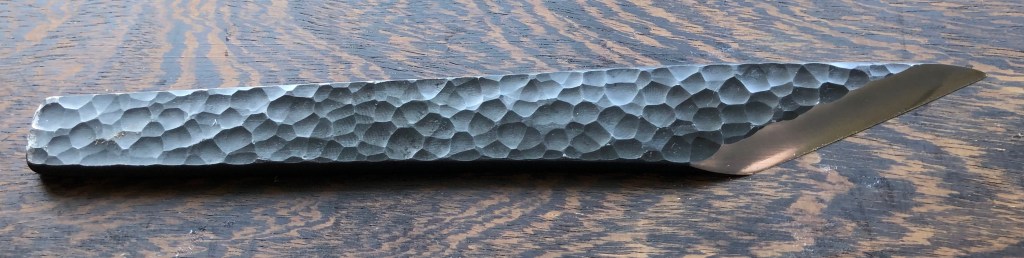
The C&S Tools’ Kiridashi Kogatana with tsuchime (hammered) finish. Identical in materials and construction to our standard knife shown above, except for the hand-textured finish on the face for a better grip and interesting appearance. This is a fully-functional finish, not an applied, plated or chemical finish that will discolor or deteriorate over time and with use. To the contrary, hard use will only improve its appearance.

Our kiridashi were previously forged by a small-scale but very famous Tokyo blacksmith called Konobu. In fact, photos of some of his products are shown in this very article. When Konobu retired some years ago we were extremely fortunate to enlist the services of a highly-capable, small-scale father and son forge who produce only kiridashi knives. After sharing their products with our Beloved Customers for a few years, and in response to customer requests for something a little more pleasing to the eye, we asked our blacksmith to propose some unusual surface treatments.

We asked our new blacksmith to propose some surface treatments he could apply in-house that would make the tool work better, look more beautiful when new, and improve in appearance with age and hard use. We ultimately selected the tsuchime finish (“hammered finish) shown in the photo above.

It exceeds all our expectations for performance, including, sharpness, edge retention, ease of sharpening, durability and appearance, and I’m confident you will find it to be a good friend and beautiful companion for the rest of your hopefully very long life.

So why is this surface treatment superior, you ask? Another excellent question! I have two answers that cover multiple facets.

First, it creates a non-slip surface that’s a significant improvement over the standard forge oxide finish, does not irritate the hand, works even when the blade is wet with sweat, and that, unlike most metal surface treatments, will not degrade with time and hard use.

Second, since it’s applied by physically hammering hundreds of dimples into the surface of the blade’s low-carbon jigane layer, and is not just a shallow surface decoration applied using paint, chemicals, rust or hot bluing, or electro-plating, there’s simply nothing to discolor, corrode, or wear away. In fact, it improves with age and hard use becoming the lovely face of a good friend.

Why Should You Use a Kiridashi Kogatana?

I can’t tell you why you need a kiridashi, but I can tell you why I and many others use them. Perhaps some of these reasons apply to you.

One can get by with disposable-blade utility knives for low-quality and rough work such as opening boxes, cutting gypboard, or discouraging icky deadish members of the legal profession, but such knives are not up to most serious woodworking jobs for several reasons.

First, while utility knives are sometimes called razor knives and may even use razor blades for cutting edges, they are nowhere near as sharp as a good kiridashi. The fact is that surgical scalpels are not as sharp as a good kiridashi sharpened skillfully. And utility knives dull quickly because the steel is soft and of miserable quality. You’ve not doubt noticed this poor performance.

Second, while your approach to life may be different, in my decrepitude I have come to despise stuffing landfills with throw-away tools, especially those made in the increasingly-despotic and murderous kingdom of China. It doesn’t make sense environmentally or morally. I prefer a faithful, high-quality kiridashi knife that can easily be made sharper than any commercial razor and will serve faithfully for decades without complaining.

Third, a good kiridashi is a compact tool with a stiff blade to which one can apply heavy pressure for serious cutting, a single-bevel that provides exceptional control for detailed carving and trimming tasks, and can be easily and quickly resharpened. It’s a tool that becomes an extension of my mind when it is in my hand. Can’t do any of that with a flimsy, clumsy utility knife.

And finally, while conventional double beveled knives are useful, because they lack the lamination of fine-grained exceptionally hard steel and the clever ura, they dull quickly and can never be made as sharp as a good kiridashi.

As they say in Japan: “The difference between the moon and a mud turtle.”

If you use knives in your work and you need them to be literally sharper than a razor and stay that way a long time without spending tons of time and attention, then nothing beats a good hand-forged kiridashi kogatana knife. All those generations of Japanese craftsmen can’t be wrong.

The other side of Sukemaru’s Ayu kiridashi knife shown at the top of this article. If you look carefully you can see the Chinese character for the Japanese sweet fish hand-engraved where the fin on a wetter fish would be. Obviously it wants to swim and frolic in wood.

YMHOS

A block print of Empress Jingu, a legendary figure in Japan said to have reigned after her husband’s death in 200 AD, and Takenouchi no Sukune having a good old time fishing for Ayu on the coast of Chikuzen, the old name for a country once located in Northern Kyushu island. The Ayu fish has an unusually bitter taste much appreciated in Japan, apparently for thousands of years.

If you have questions or would like to learn more about our tools, please click the “Pricelist” link here or at the top of the page and use the “Contact Us” form located immediately below.

Please share your insights and comments with other Gentle Readers by using the form located further below labeled “Leave a Reply.” We aren’t evil Google, fascist facebook, or thuggish Twitter and so won’t sell, share, or profitably “misplace” your information. If I lie may my sweetfish knife swim away.

← Back

Thank you for your response. ✨

Leave a comment

Related Posts:

Toolchests Part 13 – Finishes

Whatever it takes to finish things, finish. You will learn more from a glorious failure than you ever will from something you never finished.

Neil Gaiman

In this post I will briefly summarize the finishes used, mistakes made, and latest improvements to “Moby-Dick; or, The Toolchest.”

The Original Finish – A Tale of Woe

More than 26 years ago when this toolchest was new, your humble servant applied a rubbed-out catalyzed lacquer finish inside and out which showed the grain pattern and color of the wood nicely, but proved to be less-durable than I had anticipated. I refinished the chest once, but after years of rough use, many moves over many years, and painful encounters with trucks, shipping containers, forklifts, and one-legged meth-head moving company employees, the finish was in poor condition. I concluded that lacquer, varnish and even polyurethane do not really qualify as durable finishes for a piece of working casework with a target useful lifespan of 200 years, at least if it’s not to be pampered like a baby grand piano in grandma’s drawing room.

Exterior Refinish

While living on the Pacific island of Guam in 2011 and with free time on my hands due to international political corruption (difficult to imagine huh (ツ)), I gazed upon my toolchest and despaired for, yea verily, it was in bad shape, cosmetically that is, covered with scratches, dings and gouges topped off with yellowed, crazed and crumbling varnish. It had been a good and faithful servant for many years and deserved better so I girded up my loins, scraped and sanded off the old finish, leveled the scratches, dings and gouges with auto body filler, and refinished it.

Mr. Michael Dunbar and those sexy knees.

When considering how to refinish my toolchest in a way that would provide improved UV and abrasion resistance while also concealing past external cosmetic damage, I was intrigued by an article in a woodworking magazine by Mr. Michael Dunbar about milkpaint. Mr. Dunbar is a wise and retired professional Windsor chairmaker, not just a scribbler, so I take what he writes seriously.

I removed the old varnish finish inside and out and, following Mr. Dunbar’s recommendation, applied multiple coats of red, green, and dark, almost black, burgundy-colored milkpaint to the bare exterior wood surfaces. I then sanded and distressed the paint to expose the various color layers, and applied one coat of thinned clear Epifanes flat polyurethane as a protective topcoat. This was a 2 week process.

This milkpaint finish has proved effective not only in concealing past cosmetic damage and the Bondo used to repair it, but at the time these photographs were taken it had endured one international move by ship, two local moves inside Japan by truck, and months banging around inside hot humid shipping containers and dank warehouses since it was applied. It has only improved with age and abuse. Thank you Mr. Dunbar.

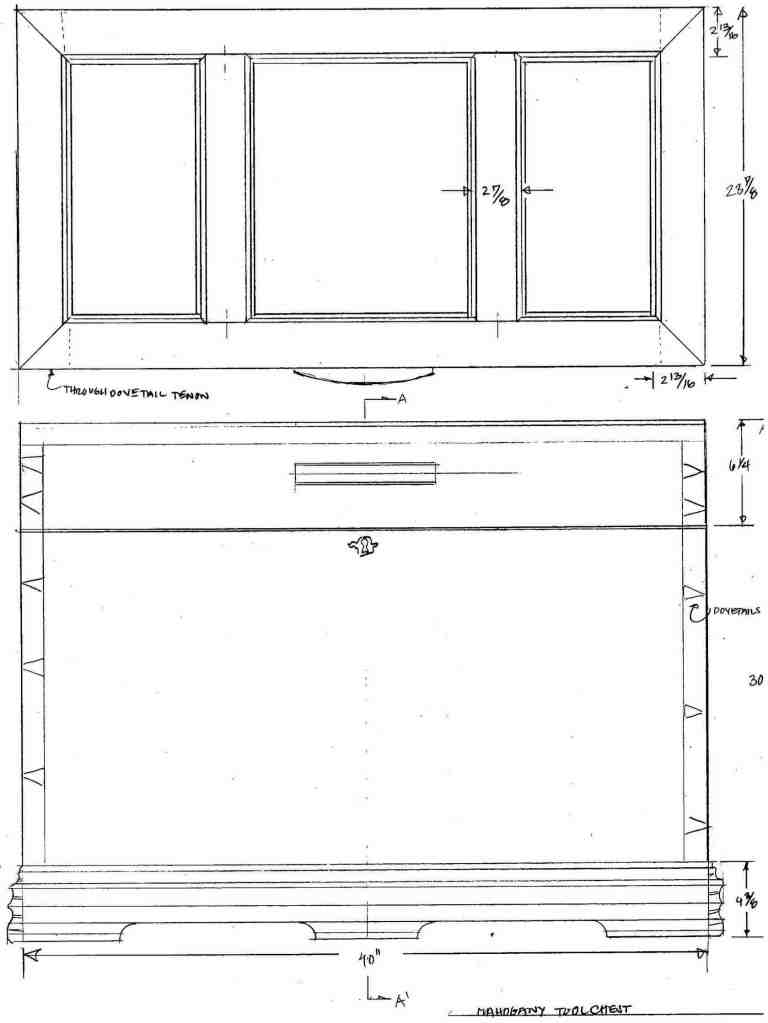
View of the lid’s frame & panel joints
View of the lid’s top, warts and all. Often used as a working surface, it has endured a lot of abuse, but the distressed areas with exposed red and green milkpaint are original to this finish. You can, however, see areas where the clear polyurethane top coat is failing. Again, so much for clear coats.
The right front corner of the skirt/base joined with through dovetails. These corners take the most abuse and are especially tough. The skirt is attached to the sides by glue and white-oak dowels.
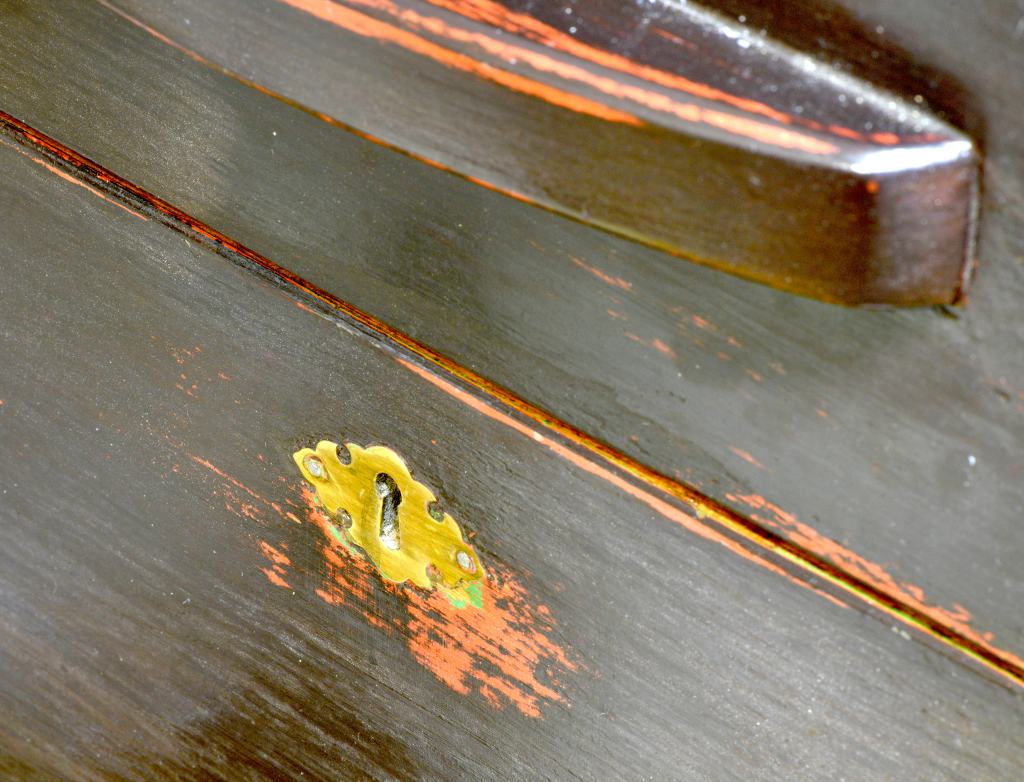
The lockplate. The burgundy-color top coat of milkpaint as well as the green and red undercoats, and even a little bare wood, are visible.
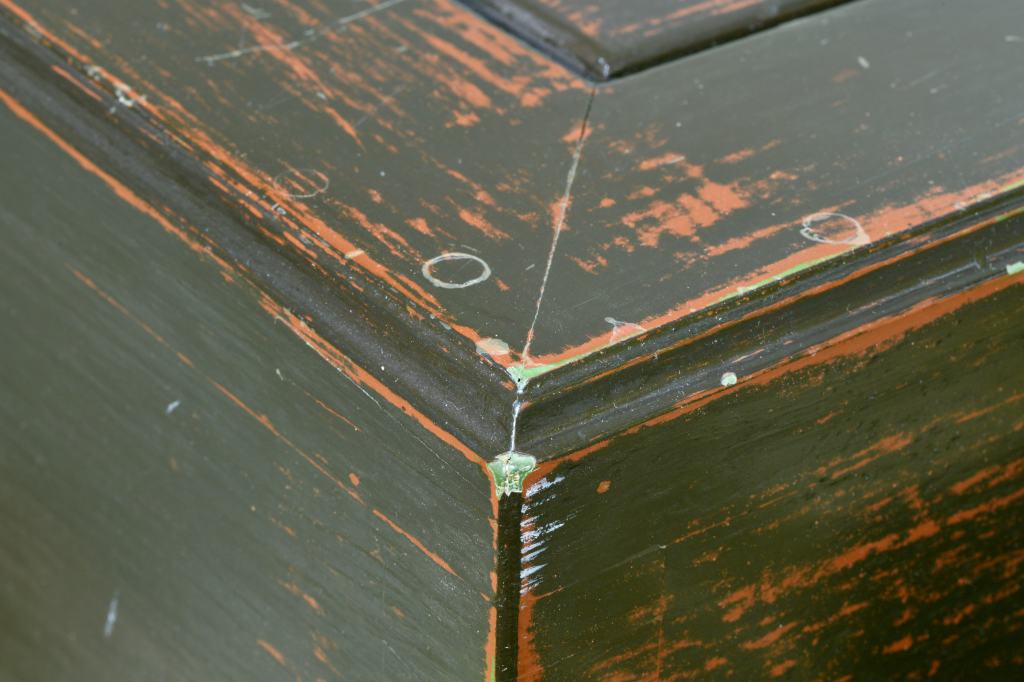
The top front corner of the lid, joined with through dovetails. The perimeter frame of the frame & panel top is connected to the sides with dowels, which have pushed out round spots in the clear Epifanes polyurethane top coat as the frame has shrunk around them over the years since the toolchest was refinished in constantly high-humidity Guam, an unavoidable reality in wooden casework. Someday I will need to shave these flush and refinish the round spots, but since the finish is milkpaint, the repairs will disappear entirely.
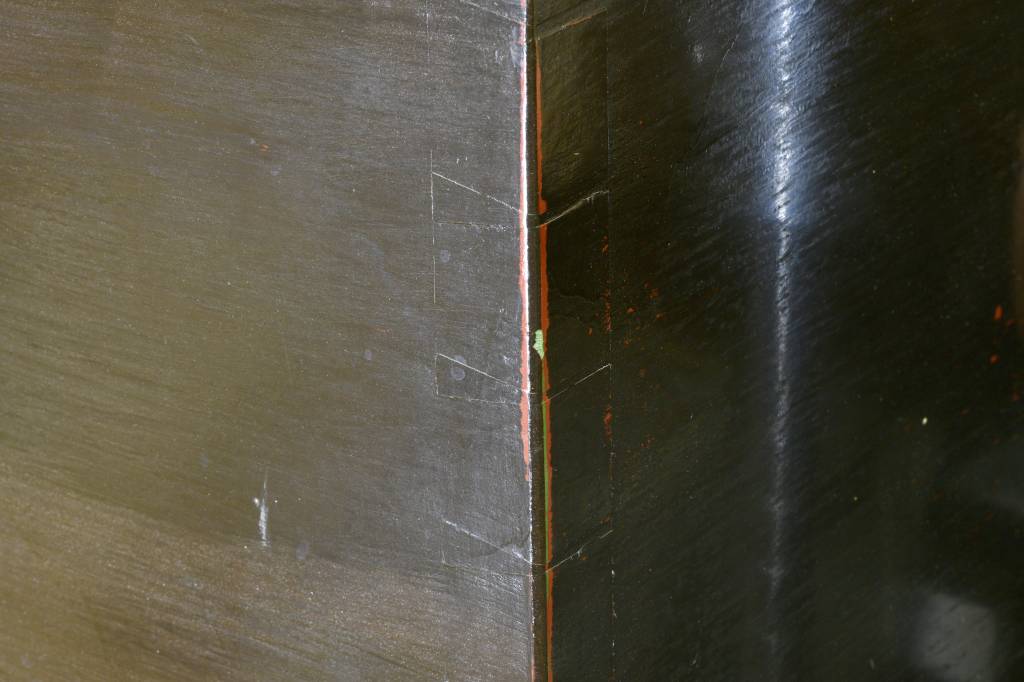
The front right corner of the lower case. What were once flush through-dovetails joining the sides have become visible as the wood has shrunk in thickness due to the relatively lower humidity of Tokyo. No joints have been repaired and all are still tight as a drum.
Front-view of the sawtill. The through-dovetails joining the corners, as well as evidence of the dowels connecting the horizontal F&P divider panel above the drawer have become visible as the wood has shrunk in the drier Tokyo humidity. Nosireebob those are not plugs concealing screws. Removing and replacing prickly saws has been hard on this little chest, but doesn’t look any worse now than when newly refinished, and will only improve in appearance with future wear and tear.

Milkpaint is an interesting material. It is non-toxic, which is nice when applying it. It doesn’t out-gas toxic compounds into the air either which is even nicer.

It has a water carrier with mostly mineral solids instead of volatile resins, so when cured it forms a hard, abrasion-resistant, non-shrink, no-peel surface unaffected by UV light, unlike latex, lacquer, varnish, and polyurethane.

The user can mix most any color they want using the available powders providing an endless palette.

It’s easy to use, forgiving and doesn’t take special tools to mix and apply, just glass jam jars, stirring sticks, strainers, paintbrushes, sandpaper, an old blender, and paper shopping bags.

Milk paint makes possible an easily-applied, inexpensive, tough, UV resistant, non-toxic surface finish with an antiquish, unique appearance that not only resists damage but even improves with time and abuse. What more could you possibly want? Egg in your beer?

Interior Refinish

I refinished the toolchest’s interior surfaces with shellac to eliminate the stink of curing resins. Time will tell how well it holds up, but so far so good.

Conclusion

My toolchest is far from perfect, but it meets all my performance criteria and works pretty darn good for me.

If I were to do it over again, I’m not sure I would change the current design or finishes, other than the way tools are mounted inside the lid. Compared to the original design, the current arrangement is more functional, but there is always room for improvement.

I think the most important thing this series of articles about toolchests has to offer is not the design itself but rather the performance criteria developed and the decision process that led to the design and ultimate construction.

As I mentioned in Part 5 of this series, there are many decisions that must be made when planning a tool storage system. I hope you, Gentle Reader, got my point that you can either take the time and make the effort to plan, or neglect to do so and let the decisions be made through default and happenstance whirling down and around the porcelain scrying bowl of chance. Either way, the decisions will be made.

Perhaps reading the performance criteria and seeing the design and execution of this toolchest will stimulate your planning. Many of your requirements will be the same as mine, but others will be different, so the solutions and design details you employ will be different too. At the very least you now have a detailed, practical example to reference when planning storage solutions for your valuable tools.

I hope Gentle Reader also noticed how tradition can provide solutions to universal challenges of tool storage, but that through careful consideration you can improve on tradition to best meet your specific needs.

In the next and final post in this series I will explain how “repairability” was incorporated (or not) into the design.

YMHOS

If you have questions or would like to learn more about our tools, please click the “Pricelist” link here or at the top of the page and use the “Contact Us” form located immediately below.

Please share your insights and comments with everyone in the form located further below labeled “Leave a Reply.” We aren’t evil Google, fascist facebook, thuggish Twitter or the Congressional IT department of the Democrat Party and so won’t sell, share, or profitably “misplace” your information. If I lie may every piece of paint I touch turn to lead, curl and crumble.

← Back

Thank you for your response. ✨

Leave a comment

Other Posts in this Series:

The Japanese Gennou & Handle Part 13 – The Drawing Part 2/6

The least initial deviation from truth is multiplied later a thousandfold.”

Aristotle (384-322 BC)

This relatively large gennou’s handle has a pronounced curvature, a design detail that is neither artistic or whimsical but is based on sound engineering principles employed to achieve specific functional objectives.

n the previous post about designing a handle for your gennou hammer on paper we discussed the reasons for making a drawing and a few of the details. In this post we will begin by representing the head and its key lines in our drawing.

But first, a disclaimer. Some Gentle Readers may find the idea of making a drawing in preparation for fabricating something as apparently simple as a handle from a single stick of wood nonsense. Indeed, I felt the same way once, but I was wrong. That is not, heaven forefend, to imply that Gentle Reader could ever possibly be wrong in anything you undertake, or less than a towering intellectual giant, only that the gennou handle is not as simple as it appears.

You may recall your humble servant mentioned the two points listed below in a previous post. They remain valid principles that should guide your eye and hand when making a drawing. Or, if wood costs you nothing and your time is worth even less, feel free to ignore them.

The first point goes like this: “When making some things, past a certain point there is simply no room for either improvisation or trial & error without starting all over again.”

The second point is a little longer, but no less valid: “The principle of “less is more” absolutely applies, but achieving an elegant and functionally superior “Less” is neither accidental nor serendipitous, but can only be consistently realized through “More” thought, planning, and eyeball time, things difficult to do without a drawing.”

A Sample Drawing

The drawing below is an actual drawing your humble servant prepared for one of his gennou incorporating a 375gm (100monme) classical-style head forged by Kosaburo. Although it’s a simple drawing made entirely by hand, it includes all the critical details other than the species of wood and flow of the grain. Please notice that it consists of a top view, side view, end view (butt) and 2 sections, all combined in a one-sheet, compact drawing.

You will want to make a similar drawing incorporating all the lines shown but adapted to your gennou head, your body’s dimensions, and your preferences.

You can download this drawing in jpeg format by clicking the link below.

Draw the Key Lines for the Side-view

The gennou that resulted from the drawing above. This handle has a distinctive curve that is neither a result of warpage nor evidence of your humble servant’s advancing senility, but an intentional design feature we will discuss in the next post. I’m supposed to take these Gingko pills, but I forget why…

You can make your drawing on paper or wood, with wood being the more durable medium since ancient times because it does double duty as both parchment and drafting board, and can be erased entirely with a handplane. Moreover, the combined drawing and drafting board can be hung on a nail on the wall for future reference without fear of deterioration. But paper is easier to use.

Begin by making one horizontal line across the sheet of paper. In the drawing above, this is the horizontal line touching the flat face of the hammer labeled “Striking Face.”

When orienting your head on the drawing, its flat striking face must be touching this line.

Gennou heads usually have a maker’s brand stamped into the steel adjacent the flat striking face. Please orient this brand closest to the “Striking Face” line.

You can of course orient the brand facing either the butt end or the tenon end of the handle. In Japan the standard convention is the butt, making the brand a little less visible. Some Westerners prefer the opposite orientation because, I assume, they want the brand to be immediately visible. This is understandable and entirely practical, but from the viewpoint of the Japanese craftsman it is akin to using underwear as headgear.

Your humble servant would never be so rude as to dictate fashion.

Back to the drawing, next make a vertical line, of course perpendicular to the Striking Face Line you just drew, and to the left of the page through the centerline of the gennou head. We will call this the “Vertical Centerline.”

Next, draw a horizontal line parallel with the Striking Face line, through the perfect center of the head’s eye (the mortise hole in the gennou head). To do this, you will need to first mark the center of the eye on the Vertical Centerline.

Begin by measuring the distance from the actual head’s striking face to the endwall of the eye closest to the striking face, and transfer this distance onto the Vertical Centerline starting from the Striking Face line using either a caliper or a sharp compass. Then measure the interior length of the eye, and add this distance to the measurement you just made. Now you have the location of both endwalls of the eye located on the drawing. Divide this line in half using your calipers or compass, and you now have located the center-point of the eye.

Be sure to precisely measure and mark these distances because if you get it wrong, problems will result. Please see the quote listed above of the Greek dude Aristotle’s opinion on the subject.

Next draw a “Horizontal Centerline” through the center-point of the eye across the sheet, of course perfectly parallel with the Striking Face line.

Next draw two more horizontal lines from the top and bottom endwalls of the eye across the page. The width of these two lines is labeled “Eye” on the side-view drawing above.

Place the head on the drawing, with its flat face perfectly flush with the Striking Face line. You may want to lay/clamp a piece of wood along the Striking Face line make sure you get the head oriented properly centered on the vertical and horizontal centerlines you drew earlier. Then draw the outline of the head on the drawing.

Insert the wooden layout tenon you made previously into the eye, place the head back on the drawing as before, and transfer the layout tenon’s outline onto the drawing. If the eye is perfectly perpendicular to the head’s centerline then the layout tenon may not be necessary, but using the layout tenon helps to ensure the eye’s angle is accurately represented in the drawing to avoid unpleasant surprises.

Draw the Key Lines for the Top-view

Moving onto the Top View, make another horizontal line 5~6 inches above the Horizontal Centerline across the page. This line will be the centerline through the head and handle seen from above. Measure the width of the eye (the narrowest dimension), divide it in half, and transfer it to the drawing. Draw two horizontal lines from the location of the eye’s endwalls across the page. These lines are labeled “Eye” on the Top View.

Place the gennou head on the drawing and trace the outline of the striking face.

The butt of the gennou shown at the top of this article. Notice it is domed. Once again, not a sign of sloppy work or senility, but an intentional and entirely functional feature, the lack of which could result in the destruction of the handle during installation (seriously). Notice also how the top edge of the butt is nearly flat, while the lower edge (leading edge) is a uniform radius. These two details are neither artistic nor whimsical but have distinct functional purposes.

The head, it’s striking face and profile, the width, length and angle of the eye, the centerline of the handle in both side view and top view are all now accurately represented on the drawing. 

In the next post in this series we will measure your body and add those details to the drawing. You don’t need a Savile Row tailor for this task, but if you have one just lounging around on your couch, hogging the remote control, drinking your beer and smoking your cigs, go ahead and put the bum to work! (ツ)

A big-nosed Dandy leaving London’s Saville Row in a sharp morning coat. The extra hand is that of his out-of-frame bride and not a birth defect. Please notice that his head covering may resemble a small garbage can but definitely not underwear.

YMHOS

The following link is to a folder containing pricelists and photos of most of our products. If you have questions or would like to learn more, please use the form located immediately below titled “Contact Us.”

Please share your insights and comments with everyone by using the form located further below labeled “Leave a Reply.” We aren’t evil Google, fascist facebook, thuggish Twitter, or a US Congressman’s Chinese girlfriend and so won’t sell, share, or profitably “misplace” your information. May I inhale a thousand needles if I lie.

← Back

Thank you for your response. ✨

Leave a comment

Previous Posts in The Japanese Gennou & Handle Series

Japanese Saws: The Hozohiki Saw

Nakaya Takijiro’s forge. Set into the floor of his workshop, it was originally used for forging swords for many decades.

“I see,” said the blind man as he picked up his hammer and saw

Anon

In this post we will look at a relatively unknown but extremely precise and useful rip saw called the Hozohiki saw. It is an essential tool for the more precise styles of advanced joinery work in Japan.

We will begin by discussing the general attributes of this saw, and then delve into the primary specifications by category. The saw under consideration is one recently developed by C&S Tools with, and produced by, Mr. Takijiro Nakaya, a famous master Japanese sawsmith in the old tradition.

The Hozohiki Saw

The C&S 210mm Hozohiki saw

The name of this saw is pronounced ho/zoh/hee/kee, written 枘挽き鋸 in Chinese characters, with “hozo” 枘 meaning “tenon,” and “hiki” 挽き meaning to “cut with a saw.” In other words a “tenon saw.”

The hozohiki saw is almost, but not quite, the twin of its better-known sister the Dozuki with a thin blade and a steel back, but instead of crosscut teeth it has fine rip teeth.

As the name suggests, the Hozohiki saw excels at making the rip cuts that shape the cheeks of tenons. In addition, it excels at making precise rip cuts for joints in joinery, cabinets, and furniture.

The Blacksmith

Nakaya Takijiro at his forge shaping a saw tang

The saw this post references is made by Nakaya Takijiro, a fifth-generation sawsmith who operates a one-man smithy located in Kawagoe, Japan. The traditional sawsmiths of his caliber still producing in Japan can be counted on the fingers of one damaged hand.

The Nakaya Takijiro line of blacksmiths were originally swordsmiths that shifted their production to saws after the Haito Edict of 1876 made it illegal to wear swords in public greatly reducing demand. The advanced skills of the swordsmith inherited by the current Takijiro make his products superior.

The front of Takijiro’s tiny smithy.
Saws temporarily residing in Takijiro’s forge waiting sharpening, repairs or pickup.
More saws wrapped in newspaper.

The Steel

Takijiro hand-forges the blades from Hitachi Metal’s Yasuki Shirogami No.2 steel, an unusually pure, simple high-carbon steel entirely devoid of alloys such as chrome, nickle, molybdenum, tungsten or vanadium. When hand-forged and properly heat-treated, this steel will form a crystalline structure of unsurpassed quality, from a handtool perspective, incorporating fine, evenly distributed carbide particles typical of the “fine-grain steel” coveted for cutting tools and weapons for millennia.

Some may wonder why Shirogami No.1 steel is not used. The answer is simply that the only difference between Shirogami No.1 and No.2 is that No.2 has less carbon, making the teeth a little less brittle.

A blade made from this steel by a master like Takijiro will hold a sharp edge a relatively long-time, but at the same time will be relatively tough, important properties in a fine-toothed professional joinery saw.

Double-tapered Blade

After forging, shaping and heat-treating the blade, Takijiro double-tapers it by hand using a two-handed scraper called a “sen.” The tapers are not flat, but curved to be narrowest at the toe (end opposite the handle) and near the steel back, increasing in width approaching the tang for proper “spring,” and of consistent thickness along the teeth. He does not use grinding equipment to achieve these tapers.

A properly tapered saw will cut straighter and bind in the cut much less than one with a blade of uniform thickness.

Takijiro’s sen scrapers, all handmade by himself.
The pile of sen shavings at Takijiro’s tapering/truing station.

Hammer-tensioned blade

In addition, Takijiro “tensions” the blade using a hammer, essentially creating points of plastic deformation with precisely-placed hammer blows in a long oval pattern above the teeth to create internal compressive stresses that tend to stretch the blade in length, placing the teeth in “tension,” thereby significantly stiffening the thin blade and its teeth.

Besides stiffening the blade, hammer-tensioning greatly reduces the tendency of the blade to warp, oil-can and buckle as it heats-up in-use. The result is a blade that is stiffer, straighter, and cuts smoother than a flat un-tensioned blade even after it heats up.

True Saw Plate

The saw plate of a high-quality handmade dozuki or hozobiki saw will not be flat, because it is double tapered, but it will be true, meaning it will be free of problematic bumps, dents, waves, and oil-canning.

Dreaded oil-canning is a form of localized buckling caused by stress concentrations. This phenomenon is named for the buckling commonly seen in the tops and bottoms of metal oil cans. Besides saws, steel drums, metal tanks, metal roofing and metal siding routinely exhibit oil-canning. Oil-canning is easy to produce but difficult to eliminate. It increases the friction forces acting on a sawblade while cutting and reduces accuracy.

Oil-canning exists but is not as obvious in modern Western saws due to the extra-thickness of the blade. The degree of this buckling will vary with changes in the steel’s temperature making it a serious problem.

Because high-quality dozuki and hozohiki sawblades are so thin and are forged from warpage-prone high-carbon steel, and because they and are subjected to multiple heats and thousands of hammer blows, warpage and oil-canning are a serious problem the sawsmith must correct many times during fabrication. Indeed, this is the most difficult task he must perform, and the one with the most significant benefits.

A hand-tapered, hammer-tensioned sawplate without the defects listed above will track true, cut easily, and create less friction. The difference is night and day.

The Teeth

The teeth and hand-filed back of the C&S Hozohiki saw. Please note the “sen” scraper left marks left by Takijiro as he shaped and trued the plate. The pile of thin metal shavings in the photo above are the result of his work with a sen. The plate has not been planed, ground or sanded. The scraper marks are straight and aligned quite precisely despite being handwork. The best saws look like this.

Takijiro hand-punches the teeth and then sharpens them by hand using tiny sawfiles hand-made for him in Hiroshima. He prefers to use newly made fresh files because he is convinced that within a few months of manufacture the cutting edges of files lose a significant degree of sharpness. I’ll take his word for it.

The Hozohiki saw Takijiro makes for C&S Tools has 7 teeth/cm (17.8teeth/in). To help get cuts started, the teeth at the last few centimeters nearest the handle have zero rake. The rip teeth to the far left in the image below are the style of tooth used.

The shape and size of the teeth are critical to the performance of a saw, and must be designed to work best for both the type of wood the user will cut, and the joints he intends to make. The style of teeth is the same as those at the far left in the sketch below. The teeth of the hozohiki saw we carry are designed, cut and sharpened specifically to cut hardwoods like maple, oak and cherry.

The saw has minimal set to ensure smooth, precise cuts in hardwoods.

The Back

A closeup of the Takijiro’s hand-engraved signature, and the saw’s back, “jaw,” and teeth. Takijiro produces this coloration by heating the steel back quite hot and then wiping it with raw silk causing the protein to stick and oxidize forming a black skin. An elegant finish indeed.

The saw’s back is relatively thin, and curved as it should be for a fine Hozohiki saw. Takijiro has also hand-filed the steel back leaving file marks, and blackened it using burnt silk as is traditional in the best hand-forged saws. Beware a saw with a steel spine that exhibits the marks/ distortion of being bent by machine. This one is very sexy!

Using the Hozohiki Saw for Crosscutting

Here is a trick used by advanced Japanese craftsmen.

When cutting joints is hard woods such as ebony and rosewood, a fine-toothed Hozohiki saw such as the C&S Tools saw, despite having rip teeth, will often cut smoother and faster than a crosscut Dozuki saw making it an especially useful tool. The cut will be easier to start compared to a dozuki and will cut cleaner. Strange but true.

Do you doubt it? Make sure you have a camera on hand to take a selfie the first time you try this because the result will be a big goofy smile you will want to remember.

The Normal Commissioning Process

The old part of Kawagoe City lined with original “Kura” buildings, most designated as historically important structures. It is said that Tokyo looked much like this in past centuries, but without the asphalt, electric lights, and ice-cream banners. Kawagoe is known for its annual festivals, in which Takijiro usually performs the Chinese Lion “Shishi” dance in a costume he made himself.

When ordering a saw from Takijiro, as I have done several times when seeking excellent saws for my own toolchest, a craftsman (few amateurs are given this opportunity) makes an appointment to visit his forge for an informal interview to discuss his preferences for the desired saw as well as the products and types of cuts he intends to make with it. Takijiro also insists the craftsman provide a small sample of the wood he will cut most often.

As a result of this interview and his hands-on tests cutting the sample, Takijiro is able to make a saw that suits the craftsman’s needs as perfectly as he understands them: a custom saw for a specific craftsman for a specific type of work.

A handmade hozohiki saw of this quality is normally available only by custom order, taking 6 months to fabricate, and costing approximately ¥60,000. Takijiro-san was kind enough to accept a special limited order at a reduced price.

Specifications

When developing any product, and especially tools, it is important to establish the product’s specifications and the performance criteria of the end-user. The ideal way to determine these specifications and criteria is the face-to-face meeting between the craftsman and sawsmith mentioned above. In this case, however, in order to save time and reduce costs, we worked with Takijiro to develop standard specifications and performance criteria preferred by our international customers. Entirely by coincidence, those specifications are closely aligned to those Takijiro’s luthier customers demand, especially those who routinely make extremely precise, almost invisible sliding joints in unforgiving and expensive hardwoods such as rosewood and ebony for shamisen stringed instruments.

FYI, the shamisen is a traditional three-stringed Japanese musical instrument that can be disassembled into its component parts without tools. In this YouTube video the owner of a shamisen shop instructs his customers how to properly disassemble their shamisen in preparation for sending it in for repairs or a new skin. In this video you can see a luthier actually making a shamisen. Notice the precision of the mating surfaces of the sliding joints. I think you can sense the skill of the luthier with his hozohiki and dozuki saws.

The logic behind this choice of specifications is that Western craftsmen who perform high-precision hand work use more hardwoods than many of their Japanese counterparts, and so need sharp but tough teeth, without the additional set necessitated by sticky, hairy softwoods. In addition, we assume these craftsmen are willing to sacrifice some speed in exchange for increased precision and tougher teeth.

Another criteria was that starting cuts be as easy as possible, a problem for most people when cutting hardwoods with rip saws. To satisfy this criteria, the first few centimeters from the heel of the blade have zero rake, as mentioned previously.

Everything humans do entails compromise, but based on experience, we feel this saw is best suited to Western woodworkers in general.

My advice to our Gentle Readers and Beloved Customers is to not judge a saw by its handle, but by its performance. Bacon before sizzle, as it were. That is, after all, the professional way.

We will describe how to make a handle for Japanese saws in a future article.

Why Should You Own a Hozohiki Saw?

If you are tired of the inaccuracy and fat, wandering kerfs produced by Western rip joinery saws; if you want to do more precise work than the throw-away kaeba saws can achieve; if you need a saw that will easily cut extremely precise joints in all woods smoothly and quickly, but will not spray teeth all over when cutting hardwoods; if you want to taste the performance of a high-quality professional-grade hozohiki saw hand-made by one of the very last remaining Japanese master sawsmiths, but without the months of waiting and high cost of a custom saw, then this is your chance. Perhaps your only chance.

If you would like to learn more about this saw, please contact us using the form below.

YMHOS

Relevant Articles

Shamisen Girls Ki&Ki performing with their shamisen, no doubt handmade made from rosewood using a Hozohiki saw. Here’s another video if the same shamisen song fans of Zatoichi will know.

If you have questions or would like to learn more about our tools, please use the questions form located immediately below. Please share your insights and comments with everyone in the form located further below labeled “Leave a Reply.” We aren’t evil Google, incompetent facebook, or gossipy twitter and so won’t sell, share, or profitably “misplace” your information. Promise.

← Back

Thank you for your response. ✨

Leave a comment

Toolchests Part 12 – The Sawtill

A view of the Sawtill’s lid nested into the opening in front of the trays.

I am but mad north-north-west. When the wind is southerly, I know a hawk from a handsaw.

William Shakespeare – Hamlet

Every woodworker worth his salt uses handsaws. Your most humble and obedient servant doesn’t mean to impugn those who use machines exclusively to perform all sawing activities, I am sure they are all fine folk; I wish them health, happiness, and hundreds of fat children, but they are more machine operators than craftsmen in wood, in my un-exalted opinion.

Saws are important tools deserving of protection, but which we need to access quickly, betimes a difficult performance criteria to satisfy. Saws have wide metal “plates” that collect dust and condensation and develop rust. And sharp teeth, shorter but much like those of the frumious bandersnatch of literary fame, that catch, cut and scratch things, and that are easily damaged in turn through contact with other metal tools. How best to store this prickly fellow in a chest filled with other burbling tools?

In this post we will examine the challenges involved in storing saws, and the solution I learned from an dusty old book hidden in a Japanese university library far back in the mists of time.

Saw Storage Performance Criteria

High-carbon steel is without doubt the best material for handsaws, but it rusts. Rust produces a rougher surface increasing friction, and if it progresses will cause deep pitting, damaging the teeth forever and permanently impairing cutting efficiency

We can apply oil to the plate and teeth to prevent/reduce rust, but oil attracts dust which often contains hard particles that dull teeth, not to mention chemicals that accelerate rust. Therefore, a good storage solution must protect saws not only from dings, but from dust and temperature swings that invite condensation and rust.

Clearly the exposed saw rack published in woodworking magazines ad nauseam as DIY projects for amateurs is easy to access and great for displaying handsaws for worship and veneration (especially grand are those with twin candlestick holders (ツ)), but they are not a good long-term storage solution because, while the saws are in plain view convenient for daily worship, they are also exposed to dust and temperature swings that encourage condensation corrosion.

One traditional solution is to mount saws to the underside of a toolchest’s lid. I have tried this method before but long ago concluded it takes up too much real estate I need for other tools. And the saws still collect some dust in this location anyway.

I especially dislike one traditional solution, namely nailing a sawtill in the bottom of the toolchest up against the front wall, because it makes the saws difficult to see, a pain to retrieve, and more importantly, limits the travel distance and ultimately the width of the all-important trays. Codswallop!

Some may insist that the internal sawtill is the only valid “traditional” method. To all the self-appointed Time Lords and Holy Arbiters of Everything Traditional that look down their patrician noses at the solution I selected I respond that there are other traditional designs they may have not seen before. Perhaps they need to… I dunno… do something crazy like… put down their congac snifters and visit different libraries?

After months of deliberation I decided I needed a sawtill that is an enclosed, sealed, insulated space in itself, one that can be removed to serve as an independent toolchest most of the time but will still fit inside the toolchest when necessary, will contain many saws, not just five or six, and is at a convenient height where I can clearly see and easily retrieve/replace them. These criteria are what attracted me to this extremely intelligent design illustrated in copperplate in an old bug-chewed British book in the University of Tokyo Library. I modified the design considerably, especially the lid and the drawer, but there is nothing new under the sun.

The Execution

My sawtill nests inside the toolchest, as you can see from the photo above. In this location the lid can be closed without interference. Saws in the top compartment can be accessed, but not the saws in the bottom drawer. Tools in the top tray and those mounted inside the lid are also easily accessible, but those in the 2nd and 3rd tray and in the dungeon are not accessible without removing either the sawtill or the trays. This may seem to be a serious flaw, but au contraire, mes amis!

When the toolchest is at home in my workshop, the sawtill spends no time inside the toolchest. Instead I take advantage of its greatest virtue, set it off to the side, and use it as an independent toolchest dedicated to saws. In my current workshop it sits on the ledge of a bay window located 1 foot from the mothership. In other workshops I rested it on sawhorses. It is a very intelligent and flexible solution.

Do I need candlesticks? They would be nice….

The sawtill resting on the toolchest’s walls. The top and drawers are closed. The drawer has recessed brass pulls and a brass lock. Nylon straps attached to each end of the sawtill make it easy to lift out of the toolchest’s interior.

Like the toolchest proper, the sawtill is made from solid medium-density Honduras mahogany joined with dovetails. The lid, central horizontal divider, and bottom are all solid-wood frame-and-panel construction. Like the toolchest, the sawtill’s lid has deep vertical sides to add stiffness and prevent warping, but unlike the toolchest, nothing is mounted inside the lid. A wooden lip projects down from the lid aligning it to the base and sealing it tightly when closed.

When open, the saw handles in the top compartment protrude above the sawtill’s sides making them easy to see, remove, and replace without fiddling around. This is supremely important.

Due to this construction, neither drawer nor lid have ever warped or become sticky.

The sawtill with the lid and drawer open. The top opening is filled primarily with Western saws and larger Japanese saws (e.g. bukkiri gagari), while the drawer is stuffed full of thinner Japanese saws as well as sharpening files, chalk and a sawset. I tend to store many of my saws wrapped in newspaper because the out-gassing of the ink is a good corrosion preventative, at least when the newspaper is new. Strange but true. It has the side benefit of providing the saws reading material.

The top compartment is sized to house 8-26” Disston No.12 saws, or a mixture of Western and larger Japanese saws. The drawer underneath will hold a dozen Japanese saws along with files and other saw-related tools. 

The sawtill’s width is a hair narrower than Moby Dick’s sliding trays, and its overall height with lid closed is the same as the combined height of the three trays so it rests neatly on the bottom tray’s ledge and nestled inside the space created when the three trays are slid to the back. The toolchest’s lid can be closed with the sawtill in this position securely locking it in place.

Dividers

When this saw till was new I installed two thin boards in the top compartment, one across each end, with the classic slits & slots cut into them to retain saws, but I soon found this arrangement to be sub-optimal. I later replaced them with the five lengthwise plywood dividers visible in the photo above creating individual compartments for saws. These compartments provide more storage options, make it quicker to access/replace saws without banging and sawing each other, and make it possible to wrap the saws in anti-corrosion cloth or paper for additional protection during long-term storage and transit. I would never go back to slits & slots.

Although it may have compromised the sawtill’s elegance and violated the eternal tenets of beauty exemplified by the Wonderful Liberace, I didn’t mount candelabra to it. Pray tell, an unforgivable omission?

In the next post in this series we will examine the finishes used. I think you will find this especially interesting. Until then, I have the honor to remain

YMHOS

If you have questions or would like to learn more about our tools, please click the “Pricelist” link here or at the top of the page and use the “Contact Us” form located immediately below.

Please share your insights and comments with everyone in the form located further below labeled “Leave a Reply.” We aren’t evil Google, fascist facebook, or trashy Tik-Tok and so won’t sell, share, or profitably “misplace” your information, not even if Joe Biden and his bloody-handed buddies in the Chinese Communist Party ask nicely. If I lie may my mattress be as prickly as sawteeth.

← Back

Thank you for your response. ✨

Leave a comment

Other Posts in this Series:

The Japanese Gennou & Handle Part 12 – The Drawing Part 1/6

A gennou with a modern-style 180monme head (700gm/25oz) by Kosaburo and a black persimmon handle.

A drawing is simply a line going for a walk. 

Paul Klee

This is the first of six posts in a sub-series describing why and how to make a full-scale drawing in preparation for making your gennou handle. 

Please note that the principles described in these posts on Japanese gennou handles apply to all varieties of hammer and axe handles, and can be adapted to Western tools with great success.

Why Bother Making a Full-scale Drawing?

The greatest fun in working wood as a hobby for your humble servant is watching an object evolve in my hands, sometimes magically becoming better than what I had imagined it would be. Many Gentle Readers have the same experience.

My day job in Japan’s construction industry is not so spontaneous or fancy free: I spend too many hours each day planning, discussing, reviewing/marking-up, and writing about complicated drawings, so drafting a drawing to make something from just a single stick of wood feels kinda sorta silly on the one hand and too much like real work on the other. But despite these conflicting emotions, please understand I am dead serious about the importance of a drawing, and you should be too.

So why am I recommending you make a drawing? There are 3 reasons: 

1. Record & Refine Ergonomic Parameters

A gennou design must begin with the fixed parameters of your gennou head, but there are several ergonomic measurements from your own body you will need to incorporate into your handle design and meld with the specific details of the head you select. This isn’t difficult to do, but because every head, every body, and therefore every handle is different, and because there are a surprising number of details that must be combined, it can be difficult to get everything right without a drawing, especially the first few times.

2. Develop an Elegant Minimalistic Design

The second reason for making a drawing before sawdust is that the gennou I am teaching you how to make is in every way a minimalist object comprised of only two simple components, the details of which require thoughtful planning to get right. 

Allow me to share a couple of points about minimalism I learned from observing the successes and failures of world-class architects and designers in New York, San Francisco, London, Hong Kong and Tokyo: When making some things, past a certain point there is simply no room for either improvisation or trial & error without starting all over again. Assuming one is not so fatuous or deluded as to accept a monkey’s scribbling as high-art, you can imagine the resulting potential for wasted time and money and brain cells.

The famous architect Frank Loyd Wright once said: “An architect’s most useful tools are an eraser at the drafting board, and a wrecking bar at the site.” When used with skill, which of these tools do you think is the most cost and time effective?

Here is wisdom: The principle of “less is more” absolutely applies, but what most people not involved professionally in the design and fabrication of expensive minimalist physical objects do not realize is that achieving an elegant and functionally superior “Less” is neither accidental nor serendipitous, but can only be consistently achieved through “ More” thought, planning, and eyeball time, something difficult to do without a drawing.

How does this apply to making a simple gennou handle, you ask? Excellent question; You really are paying attention, I see. Once you have cut or shaved away too much wood (even a single shaving can easily be too much), there can be no more thinking, planning or eyeball time without starting over, wasting much of your valuable time and wood. Best to avoid that nonsense if possible, don’t you agree?

3. Take a Mulligan

The third reason for making a drawing is related to the first and based on the unfortunate likelihood that your first attempt is unlikely to produce perfect results. But don’t be discouraged because your second attempt will be much better. If you begin with a drawing, by the third attempt you will have figured out precisely what works best for you, knowledge that will serve you well your entire life. I promise.

In order to accomplish the goal of the perfect handle in just two or three iterations you will need to record the measurements, assumptions and changes you made each time so you can effectively refine them without having to start over from zero each time. A drawing is the best tool for this purpose.
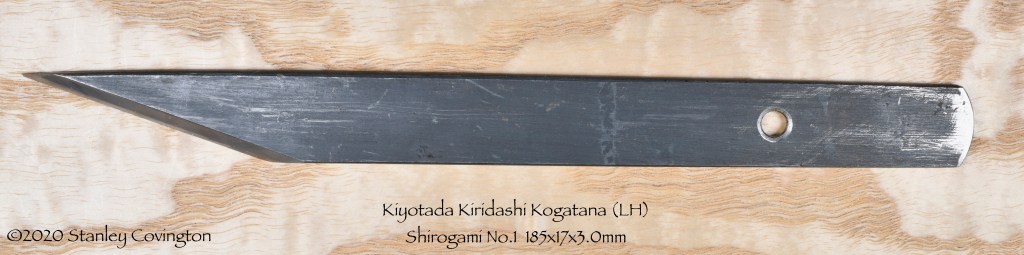
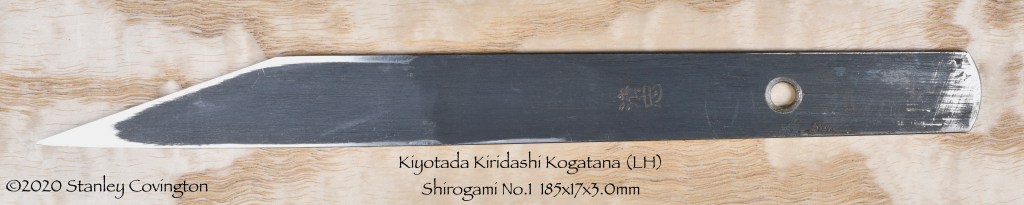
A drawing will also help you avoid repeated errros. A drawing will also help you avoid repeated errros.

What to Include in the Drawing

I recommend you make a full-scale drawing of the handle viewed from the side, the top (back) edge, and the butt for a total of 3 viewpoints on a single piece of paper. You should also make cross sections at several locations at the handle inside the side view.

It is also useful include general dimensions, such as overall length, width at the eye and width at the butt to help you select a suitable piece of wood.

Developing Drawing Skills

Many have no experience making drawings. That’s perfectly OK. The only way to become competent at making simple drawings using orthographic projection is to do it.

The basic idea of orthographic projection is to represent a 3-D object in 2-D drawings, usually a side view(s), top/bottom view, and end view(s), but for the purpose of drawing a simple gennou handle without power windows and tuned exhaust, a side view, top view, end view and a few simple sections are plenty.

The drawing below is one I made for one of my gennou showing just top and side views. As you can tell, it starts with the head. Sorry, no sections. I will provide more drawings beginning with the next post.

A handmade drawing for gennou hammer made to fit the author with an 85monme Kosaburo head. You can download this drawing for your reference by clicking the button below.

If you are serious about making quality objects in wood long-term, the ability to make a simple drawing is a skill you should develop. The drawing doesn’t need to be pretty, it doesn’t even need to be detailed or show numerical dimensions if you are making it full-scale and for your own use, but it should represent and record things like critical dimensions (length and width), straight line/curves, and the locations of features.

“Why can’t I just do it in my head?” you ask? Of course that is an option; There are times when we all shape wood as we imagine it, the instant we imagine it.

But a drawing lets you combine and adjust details, and allows you to wait some time to grow “fresh eyes” to reexamine the design. A drawing makes it easy to make fine adjustments to a minimalist object. It lets you share the design with others and get their opinion. It lets you record your successful designs for future use. It is a powerful tool, one that will improve your woodworking skills.

And with practice, the act of making drawings refines your eye and your imagination, improving not only your design ability on-paper, but your ability to create an object in your head and examine it from different angles. Just ask any second-year architecture student.

Tools for Drawing

I will go into more details about drafting tools every woodworker should own and become proficient with in a future post, but in preparation for producing the drawing we will begin in the next post, and assuming you will make the drawing on paper instead of a board, you should gather the following minimal tools:

  1. Drawing board: A plain wooden board with four straight sides and square corners at least a little bigger than the finished gennou. Any smooth, flat board will suffice;
  2. Paper: Better quality drafting paper, vellum, or mylar is best, but any smooth, white paper will suffice;
  3. Masking tape: To secure paper to board (drafting tape will damage the drawing least);
  4. Straightedge: 12″ or longer (must be truly straight);
  5. Mechanical pencil with lead;
  6. Eraser: A good quality one that won’t leave smudges;
  7. Square: A clean framing square without burred edges will suffice;
  8. Drafting Triangle: A 45° plastic or steel drafting triangle, with minimum 8″ legs (cheap is OK);
  9. Compass: With pencil;
  10. Divider: With sharp points;
  11. Vernier caliper (not mandatory but helpful);
  12. Eraser shield (not mandatory but helpful).

The Gennou Head

So far in this series we’ve looked at a lot of gennou heads of many different varieties and weights made by different blacksmiths. Now that we are on the brink of making a design drawing, however, the time for talking is over. If you don’t have a good gennou head in-hand, please get one. The design of your handle simply cannot begin without it.

In the next installment in this story of love and longing we will begin our drawing. Please sharpen your pencils and get your eraser ready.

YMHOS

Can I eat your eraser? Pleeeeeease?

The following link is to a folder containing pricelists and photos of most of our products. If you have questions or would like to learn more, please use the form located immediately below titled “Contact Us.”

Please share your insights and comments with everyone by using the form located further below labeled “Leave a Reply.” We aren’t evil Google, facist facebook, thuggish Twitter, or a US Congressman’s Chinese girlfriend and so won’t sell, share, or profitably “misplace” your information. May I swallow a thousand needles if I lie.

← Back

Thank you for your response. ✨

Leave a comment

Previous Posts in The Japanese Gennou & Handle Series