If someone tries to steal your watch, by all means fight them off. If someone sues you for your watch, hand it over and be glad you got away so lightly.
― John Mortimer
A watch is an essential tool to anyone who must perform a job within contractual time constraints, or when She Who Must Be Obeyed demands punctuality using the cat-o’-nine-tails that is her tongue (ツ). Not critical for fishing, cleaning rifles, or watching TV perhaps, but indispensable when engaged in work-related activities such as installing cabinets, pouring concrete foundations, or erecting structural steel frames.
In this series of articles your most humble and obedient would like to relate a few ways I’ve used my watches at work, and the sticky ends some of them met.
In this first article I will relate a true story of an effective, time-proven way to use an honest wristwatch to stave-off venal, criminal bureaucrats for good purposes. It’s a tale as ancient as mudpies and just as attractive. Your humble servant doesn’t know the watch in question’s ultimate fate but, for a time at least, it ended up in the hands of a smelly, undesirable person.
As background information, I should first share my sartorial philosophy about timepieces, because after all, fashion is my life (ツ).
In our time, the wristwatch is the only jewelry, besides a wedding ring, a manly man can wear during manly pursuits. That said, my exquisite sartorial standards do not mandate fancy watches, for while a finely crafted diamond watch can make a serious fashion statement, IMO an expensive luxury watch clasped on the wrist says nothing positive about the man, be he manly or no. That said, at one time in my career in international construction I was compelled to buy, wear, and even drop a luxury clepsydra (wristwatch) in public. No diamonds…
Allow me to explain this contradiction.
At the time of this story I lived in Tokyo and was employed by a major Japanese general contractor, indeed the largest general contractor in the world at the time.
As you are aware, commercial construction requires many sheets of drawings. Nowadays, we think nothing of transmitting vast quantities of digital data instantly and very cheaply, via the internet, data devoid of weight and volume. But at the time of this incident, internet access was available only to a few major research Universities and government agencies, so architectural and technical drawings, which were all drawn by hand at the time and printed out as heavy, bulky, paper blueprints reeking of ammonia copy fluid, were delivered to government agencies, bidders, suppliers, subcontractors, and jobsites either by slow boat, airmail, courier or shank’s mare. Accordingly, the cost of reproducing and distributing such bulky documents internationally was a major project cost that made UPS, DHL and Fedex highly profitable back in the day.
Time and traffic aside, the extortionary taxes these drawings and specifications faced when the customs agencies of some countries (actually, many countries taxes and tariffs) got their mitts on them were monumental.
In this case, my employer had been awarded a turn-key hospital construction project (including medical equipment!) inside the Philippines through an agency called JICA. JICA selected the designers, contractors and equipment suppliers (always Japanese companies) and funded 100% of the design and construction costs with all payments made following JICA procedures inside Japan. This means there were no funds paid within the country where the public hospital was erected.
As you can imagine, while the local residents no doubt appreciated the improved, indeed unprecedented access to health care this facility provided to the poor, the JICA system prevented the construction funds from flowing through local hands precluding local government kleptocrats from embezzling or stealing the project funds, so they hated JICA projects with a dragons’ hot hate. Gentle Readers familiar with both large bureaucracies and international construction will immediately grasp the ramifications.
Chief among these ramifications, IMHO, is the evidence it provides that corrupt governments would rather their citizens suffer and die in pain if their survival meant local politicians and/or government employees might be denied a single pocketful of graft and extortion. This is not even a tiny exaggeration.
In the case of international donations of this sort, it is standard procedure, indeed almost mandatory, for the local politicians, government officials and their many relatives and friends to work feverishly from day one to embezzle every last penny of the project’s funds without an ounce of concern for whether the project gets completed or not, regardless of how many innocent people in need of the donated facilities are impoverished or harmed. The only reason for not bleeding the project dry from the beginning is the time needed to suck out progress payments through forged reports.
An example of just such a callous project, but on a bigger scale, in the United States is Boston’s “Big Dig,” a public works project began in 1991 scheduled for completion in 1998, but which actually finished in 2007, a 228% time overrun. The contractual, approved budget was $2.8 billion, but the final cost was $14.6 billion, a 521% cost overrun. “Acts of God” and “unforseen conditions” were the excuse, but it’s impossible to prolong a taxpayer-funded project project and increase the cost this much without the direct, criminal collusion by government agencies, politicians, consultants and contractors.
Another example of a project currently underway, and unlikely to ever be completed, is California’s Governor Newsom’s “Train to Nowhere.” With promises and fanfare, construction on this railway project planned to connect San Francisco to Los Angeles began in 2008 with a budget of $33 billion. In 2026, with zero stations built and no rail laid, the cost has exploded to $135 billion with no reliable date for completion established and no end to the fiscal bloodbath in sight. As of 2026, the construction costs have increased 410% and the schedule overun has yet to be determined. This is criminal theft worthy of a rope or a firing squad, but I guarantee no one will be punished, much less lying Gavin “let it burn” Newsom.
Why is it that politicians and government employees can perpetrate this kind of theft, but a working stiff who fibs on is tax return to pay rent is sent to the slammer? The answer is because criminals in government office look out for each other in the “Chicago Way.”
This sort of waste, graft and corruption is not accidental, but is standard procedure on projects funded through government agencies around the world. Does this truth make you want to pay more taxes or less?
But I digress. I don’t know about now, but at the time Japanese taxpayers and general contractors smiled on JICA projects because they provided a an actual, physical, world-class hospital to people in third-world countries desperately in need of health care quickly, reliably and at a reasonable cost, thereby showing Japan’s benevolence to countries the Japanese military ravaged during past foreign adventures, all while maximizing retention of taxpayer funds within Japan. The Philippines is one such country.
But graft, corruption and outright theft by government are always a problem with construction in the Philippines, and the local politicians, at least those I knew at the time, loathed JICA projects because funds for the construction work were paid directly to the Japanese construction companies, like my employer, in Japan, giving the famously corrupt government in Manila no opportunity to embezzle them. Likewise, Japanese politicians, also extravagantly corrupt, loathed JICA projects because the opportunities for graft and embezzlement were much much fewer than a standard construction project.
Here’s a word to the wise: Be extremely distrustful of any politician in your nation that goes to a foreign country to discuss, negotiate, or visit a government-funded construction project over which he has any influence because it’s almost guaranteed that he/she will use the opportunity to open an account in the Bank of China to receive bribes from foreign governments, contractors and suppliers free from the risk of detection of wrongdoing by their own government. I say this based on direct experience.
But I digress. Meanwhile, back in Manila, at that time customs demanded importers pay an import tax of 25% of the full value of the actual physical construction work reflected in the drawings. Not just the cost of producing and/or printing the documents, but the cash cost of placing physical concrete and erecting actual steel. That’s a lot of money, millions of US dollars in fact, and involved a big time delay while the amount is evaluated and negotiated.
But as with most problems, there was a way to sidestep the problem. To whit, my superiors in Tokyo asked me to courier the drawings to Manila on several occasions. The reasons for this, as it was explained to me, is that Japanese companies have a history of being generally more agreeable to demands for bribes, so they are pressed harder than American citizens, such as your humble, befuddled servant, who have a reputation for refusing demands for bribes entirely, and then angrily calling on embassies to support them against undue pressure from foreign governments. It’s illegal under American law to pay bribes, donchano.
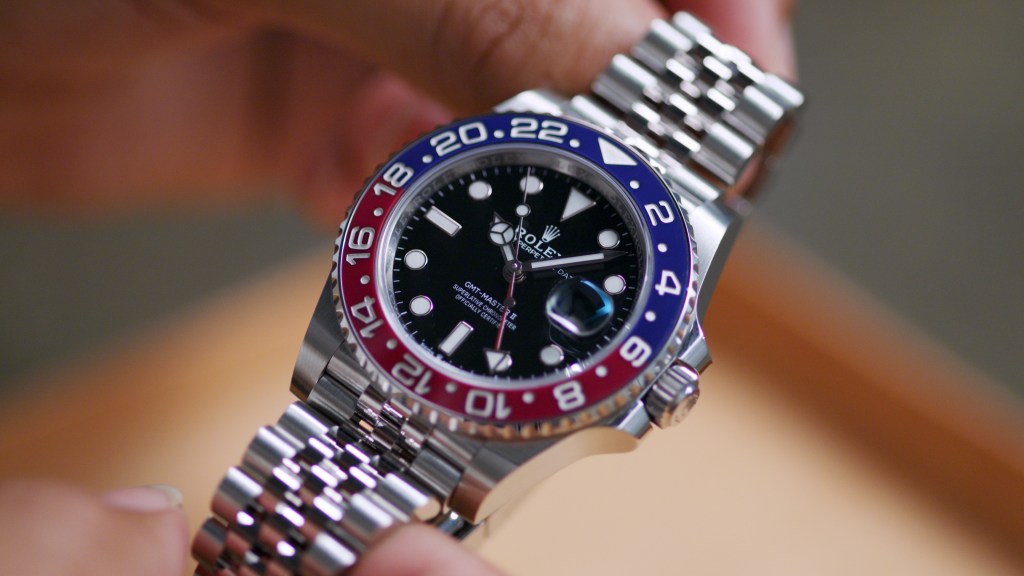
But because promises from Philippine government officials of speedy, honest treatment at customs (which, in the Spanish tradition, is a franchise) could not be relied upon, in preparation for my visit at Manila Customs, my superiors required me to buy a Rolex watch, with my own funds, with the promise they would reimburse me in due time. So I bought a GMT-Master II.
At the airport I retrieved my bags and three big packages of specs and drawings and toddled off to customs inspection. As soon as the agents at Manila customs saw the heavy pile of drawings their beady, greedy eyes lit up, but before they actually demanded a percentage of the total construction cost, I followed my superior’s instructions, extended my left arm over the stainless steel inspection table, displayed the watch, deliberately released the catch on the watch band, and allowed the watch to fall clattering onto the table.
The inspector quickly picked up and examined the watch, and glanced at me questioningly. I just nodded to him respectfully, loaded up my documents, grabbed my travel bag, and left without saying a word. As I was passing through the doors isolating the inspection area, I glanced back and saw the custom inspector smile like a maniac, stuff my watch into his pocket, and wave his next victim to his station. And so the ancient game of taxes, tariffs, bribes and extortion continued.
Of course, my associates were waiting outside the airport in an automobile by the curb to receive the drawings. We drove straight to the office to drop them off, and then headed out to one of the many clubs in Manila to relax until my return flight to Tokyo was ready to depart.
Why a Rolex GMT-Master II watch, you say and not the Breitling Navitimer James Bond wore in Thunderball or Scaramanga’s Rolex Cellini King Midas seen in The Man with the Golden Gun, or even the economical Swatch GE218 that Blowfeld wore with such panache? This was before the fake “Swiss Made” watches deceptively sold by Rolex recently destroyed their reputation were available, but until recently Rolex watches were immediately recognizable and were considered as good or better than cash in many countries, including the Philippines. Indeed, it was standard operating procedure back in the day for businessmen of all nations to wear a Rolex watch as a last-ditch source of emergency funds, especially since the prestige and value of this brand of watch was instantly recognizable, unlike a cheaper Omega or a more-valuable but little-known Patek Phillipe.
BTW, this is exactly why the solid gold Rolex Presidential watch sold so well for a time in many backwards countries.
And why was I instructed to ostentatiously and noisily drop the watch onto the metal table and then walk away without a word? Three reasons.
First, because if one offers government employees cash, it’s obviously a bribe, a crime even if the customs officer demanded the bribe at gunpoint. And as in the United States, superior officers are always eager to use the color of authority to steal cash from subordinates. Just ask Congress, the US military, or the IRS where they misplace billions of US dollars every year. But a watch is just a timepiece without a receipt.
Second, human avarice being what it is, an argument about the amount or method of a cash payment is likely to arise, especially if the prospective recipient has the power to demand a look into one’s wallet, as the man with the gun often does. The Rolex simplifies all that.
Third, if one pays cash, unlike a single timepiece that cannot be easily divvied-up among other customs officials, arguments and long delays in backrooms will always arise. But if the bakshish is just a single watch of obvious value that cannot be divvied-up like cash, dealing with the custom agent’s coworkers and relatives becomes his problem to resolve after his shift is over and you and the drawings are long gone. Indeed, if he’s clever and discrete, they may never know the transaction occurred. This is the real goal, of course.
And lastly, if the customs agent suddenly decides a watch is not enough compensation, and in mighty, puffed-up, hypocritical umbrage pushes his extortion to the limit claiming a crime has been perpetrated, you can play dumb and insist you innocently, clumsily, or accidentally dropped the watch, and you thought the agent kindly picked it up to return it to you. Cash would not work for this approach.
Clever no? I didn’t think this technique up, but I saw it work well 5 times. Welcome to the wonderful world of international construction.
While it was good to provide a hospital to poor people, I’m not proud of my role in this tale. Gentle Reader will draw your own conclusions from this account, but I will be so bold as to state that it’s a stretch to criticize the person being extorted when the person doing the extortion is one government official among many making the same demand, and he has a gun.
Corruption always lead to destruction of civilizations and the suffering and death of innocents.
In future articles in this series well consider the attributes of a useful watch for the woodworker, and examples of how to use one to improve one’s efficiency at work.
YMHOS
If you have questions or would like to learn more about our tools, please click the “Pricelist” link here or at the top of the page and use the “Contact Us” form located immediately below.
Please share your insights and comments with everyone in the form located further below labeled “Leave a Reply.” We aren’t evil Google, fascist facebook, or a Whitehouse staffer and so won’t sell, share, or profitably “misplace” your information. If I lie may all my sawteeth shatter.

















 A man in love is incomplete until he has married. Then he’s finished.














Please Leave a Reply