Toolchests Part 12 – The Sawtill

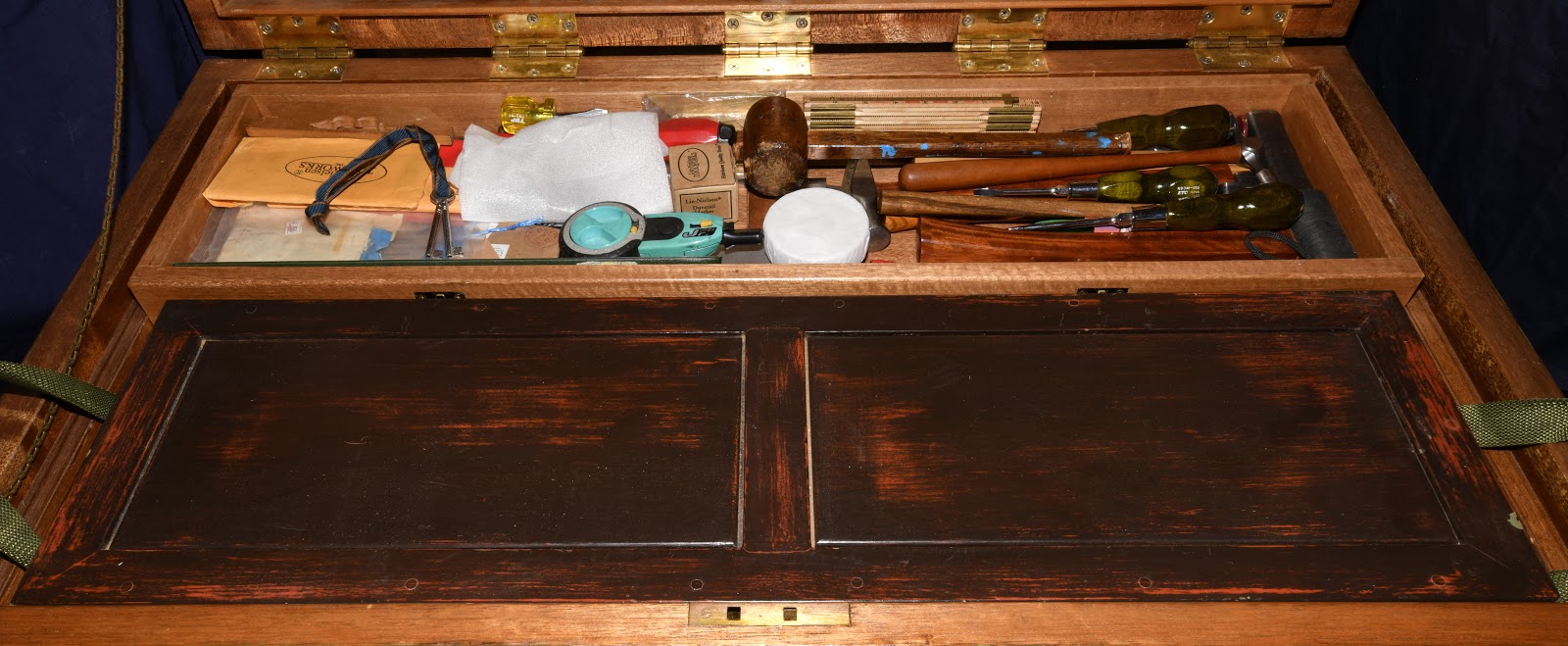
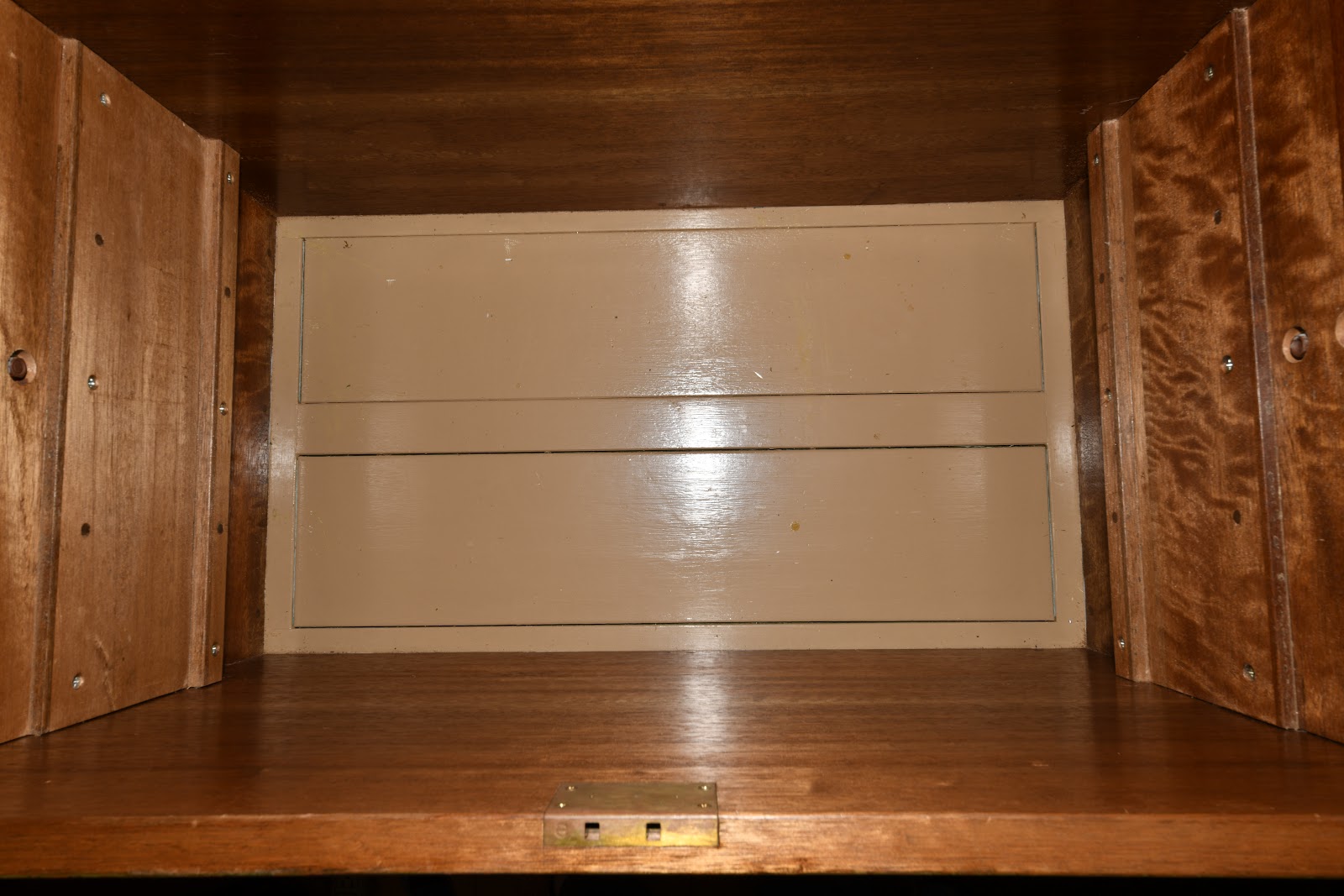
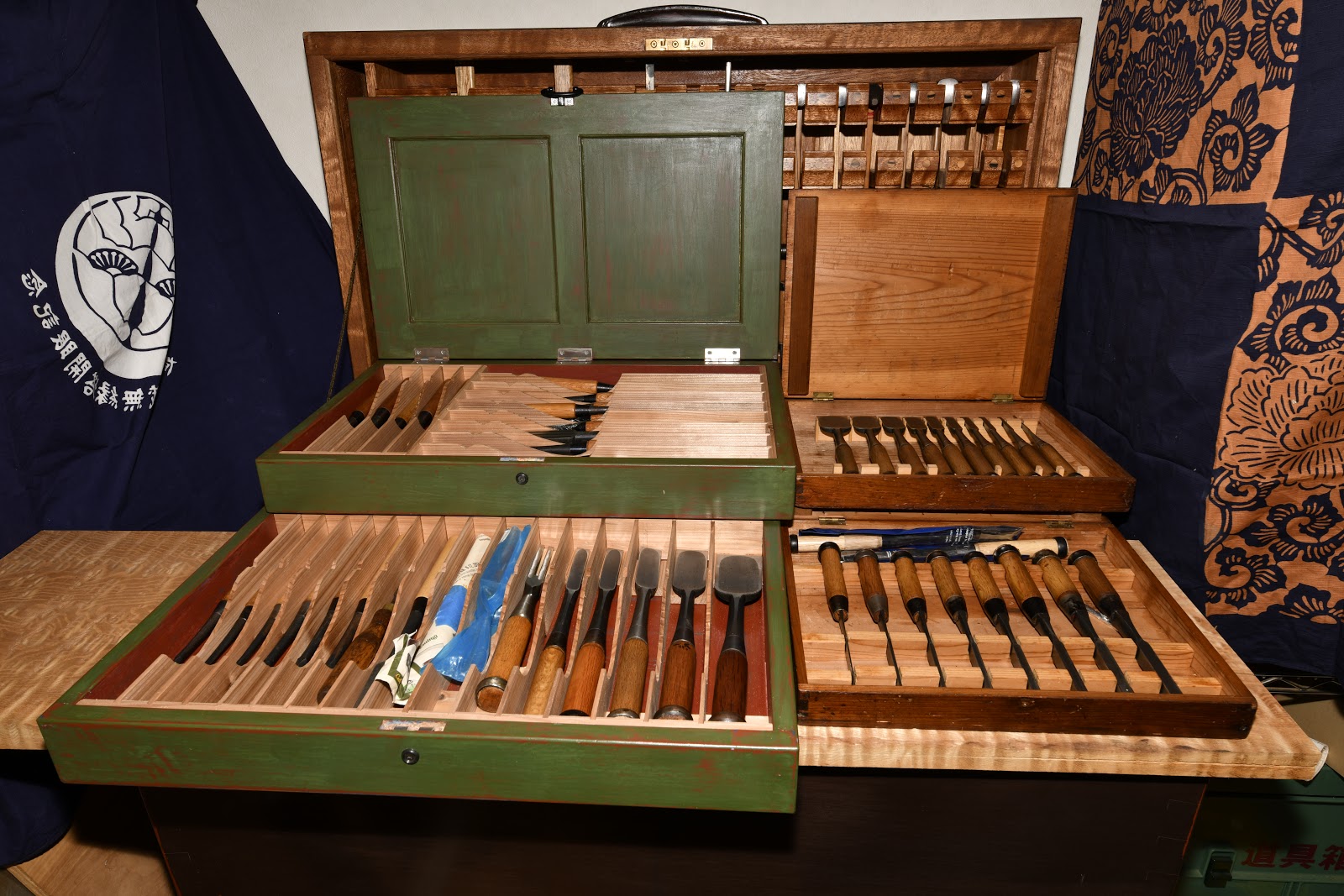
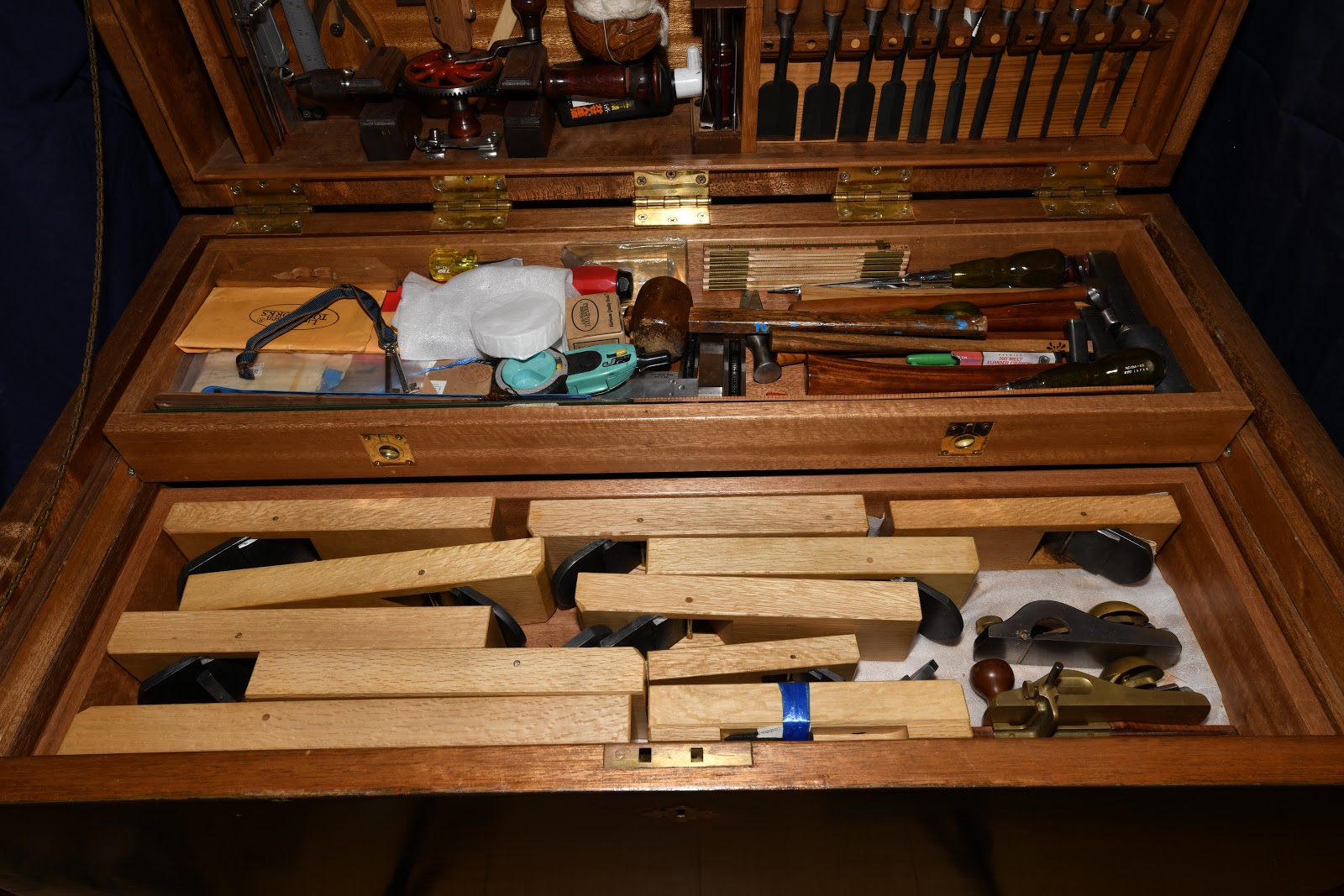
A view of the Sawtill’s lid nested into the opening in front of the trays.

I am but mad north-north-west. When the wind is southerly, I know a hawk from a handsaw.

William Shakespeare – Hamlet

Every woodworker worth his salt uses handsaws. Your most humble and obedient servant doesn’t mean to impugn those who use machines exclusively to perform all sawing activities, I am sure they are all fine folk; I wish them health, happiness, and hundreds of fat children, but they are more machine operators than craftsmen in wood, in my un-exalted opinion.

Saws are important tools deserving of protection, but which we need to access quickly, betimes a difficult performance criteria to satisfy. Saws have wide metal “plates” that collect dust and condensation and develop rust. And sharp teeth, shorter but much like those of the frumious bandersnatch of literary fame, that catch, cut and scratch things, and that are easily damaged in turn through contact with other metal tools. How best to store this prickly fellow in a chest filled with other burbling tools?

In this post we will examine the challenges involved in storing saws, and the solution I learned from an dusty old book hidden in a Japanese university library far back in the mists of time.

Saw Storage Performance Criteria

High-carbon steel is without doubt the best material for handsaws, but it rusts. Rust produces a rougher surface increasing friction, and if it progresses will cause deep pitting, damaging the teeth forever and permanently impairing cutting efficiency

We can apply oil to the plate and teeth to prevent/reduce rust, but oil attracts dust which often contains hard particles that dull teeth, not to mention chemicals that accelerate rust. Therefore, a good storage solution must protect saws not only from dings, but from dust and temperature swings that invite condensation and rust.

Clearly the exposed saw rack published in woodworking magazines ad nauseam as DIY projects for amateurs is easy to access and great for displaying handsaws for worship and veneration (especially grand are those with twin candlestick holders (ツ)), but they are not a good long-term storage solution because, while the saws are in plain view convenient for daily worship, they are also exposed to dust and temperature swings that encourage condensation corrosion.

One traditional solution is to mount saws to the underside of a toolchest’s lid. I have tried this method before but long ago concluded it takes up too much real estate I need for other tools. And the saws still collect some dust in this location anyway.

I especially dislike one traditional solution, namely nailing a sawtill in the bottom of the toolchest up against the front wall, because it makes the saws difficult to see, a pain to retrieve, and more importantly, limits the travel distance and ultimately the width of the all-important trays. Codswallop!

Some may insist that the internal sawtill is the only valid “traditional” method. To all the self-appointed Time Lords and Holy Arbiters of Everything Traditional that look down their patrician noses at the solution I selected I respond that there are other traditional designs they may have not seen before. Perhaps they need to… I dunno… do something crazy like… put down their congac snifters and visit different libraries?

After months of deliberation I decided I needed a sawtill that is an enclosed, sealed, insulated space in itself, one that can be removed to serve as an independent toolchest most of the time but will still fit inside the toolchest when necessary, will contain many saws, not just five or six, and is at a convenient height where I can clearly see and easily retrieve/replace them. These criteria are what attracted me to this extremely intelligent design illustrated in copperplate in an old bug-chewed British book in the University of Tokyo Library. I modified the design considerably, especially the lid and the drawer, but there is nothing new under the sun.

The Execution

My sawtill nests inside the toolchest, as you can see from the photo above. In this location the lid can be closed without interference. Saws in the top compartment can be accessed, but not the saws in the bottom drawer. Tools in the top tray and those mounted inside the lid are also easily accessible, but those in the 2nd and 3rd tray and in the dungeon are not accessible without removing either the sawtill or the trays. This may seem to be a serious flaw, but au contraire, mes amis!

When the toolchest is at home in my workshop, the sawtill spends no time inside the toolchest. Instead I take advantage of its greatest virtue, set it off to the side, and use it as an independent toolchest dedicated to saws. In my current workshop it sits on the ledge of a bay window located 1 foot from the mothership. In other workshops I rested it on sawhorses. It is a very intelligent and flexible solution.

Do I need candlesticks? They would be nice….

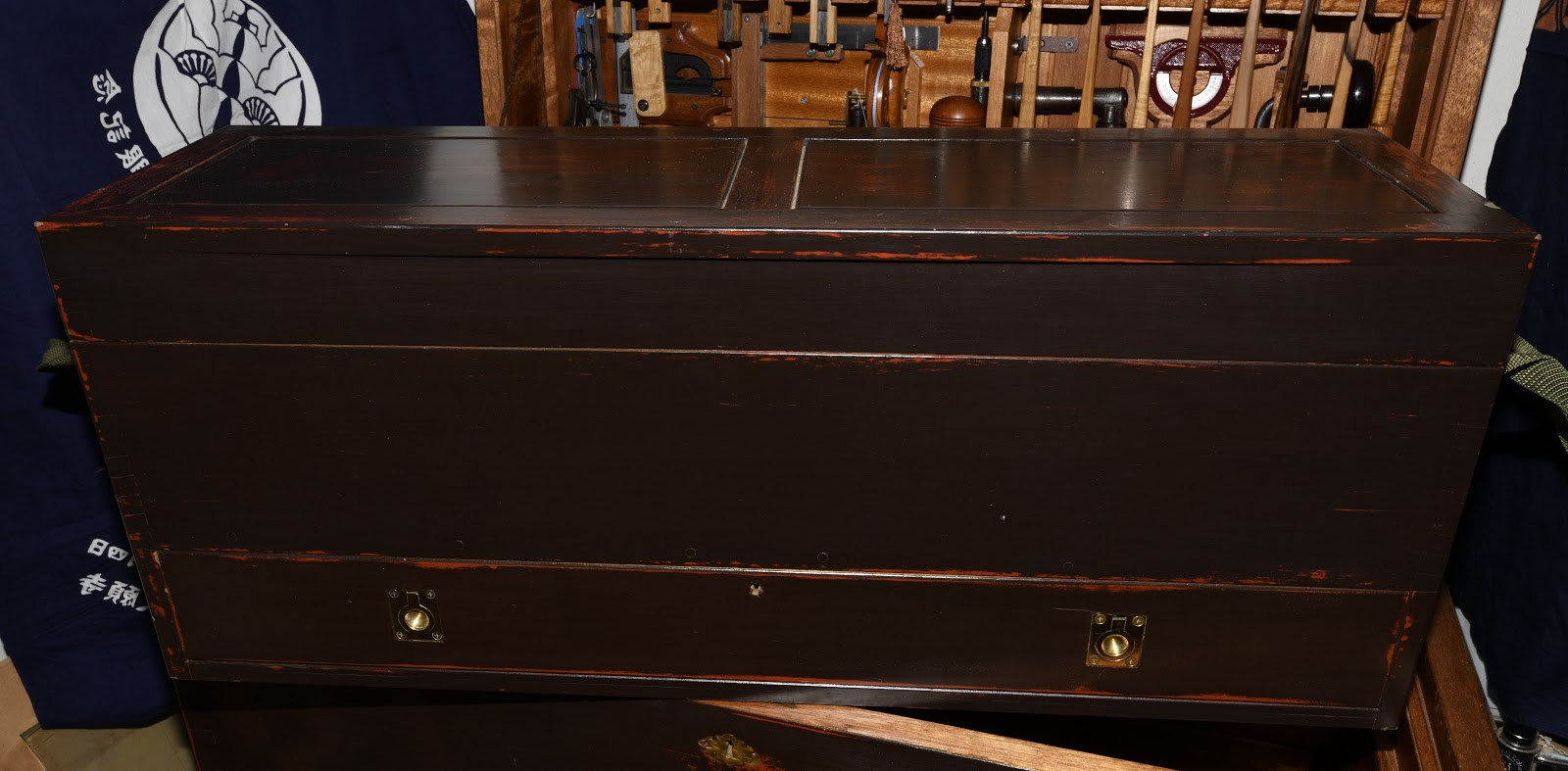
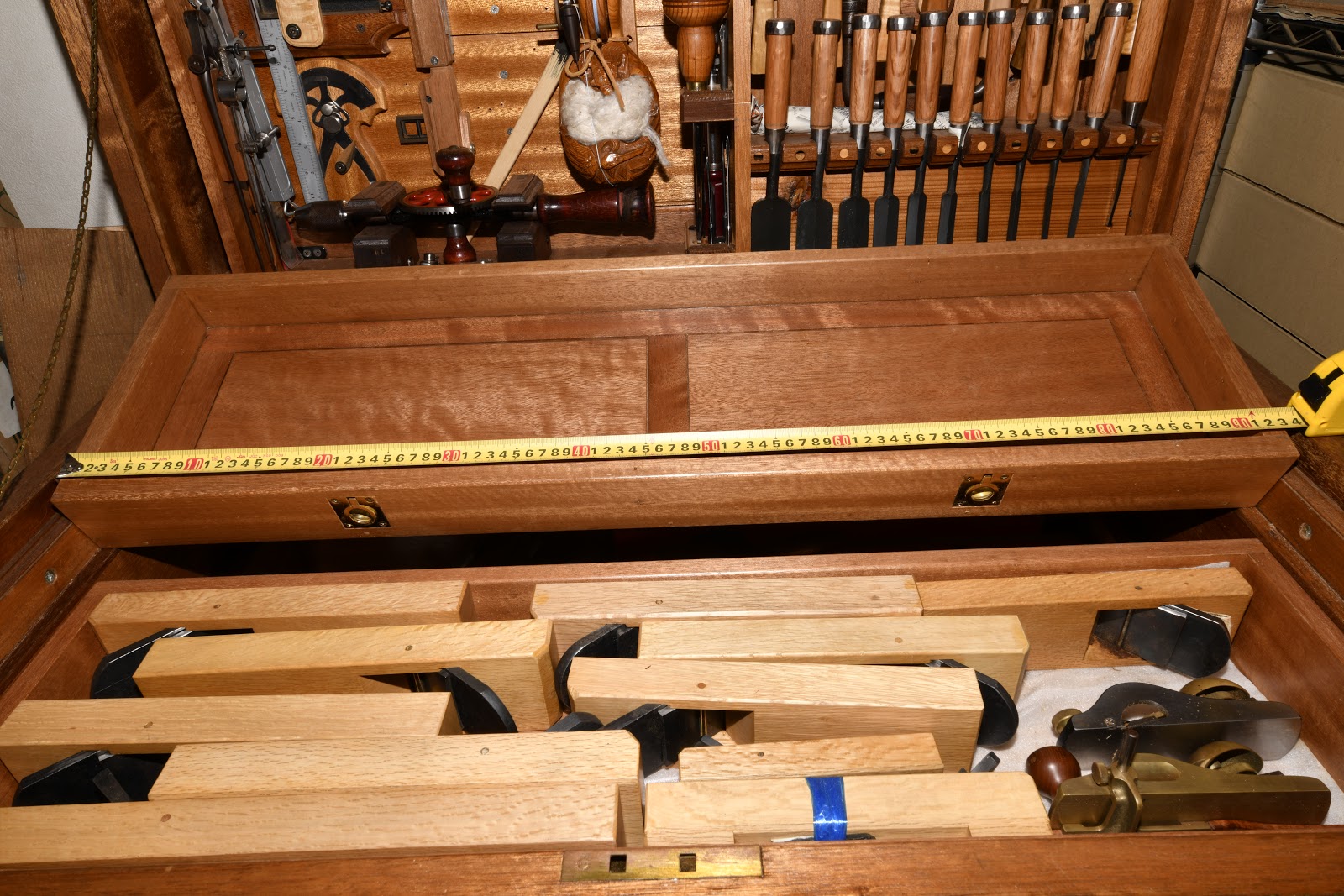
The sawtill resting on the toolchest’s walls. The top and drawers are closed. The drawer has recessed brass pulls and a brass lock. Nylon straps attached to each end of the sawtill make it easy to lift out of the toolchest’s interior.

Like the toolchest proper, the sawtill is made from solid medium-density Honduras mahogany joined with dovetails. The lid, central horizontal divider, and bottom are all solid-wood frame-and-panel construction. Like the toolchest, the sawtill’s lid has deep vertical sides to add stiffness and prevent warping, but unlike the toolchest, nothing is mounted inside the lid. A wooden lip projects down from the lid aligning it to the base and sealing it tightly when closed.

When open, the saw handles in the top compartment protrude above the sawtill’s sides making them easy to see, remove, and replace without fiddling around. This is supremely important.

Due to this construction, neither drawer nor lid have ever warped or become sticky.

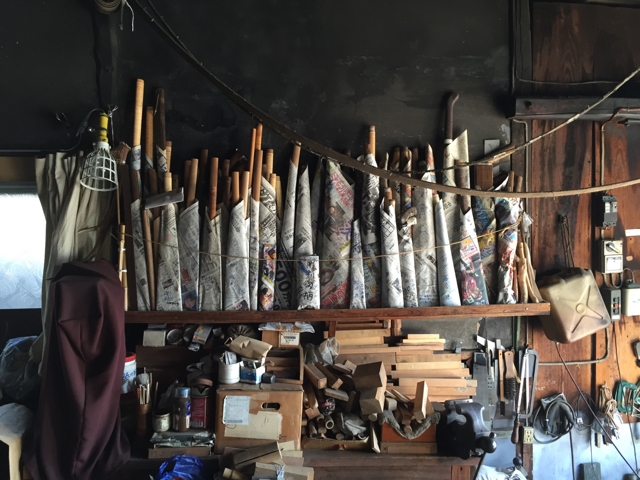
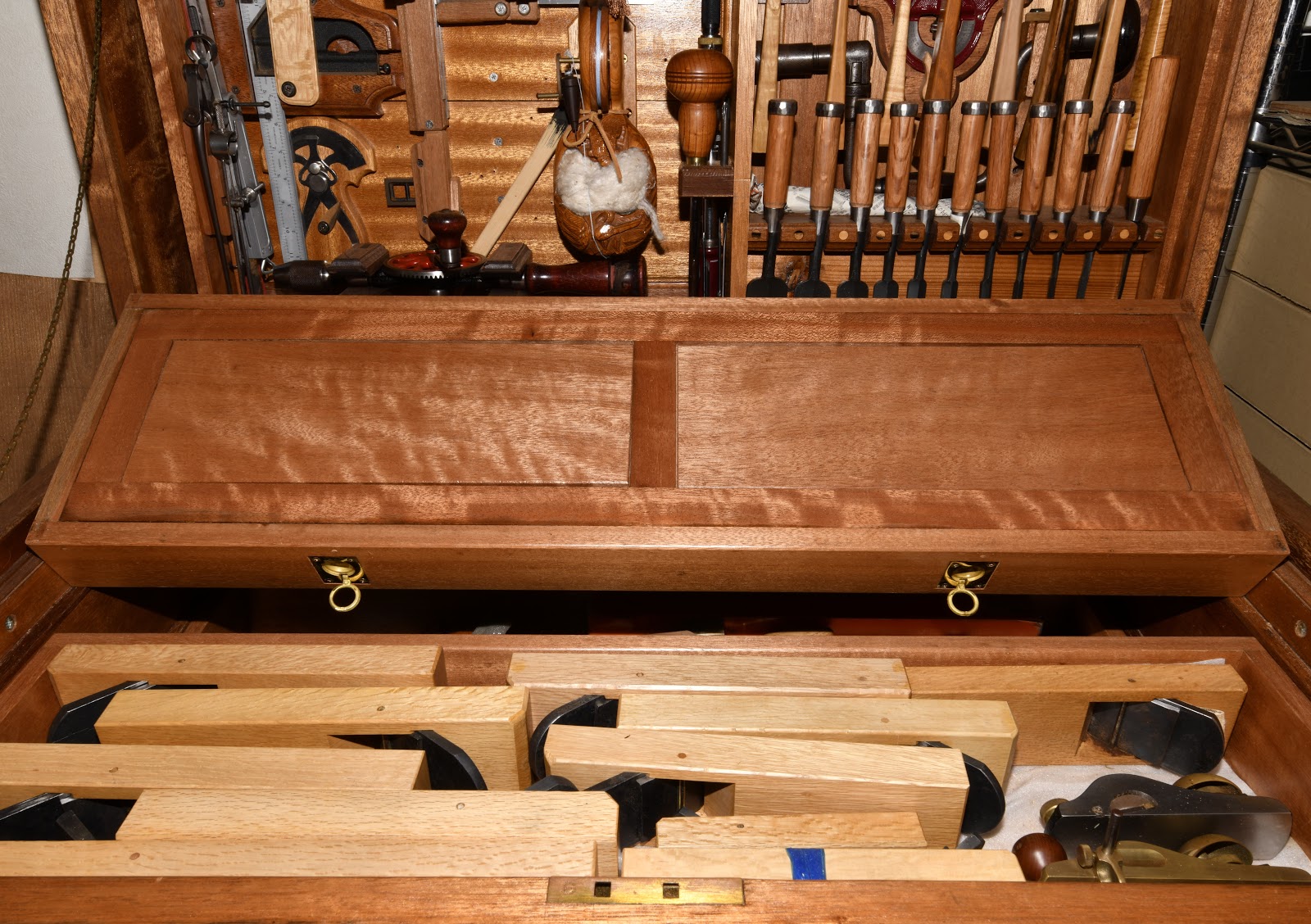
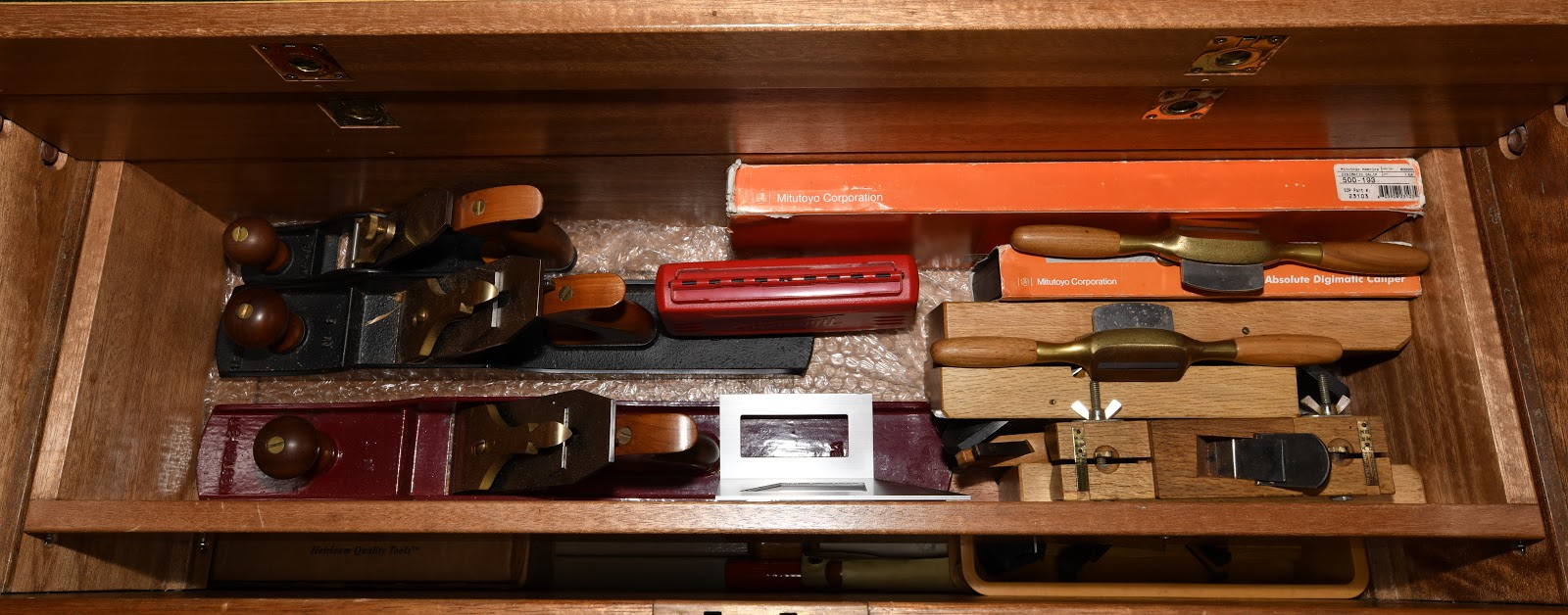
The sawtill with the lid and drawer open. The top opening is filled primarily with Western saws and larger Japanese saws (e.g. bukkiri gagari), while the drawer is stuffed full of thinner Japanese saws as well as sharpening files, chalk and a sawset. I tend to store many of my saws wrapped in newspaper because the out-gassing of the ink is a good corrosion preventative, at least when the newspaper is new. Strange but true. It has the side benefit of providing the saws reading material.

The top compartment is sized to house 8-26” Disston No.12 saws, or a mixture of Western and larger Japanese saws. The drawer underneath will hold a dozen Japanese saws along with files and other saw-related tools. 

The sawtill’s width is a hair narrower than Moby Dick’s sliding trays, and its overall height with lid closed is the same as the combined height of the three trays so it rests neatly on the bottom tray’s ledge and nestled inside the space created when the three trays are slid to the back. The toolchest’s lid can be closed with the sawtill in this position securely locking it in place.

Dividers

When this saw till was new I installed two thin boards in the top compartment, one across each end, with the classic slits & slots cut into them to retain saws, but I soon found this arrangement to be sub-optimal. I later replaced them with the five lengthwise plywood dividers visible in the photo above creating individual compartments for saws. These compartments provide more storage options, make it quicker to access/replace saws without banging and sawing each other, and make it possible to wrap the saws in anti-corrosion cloth or paper for additional protection during long-term storage and transit. I would never go back to slits & slots.

Although it may have compromised the sawtill’s elegance and violated the eternal tenets of beauty exemplified by the Wonderful Liberace, I didn’t mount candelabra to it. Pray tell, an unforgivable omission?

In the next post in this series we will examine the finishes used. I think you will find this especially interesting. Until then, I have the honor to remain

YMHOS

If you have questions or would like to learn more about our tools, please click the “Pricelist” link here or at the top of the page and use the “Contact Us” form located immediately below.

Please share your insights and comments with everyone in the form located further below labeled “Leave a Reply.” We aren’t evil Google, fascist facebook, or trashy Tik-Tok and so won’t sell, share, or profitably “misplace” your information, not even if Joe Biden and his bloody-handed buddies in the Chinese Communist Party ask nicely. If I lie may my mattress be as prickly as sawteeth.

← Back

Thank you for your response. ✨

Leave a comment

Other Posts in this Series:

The Japanese Gennou & Handle Part 12 – The Drawing Part 1/6

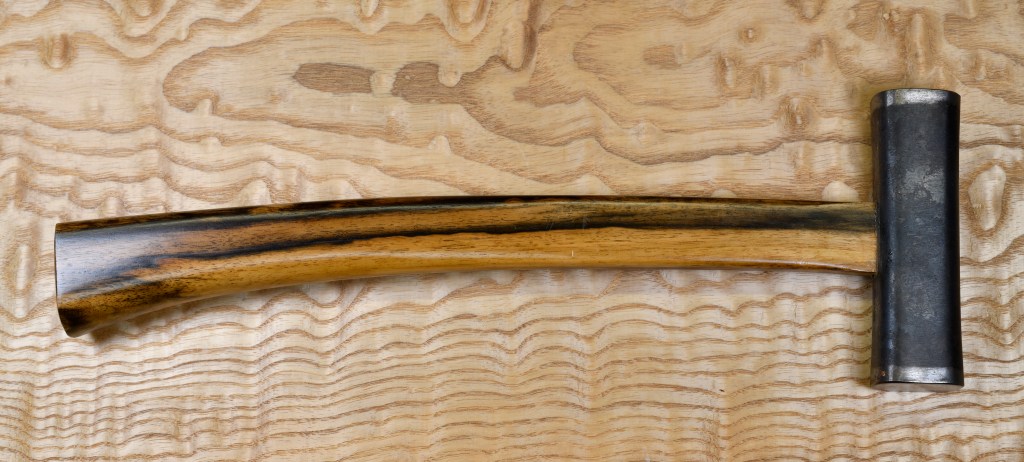
A gennou with a modern-style 180monme head (700gm/25oz) by Kosaburo and a black persimmon handle.

A drawing is simply a line going for a walk. 

Paul Klee

This is the first of six posts in a sub-series describing why and how to make a full-scale drawing in preparation for making your gennou handle. 

Please note that the principles described in these posts on Japanese gennou handles apply to all varieties of hammer and axe handles, and can be adapted to Western tools with great success.

Why Bother Making a Full-scale Drawing?

The greatest fun in working wood as a hobby for your humble servant is watching an object evolve in my hands, sometimes magically becoming better than what I had imagined it would be. Many Gentle Readers have the same experience.

My day job in Japan’s construction industry is not so spontaneous or fancy free: I spend too many hours each day planning, discussing, reviewing/marking-up, and writing about complicated drawings, so drafting a drawing to make something from just a single stick of wood feels kinda sorta silly on the one hand and too much like real work on the other. But despite these conflicting emotions, please understand I am dead serious about the importance of a drawing, and you should be too.

So why am I recommending you make a drawing? There are 3 reasons: 

1. Record & Refine Ergonomic Parameters

A gennou design must begin with the fixed parameters of your gennou head, but there are several ergonomic measurements from your own body you will need to incorporate into your handle design and meld with the specific details of the head you select. This isn’t difficult to do, but because every head, every body, and therefore every handle is different, and because there are a surprising number of details that must be combined, it can be difficult to get everything right without a drawing, especially the first few times.

2. Develop an Elegant Minimalistic Design

The second reason for making a drawing before sawdust is that the gennou I am teaching you how to make is in every way a minimalist object comprised of only two simple components, the details of which require thoughtful planning to get right. 

Allow me to share a couple of points about minimalism I learned from observing the successes and failures of world-class architects and designers in New York, San Francisco, London, Hong Kong and Tokyo: When making some things, past a certain point there is simply no room for either improvisation or trial & error without starting all over again. Assuming one is not so fatuous or deluded as to accept a monkey’s scribbling as high-art, you can imagine the resulting potential for wasted time and money and brain cells.

The famous architect Frank Loyd Wright once said: “An architect’s most useful tools are an eraser at the drafting board, and a wrecking bar at the site.” When used with skill, which of these tools do you think is the most cost and time effective?

Here is wisdom: The principle of “less is more” absolutely applies, but what most people not involved professionally in the design and fabrication of expensive minimalist physical objects do not realize is that achieving an elegant and functionally superior “Less” is neither accidental nor serendipitous, but can only be consistently achieved through “ More” thought, planning, and eyeball time, something difficult to do without a drawing.

How does this apply to making a simple gennou handle, you ask? Excellent question; You really are paying attention, I see. Once you have cut or shaved away too much wood (even a single shaving can easily be too much), there can be no more thinking, planning or eyeball time without starting over, wasting much of your valuable time and wood. Best to avoid that nonsense if possible, don’t you agree?

3. Take a Mulligan

The third reason for making a drawing is related to the first and based on the unfortunate likelihood that your first attempt is unlikely to produce perfect results. But don’t be discouraged because your second attempt will be much better. If you begin with a drawing, by the third attempt you will have figured out precisely what works best for you, knowledge that will serve you well your entire life. I promise.

In order to accomplish the goal of the perfect handle in just two or three iterations you will need to record the measurements, assumptions and changes you made each time so you can effectively refine them without having to start over from zero each time. A drawing is the best tool for this purpose.

A drawing will also help you avoid repeated errros. A drawing will also help you avoid repeated errros.

What to Include in the Drawing

I recommend you make a full-scale drawing of the handle viewed from the side, the top (back) edge, and the butt for a total of 3 viewpoints on a single piece of paper. You should also make cross sections at several locations at the handle inside the side view.

It is also useful include general dimensions, such as overall length, width at the eye and width at the butt to help you select a suitable piece of wood.

Developing Drawing Skills

Many have no experience making drawings. That’s perfectly OK. The only way to become competent at making simple drawings using orthographic projection is to do it.

The basic idea of orthographic projection is to represent a 3-D object in 2-D drawings, usually a side view(s), top/bottom view, and end view(s), but for the purpose of drawing a simple gennou handle without power windows and tuned exhaust, a side view, top view, end view and a few simple sections are plenty.

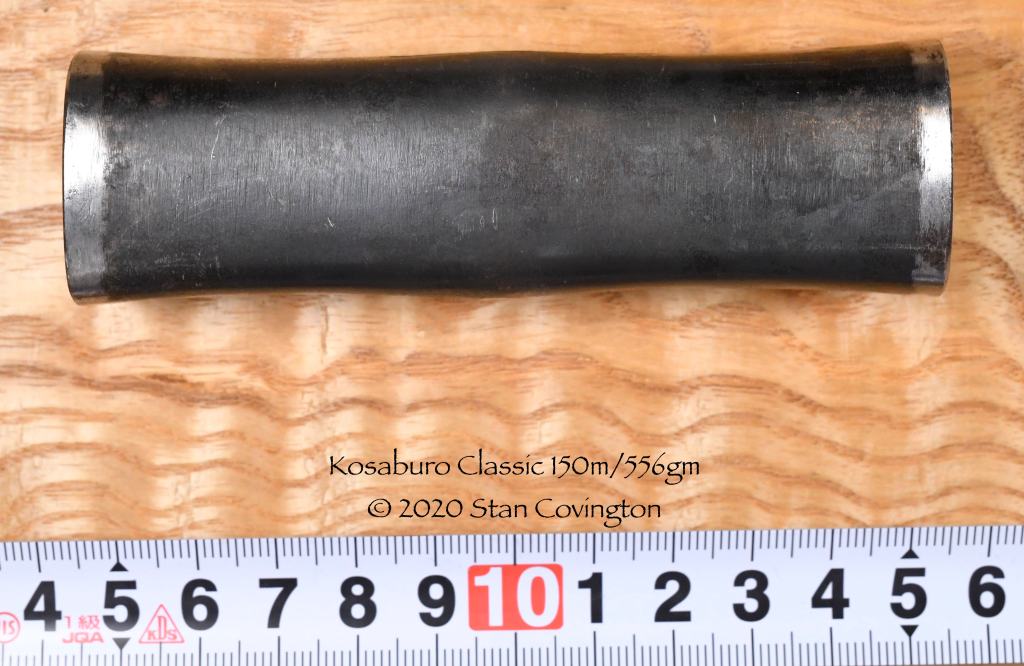
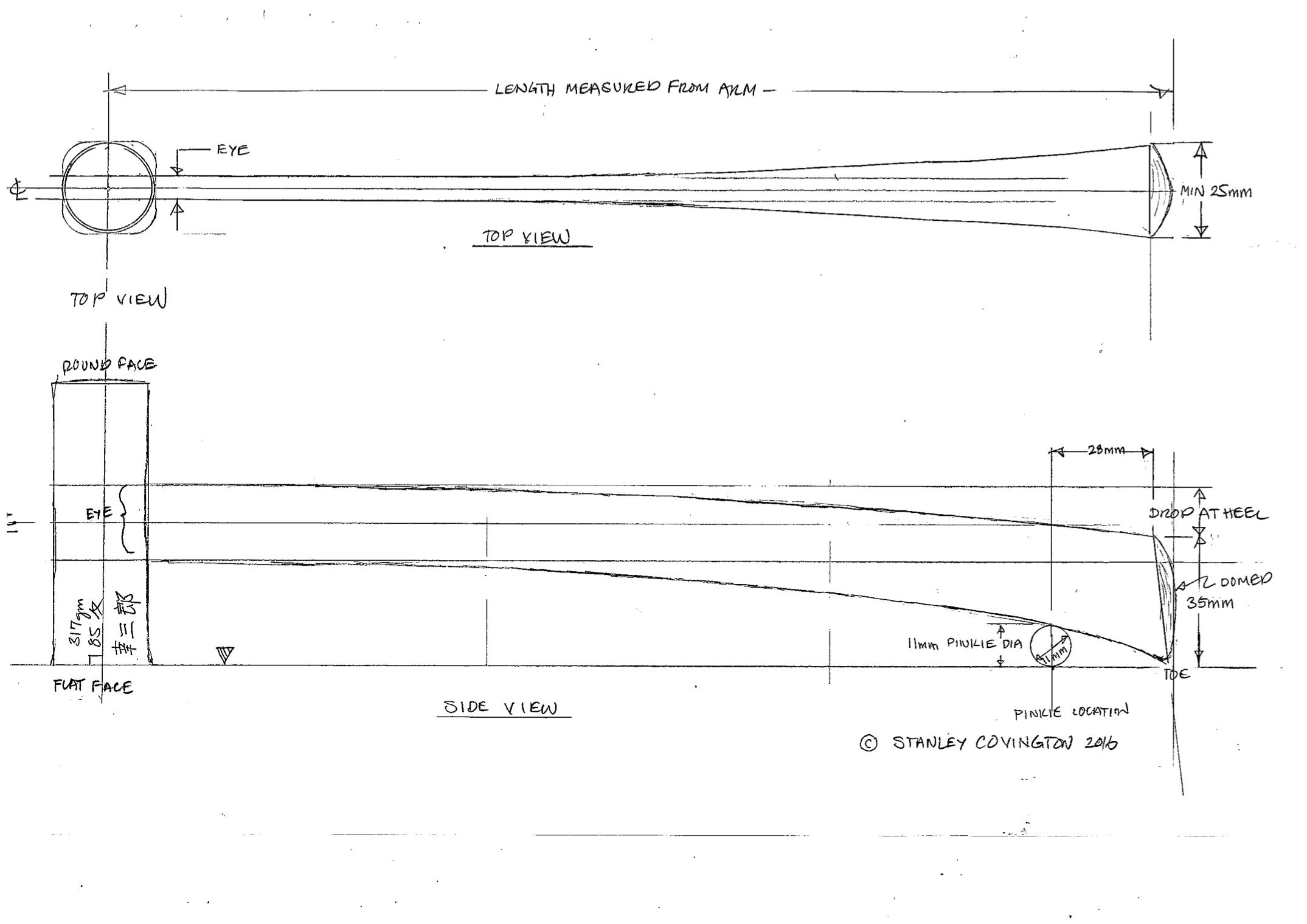
The drawing below is one I made for one of my gennou showing just top and side views. As you can tell, it starts with the head. Sorry, no sections. I will provide more drawings beginning with the next post.

A handmade drawing for gennou hammer made to fit the author with an 85monme Kosaburo head. You can download this drawing for your reference by clicking the button below.

If you are serious about making quality objects in wood long-term, the ability to make a simple drawing is a skill you should develop. The drawing doesn’t need to be pretty, it doesn’t even need to be detailed or show numerical dimensions if you are making it full-scale and for your own use, but it should represent and record things like critical dimensions (length and width), straight line/curves, and the locations of features.

“Why can’t I just do it in my head?” you ask? Of course that is an option; There are times when we all shape wood as we imagine it, the instant we imagine it.

But a drawing lets you combine and adjust details, and allows you to wait some time to grow “fresh eyes” to reexamine the design. A drawing makes it easy to make fine adjustments to a minimalist object. It lets you share the design with others and get their opinion. It lets you record your successful designs for future use. It is a powerful tool, one that will improve your woodworking skills.

And with practice, the act of making drawings refines your eye and your imagination, improving not only your design ability on-paper, but your ability to create an object in your head and examine it from different angles. Just ask any second-year architecture student.

Tools for Drawing

I will go into more details about drafting tools every woodworker should own and become proficient with in a future post, but in preparation for producing the drawing we will begin in the next post, and assuming you will make the drawing on paper instead of a board, you should gather the following minimal tools:

  1. Drawing board: A plain wooden board with four straight sides and square corners at least a little bigger than the finished gennou. Any smooth, flat board will suffice;
  2. Paper: Better quality drafting paper, vellum, or mylar is best, but any smooth, white paper will suffice;
  3. Masking tape: To secure paper to board (drafting tape will damage the drawing least);
  4. Straightedge: 12″ or longer (must be truly straight);
  5. Mechanical pencil with lead;
  6. Eraser: A good quality one that won’t leave smudges;
  7. Square: A clean framing square without burred edges will suffice;
  8. Drafting Triangle: A 45° plastic or steel drafting triangle, with minimum 8″ legs (cheap is OK);
  9. Compass: With pencil;
  10. Divider: With sharp points;
  11. Vernier caliper (not mandatory but helpful);
  12. Eraser shield (not mandatory but helpful).

The Gennou Head

So far in this series we’ve looked at a lot of gennou heads of many different varieties and weights made by different blacksmiths. Now that we are on the brink of making a design drawing, however, the time for talking is over. If you don’t have a good gennou head in-hand, please get one. The design of your handle simply cannot begin without it.

In the next installment in this story of love and longing we will begin our drawing. Please sharpen your pencils and get your eraser ready.

YMHOS

Can I eat your eraser? Pleeeeeease?

The following link is to a folder containing pricelists and photos of most of our products. If you have questions or would like to learn more, please use the form located immediately below titled “Contact Us.”

Please share your insights and comments with everyone by using the form located further below labeled “Leave a Reply.” We aren’t evil Google, facist facebook, thuggish Twitter, or a US Congressman’s Chinese girlfriend and so won’t sell, share, or profitably “misplace” your information. May I swallow a thousand needles if I lie.

← Back

Thank you for your response. ✨

Leave a comment

Previous Posts in The Japanese Gennou & Handle Series

Toolchests Part 11 – The Bottom

A famous bottom painted by Jean-Auguste-Dominique Ingres, La Grande Odalisque, 1814, Oil on canvas, 36″ x 63″ (91 x 162 cm), (Musée du Louvre, Paris)

When I’ve painted a woman’s bottom so that I want to touch it, then [the painting] is finished.

Pierre-Auguste Renoir

A worthy toolchest’s bottom should be like that of an elegant woman: well-formed, seldom seen, and never heard. Not that your most humble and obedient servant has an obsession with bottoms, mind you, it’s just that my goal of a 200 year useful lifespan for my toolchest compelled me to give this obscure, oft-neglected component bottomless thought. If you expect your toolchest to endure eight generations, you too may want to give it some fundamental consideration too (ツ).

The Historical Record

A strong, rot-resistant bottom panel that shuts out moisture, dust, insects, and vermin is a critical component in any workman-like toolchest in your humble servant’s opinion.

You may think these are easily satisfied common-sense performance criteria, but the historical record shows that such is not the case. Indeed, a problem commonly seen in antique casework is rotted-out, bughole-weakened, rodent-nibbled bottom panels. One cause of this damage is that, during much of their lives, the bottoms of many old chests rested directly on damp floors or even the bare ground, absorbing moisture and creating a damp, woody environment for bacteria to run riot for decades on end, with no air circulation to remove dampness, and no exposure to sunlight to either dry the bottom or retard fungal growth. And don’t forget that yummy unprotected, unsealed softwood just begging to be munched on by bugs (betimes with a drop o’ Tabasco sauce, no doubt).

The bottom panel of my toolchest. Solid Honduras Mahogany with floating frame and panel construction, treated with CCA and painted with high-quality exterior-grade washable latex paint. The ledges that trays slide on are visible at the chest’s sides. Keruing strips are glued to to them to compensate for wear over the years.

Indeed, damaged bottoms were so common in casework in past centuries that it appears to have been standard practice to make them easy to replace. Or perhaps they rotted because they were less visible, excusing the use of cheaper, less-durable, unfinished secondary woods attached using nails instead of more expensive and durable woods, finishes and joinery techniques, with easy replacement being just an unintended side-benefit of cheaper construction. 

I will let the preservationists and historians argue this chicken-or-egg problem, but being a belt-and-suspenders-and-safety harness kind of guy, I’ll have nothing to do with a flawed chicken even if it was hatched from a traditional egg.

Frame & Panel Construction

There are a number of ways to build a toolchest’s bottom panel. Perhaps the most convenient but worst material to use is MDF, or as I like to call it, “garbage.”

Marine-grade plywood is a much better choice, but it too will delaminate and rot given enough time, moisture, and persistent micro-organisms.

Of course, in order avoid the failings common to most casework thereby ensuring the chest will provide useful service for 200 years, I selected time-proven frame-and-panel (F&P) construction in solid wood for my toolchest’s well-formed bottom.

Solid wood is not perfect, but it is better than either garbage or plywood on condition that the F&P assembly is built correctly, and some of the measures listed below are employed.

Some general principles of proper F&P construction follow:

  1. Properly Acclimated Wood: All the wood used must be well dried and its moisture content be in approximate equilibrium with the local environment at the time you make the assembly. Neglecting this condition is a common cause of eventual failure;
  2. Properly Sized Frame Members: The width of the frame members must not be too wide or the corner joints will fail and/or the frame may push the casework apart when it expands, or leave gaps when it shrinks, due to seasonal humidity changes;
  3. Properly Sized Panels: Panel width and the dimensions of the tongues and grooves that connect panel to frame must be sized so that seasonal humidity changes do not cause the panel to swell enough to break or warp the F&P assembly, or shrink enough to leave gaps between the panel and frame members;
  4. Unconstrained Movement: A very important consideration is related to number 3 above, namely that the movement (expansion/contraction/sliding) of panels must be unconstrained. A common failing in F&P assemblies is glue squeeze-out or finishing materials inadvertently gluing the panel’s tongues inside the frame’s grooves resulting in broken assemblies, and more frequently, cracked/split panels. The solution is of course to use the right amount of glue and be careful when finishing, but since Murphy is a cunning bugger adept at concealing glue squeeze-out and finish infiltration until it’s too late to detect (and pixies), I always coat the panel’s tongues and the inside of grooves with wax to prevent glue/finish adhesion. Please also be careful that nails/screws/dowels used to secure F&P assemblies into the casework do not prevent your panels from moving freely.

Isolation

With a lifespan performance criteria of 200 years in mind, the first solution I employed to maximize the bottom’s longevity was to make it nearly impossible to place the bottom in direct contact with the floor or ground by leaving an “air-gap.” I did this by dropping the skirt below the chest’s bottom panel so the chest rests on the perimeter skirt instead of its bottom reducing the potential for moisture absorption through direct contact with the ground/floor. Better-quality casework in past centuries often incorporated this design detail because it works.

Ventilation

The second design detail I employed was to scallop the base/skirt to allow air to circulate underneath the toolchest from all four sides, and to facilitate cleaning. This too is a traditional detail superior to simpler modern designs.

Better Woodworking Through Chemistry

The third rot-prevention measure I employed is more or less modern. I saturated the frames and panels of the chest’s bottom as well as the skirt in CCA (chromated copper arsenic) wood preservative using plastic bags and a vacuum pump, then let the wood dry thoroughly. I also primed/painted the bottom panel with high-quality latex paint to keep out water and seal in the nastiness of CCA.  

CCA is a very effective chemical that was not available before the mid 1930’s. Its use is restricted in the USA in some places, and is no longer available for retail sale in a few States, but despite what the coke-snorting enviro-despot lying lawyers in North Venezuela (the coastal badlands nestled between Mexico and Oregon) opine, it is quite safe if used properly. The key is to not ingest it. Please everyone recite the wood finisher’s pledge along with me now: “I will not drink wood preservatives, use CCA impregnated toothpicks, nor wash my face with oven cleaner.” Don’t you feel safer now?

Wood treated with CCA has a greenish color. No doubt you have seen construction lumber pressure-treated with this chemical. Copper is the active ingredient which prevents the growth of bacteria and fungi. Arsenic is the primary insecticide. The chromium component has little if any direct preservative effect but serves to fix the copper and arsenic to the wood. We don’t want it leaching out, of course.

So far, the bottom is holding up perfectly even after spending years resting directly on the concrete slab-on-grade floor of a non-air-conditioned garage on the very humid (80~95% RH year-round) and horrifically termite-infested Pacific island of Guam, but the final verdict won’t be in for another 175 years. I’ll let you know how that goes.

In the next exciting chapter in this tale of high adventure I would like to present the most unique feature of my toolchest, the sawtill. Trust me, you have not seen one like it before.

YMHOS

A well-considered bottom

Other Posts in this Series:

If you have questions or would like to learn more about our tools, please click the “Pricelist” link here or at the top of the page and use the “Contact Us” form located immediately below.

Please share your insights and comments with everyone in the form located further below labeled “Leave a Reply.” We aren’t evil Google, fascist facebook, thuggish Twitter or the Congressional IT department of the Democrat Party and so won’t sell, share, or profitably “misplace” your information. If I lie may my toothpaste taste like oven cleaner.

← Back

Thank you for your response. ✨

Leave a comment

← Back

Thank you for your response. ✨

The Japanese Gennou & Handle Part 11 – Decorative Gennou Heads

Simplicity is the ultimate sophistication.

Leonardo Da Vinci

n the previous post in this series about the Japanese gennou hammer we looked at an old-fashioned laminated gennou with some simple surface decoration by Hasegawa Kosaburo and discussed its construction and benefits.

In this post we will take a gander at some other styles of expensive heads with decoration for the sake of being decorative.

Decorative Gennou Heads

A chemically-blackened square head by Masayuki with his name engraved in red-filled characters

For a higher price, more decorative gennou can be had. Some of these have various surface textures and applied finishes, while others have designs etched into their surfaces, with the more expensive varieties even having designs of dragons, tigers, zodiac and religious figures deeply hand-engraved into their surfaces.

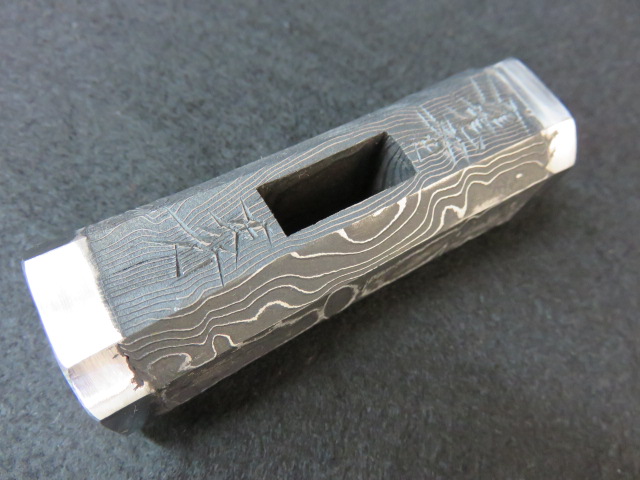
A “suminagashi” pattern-laminated octagonal head by Masayuki
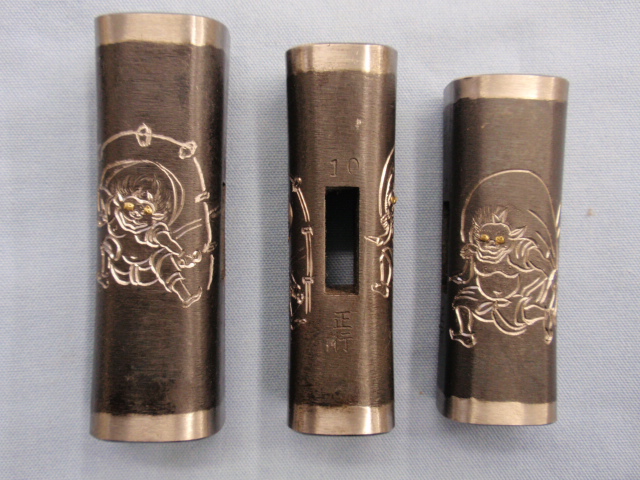
Hand engraved images of the gods of wind and lightning. Despite the polished hachimaki strip, these are not laminated heads.

One of my favorite gennou is an 80monme square head with the figure of a monkey acid-etched on one side and some Chinese characters on the other referring to the patron god of those born in the Year of the Monkey, which I am. Sorry, I don’t have the hammer with me here in Tokyo, so no pictures. It was a gift from my Japanese Mother-in-Law (RIP) and so I value it highly although I don’t use it anymore.

She had it blessed by a Shinto Priest at the same time he came to perform the annual blessing of their book-binding factory in Sendai, so I consider it more of a good-luck charm than a working tool. It has not aged gracefully.

BTW, it’s not at all unusual for carpenters, construction companies and factories to have Shinto Priests perform similar ceremonies at least once a year to purify their tools and equipment and to bless their workplaces for safety purposes. Both of the large construction companies I worked for in Japan had Shinto “kamidana” shrines made of wood mounted high on the interior walls of their offices, and smaller ones installed at their major jobsites, to encourage deities and local spirits to protect the jobsite, people and tools, and to drive off malevolent spirits that might cause harm. Belt, suspenders, and safety harness.

Construction companies in Japan are especially old-fashioned this way. One large construction company I worked for in Japan was established 147 years ago, just a youngster by Japanese standards. Perhaps the oldest construction company in Japan is Kongo Gumi Co., Ltd. established in the year 578 AD. Other large and old Japanese construction companies include Kajima Corporation, established in 1840, Shimizu Corporation, established in 1804, and Takenaka Corporation, established in 1610. Long memories and deep traditions.

A typical kamidana shrine in an office.

Of course, decorating a gennou head adds nothing to its functionality while significantly increasing cost, so highly-decorated heads are probably more suitable for ceremonial purposes, for displaying in a collection, or as gifts rather than practical tools. In fact, the older generation of Japanese craftsmen I learned from, now all either in their late 80’s and retired or passed on to the big lumberyard in the sky, considered such decorated tools frippery beneath the dignity of a respectable “shokunin” (a wabi sabi sorta thing) and would mercilessly rib someone who brought a gaudy tool to the jobsite or workshop.

Aging Gracefully

If you are considering purchasing a decorative gennou head, one factor you should seriously consider is the appearance of the head after many years of use. After all, a quality gennou head should be a lifetime investment and an heirloom tool. It may look as beautiful as Raquel in her fur bikini when new but will it look better than my scratched and rusty etched zodiac monkey head hammer after 20 years of use?

A “suminagashi” pattern-laminated square head by Masayuki

Some heads pictured in this article show a pattern-welded structure incorrectly called “damascus steel” in the West, or “suminagashi,” meaning “ flowing ink,” in Japan. This structure is not the famous damascus steel developed in the Levant centuries ago and made famous by swordsmiths. It is simply a mix of at least two different types of steel, one of which resists oxidation/discoloration (usually containing nickle) when exposed to an acid wash, producing a pattern. Theoretically, this construction neither improves nor harms the performance of the steel so long as the deferential hardening process is handled properly, but personally, while it looks fun, I distrust this material for gennou heads and blades that must do real work.

Hand-engraved dragon

Other heads have received fancy decorative surface treatments that neither harm nor improve a hammer’s performance. However, being decorative, one should consider the durability of such treatments. Chrome, nickel, copper plating, bluing, chemical pickling, or burnt-silk for instance, will not remain unchanged long in the case of a hammer used frequently on the jobsite or if laid on the concrete floor of a workshop frequently. Indeed, color case hardening, pickled finishes, paint, and even most bluing will look nasty and may rust before too long.

Perhaps the most durable surface finish is the black oxide that forms naturally on the steel surface during the heat-treatment process because it is reasonably rust resistant and naturally harder than the steel/iron it covers. It’s my favorite, but for some reason doesn’t seem to attract the ladies. Bummer. Decisions, decisions…

YMHOS

Raquel Welsh wearing her iconic fuzzy bikini in the 1966 film that made her an international sex symbol “One Million Years B.C.

The following link is to a folder containing pricelists and photos of most of our products. If you have questions or would like to learn more, please use the form located immediately below titled “Contact Us.”

Please share your insights and comments with everyone by using the form located further below labeled “Leave a Reply.” We aren’t evil Google, facist facebook, thuggish Twitter, or a US Congressman’s Chinese girlfriend and so won’t sell, share, or profitably “misplace” your information. May the bird of paradise fly up my nose if I lie.

← Back

Thank you for your response. ✨

Previous Posts in The Japanese Gennou & Handle Series

Toolchests Part 10 – The Dungeon

Welcome to the Dungeon. Please relax, take off your shoes, pull up a chair and sit on a spike.

Far over the misty mountains cold
To dungeons deep and caverns old
We must away ere break of day
To seek the pale enchanted gold.

JRR Tolkien – The Hobbit

In the previous post your humble and obedient servant described the three sliding trays in my toolchest. In this post we will descend beneath those trays into the lowest depths, a lonely space I call “the Dungeon.” So light your torches, unsling your axes, and let’s meet what lurks in the dark. Don’t worry about me, Gentle Reader, I’ll be right behind you!

Chisel Storage

Many things suffer durance vile in the toolchest, but by far the largest number of denizens are chisels. They are sharp, dangerous tools and difficult to both store securely and access safely.

As mentioned in previous posts in this series I have a handy dandy 10-pc set of chisels mounted in the lid. This is a high-quality set of hand-forged shinogi oirenomi but they are not my best chisels; Those are stored in four wooden chisel boxes kept in the dungeon.

One chisel box contains a 10pc oirenomi set, another a 10-pc mukomachinomi (mortise chisel) set, the third and fourth boxes contain various usunomi, kotenomi, atsunomi, and other specialty chisels. Approximately 38 Kiyotada-brand chisels reside in these boxes, mostly custom-forged.

The Toolchest’s Dungeon with its residents. Neither gold nor gems nor dragons are to be found here, but there are plenty of pokey things. Two well-used hinoki-wood green wooden boxes are stacked atop each other, the one on top contains mostly paring chisels; The identical box underneath it contains mostly atsunomi and kotenomi. Not seen, because they are shy, are two old re-purposed cryptomeria (akita sugi) wood chisel boxes, one containing a 10-pc set of mortise chisels and the other a 10-pc set of oiirenomi chisels. These boxes were originally made to house precision measuring tools in the Tokyo Imperial College’s artillery department. Pre-WWII, of course. The 2 brown plastic boxes on top contain mostly plow planes. The canvas rolls contain handmade files and rasps. The black and white thing in the front is a box containing a traditional Japanese tool for checking plane soles called an “Awase Jogi,” the first tool I made during my training in joinery, and one which may or may not be the subject of a future post. The Lie-Nielson box contains a router plane, a tool not available in Japan.

l have, and use, too many chisels to store in trays, so my work philosophy is to store them, sorted more or less by types, in wooden boxes which protect them thoroughly even outside the toolchest. I can remove my box of mortise chisels, for example, along with my box of usunomi paring chisels from the dungeon and set them either on or under my workbench and have quick access to all widths without wasting time digging around in the toolchest. When I am done with a chisel for a time, I wipe it down, oil it with my oilpot and return it to its place in its box keeping my workbench uncluttered and my valuable chisels protected.

Removing these four chisel boxes is as easy as sliding the 3 trays to the rear and reaching down into the dungeon which, along with the trays is designed specifically to provide adequate clearance for easy removal.

When I need to grab an oiirenomi chisel for a quick job, however, the 10-pc set mounted in the lid is handiest.

Four chisel boxes have been temporarily released from the dungeon and opened for your perusal.

Other Implements of Torture

You will also notice two tan-colored plastic containers holding plow planes of various widths and a moisture meter. To avoid noise and dust problems I don’t have any electrical routers with me here in Tokyo, so while not as efficient, these rather old-fashioned and sometimes cantankerous tools are the best alternative.

Also visible in the photo are several canvas tool rolls containing mostly handmade rasps and files, as well as a cardboard box containing a router plane, another essential tool for the unplugged shop.

Besides chisels and planes I can also store a hewing hatchet, an adze, and a large Japanese “bukkiri gagari” rip saw on top of the chisel boxes, but I usually remove them, wrap them up, and hang them on my adjacent wire shelf when the toolbox is in residence.

In the Dungeon’s far left-hand corner one American framing square and two Japanese kanejaku squares, one in centimeter scale and the other in traditional shaku/sun scale, can be seen resting against the back wall. They were sleeping quietly at the time of the photo probably because of a late night. Judging by the ruckus they made at the time and the dead soldiers they left laying about in the morning, they must have spent the entire evening drinking, playing dice on the chisel boxes and arguing loudly about the superiority of the Japanese “Shaku” measuring system vs. the metric system vs. the imperial system. Fortunately, while squares have both tongues and blades, they lack arms and legs, so their drunken deliberations never become more violent than rattling. I don’t allow them any stogies, however; One must draw the line somewhere, I’m sure you’ll agree.

This arrangement keeps everything ship-shape and Bristol fashion, an idiom especially suitable to a toolchest with so many tools mounted in the lid even if it is not subject to the tides.

In the next post in this we will examine the toolchest’s bottom panel. Not as sexy as you might imagine, but more important than you may realize.

Hmmm, now where did I put that darn ootsukinomi?

YMHOS

If you have questions or would like to learn more about our tools, please click the “Pricelist” link here or at the top of the page and use the “Contact Us” form located immediately below.

Please share your insights and comments with everyone in the form located further below labeled “Leave a Reply.” We aren’t evil Google, fascist facebook, thuggish Twitter or the Congressional IT department of the Democrat Party and so won’t sell, share, or profitably “misplace” your information. If I lie may I spend every Thursday night dicing in the dungeon with argumentative squares.

← Back

Thank you for your response. ✨

Leave a comment

Other Posts in this Series:

Timber Frame Water Mill Reconstruction Project, UK Part 2 – Framing the Roof

Written by Guest Author, Gavin Sollars, Timber Frame Carpenter, UK

The proper proportioning of roofs forms one of the, if not the most important branch of the art of carpentry, testing alike the manual dexterity of the craftsman, and the taste of the designer.

George Ellis, Modern Practical Carpentry, 1910

Forward

In Part 1 of this three part series about the reconstruction of an historically significant timber frame water mill located on the beautiful River Test in Southern England for which he was responsible, Gavin shared some background about the project, some design details, the challenges his team faced at the jobsite, and the fabrication, delivery, and assembly of the green oak timber frame on-site. In this post he will share some details about framing the roof structure. If, Gentle Reader, you have not read Part 1, you may want to do so before reading further.

Introduction

Framing roofs has always been the most satisfying aspect of carpentry and one to which I have dedicated the most amount of study. When I first began learning the trade I was fascinated by the way more experienced carpenters succeeded in making differing planes and angles intersect. I often struggled to get my head around how they made it all come together. From those early days I made it my aim to soak up as much knowledge as I could from other carpenters about their approach, how they overcame problems and most crucially the ways in which they worked. 

During the time I spent with the Compagnons Du Devoir in France I was introduced to a way of thinking about the roof as more than a functional structural component, but rather the highest expression of the carpenters’ craft, indeed timeless art.

Compagnons Du Devoir has regulations, and one of my favorites reads as follows:

“Individuals are invited to sow beauty with their hands, hearts and minds.”

Compagnons Du Devoir

One only needs to see some of the chef d’oeuvre (masterpieces) that Compagnons Charpentiers have completed, many of which required in excess of 1,000 hours to complete, to understand the deep respect these craftsmen have for their trade.

In addition to my time with Compagnons Du Devoir I have been very lucky in my career to have worked under and alongside many extremely talented carpenters and craftspeople who generously shared their time, knowledge and skills with me. As the years go by I have come to a greater appreciation of the fact that the information and techniques they passed on to me were in turn passed on to them by other generous craftsmen in the past, and so on down through the ages. The knowledge we have today of structural woodworking is a gift from many generations of carpenters who worked to perfect their craft, serving their communities while at the same time training future generations.  

While the roof is essentially about providing shelter from the elements, one of the most basic human needs, over uncountable millennia carpenters the world over have built diverse roof structures for diverse conditions, to perform in different ways and to convey many meanings far beyond simply keeping the rain off – some as a display of wealth and power, others as a show of skill and mastery. Many stunning examples are breath-taking monuments to the earthly representations of the deities they protect.

The stunning wooden Muqarnas vaulting that forms the ceiling at Cappella Palatina, Palermo (Palatine Chapel), built by the Normans (completed 1143 AD). Having conquered the region, they fused the craftsmanship of the Byzantine, Norman and Fatimid traditions- A spectacular display of power, cultural understanding and dedication to God. 
The Pantheon, completed in 126AD Rome, Italy. Originally a temple, later a church and even government offices, now a tourist attraction. A tremendous feat of roof engineering in any age, one every carpenter and architect should visit.
The Pantheon at night
The Pantheon’s coffered domed ceiling, also the underside of the roof structure.
Filippo Brunelleschi’s Duomo at the Santa Maria del Fiore cathedral in Florence Italy, completed in 1461. 45 meters diameter. A marvel of both roof engineering and timber framing, it was the largest dome in the world for several centuries. In addition, the drafting techniques Brunelleschi invented to design it remain the basis for all architectural and engineering drawing even today.
The ceiling of the Duomo. The little hole above the soldier’s spearpoint is a window between the inner and outer domes visitors can peer through.
Horyuji Temple, the oldest surviving wooden structure in the world. All wooden construction
The 5-storey pagoda at Horyuji Temple, Nara, Japan is 32.5 meters in height (106 feet) and is one of the oldest extant wooden buildings in the world. All wooden construction
The pagoda at Yakushiji Temple, Nara, Japan. Built in 680 AD, this all wooden structure is listed as one of Japan’s National Treasures. Clearly, for this and the other buildings pictured above, their roof structures define, beautify and give spiritual meaning to the building beyond just keeping the rain off.

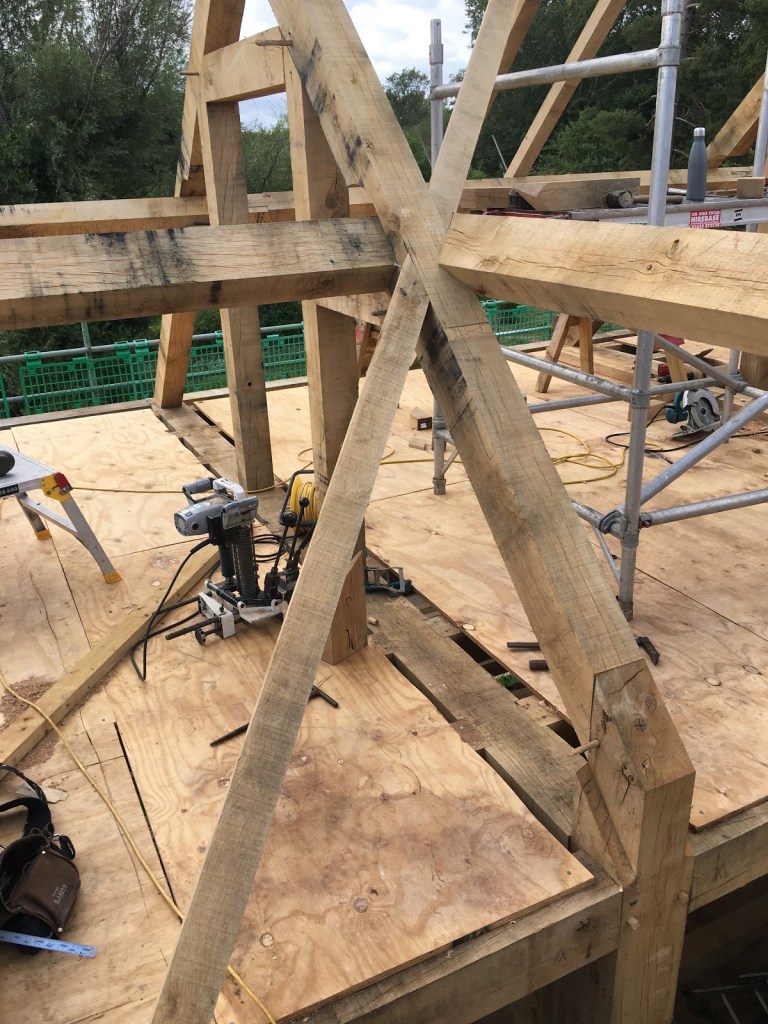
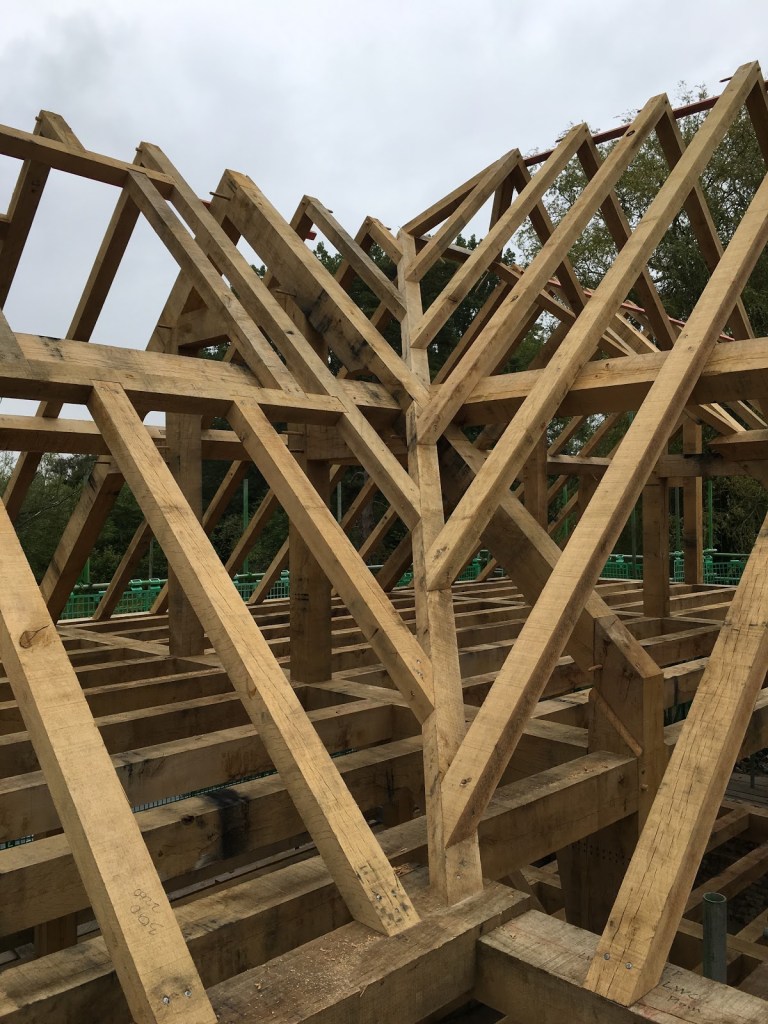
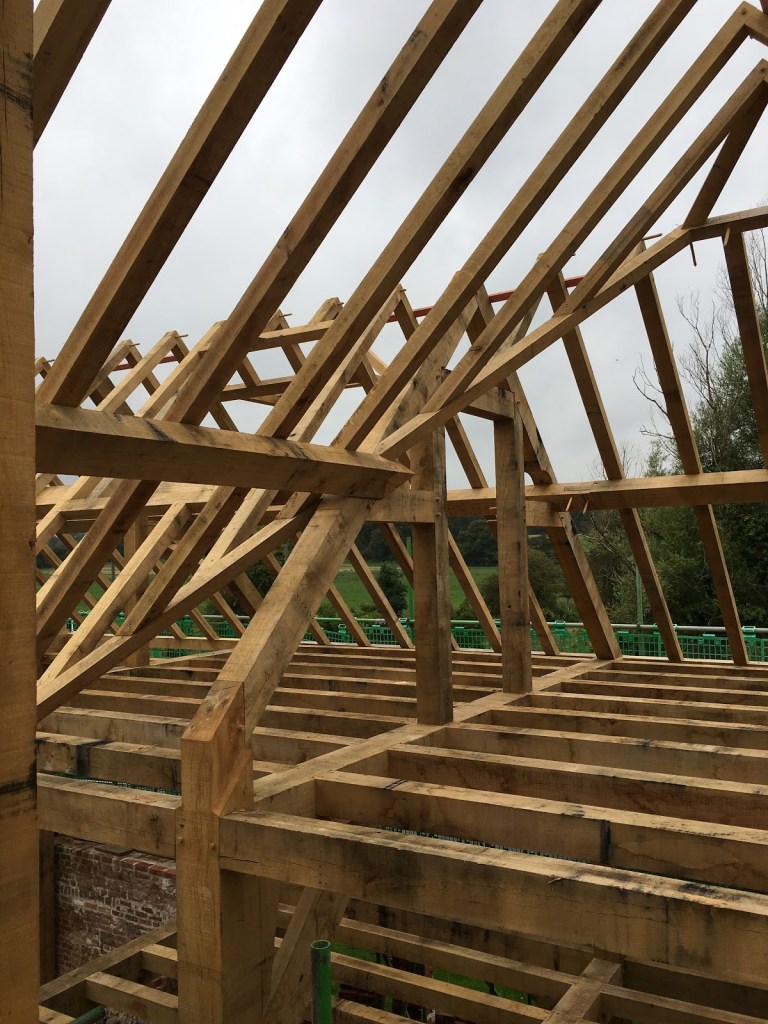
What I aim to show in this article is how we framed out the roof for this humble watermill project, in particular the two valleys – areas of the project I was directly involved in. Some of the elements are complicated so I have included photographs and drawings to aid in visualizing.

Recap

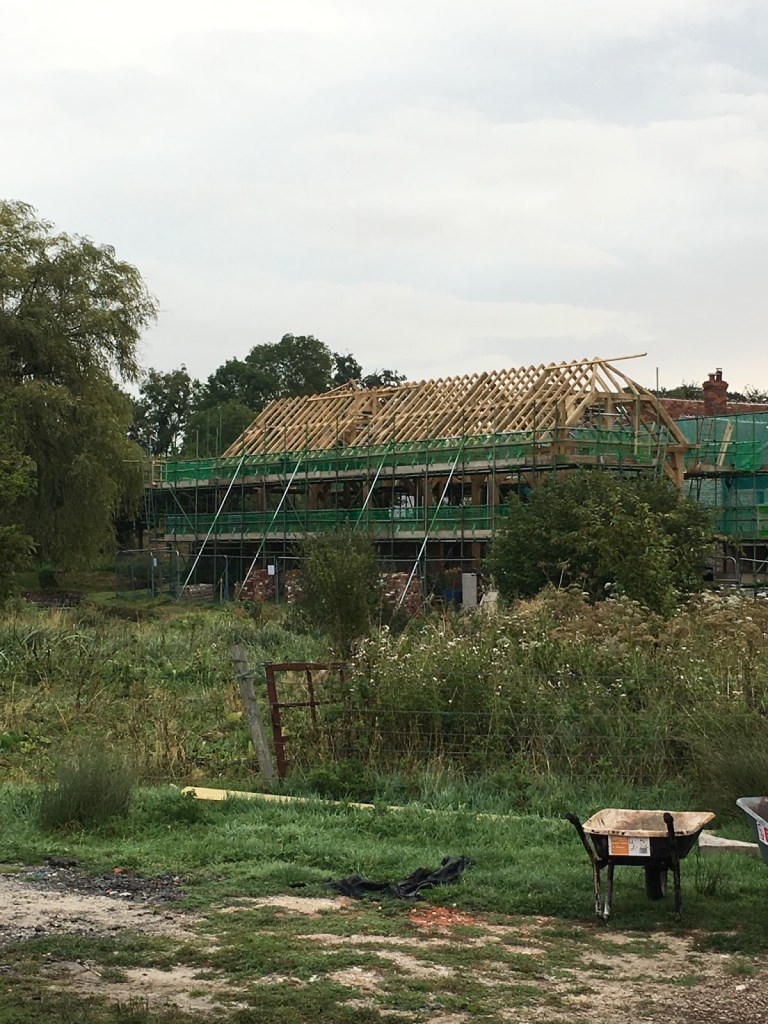
The reconstruction of this watermill was undertaken in two phases. The majority of the main house (with one side along the river Test) and the original watermill structure were destroyed by fire in 2018. In the aftermath of the fire the main house building had been repaired by a contractor, leaving us the bare bones of the original mill on the other side of the river to reconstruct. The main contractor had left us an exposed gable end on the already restored house to connect our frame to the existing dwelling. This was achieved via a small link building at right angles to the mill and ultimately spanning the river. 

Pre-cutting

We cut as many components as possible in the workshop, either from drawings or by standing the roof components up in the shop and working directly from them. In the long run this way reduces expensive site assembly time and it’s generally easier to complete the work in the comfort of the workshop protected from the English weather. On this occasion however, it wasn’t practical to pre-cut everything in the workshop because of the many unknowns, the impending assembly date, and the high risk of critical components not fitting correctly at the job site.

Ultimately the two buildings did not end up square to each other creating a sort of crushed box geometry effect in the roof that joined the structures. While not a problem in itself, this unusual geometry complicated matters a bit. Small variations made what should be even and regular roofing lengths and bevels suddenly slightly irregular, amplifying small discrepancies over distance. 

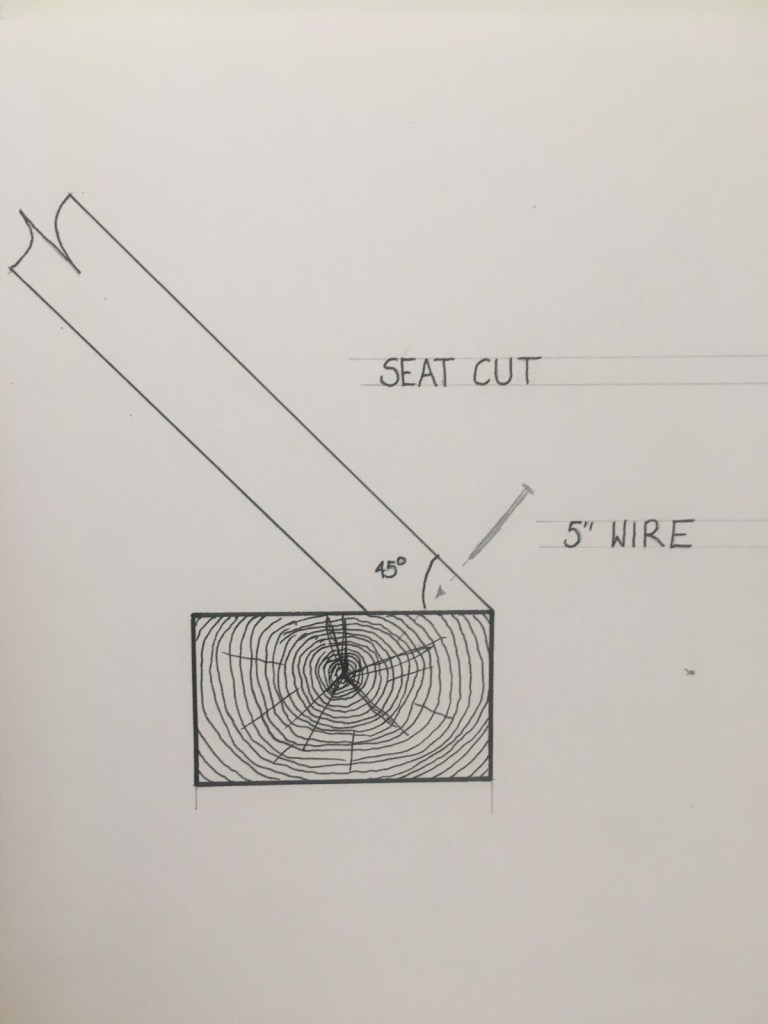
My team cut the simple common rafter pairs in the workshop. They were joined at the apex using a pegged bridle joint (see sketch below) with the seat cuts pre-cut based on measurements taken from our drawings. We also pre-cut the bridle connections at rafters that either met a valley, or formed an opening for a rooflight or dormer, but left long them long and trimmed to final length on-site.

A sketch of a bridled common rafter. Essentially an open ended tenon and mortice, this joint performs well in compression as the weight of the roof on each side pushes the two parts together. Both the tenon and mortice are one third the width of the timber and pegged together.
A seat cut on a common rafter.

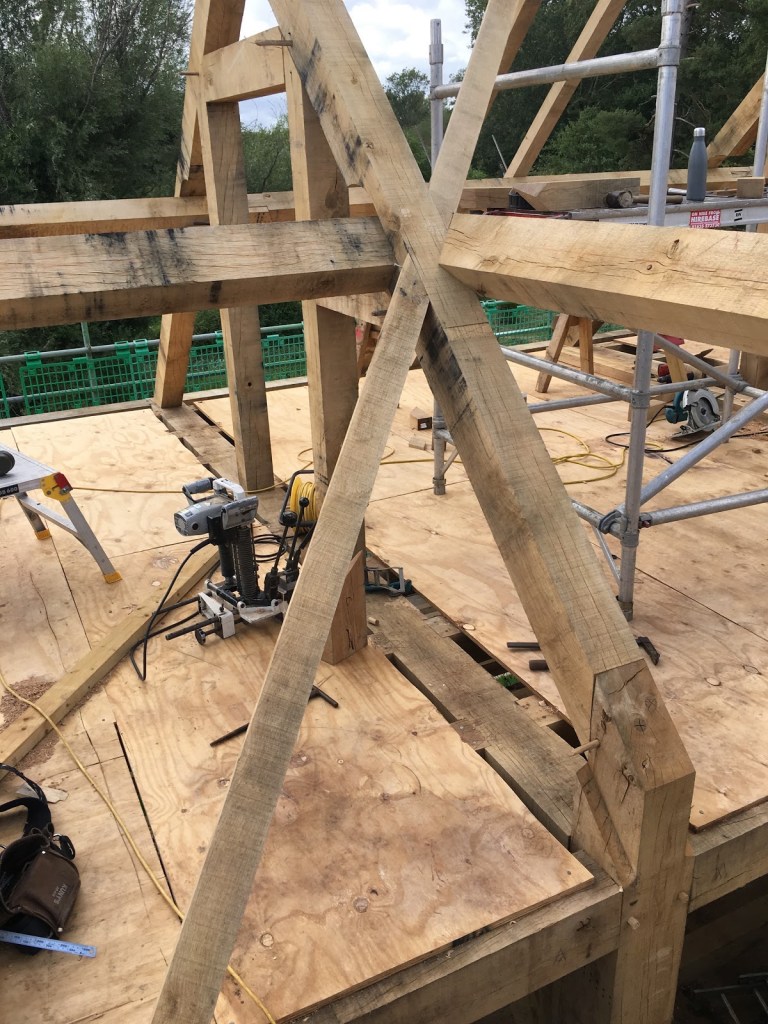
With the structural frame assembled, two members of the team set to work fitting, pegging, and nailing in place the standard common rafter pairs whilst I and another worked on the purlin returns and the valleys. When the framing of these elements were completed we were joined by another colleague, Jamie, who framed out the hipped gable end, dormer and rooflights.

Purlin Returns   

Definition of a Purlin – “Horizontal beams supported by the trusses between the ridge and the wall plate that carry the common rafters” Corkhill, T., 1979. A Glossary Of Wood. London: Stobart Davies, pp.431,432.

In the run-up to this job I held an interim leadership role – this watermill was one of the first jobs I had overall responsibility for, and to date one of the largest roofs I have worked on. From the instant I first saw the drawings I realized these purlin returns would be one of the more difficult elements. 

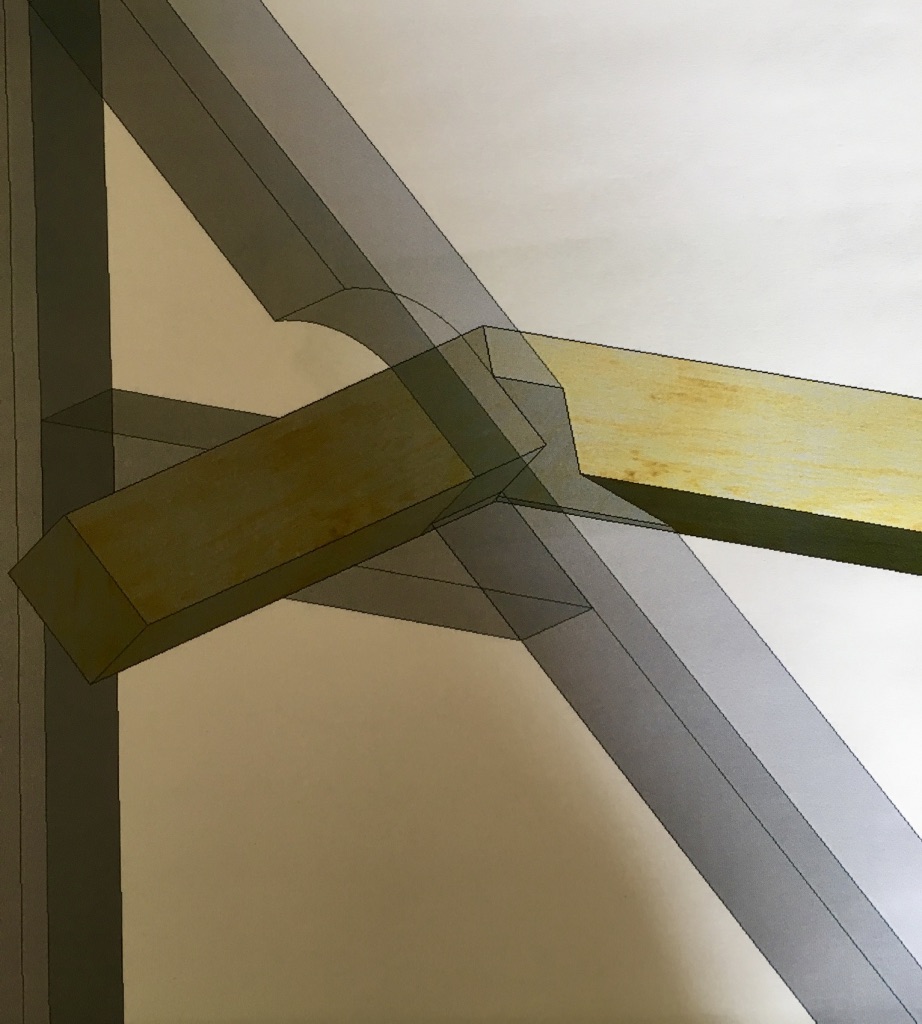
One of the more unusual things of note about the way in which the purlins are framed is that they are clasped between the underside of the principal rafter and a short tie. This method was often traditionally applied on trusses with smaller sections where the size of the principal rafter would decrease above the purlin. However in this case we cut a scallop (seen in the rendering above) to allow the purlin to be rolled into it’s housing after the trusses were in position.

The purlins are positioned at the same elevation around the whole building, which means that at the intersection of the link and the main frame one returns into the other and wraps around a principal rafter, throwing up the slightly odd compound cut shown in the rendering above. Ordinarily purlin returns can be tricky enough to get right, they often result in either a mitered cut or one notching around the other. 

With the help of our draftsman and my roofing square I made a test piece to take to site to aid in tweaking the final fit where necessary.  

On site after some careful measuring, test fitting and a little adjustment we got the returns installed.

Valley Rafters

The next step in the process was to pitch the valley rafters. On each side there was a lower and an upper rafter. The lower one was relatively straight forward, springing from the top plate (or wall plate) and striking the side of the principal rafter. However the upper sections were a different kettle of fish.

Here you can see the upper and lower valley rafters in place.

Where the valley struck the purlin a complex cut wrapping around the top arris of the purlin was necessary (shown below) before striking onto the side of the principle rafter. This took a little bit of trial and error, but with my colleague Dom’s assistance in figuring out a couple of the bevels, we got them cut and fitted with satisfying results.

Jack Rafters 

Definition of a Plane – “A flat surface; one in which any two points lying on the surface may be joined by a straight line lying on the surface” Corkhill, T., 1979. A Glossary Of Wood. London: Stobart Davies Ltd, p.411.

Definition of a Layboard – A layboard is a board of timber fixed to the rafters of one pitched roof to take the feet of the jack rafters of an adjoining roof.

Once all the head scratching over complexities was out of the way it was onto cutting the jack rafters to length. You may notice that the above photograph of the two valleys shows them sitting in the plane of the main roof similar to a ‘layboard.’

A design like this has few advantages for cutting the feet of jack rafters. On one side of the roof the cuts are beveled across the face and square on edge making them simple to cut. And on the adjoining roof there is again a beveled cut on the face but with a seat cut angle on edge. Whilst one carpenter trimmed out for the rooflight window, two others set about cutting and fitting the jacks to the left of the valley. As this was progressing I concentrated on determining the lengths for the right hand side and cutting the pairs on the adjoining link building. Once cut, the rafter pairs were raised one by one and nailed off. We used galvanized wire nails where they would be concealed from view (bright steel corrodes badly with the high tannin content in green oak). And where visible we used tapered rosehead nails for a more decorative finish.     

Once completed we stood back and admired the work. Everyone involved put in a great deal of time, care and effort to ensure this frame was both structurally sound and looked the part. Leaving nothing behind but a hand-jointed timber framed building of this sort of size and quality was very satisfying.

I hope my Gentle Readers have gained some insight into the basics of how traditional timber-framed structures like this are built, and how, despite using more modern techniques to do the “grunt work,” the ways in which these buildings are constructed has remained fairly unchanged throughout the generations. 

Gavin Sollars

If you have questions or would like to learn more about our tools, please use the questions form located immediately below. Please share your insights and comments with everyone in the form located further below labeled “Post Comment.” We aren’t evil Google, incompetent facebook, or sneaky data miners and so won’t sell, share, or profitably “misplace” your information. No sir.

← Back

Thank you for your response. ✨

Other Posts in Timber Frame Water Mill Reconstruction Project Series

  .

The Japanese Gennou & Handle Part 10 – Laminated Gennou Heads

Fast is fine, but accuracy is everything.     

Wyatt Earp
This image has an empty alt attribute; its file name is kosaburotansetsugennou.jpg
This image has an empty alt attribute; its file name is kosaburotansetsumei.jpeg
A modern-style (post 1890’s) gennou with high-carbon steel faces forge-welded to a soft jigane (low-carbon/no-carbon) iron body. You can see the difference in color between the soft jigane body and the hard high-carbon steel faces. This laminated construction was commonly used in Japan before inexpensive steel imported from England became available. The finish is hand-filed, and the blacksmith’s name, “Kosaburo,” meaning the “happy third son,” is hand-engraved. A high-quality gennou head is truly a lifetime tool. In fact, I have used this head hard as a professional and hobbyist for over 35 years, as you can tell from the dings and light corrosion. The handle is made from Japanese kurogaki wood (black persimmon, ebony genus), a rare variety valued for high-end cabinetry and casework in Japan. Kosaburo’s eyes are always as close to perfect as a man can forge them by hand, and better than all but a few expensive machines can manage.

n the previous post in this series we talked about the difference between mass-produced and hand-forged gennou heads. In this post we will take a look at a more antique style of gennou head.

A Laminated Gennou Head

Prior to the advent of inexpensive steel imported from England, gennou had bodies forged of soft low/no-carbon steel with wafers of hard, high-carbon steel forge-welded to each face. The shiny strips called “Hachimaki,” meaning “ headband,” polished onto the sides of the ends of genno heads sold nowadays, while purely decorative, are vestiges of this old-timey method.

The photos above are of a laminated gennou head hand-forged by Kosaburo which came to me long ago as payment for a debt. Laminated gennou heads made this way are still available today at exorbitant prices. I understand Hiroki occasionally makes a few.

Some believe the combination of hard face and soft body produces a softer impact and less vibration making the gennou less tiring to use. Others prefer the slightly different sound they imagine a laminated gennou head makes. I have used this laminated Kosaburo head for many years, and while I am very fond of it, I cannot detect any advantage to its laminated construction.

While laminated gennou are much more expensive, the blacksmiths I have spoken with have told me that they are significantly easier to make than one-piece high-carbon steel gennou since they do not require the more difficult differential hardening process. And they all agree that laminated construction provides no practical advantage to the end user. A curio in other words. Nothing wrong with that so long as one’s expectations are calibrated accordingly.

If you are just getting started in woodworking, or are on a tight budget, a quality mass-produced gennou head will do the job if you clean up the eye and replace the handle with one that fits your body.

Better yet, buy a hand-forged head by Hiroki or Kosaburo and make your own handle in the best craftsman tradition, and take pride in a custom tool of the highest possible quality that will serve you well for your entire life.

However, if you have the budget and enjoy collecting traditional tools, then by all means try a laminated gennou head. They are not easy to find nowadays.

YMHOS

The following link is to a folder containing pricelists and photos of most of our products. If you have questions or would like to learn more, please use the form located immediately below titled “Contact Us.”

Please share your insights and comments with everyone by using the form located further below labeled “Leave a Reply.” We aren’t evil Google, fascist facebook, thuggish Twitter, or a US Congressman’s Chinese girlfriend and so won’t sell, share, or profitably “misplace” your information. May ice cream forever taste like burnt rubber if I lie.

Toolchests Part 9 – Trays

The top 2 trays. Each tray has 4 brass flush ring-pulls (2 on the front and 2 on the back) installed to help move the trays forward and backwards.

It’s the job that’s never started as takes longest to finish.

J.R.R. Tolkien, The Lord of the Rings

In the previous post in this series we looked at the the lid of your humble servant’s toolchest, and the tools mounted inside it. In this post I intend to liven things up with an exciting discussion about trays! Be still my heart!

The Trays

Item No. 4 in the Performance Criteria list in Part 5 of this series is as follows:

“Tool Access: Tools used regularly are to be easily and quickly accessible without bending over or moving trays around.”

This was a critical factor in my mind, but one traditional toolchest designs often do not satisfy, so I had to get creative: always a dangerous thing.

The logic for this criteria is simple: Bending down and pawing through a jumbled toolchest is both unpleasant, inefficient, and distracting at a time when concentration is important. Shifting trays hither and thither every time a tool is needed is irritating and wasteful too. In addition, knees and backs do not last forever, no matter what we imagine when we are young, so a lot of bending is not acceptable. Therefore, contrary to some toolchest doctrine promulgated nowadays, the solution I struck on was for the tools I use regularly to be either mounted in plain view in the lid, or contained in exposed trays as wide as the chest’s internal dimensions would permit.

With the lid open, the top tray positioned to the rear, and the second tray positioned to the front as shown in the photo above, the tools I use most are all positioned front and center so I can quickly locate, extract and replace most of them one-handed without bending over, shuffling trays, or digging around. Maximizing the width of the trays and visibility of their contents was therefore of prime importance. Tool access is faster than any other “tool storage system” I have used besides exposed pegboard and open shelves, inefficient storage methods that do not provide adequate protection for my tools without a climate controlled environment.

A rough cross-section sketch of the toolchest. Skirt and rolling base are not shown. Dimensions are only approximate.

The design includes three trays each dimensioned to half the chest’s internal width. All three trays differ in depth to accommodate specific tools and to leave adequate space in the lower dungeon for larger tools and chisel boxes.

The four corners are dovetailed and bottoms are twin frame-and-panel construction. Three panels might be better, and would certainly be luckier, being an odd number of course, but two is OK. Just where did my lucky fuzzy dice run off to….?

Unlike many traditional toolchests, but true to the British design that inspired it, I did not mount saws, chisels, screwdrivers or anything at all to the inside of the toolchest’s front wall, so the trays are the maximum width possible with nothing obstructing travel backwards or forwards.

This decision came from my strong dislike, for the three reasons listed in the previous post in this series, of storing sharp or pointy tools in a situation where I might cut myself on them while trying to dig out another tool. Run your wrist over the edge of a chisel or your knuckles along the edge of a saw just once and you will understand. The current mounting system places these tools in plain view with edges protected. I also find mounting tools to the front wall of the carcass to be an inefficient use of space. You will need to do the math yourself, but whatever you decide, please don’t let your chisels bite you!

The Top Tray

This image has an empty alt attribute; its file name is fSTwgaY60cjUsj6lktEF7KBfvPYdJaF4yLt16c4IujHS88rexvo9z-96vKQyan21jbQPsAn_IIAMYOrjAmYLlK_D58CoSKLMUTwRVPboq4huNHxIUGSR9UbxXL3aShGNNV6LoAU
In this photo the top tray is in the rearward position and the second tray in the forward position. All the tools in both trays and inside the lid are easily and quickly accessible with one hand and without bending over.

The top tray contains more of the tools I use all the time, including precision straightedges, layout tools, more hammers, inkpot, scrapers, jigs, odds and sods. The shallow depth of this tray is intentional.

Despite appearances, it is not a rat’s nest: I know exactly where every single tool is located. I believe excessive tidiness to be a mental illness people of intelligence should vigorously eschew.

“If a cluttered desk is a sign of a cluttered mind, of what, then, is an empty desk a sign?” – Albert Einstein
View of the empty top tray angled forward, showing the frame & panel bottom. The middle tray is pulled forward. The plane in the foreground with the blue belt is a special kiwaganna rabbit plane with fence and nicker blade I use a lot.

Middle Tray

View of the top tray’s frame and panel bottom. Gravity has caused the brass flush ring-pulls to flop out of their rest position. Each tray has four such ring pulls installed. The second tray is in the forward position and stuffed with 13 planes.

With the sawtill removed and placed nearby to serve as an independent toolchest dedicated to saws, the second tray normally resides in the forward position so I can see and access all the tools in the lid, the first tray, and this middle tray without moving anything. I will present the sawtill to you in a future post

As you can see, this tray contains 13 planes, (I like planes and use them a lot), including a 48mm mame plane, 60mm, 65mm, and 70mm hiraganna, LN rabbet block plane w/nicker, and an LN skewed rabbet plane. Molding planes are stored in a separate chest of drawers.

Japanese planes are more compact than their Western counterparts, as Gentle Reader no doubt observed. I haven’t calculated the necessary volume, but it is certain 13 Bailey-style planes would not fit in the same space, and the weight would be triple.

Third Tray

The third and lowest tray is deeper than the other two, and contains heavier and larger tools I don’t use as often, or tools I remove once at the beginning of a woodworking session and leave out all day.

You can see a Lie-Nielson No.6 and No.7, and scrub plane. I also have twist drill bits, two digital vernier calipers, spokeshaves, various jigs, a precision bevel square, two 80mm planes, shoulder planes, two kiwaganna planes (skewed rabbet planes), an adjustable 45° chamfer plane, etc. stored in this tray.

Thank you for your patience so far with this lengthy show-and-tell. In the next post we’ll peek into the toolchest’s dungeon to see what shall see. Rusty chains and moldy bones, perhaps? Please stay tuned.

YMHOS

If you have questions or would like to learn more about our tools, please click the see the “Pricelist” link here or at the top of the page and use the “Contact Us” form located immediately below.

Please share your insights and comments with everyone in the form located further below labeled “Leave a Reply.” We aren’t evil Google, fascist facebook, or thuggish Twitter and so won’t sell, share, or profitably “misplace” your information. If I lie may my chisels make me leak sticky red stuff.

The Japanese Gennou & Handle Part 9 – Mass-produced vs. Hand-forged

The gentle reader will never, never know what a consummate ass he can become until he goes abroad. I speak now, of course, in the supposition that the gentle reader has not been abroad, and therefore is not already a consummate ass. If the case be otherwise, I beg his pardon and extend to him the cordial hand of fellowship and call him brother. I shall always delight to meet an ass after my own heart when I have finished my travels.

Mark Twain, The Innocents Abroad

n the previous post in this series we discussed the various styles of gennou heads you might consider when planning a custom-made gennou that fits your body perfectly, as well as the range of weights for each application.

While one has few options besides either using a mass-produced head or making one yourself nowadays, in Japan there are still one or two overworked blacksmiths that specialize in hand-forging high-quality gennou hammer heads. In this post we will compare mass-produced heads and hand-forged heads to help you make an informed decision.

Comparing Mass-produced Heads to High-quality Hand-forged Heads

When selecting a gennou head you have the choice of a mass-produced gennou (usually with a handle attached) or a handmade gennou head without a handle, if you can find one. Lets examine the differences.

Mass-produced genno are readily available, relatively inexpensive and for the most part, entirely useable. However, as with any product, it is wise to inspect a gennou carefully before purchasing it, as discussed in a previous post in this series, or to at least buy from a retailer with a solid return policy. When purchasing any gennou, check to make sure the eye’s walls are clean, it’s centered in the head, and not skewed.

The practical advantages of a hand-forged gennou hammer head over a mass-produced factory head are as follows:

  1. Proper differential hardness;
  2. Precise eye placement and alignment;
  3. Uniform interior dimensions of the eye, resulting in time saved and aggravation avoided when fitting/refitting a handle;
  4. Faces are square with the long axis of the head;
  5. Improved Performance due to more uniform distribution of mass providing improved stability during the swing with fewer wiggles, more solid strikes, and fewer off-center hits.
  6. Unique appearance and pride of ownership.

Let’s examine these points in more detail next.

Heat Treatment

Most Gentle Readers will have never given this matter any thought, but the quality of the heat treatment matters… a lot. This is a chemical/crystalline property impossible to confirm long-distance, so we must rely on the manufacturer, be it factory or blacksmith, to get right. Therefore, the manufacturer’s QC reputation as well as the retailer’s guarantee also matters.

A good head will be hard at the faces, becoming gradually softer towards the eye, certainly softer than a file, to make the head “tougher,” using the materials engineering term, and to reduce resonant harmonic vibrations. If you have used hammers with uniformly hard heads and integral steel handles you have felt this tiring vibration before.

The faces must be hard, around 50~55Rc, to prevent deformation, but not so hard the hammer will chip or crack. You may think that wooden chisel handles could not deform a steel hammer face, but if the striking faces are not properly hardened, they will mushroom sure as eggses is eggses, something your humble servant learned when he made a gennou head for himself from unhardened octagonal steel bar stock back when dinosaurs roamed the earth.

It’s interesting to note that the handle I made while residing in a cave (no plumbing!) was straight, unlike the handles your humble servant currently advocates, and that the lower 1/3rd of the face (closest to the hand) mushroomed, while the upper 2/3rds did not deform at all. Curious….

This was the first time I really noticed that the head of a hammer with a straight handle attached perpendicular to the head’s centerline tends to hit the chisel/nail cocked and not in-line with the long axis of the chisel/nail. I also realized that the direction of deformation of the head’s steel indicated a lot of energy was being wasted by my straight handle. I hope you can see why the solution the anaya carpenters of Japan developed so long ago resonated with me so strongly.

But what happens if the heat treatment results in a head that is too hard? In this case, while the head and faces may not deform, the face may chip and the entire head may fracture, sometimes even causing embarrassing leakage of sticky red stuff (or at least that’s what the product liability lawyers assert).

A word to the wise: always use properly heat-treated hammers and wear safety glasses when pounding nails, adding nitric acid to highball cocktails, or when writing your name on your forehead with ballpoint pen after losing a tequila shot contest.

Precision of the Eye

Gentle Readers may think it passing strange that your most humble and obedient servant is seemingly fixated on the precision of something as boring as the hole in a hammer’s head. Rest assured, this concern is not a fever dream resulting from an obsessive/compulsive over-analysis of negative space, but was born of bitter experience. My new therapist concurs.

Of all handtools, the hammer is one of the simplest. But is also the one that moves the fastest and is most influenced by dynamic physics. Things like concentricity, center of gravity, and moment of inertia make a difference to an object moving this quickly, then suddenly slowed by an impact with a chisel or nail, and then returned to battery for another blow faster than you can say “ouch.” Negative spaces like holes influence the physics, and therefore the stability, of hammer heads. Don’t make me inflict you with differential equations, just take my word the hole needs to be centered, not skewed, and of uniform size or the hammer will be skittish resulting in twisted mortise holes, bent nails, and maybe even smashed thumbs.

Another advantage of a well-made gennou head is that its eye will have uniform interior dimensions. We talked about this in an earlier post. In summary, all four walls will be straight, clean, flat, free of wind, parallel and square to each other. This matters because a sloppy eye will not apply uniform pressure on the handle’s tenon, ensuring it will come loose sooner than later. In addition, this uneven pressure may also induce unwanted vibrations in the handle. I kid thee not.

Nothing can be done to economically renovate an offset, misaligned or skewampus eye, but if it’s just rough or sloppily forged, it may be possible to improve it using small files while ruining one’s vision (not an exaggeration).

Depending on the degree of error, correcting the inside walls of that tiny hole in a steel head with skinny files and a flashlight can be frustrating work and may even help your therapist buy that new bimini top he wants for his fishing boat. You see, most people make the problems worse the first time they try to correct them. I know I did.

If you count your time worth anything, the extra cost of a precision eye is money well spent, and certainly cheaper than the price of a Rolex for your therapist’s girlfriend.

This image has an empty alt attribute; its file name is kosaburotansetsugennou.jpg
A “Modern”style hand-forged gennou head by Hasegawa Kosaburo. This head is of antique construction with high-carbon steel wafers forge-welded to both striking faces of the softish iron body. Prior to the importation from Europe of cheap steel to Japan, all gennou had this laminated construction. I have been using this head for over 35 years. I think this is its third handle (black persimmon wood).
This image has an empty alt attribute; its file name is gennou.jpg
A standard hardware store mass-produced gennou made by a large corporation and sold everywhere in Japan. The eye is sloppy, so the head is secured with steel wedges. The handle is tapered towards the eye to compensate for and conceal dimensional irregularities. Of course, this hammer can hit stuff just fine, but it will never feel right, the head will loosen much sooner than later, and it will be impossible to adequately repair. A decidedly unprofessional, disposable tool.

Precision of the Face

Let’s move on to item 4 “Faces are square with the long axis of the head.” The striking faces of mass-produced hammer heads are often not square with the head’s axis (i.e. manufactured 90˚ to the head’s longitudinal axis) resulting most obviously in bent nails, but the less obvious consequence is that energy we intended to transmit directly to the chisel and into the workpiece ends up being wasted as heat and violent twerking of the chisel out of alignment. It also wastes time and undermines the user’s confidence, once again providing a windfall to head doctors everywhere.

A precisely manufactured face square to the tool’s centerline will yield better static performance and more precise chisel work and nail bashing than a mass-produced head ever can.

The hammer that is stable during the swing and makes a solid impact exactly where you aimed it without producing strange vibrations, wasting energy or bending nails, will help you make every strike with confidence and greater control, and will make your woodworking more enjoyable and profitable. Not insignificant benefits.

Improved Dynamic Performance

In addition to the advantages described in the previous paragraph, a hand-forged head, if made correctly, will be more stable during the swing, and wiggle less upon impact because its mass is more uniformly distributed. This means fewer misses and more energy transmission on impact. And that’s the whole purpose of a hammer, right?

A hammer made using a good head and a handle made to fit both that head and your body will perform better than any tool you have experienced before. You won’t need to look when you pick it up to tell which face (or claw/vs face) is oriented towards the nail/chisel because your fingers will know instantly. The handle will fit your hand perfectly without slipping or causing blisters or needing to be “choked-up on.” Without looking at your hammer you will be able to sense beforehand exactly where the center of its face will strike, and will be able to hit the target dead-center and squarely even with your eyes closed.

Appearance and Pride of Ownership

And finally, let’s examine the more ephemeral item 5: “Unique appearance and pride of ownership.” I have mentioned it elsewhere before, but it is a fact that, no matter how much they may deny it, humans are competitive herd of beasties in all endeavors.

As a day job your humble servant manages construction projects in Japan and spends a lot of time inspecting jobsites, meeting with construction companies and speaking with craftsmen. Indeed, there was a time when I was labor instead of management on construction jobsites, so I have enough experience to know that, while some professional woodworkers may not read those glossy fashion magazines with titles like “Amazing New Toolbag Design that Will Lift and Shape Your Butt” during coffee breaks, or wear sleek, handmade calf-skin steel-toe Italian footwear during the workday, they are conscious of their personal performance, and the performance of their tools, in comparison to those of their peers. It’s a guy thing, something women think they understand because they have similar tendencies in other areas, but rarely do. This performance is difficult to ascertain unless one is working side by side with one’s peers, so it is human nature to make indirect judgements about performance by observing the quality and condition of a fellow worker’s tools.

Of course, one casually notices the brand of chisel or plane a fellow craftsman is using. Next, if it can be done without being rude (sometimes a difficult thing to accomplish), one examines the fellow workman’s tool’s cutting edge and its sharpness because this tells much about his character and skill (chisels are terrible gossips, you see). Such a close examination may not be possible, but one can usually examine the finish left by his plane and crispness and precision of his chisel cuts.

But more than plane or chisel, the tool that is always visible to others during the workday is the craftsman’s hammer comprised of the head forged by the blacksmith, and the handle made by the craftsman himself. The quality of this combination tells Japanese craftsmen much about the man that owns and uses the tool. A hand-forged head by Kosaburo or Hiroki with a graceful, professional-grade handle made by the owner, even if it is dinged through years of hard use, will be noticed by those with eyes to see for decades, even generations.

Among the Japanese professional woodworkers your humble servant knows well, most of whom are sorting boards in the big lumberyard in the sky nowadays, a highly-decorated expensive gennou head is thought to be a gaudy, obvious plea for attention in poor taste, akin to wearing a sequined, high-visibility safety suit of fluorescent purple silk with Jimmy Choo 8″ gold-plated steel-toe stilettos to the hardware store (best saved for the New Years party anyway, you sexy beast).

A plain head by Hiroki or Kosaburo, on the other hand, is understated, tasteful evidence of a serious craftsman that appreciates tradition and places quality first. Very much a wabi sabi kinda thing.

And finally, a quality hand-forged head is a lifetime tool, one that won’t wear out or break. The handle may be damaged and wear out over time and need to be replaced, but such wear and tear is unavoidable if the tool is actually used, like a good pair of workboots. But the handle made for a quality head will last longer and be much much easier and quicker to replace. To the professional focused on turning his time into money, this is not an insignificant consideration.

A mass-produced factory head, by comparison, simply won’t work as well. It is of course neither high-quality, unique, nor a lifetime heirloom tool. It isn’t pleasing to the owner’s eye nor impressive to his fellow workers. It is a consumable, expedient tool, the sort of thing a craftsman does not want himself to become.

Conclusion

A high-quality head combined with a handle that fits your body will accomplish more work more precisely with less mental concentration and physical effort. It will become a lifetime friend and a source of satisfaction boosting your confidence. It will be relatively easy to make replacement handles for during your lifetime, and those handles will stay tighter longer. It will tell those who see it that you are serious, no-nonsense craftsman who understands true quality and prefers understated elegance.

If you take pride in your tools, appreciate heirloom value, don’t want to waste time trying to rework sow’s ears into silk purses that smell piggy, and are not inclined to pay cashy money to psychiatrists to rummage around in your head, then a hand-forged gennou head is worth owning, in the opinion of your most humble and obedient servant.

In the next post in this shockingly fashionable adventure I will try to dispel some rumors about laminated gennou heads.

YMHOS

My newest gold lame safety shoes by JC. I must say they go really well with my dual-reel safety harness! What do you think about the steel-toe safety shoes shown above? Too severe?

The following link is to a folder containing pricelists and photos of most of our products. If you have questions or would like to learn more, please use the form located immediately below titled “Contact Us.”

Please share your insights and comments with everyone by using the form located further below labeled “Leave a Reply.” We aren’t evil Google, facist facebook, thuggish Twitter, or a US Congressman’s Chinese girlfriend and so won’t sell, share, or profitably “misplace” your information. May puppies all hate me if I lie.

Leave a comment

Toolchests Part 8 – Under the Lid

Even the smallest person can change the course of history.

Lady Galadriel – The Lord of the Rings

In previous posts in this series about toolchests, and your humble servant’s toolchest in particular, we looked at how the design was guided by performance criteria such as portability, tie-down and lifting, and pixie infestation prevention. In this post we will examine one solution to another performance criteria. Perhaps the solutions in this article will help you solidify your storage requirements.

Inside the Lid

Key Performance Criteria No.4 defined in Part 5 of this series is as follows:

Tool Access: Tools used frequently to be quick to locate and easy to remove and replace without bending, kneeling, or shifting trays around.

The solution I selected was to mount many of the tools I use most frequently inside the lid where they are in clear view and quickly accessible. This technique is one seen in historical examples, but as always, I wanted to do things a little bigger, a little better.

Alas, unbeknownst to me I had fallen prey to a sophistry that has afflicted many, indeed one that has destroyed entire civilizations and can be summarized as: “ if a little bit is good then too much must be excellent.”

I began the planning of this space with visions of Mr. Studley’s famous toolchest dancing in my head. The image in my mind was mahvelous dahling, simply mahvelous, but the conceptual drawing was only good. While I was distracted by my dreams, reality snuck up behind me, shot me in the head and dumped my virtual body in the river. The water was cold!

After a refreshing swim I realized my plan was too dense, too inflexible, too expensive, and most importantly, violated the unwritten performance criteria common to most human endeavors: “It must be finished in my lifetime.”

The compromise I arrived at is shown in this post. It is not perfect. You should not emulate it. But it is the fruit of trial and lots of error over many years and it works reliably.

A view of the inside of the toolchest’s lid with all the tools in residence. Please also notice the 5 heavy brass butt hinges, the sealing lip around the inside edge of the lid, and the brass chain to keep the lid from flopping open. The unusual wooden tool mounted nearly in the center is an unused, hand-carved Japanese inkpot called a “sumitsubo,” an excellent tool for snapping straight lines on wood. Its purpose here is purely decorative. My daily-use sumitsubo is the blue plastic widget located below the wooden sumitsubo; far more practical but not as traditional, sculptural or as propitious.

An obvious problem with mounting tools inside a lid is their rebellious desire to drop to the bottom of the chest when the lid is closed, especially if the petty pernicious pixies that sometimes skulk in the shadows of my workshop lend a claw.

To deal with this mischievous propensity, each tool’s mounting mechanism must retain the tool securely in place while the lid is opened, closed, and even while the toolchest is being moved around. At the same time, the mounting mechanism must be simple and quick to operate. This combination of security and speed is not as easy to accomplish as Gentle Reader might imagine because, well, tools can be naughty, and gravity is not our friend when the lid is closed. And pixies.

In the center of the picture is a favorite old Japanese screwdriver with a bulbous handle made from keyaki (zelkova wood). Behind it are mounted two Yankee screwdrivers of different lengths along with driver and Japanese-style gimlet bits. To the left, most of the wooden sumitsubo, secured to its mounting board by a leather thong, is visible. Under it you can see the fire-damaged end of the handle of a Millers Falls eggbeater. To the right is a set of expensive but dismal-quality oiirenomi (since replaced) and the handles of gennou hammers. Bits for the brace mounted behind the hammer handles are stored in the space behind the chisel blades. The sealing lip attached to the inside of the lid is visible just above the brass butt hinge. This is simply nailed in place to be easily replaced if damaged, but that has not been necessary yet.

So let’s examine the tools mounted inside the lid and how they are secured.

The upper third of the lid is dominated by two full-width parallel boards secured to both sides of the lid. These two boards have edge lips and matching notches. The left side holds 7 marking gauges of various lengths and types. Four of them are dual-blade mortise gauges (kamakebiki) made by Kinshiro. After placing a marking gauge in its designated set of slots, it is secured by extending the tool’s beam or blade upwards and locking it in place with its own adjusting screw. This mounting method has been entirely successful.

The right hand side of these parallel boards holds 8 hammers (gennou). The back-side of each notch and the surrounding lip is shaped to fit a specific hammer, and super-magnets help hold each hammer’s steel head in place.

The handles of the chisels mounted below also help to retain the hammers, as you can see from the photo. This is not a perfect solution, but it has not let me down so far.

The tools stored in the lid’s right-hand side spread out for your inspection. The 11 chisels are not shown.

The 11 chisels on the right side are held in place by friction between the chisel’s cone-shaped ferrules and the closely-fitted wood notches, and stay in place even when the lid is closed. But vibration can become a problem if I need to move the chest over a rough surface with the lid closed, so I wrap a rubber bungee cord around the chisel’s handles to keep them in their slots during jiggly transport.

The chisel’s cutting edges are oriented downward when the lid is open, close to the lid’s side (below) so that there is little danger of snagging a finger or wrist on the extremely sharp edges. I strongly dislike getting red sticky stuff all over my tools, and accordingly I disdain any storage system that leaves sharp cutting edges exposed.

Whatever chisel storage solution selected, I strongly urge Gentle Reader to ensure there is no opportunity for chisels to express their peckish nature for three reasons: First, 10 fingers are better than 9 (just ask Frodo); Second, red sticky stuff promotes rust; and Third, Murphy always has the last laugh. I promise you won’t like whatever gives that bloody bastard the giggles when chisels are involved.

A 10-pc set of Kiyohisa oiirenomi with white oak handles mounted inside the lid. I was deeply dissatisfied with the poor quality of these expensive chisels and have since replaced them with the higher-quality but much less expensive set with red oak handles shown in the next photo. A sokozarai chisel with a red oak handle is mounted to the far right of the row. An antique brace with rosewood fittings, as well as an old Starrett protractor head are mounted behind the chisels and gennou hammer handles

Behind the chisel and hammer handles, you can see my Starrett protractor head, and my father’s old Stanley brace with rosewood fittings. Bits are placed in tool wraps and stored in a compartment behind the chisel blades. Not easy to get at. I have thought about combining the chisel rack into a drawer to hold the bits, but have not done anything yet because I’m not sure it would be an improvement.

The tools mounted in the lid’s left-hand side are removed and displayed for your inspection. The zelkova wood sumitsubo hand-carved in the lucky turtle and stork pattern can be seen in profile with its ebony karuko needle and bamboo sumisashi marking stick below. The black plastic bottle with the blue and white lid at the far right contains ink for the sumitsubo.

On the left side, a Starrett 92 divider and two spring dividers are secured by a block screwed to the far left sidewall. Chastely closing the divider’s legs together pinches a screw head locking them securely in place. If you don’t already own a Starrett 92, you need to get one.

In this photo the sumitsubo is front and center. The tails of 6 marking gauges, 4 of which are dual-blade units by Kinshiro, can be seen in the rack above.

Behind the dividers, there are several steel rulers and a bevel gauge secured by a hook on top and retained by the Starrett 92’s arm. In the center are mounted 3 Matsui Precision stainless steel squares, a Starrett combo square, a Starrett adjustable mini square, and a thickness caliper.

I also mounted an unused hand-carved Zelkova-wood Japanese inkline/inkpot (墨壷 sumitsubo) with silk wadding in a central position of honor. While this is a practical tool, I mounted it there just as decoration and for good luck, as you can tell because the line is still blue and the silk wadding is still white. I have a more convenient sealed Shinwa-brand plastic sumitsubo stored in the top tray I use when I need to snap a line.

At the bottom of the lid I mounted an old Millers Falls eggbeater drill. I don’t recall the model number, but I purchased it used in Delaware, Ohio many moons ago. The cap on the handle was damaged by fire sometime before I bought it. It’s a handy a little guy, but nothing special.

On the left side of the center vertical divider are mounted 2 Yankee spiral screwdrivers, bits and gimlet blades, as well as an antique Japanese screwdriver with a polished steel shaft and a bulbous Zelkova wood handle. I am irrationally fond of this old tool.

I have tried different arrangements for mounting tools inside the lid over the years, and I will continue to improve it because I am confident the solution shown is not the best possible arrangement. It’s a difficult planning problem for two reasons. First, the tools in the lid are the most easily accessible and therefore must be ones I need all the time. Assigning priority and ease of access seems as easy as falling off a greasy log, but it isn’t. The Studley solutions to storing tools are amazing, but not really practical. Second, I need to be able to remove and store these tools quickly, but at the same time, they can’t be so heavy or so difficult to secure they fall out when the lid closes or opens. Once again, the conflict between safety and security is tricky to resolve.

Regarding priority, marking gauges and other layout tools see the highest frequency of use, followed by chisels, hammers, drills and screwdrivers. This priority is reflected in their location inside the lid, as you can see.

I don’t use the protractor head, brace or bits very often, so they are assigned a lower priority and reside behind the hammers and chisels. It takes time to remove them, but on the other hand, they would always be in the way if placed in the trays, which is more valuable real estate, so this is their home.

To hold the lid open and keep it from flopping back, I installed a brass toilet tank chain on the left side, and boxed out a space so it doesn’t hang up on tools. When the lid is closed, it automatically lays alongside the top tray. This chain was inexpensive, it’s strong, it will never rust, and it has never caused me a second of grief.

Well, that’s all for this post. Next time we’ll look at the trays. There will be planes. Oh joy!

YMHOS

If you have questions or would like to learn more about our tools, please click the “Pricelist” link here or at the top of the page and use the “Contact Us” form located immediately below.

Please share your insights and comments with everyone in the form located further below labeled “Leave a Reply.” We aren’t evil Google, fascist facebook, or thuggish Twitter and so won’t sell, share, or profitably “misplace” your information. If I lie may my toilet chain break and the lid crush my stupid head.