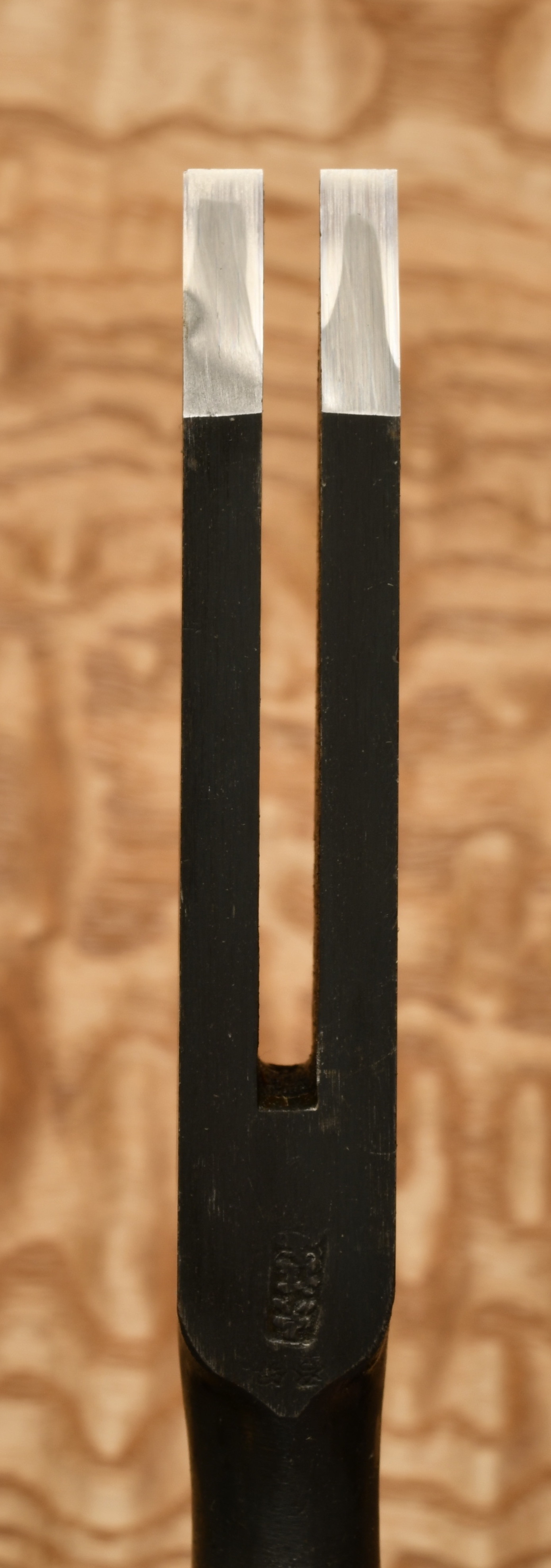
Sharpening Part 4 – ‘Nando and the Sword Sharpener

Billy Crystal in Fernando’s Hideaway

And this is from my heart
Which is deep inside my body:
It’s better to look good
Than to feel good

Fernando

This article is a little longer and more roundabout than your most humble and obedient servant’s previous posts, but I wanted to share with you some of Japan’s history, and examples of this country’s most fabulous practical art as produced by its blacksmiths and professional sharpeners as insight into the Japanese mindset regarding sharpening. But before I get into that, I would like to share some relevant words of wisdom from Hollywood’s wisest man.

The handsome gentleman in the picture above is Fernando (actually Billy Crystal). He is neither a blacksmith nor a sharpener of tools or weapons, but his insight into physical beauty and words of wisdom about happiness are pertinent to sharpening, as we shall see below. If you are not familiar with ‘Nando, I suggest you google him or view a video or two on NoobTube.

So what does this dapper Latin lover have to do with sharpening? And swords? Read on kind sir.

As ‘Nando taught the world, a wise person will not equate looking good with feeling good. Likewise, you would be wise to not confuse a blade’s appearance with its performance. Indeed, a blade that looks as sharp as the skinny end of nothing may not actually cut well in some applications.  A good example is Japanese swords. Let me tell you a true story to illustrate my point.

When I was a university student in Japan, I was privileged to be entrusted with a number of swords that belonged at the time to the late Dr. Walter Compton, Chairman of Miles Laboratories and the inventor of Alka-Seltzer. He was a wealthy man who had a huge collection of swords obtained while an officer for the US military in Japan immediately after the war when Allied forces required the defeated Japanese people, on pain of death, to surrender all swords, civilian and military. Of course, many valuable and rare family heirlooms were surrendered or forcefully confiscated. Supposedly they all went to the bottom of Tokyo Bay in bunches, or were melted for scrap. But we know better, don’t we.

Towards the end of his life, Dr. Compton put a lot of money into having his better swords professionally sharpened, new shirasaya scabbards and furniture made, and formally evaluated in preparation for donating them to the Boston Museum of Art, where many of them reside in obscurity today. Sadly, due to progressive dementia, some of his most valuable swords were auctioned off without his permission. “The feckless sons of wealthy men” is the operative phrase in this case, I fear.

I assisted Dr. Compton’s representative by transporting over 70 of these swords to and from Japan and performing the necessary legwork to accomplish these goals inside Japan. During those years I held in my hands and feasted my eyes on rare and beautiful blades of great historical value several of which would have easily been designated National Treasures if they had been intended to remain in Japan (“National Treasures” may not leave Japan). 

During those years I spent a lot of time meeting, questioning, and requesting services of the best sword sharpeners in Japan, learning much about swords, stones, and sharpening. Dr. Compton’s reputation was such, and his swords were of such rarity and high quality, that I had no difficulty persuading the very best craftsmen to work on them and speak with me, including a famous sword polisher named Mr. Okisato Fujishiro.
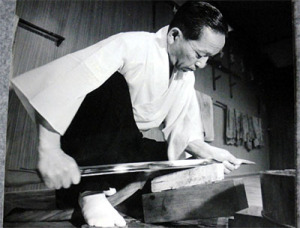
Interestingly, in Japan such craftsmen are called “Togishi” (研師), an unambiguous word that can only be translated as “sharpener.” However, in the West these same Japanese craftsmen are called “ Sword Polishers.” In the post-war context, this actually may be more accurate than the Japanese term. In a post-war world it’s certainly more politic.
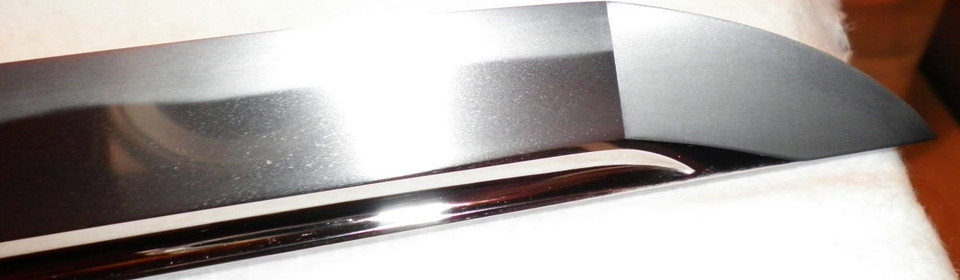
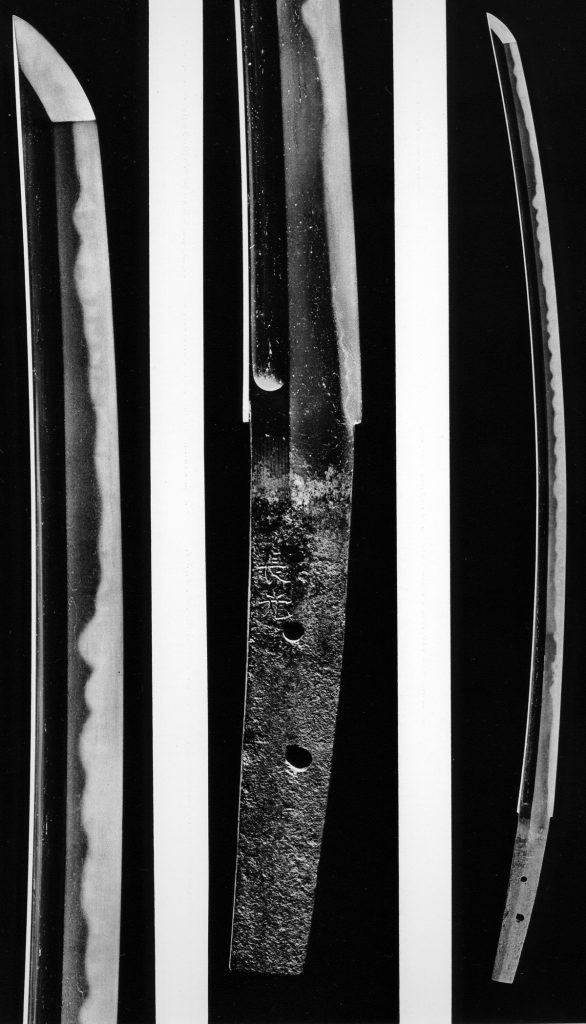
A very subtle, high quality sword tip brought to life by the arts of the Sword Sharpener. Notice the peaceful elegant hamon (wavy milky pattern at the cutting edge oriented towards the top of the photograph), the grain of the steel just below the hamon, and the burnished polish surrounding the fuller. Notice also the clean delineation where the blade tip, the “boshi,” begins. Very nice work.

Before the elimination of the caste system Japanese society had 4 main divisions labeled  “Shi No Ko Sho,” meaning, in descending order, Warrior (samurai), Farmer, Craftsman, and Merchant at the bottom. The Emperor, Court Nobles, and Shoguns were above these strata, although of the three, only the Shogun possessed any actual power because the man with the sword makes the rules, and those without weapons do as they are told and quickly, or they go away permanently. Thus it has always been because both fool and wise man leak red sticky stuff.

Blacksmiths and sword sharpeners were both in the craftsman caste, but curiously the sword sharpener was above the swordsmith in rank. Depending on their support among the warrior caste, and with the generous application of yellow metallic lubricant, both swordsmiths and sword sharpeners occasionally obtained noble rank, an honor to which few craftsmen, farmers, and merchants could aspire. My point is that sword sharpeners, while of relatively lower caste, often had a perceived rank higher than their craftsman position would suggest.

Why was the Japanese sword sharpener of higher effective rank than the swordsmith? I haven’t seen documentation from back in the day confirming it, but I suspect it is because the sharpener turns the swordsmith’s plain steel blade into a thing of jewel-like sculptural beauty that almost seems alive. One only has to see a sword blade fresh from the swordsmith’s shop and compare it with the same sword after the sharpener’s ministrations to understand.

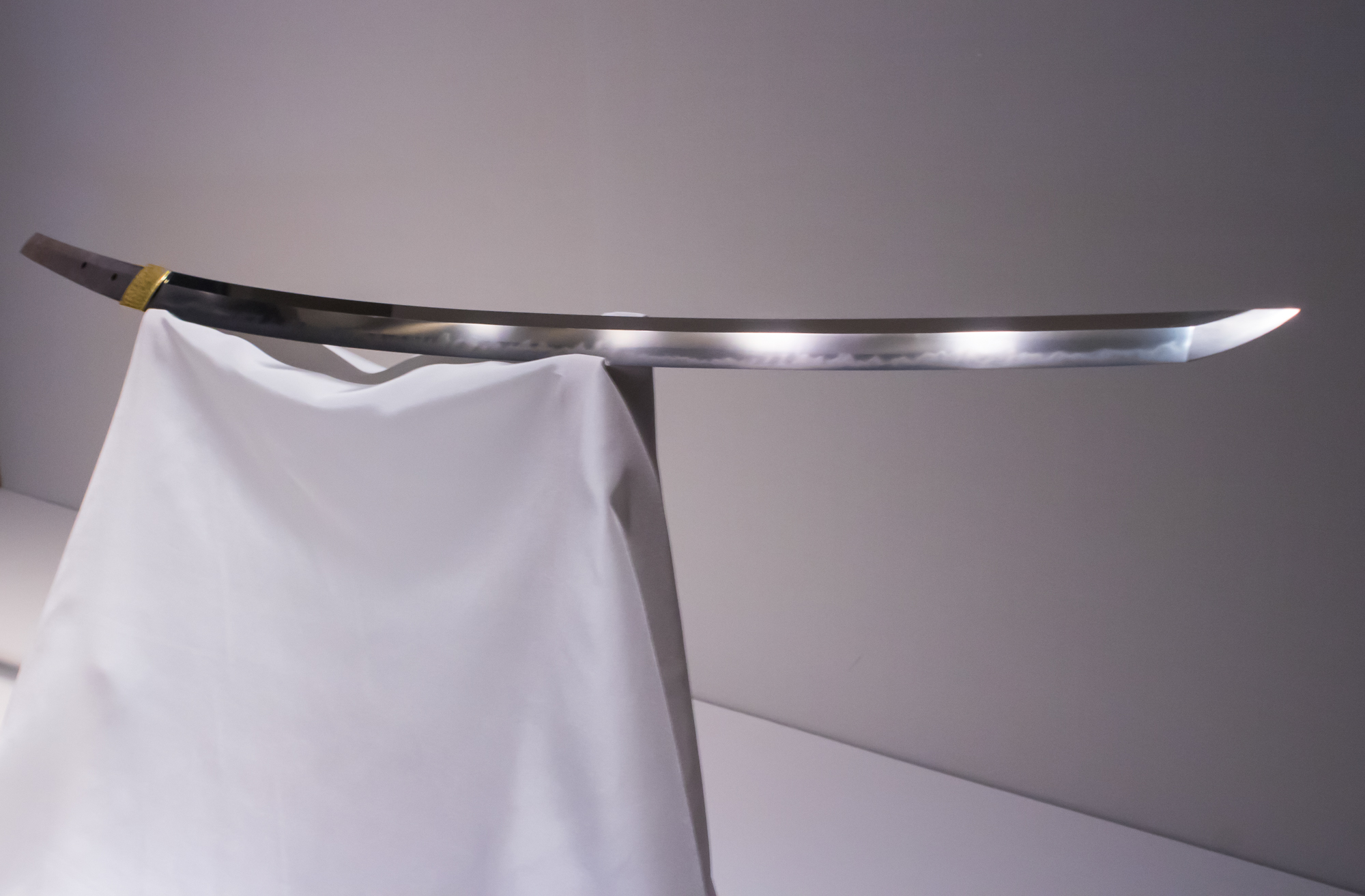
The Nikko Sukezane sword, a designated National Treasure of Japan
Related image
This sword is known as the “Nikko Sukezane,” Nikko for the temple commemorating the Shogun Tokugawa Ieyasu (徳川家康, January 31, 1543 – June 1, 1616) where it is stored, and Sukezane (助真 meaning “Aid the Truth) for the name of the smith who forged it for the Kamakura Shogunate (1185~1333). The blade’s shape and crystalline pattern above the hamon are characteristic of Sukezane’s work. This sword’s brother was in my care for about 2 years while it was being polished and appraised in Tokyo.
大般若長光-画像2
This sword is another of Japan’s National Treasures. It was forged by a swordsmith name Nagamitsu (長光)during the same time period as the Sukezane above. The tang (nakago) is corroded by exposure to bare hands over a period of around 700 years. Multiple holes were drilled in the tang to accommodate a variety of hilts during its lifetime. I also had a sword by this same smith and of very similar appearance in my care for about one year, although it was not owned by Dr. Compton.
A different Nagamitsu sword, also listed as a National Treasure. An unusually healthy example.

I have even witnessed a skilled sword sharpener create a beautiful hamon (a pattern formed on the edge of a sword by the steel’s crystalline structure) on a sword forged by a famous smith that had lost the crystalline structure necessary to form an actual hamon. While a deception of sorts, the intention was not to deceive for profit (the sword was donated to a museum), but to return an unusual and historically important sword to its former beauty, a glory that would have been lost but for the sword polisher’s exceptional skills.
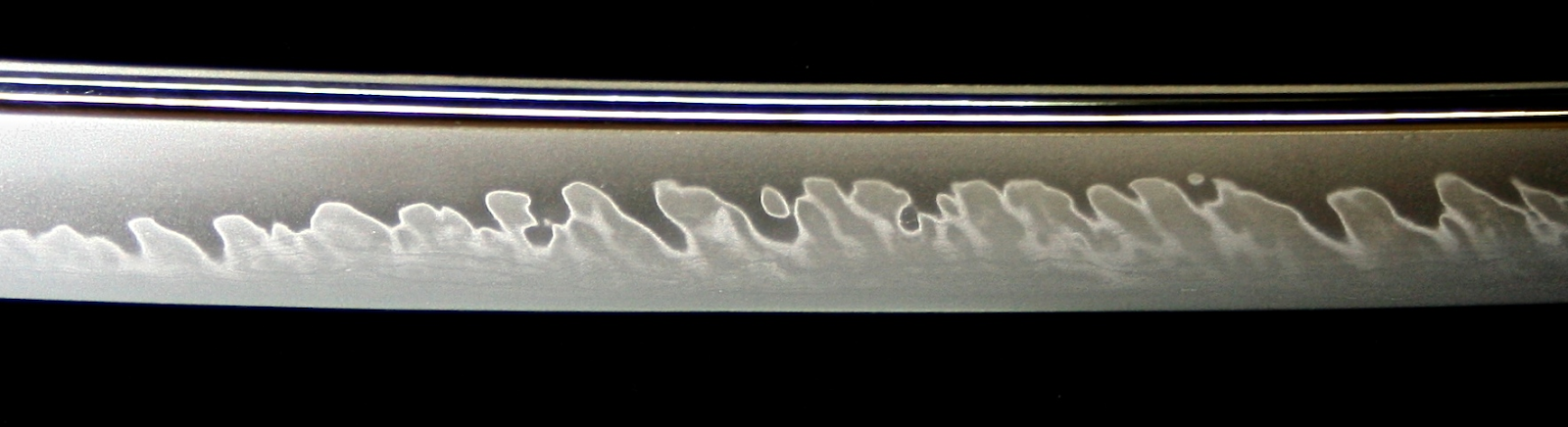
A dramatic chouji midare hamon in a modern sword. The pattern exists not because of a lamination or some silly pattern welding but because of the changing crystalline structure of the blade that results from the differential heat treatment process performed by the blacksmith. It only exists because of the swordsmith’s skill, but it is only visible and beautiful because of the sword sharpener’s stones and his skill with them. Is the blade sharp? Don’t judge a blade’s performance by its polish.

If we liken the swordsmith with his forge and hammer to the quarry worker cutting marble from the mountain, then the sword sharpener is Michelangelo cutting the Pietà with his chisels and files. Both craftsmen work on the marble and blade respectively, and both are essential. The sculptor uses steel to bring stone to life, while the sword sharpener uses stone to bring steel to life.
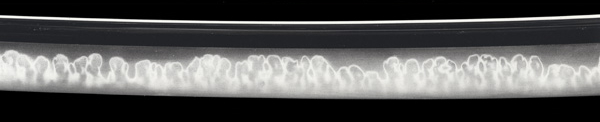
chojimidare.jpg
Another dramatic hamon in a modern sword. This pattern is a surface manifestation of the steel’s crystalline structure as created by the swordsmith, but revealed and made glorious by the polisher

But despite these artistic abilities, modern “Sword Polishers” have no interest in and put forth no effort to actually make a sword blade cut well. Indeed, in some cases, they actually intentionally dull the blade so it can’t cut, thereby making it safer. This intentional vandalism is called “habiki.”

A different style of hamon pattern on a blade with a different grain pattern. Notice the different colors and lines inside the hamon. All these crystalline details are categorized, have names, and are studied intensely by aficionados. All things equal, this sort of pattern and color is considered to be more elegant and desirable than the two more dramatic hamon pictured above. An extremely deep rabbit hole, I assure you. Please watch your step!

The Key Point

Here’s the key point your humble servant wants Beloved Customers and Gentle Readers to grasp: Despite the long years of apprenticeship, advanced skills learned, and gallons of red sticky stuff unintentionally leaked by sword sharpeners, the frank sword sharpeners I have spoken with all admitted that, of all the craftsmen in Japan that used edged tools, woodworkers like carpenters, cabinetmakers, and joiners routinely create sharper blades despite those blades not appearing to be as sharp as swords. This is consistent with my direct experience of handling over 70 swords before and after being worked on by sword sharpeners.

While there is great pleasure to be found in polishing a plane or chisel or knife blade to levels of great beauty, do not make the mistake of equating appearance with performance.

Appearance aside, and looking strictly at cutting performance, will a chisel or plane or knife blade skillfully sharpened on a 15,000 grit stone cut better and longer than if sharpened on an 8,000 grit stone? In the case of woodworking blades and kitchen knives, no it won’t. In fact, due to higher levels of friction the higher degree of polish produces in the cut, it will certainly not cut wood as well. More on this subject later.

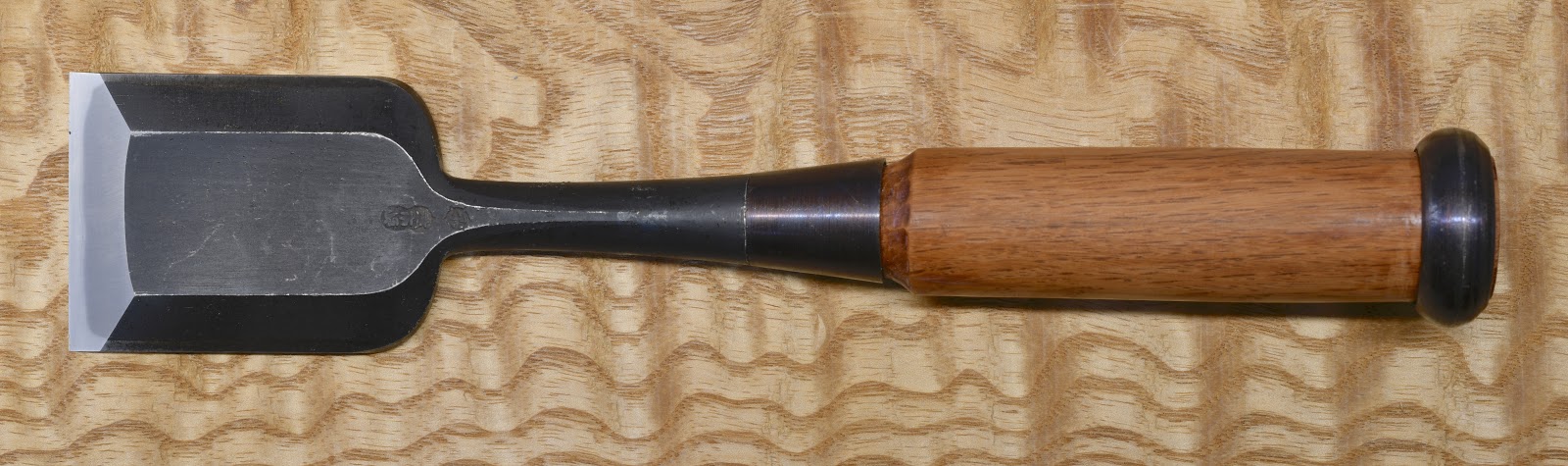
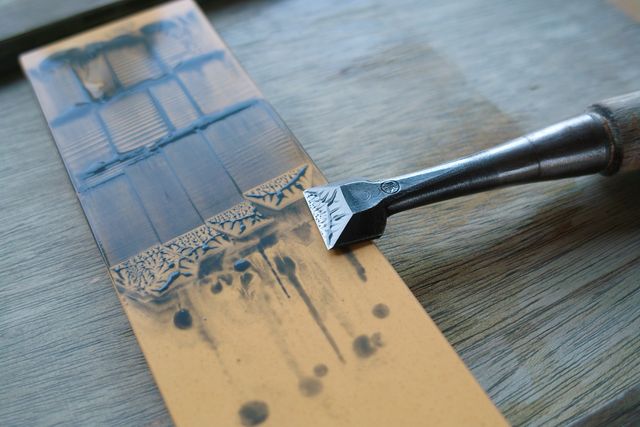
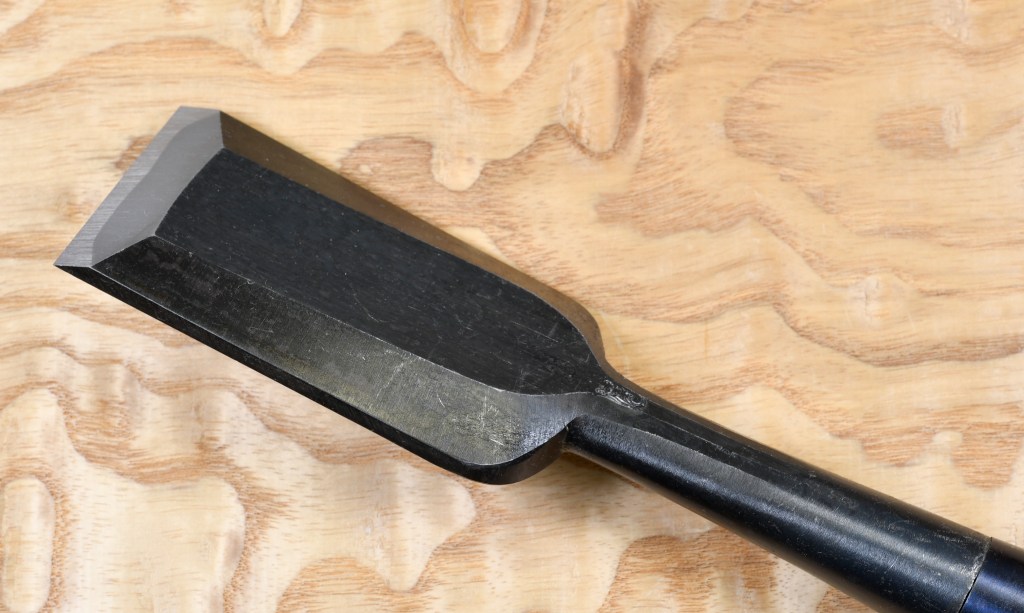
An oiirenomi chisel by Hidarino Ichihiro. The hazy silver of the hard steel hagane lamination and the cloudy grey of the softer iron jigane lamination, combined with the shape and upward curvature of the corners of the lamination are indicative of excellent craftsmanship by the blacksmith, superior skills of the sharpener, and wonderful stones. Such details are considered sublimely beautiful to tool connoisseurs. But will the edge cut well? We can’t tell from this photo.

Keep in mind that the stones used to apply the beautiful polish and accentuate the hamon on Japanese swords are different from those used to sharpen woodworking tools. For instance, the uchigumori stones sword polishers use are small slices of soft stone glued to paper using urushi lacquer adhesive, and are only 3,000~5,000 grit. These small slips of stone are rubbed on the sword blade using thumb and fingertips.

Here is a link to a blog showing Mr. Fujishiro, son of one of the sword sharpeners I employed back in the day, making and using these thin slices of stone.

Tools are designed to perform specific tasks. Although it could do the job, more or less, you wouldn’t use a crescent wrench to stir spaghetti sauce on the stovetop would you? A longish spoon just might work better.

Does a sword’s edge need to be extremely sharp to cut the enemy effectively? No, it doesn’t because the sword’s geometry, blade orientation, speed, impact force, and the swordman’s technique drive its cutting effectiveness much more than simple sharpness. So sword sharpeners in Japan, and probably most of the world too, have always been more focused on edge durability, resistance to chipping, and appearance than absolute sharpness. In modern times, when swords are almost never used to cut living flesh outside of Saudi Arabia, the blade’s appearance may be critical, but sharpness is not a practical concern.

Another example is food preparation knives. A chef’s knife looks terribly sharp, and as it slices tomatoes and fillets fish we can see that it cuts well. But how sharp is it really? In comparison with a joiner’s plane blade, not really that sharp. But both tools are exactly suited to the job assigned them.

The “willow-leaf” yanagiba chef’s knife shown above is most effectively used in slicing or drawing motions, much as expert swordsmen use their weapons against enemies. In this style of cut, a smooth and uniform cutting edge does not perform as well as a more ragged, serrated edge as seen at the microscopic level. Therefore, there is little if any practical benefit (assuming beauty is not practical) to be obtained by sharpening a kitchen knife beyond 1,000~3,000 grit. In fact, at least in Japan, these are the upper-limit of stones in daily use by professional chefs of all varieties. Yes, and that includes sushi chefs.

But don’t misunderstand my point: In the case of both swords and yanagiba hocho knives, the bevel angle must be correct for both the blade being used and the material being cut, and the microscopic edge must be a clean intersection of planes. If you get these two factors wrong, a crescent wrench might work just as well.

The other point I want to make is that, while I enjoy using high-level skills to give a beautiful appearance to extremely sharp blades, such a blade will not perform better than an identical blade of equal sharpness but with a less polished appearance, and the extra time and money spent on improving outward appearance is wasted on bread and butter work. 

Since easily-deceived, morally-challenged Hollywood celebrities have the answers to all the world’s problems (at the cost of other people’s money, labor and freedom, of course) perhaps our quest for the sharp edge can benefit from the wisdom of the famous Latin lover ‘Nando, Tinseltown’s most elegant star. ‘Nando once shared his father’s advice that it is “better to look good than to feel good.” Accordingly, perhaps we should all go crazy nuts and polish our blades like beautiful but dull museum swords and wear waistcoats and cravats as we cut sliding dovetails and plane door stiles. After all, one must be ready for every photo op. In this way, our woodworking blades may be worthy of ‘Nando’s highest praise: “You, dahling, you look mahvelous, absolutely mahvelous!”

Fernando Lamas in “The Merry Widow.” The crease in his pant leg could slice bacon.

No, on second thought, while there is much one can learn from Fernando’s elegant philosophy, his standards of beauty and suffering are too high for me. I would rather be a simple joiner or cabinetmaker in stained work clothes that has the ability to make a blade exceptionally beautiful but chooses not to expend the time and cost required to do so most of the time, rather than someone who doesn’t because they can’t.

Although Fernando has a pressing appointment for a tango lesson (discretion prevents me from naming the young lady he will be pressing) and won’t be providing further insight today, our adventures in sharpening Japanese woodworking tools will continue in Part 5 of this series.

Let’s meet at Tsukiji for sushi afterwards. Until then, I have the honor to remain,

YMHOS

If you have questions or would like to learn more about our tools, please click the “Pricelist” link here or at the top of the page and use the “Contact Us” form located immediately below.

Please share your insights and comments with everyone in the form located further below labeled “Leave a Reply.” We aren’t evil Google, fascist facebook, or treacherous TikTok and so won’t sell, share, or profitably “misplace” your information. If I lie may all my dance steps turn to stumbles.

Leave a comment

← Back

Thank you for your response. ✨

Sharpening Part 3 – Philosophy

Always ready for battle

“A wild boar was sharpening his tusks upon the trunk of a tree in the forest when a fox came by and asked, Why are you doing that, pray? The huntsmen are not out today and there are no other dangers at hand that I can see. True, my friend, replied the Boar, but the instant my life is in danger, I shall need to use my tusks. There will be no time to sharpen them then.”

Aesop (621~565 BC)
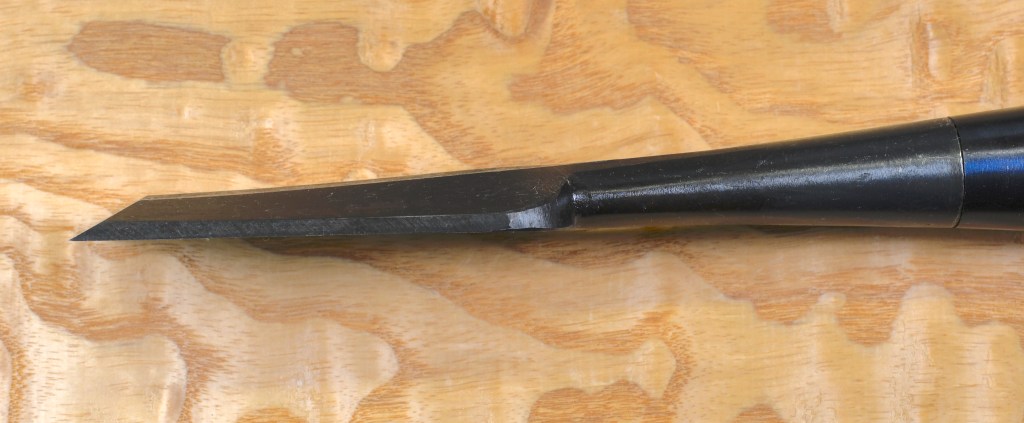
It’s nice to have a philosophy on a subject because it helps one distill random thoughts down to the essentials.

Allow your humble servant to explain his philosophy about sharpening woodworking tools, not because it is charming and unique, and not because you should emulate it, but because it will provide insight into the things written in this blog and elsewhere. Use it to calibrate your BS meter. It’s often nose-deep when people talk about sharpening.

My philosophy regarding sharpening was shaped by my experience as a carpenter, contractor, commercial cabinetmaker, and joiner working under pressure, against a clock, sometimes with a boss watching with eagle eye, and often in front of customers, not as a hobbyist fiddling around in a garage workshop. Married young with a growing family to support, I quickly discovered that children eat constantly and in ever-increasing quantities, so efficiency was and is important to me. 

Efficiency was also important to the Clients who hired me. Sharpening and maintaining tools is, of course, part of the job, but from the viewpoint of Client or employer it’s wasted time, so it’s important to minimize time spent fiddling with tools during the work day. Accordingly, I followed the example of craftsmen I respected and started the day with sharp tools in good working order, and kept spare planes and chisels sharpened and ready to go as backup.

Self-employment hammered into me the monetary value of time. It also taught me that quality sharpening stones and tools are expensive and wear out, and that to feed wife and babies every day I had to work efficiently to minimize time and money expended on maintaining tools, while maximizing the amount of work I accomplished between sharpening sessions. 

I developed a strong dislike, nay hatred, for blades that fail to perform, refuse to become extremely sharp, that dull quickly, or take too much time and effort to sharpen. I loathe them not just because they are irritating, but because they waste my time and money. Even considering the higher initial cash outlay, the cost-effectiveness of handmade, professional-grade tools in helping my mind and hands do good work and feed the family became as obvious as a burning road flare on a midnight highway.

You, Beloved Customer, may not feel the time and financial pressures that professionals do, but owning professional-grade cutting tools and learning how to sharpen them in an efficient and professional manner will make woodworking less frustrating, more profitable, and more enjoyable.

What is your philosophy?

The journey will continue in Part 4 with wisdom from a celebrity and pictures of pretty swords. Until then, I have the honor of remaining,

YMHOS

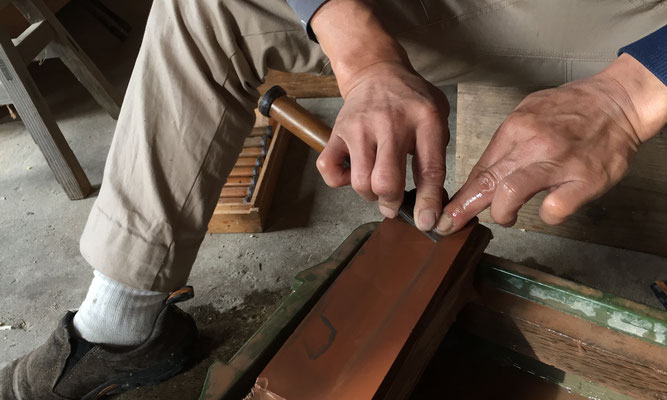
Sharpening a plane blade at the jobsite, then back to work, jiggity-jog.

YMHOS

If you have questions or would like to learn more about our tools, please click the “Pricelist” link here or at the top of the page and use the “Contact Us” form located immediately below.

Please share your insights and comments with everyone in the form located further below labeled “Leave a Reply.” We aren’t evil Google, fascist facebook, or thuggish Twitter and so won’t sell, share, or profitably “misplace” your information. If I lie may I never finish the journey.

← Back

Thank you for your response. ✨

Leave a comment

Sharpening Part 2 – The Journey

You don’t have a soul, Doctor. You are a soul. You have a body, temporarily.” 

Walter M. Miller Jr., A Canticle for Leibowitz

Life is neither a dead-end course nor a race, but a hard journey along many paths all leading to a single gateway. Without exception, all the physical things, possessions, financial wealth, qualifications, status, accomplishments and accolades we value and struggle like fevered demons to obtain and preserve in this life, even our own bodies, will all return to shadows and dust. What truly matters are the friends and family that journey with us, the kind deeds we do, the joy we share, the things we experience and learn along the way, and most importantly, the quality of our souls at the journey’s end, for these are all that will pass through that last gateway into eternity with us; Nothing else matters a handful of beans.

Woodworking can be a wonderful diversion and even a source of joy during this journey, one that can make our lives and the lives of those around us more pleasant. For many it is a way to keep body and soul connected. For those that rely on their tools to feed their families, the efficiency of that work, and the joy they find in doing it are not trivial matters.

Thoughtful woodworkers on this path learn early that dull tools are an impediment to making excellent wooden products regardless of the skill of the hand and eye that manipulates them, because, being an extension of the user’s mind and hands, a dull tool will often darken the mind and leaden the hand of even an accomplished woodworker.

Sharpening has always been the most important woodworking skill. It is no coincidence that for millennia the first thing apprentices were taught once they were permitted to handle valuable tools was how to sharpen them properly.

In our time the prevalence of machinery with built-in precision and spinning cutters driven by motors and sharpened by others has made it possible for those lacking even basic sharpening skills to represent themselves as craftsmen. Although they may be skilled, I believe such individuals are less craftsmen in wood and more machinery operators.

Those thoughtful souls who aspire to become accomplished woodworkers, and not just machine operators, need minimal sharpening skills. Untold thousands of years of human history verify the truth that all other woodworking accomplishments flow from this bedrock skill.

I believe, perhaps because the men I learned from and respected also believed, that free-hand sharpening is the way a skilled craftsman maintains his tools. My experience and observations over many years have confirmed the efficiency of this technique. It is consistent with my work-driven philosophy about sharpening which I will explain in more detail in the next post in this series.

Sharpening a blade free-hand is a zen-like activity. It requires observation. It requires muscle memory. It requires consistency. It requires composure. It requires meditative focus. And at the pinnacle, it requires one to feel and hear work being done in a place one cannot see, a place where destruction creates order; where nothing becomes something.

Some will disagree with my beliefs about free-hand sharpening, especially the machinist-types, the scribblers and gurus promising instant results in a few hours for the price of a book, DVD, or class, and the purveyors of sharpening jigs disinclined to work without “training wheels.” No mystery there, so I won’t even try to please everyone, just professional woodworkers.

When professional woodworkers gather in the presence of edged tools, they often talk about sharpening techniques and rare stones, and they are always curious about the quality of other men’s tools. In Japan, it is considered rude to pick up another’s tools and examine the edges, or even to look at them too hard, but the desire is always there nonetheless because it is human nature to compare oneself to one’s peers. 

Indeed, much can be learned about a man’s quality standards and his skills from his blades. Perhaps the condition of one’s tools gives a tiny glimpse into the owner’s character.

What do your tools say about you? Some are terrible gossips, you know. (ツ)

The journey will continue in Part 3.

Allow me to end this article with a quote from the best-selling book of fiction in human history:

End? No, the journey doesn’t end here. Death is just another path. One that we all must take.

J.R.R. Tolkien, The Return of the King

YMHOS

Tianmen Gate, China. 999 steps to the natural gateway above.

If you have questions or would like to learn more about our tools, please click the “Pricelist” link here or at the top of the page and use the “Contact Us” form located immediately below.

Please share your insights and comments with everyone in the form located further below labeled “Leave a Reply.” We aren’t evil Google or fascist facebook and so won’t sell, share, or profitably “misplace” your information. If I lie may I never finish the journey.

← Back

Thank you for your response. ✨

Leave a comment

Sharpening Japanese Woodworking Tools Part 1: Introduction

Hidari no Ichihiro Mentori Oiirenomi

It is well with me only when I have a chisel in my hand

Michelangelo 1475-1564

This is the first in a series of 30 articles that describe the sharpening procedures your humble servant uses and recommends for Japanese plane and chisel blades. Links to the other 29 articles are located at the end of this one.

The purpose of these articles is to share with our Beloved Customers reliable techniques for sharpening and maintaining the tools we sell consistent with standard practice among advanced Japanese professional woodworkers.

Each article in this series describes separate but related aspects of sharpening Japanese woodworking tools, especially chisels, plane blades, and kiridashi knives. While 30 articles sounds like a lot, it is certainly not enough to cover all details of this first and most important woodworking skill. No doubt Beloved Customer could add chapters based on your own experiences.

If it seems less than concise, please understand that it is written with enough detail so even the first-time sharpener can benefit from it, but with enough advanced techniques to stimulate the interest of even jaded professionals.

Of course, if I wrote only for the professionals, then those new to the process would be left confused and frustrated. Likewise, if I wrote only for Beloved Customers new to sharpening Japanese tools, then the professionals reading it would begin to make snoring noises (highly intelligently, of course). I hope you can appreciate the conundrum and forgive the resulting compromises.

Unlike most of what is available on the internet, these techniques are not based on irresponsible rumors expounded as fact in smelly, troll-infested forums, articles in magazines written by self-educated journalists, or silly videos on NoobTube.

I didn’t invent the techniques described herein, but they are nonetheless my techniques, the results of hard experience working with, and lessons learned from, professional craftsmen in Japan over a period of some 30 years, sometimes working as a professional woodworker, and other times working as an employee of two of Japan’s largest “super” general contractors.

This series of posts has 4 objectives: To save Beloved Customer (1) time, and (2) money, and to make your Japanese blades (3) sharper, and (4) cut longer. These benefits are worth obtaining if you are serious about woodworking, as professional woodworkers must be, but the requisite attention to detail and manual skills may not come easily to some. 

Indeed, you may need to unlearn bad habits, and develop new habits, skills and muscle memory in order to achieve these objectives. This is not a 90 minute process but will take weeks, maybe months. It certainly took me years to completely unlearn my bad habits and develop the necessary skills. I am confident these writings will make the process more efficient for you, if you follow them. I only wish I had the benefit of this information all in one place back in the day.

Of course these are not the only viable solutions available. Many woodworkers are self-taught nowadays and learn how to sharpen from books, magazines, videos, and classes, and have developed methods that work well for them. I am not minimizing those successes, merely proposing methods to further advance their skills.

However, be aware that several of the techniques described herein may directly contradict the teachings of the Holy Woodworking Gurus oozing virtue received from the Giant Pixie and who make a living scribbling, making videos, and teaching classes about woodworking.

These guys achieve popularity and financial success by helping amateurs get better results quickly after reading only a few pages in their $29.99 book, or attending their 2-hour class. To maintain their popularity and income, the techniques some (but not all) of them promote must be dumb-as-dirt simple, and often involve shortcuts and gimmicks yielding “instantaneous gratification,” without the need to learn real skills. Nothing wrong with that, but is it good enough for you?

Unlike amateurs satisfied with superficial results, professionals need real skills that yield consistent results long-term. 

e0248405_1553630.jpg

Don’t be shocked, but I am not offering 90 minute gratification in exchange for your money. 

There are no “sponsors “of this blog. There are no advertisements, period, so this blog generates no direct income.

I have no “click goals, ” or “SEO strategy” to deploy; I don’t care if you “like” me, “subscribe” to my BoobTube channel (I don’t have one), or buy access to my online tutorials (don’t do those either). In fact, this website doesn’t require you to register, it doesn’t use Google Analytics, it doesn’t embed cookies in your computer or attempt to mine your data in any way.

The advice I offer is free, but if you prefer gimmicks to lifetime skills, the techniques described here are not for you. I am sure such Gentle Readers can find some brightly-colored bubble-wrap to keep themselves entertained.

Do I have a profit motive? Nope, this information is free. I am not a sneaky corporate shill trying to sell books, magazines, videos, video games, advertising space, banners, VPN services, home security systems, sharpening stones, or heaven forfend, powertools with laser sights. I have never been lent or given a tool in exchange for a review, nor have I been wined, dined, laid or paid to write good things about crappy tools. 

Over the years, my professional needs and curiosity led me to purchase literally hundreds of planes and chisels made by many blacksmiths and companies. The operative word here is “purchased.” With my own money. Not a single one was ever given or loaned to me. Some I later sold, the good ones I kept. The two points I want to make are: (i) I put my money where my mouth is; and (ii) I have no financial conflict of interest.

I have several motivations for writing and sharing this information. One is selfish convenience. Over the years, people have asked me how to sharpen Japanese tools, and I have explained the process in letters, emails, and in person many times. This series of articles is essentially a collection of my scribblings on the subject over several decades, and is intended to save me time explaining processes.

Another motivation is to ensure that the people who buy the small number of hand-forged tools we sell (our “Beloved Customers”) know how to properly sharpen and maintain them, so that those tools will provide long, productive, high-performance service. Our tools deserve to be properly maintained.

Some who experience difficulties with Japanese woodworking tools blame the tools, but in many cases the problem lies not in defective tools but rather stems from an insufficient understanding of basic sharpening principles and lack of experience. Without exception everyone with aspirations to be an excellent woodworker must go through that learning process at least once. Your humble servant hopes these scribblings will enlighten more than confuse.

But my primary motivation for making this series of articles available at no cost is to fulfill a promise I made to freely share with others the techniques I learned from the many carpenters, joiners, blacksmiths, tool makers and professional sharpeners in Japan who taught me. In exchange for this free information all I ask of you, Beloved Customer, is an open mind and eager hands. Please, don’t cut either of them.

The adventure will continue in Part 2! But be forewarned, the price of admission may double. (ツ)

YMHOS

If you have questions or would like to learn more about our tools, please click the “Pricelist” link here or at the top of the page and use the “Contact Us” form located immediately below.

Please share your insights and comments with everyone in the form located further below labeled “Leave a Reply.” We aren’t evil Google, fascist facebook, or thuggish Twitter and so won’t sell, share, or profitably “misplace” your information. If I lie may the bird of paradise fly up my nose.

← Back

Thank you for your response. ✨

Leave a comment

Seismic Damping

The more one gardens, the more one learns; And the more one learns, the more one realizes how little one knows.

Vita Sackville-West

This post is definitely different from my previous ones. It will deal with buildings and earthquakes. It has nothing to do with wood or woodworking tools.

Image result for toranomon hills business tower
Toranomon Hills Business Tower (foreground)

In my day job I am an executive with a large international Real Estate and Construction Project Management company in Tokyo, Japan. Without going into details that might violate non-disclosure agreements, my job involves managing all aspects of real estate acquisition and leasing, as well as the design, procurement, and construction of commercial and industrial projects. Mostly for non-Japanese Clients.

The photo above is one project I am involved in on behalf of a Client.

Tokyo is an expensive place to set up operations, and the real estate and construction processes are especially confusing for foreign companies. Ergo, the need for me and my teams.

My educational background is structural engineering, focused on seismic-resistant design. All of my Clients are very concerned about the earthquakes Tokyo experiences almost daily. There will be several magnitude 4~5 quakes here each year. This tends to keep people focused.

My point is that earthquakes are a constant threat taken seriously and for good reason. Accordingly, to one degree or another as building codes and Owners require, all buildings incorporate aseismic design features.

I have worked on buildings with expensive full-blown base isolation using rubber bridge bearings and hydraulic dampers similar to giant automotive shock absorbers, and other systems designed to dissipate damaging earthquake forces, but what I would like to show you today is a “slip-joint brace damper” just installed at a building near my office located in Marunouchi near the Imperial Palace (not the building in the perspective rendering above).

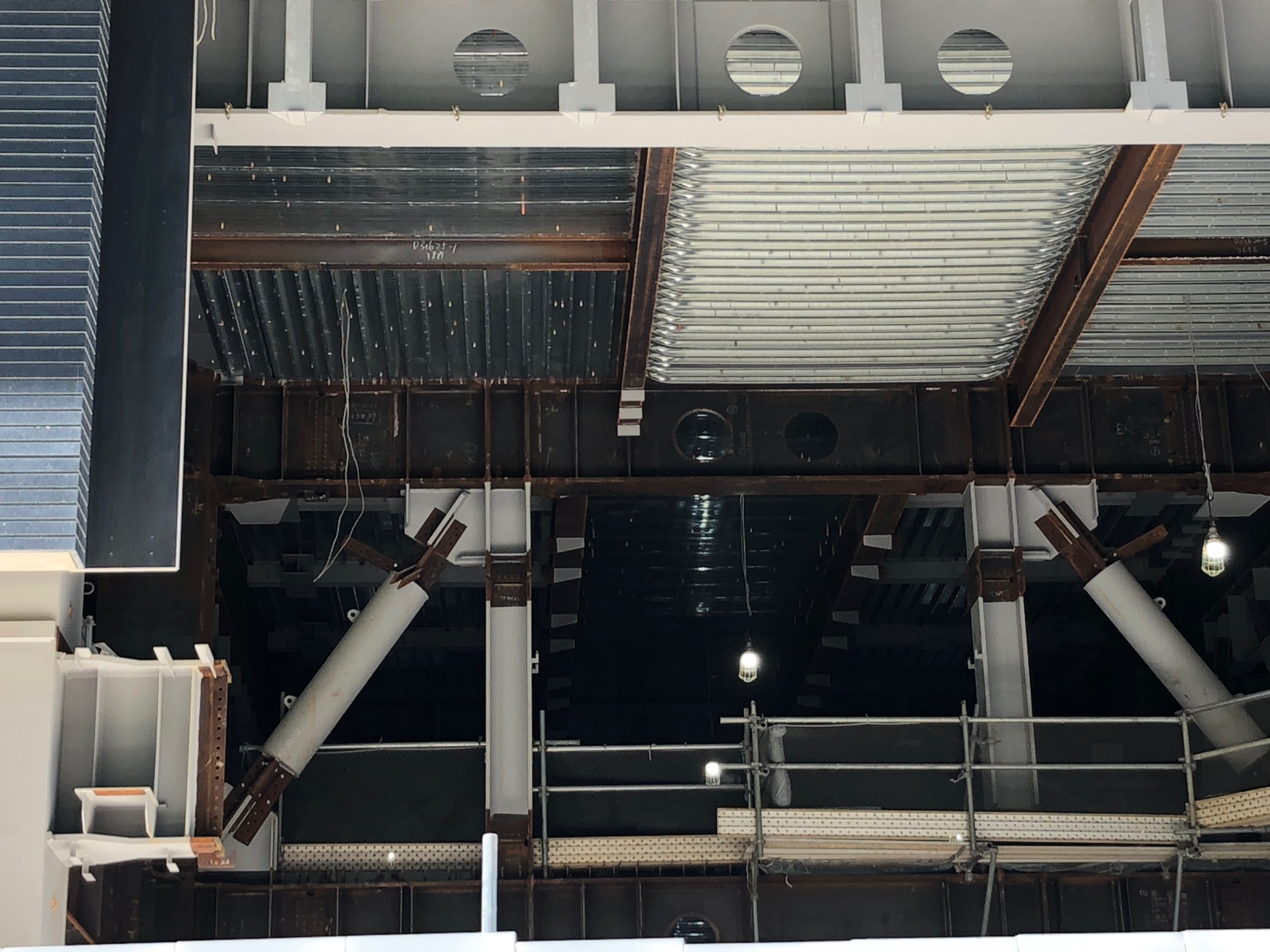
Notice how deep the beams are, and how thick the steel is. Although they don’t show up well in the photo, the columns too are massive. Much heavier than is typical in Western structures. I love Japanese structural steel!

Slip-joint Brace Dampers (white), Tokyo

I am not involved in this high-rise building, but a contractor I have used in the past named Obayashi Corporation 大林組 is the General Contractor. I was able to snap this picture of Obayashi’s jobsite while walking to my office from the subway station last week during a rare moment when the front gate was open and nothing was in the way.

The white columns and diagonal braces are the key to this seismic damping system.

The white paint is a fire-resistant intumescent coating designed to protect the steel from heat during a fire. Structural steel is very weak when exposed to fire, much more so than wood or concrete, so this sort of protection, while expensive, is necessary. The rest of the structural steel will be sprayed with a thicker, less-expensive and less-durable fire-resistant coating of one variety or another.

The diagonal braces in the photo are basically two steel plates bolted together face to face. The bolt holes are slotted to allow the bolts and plates to slip past each other when subjected to a certain amount of force.

The plates and bolts are contained in a steel pipe filled with high-friction oil to prevent the brace from buckling, prevent corrosion, and ensure the coefficient of friction between the plates/bolts remains constant for many decades in the future.

As the ground moves during an earthquake, the building moves with it, and the structural steel sways. The rectangular opening framed by connected beams and columns changes shape, becoming longer or shorter in the diagonal directions. Braces resist this “racking” movement.

As the plates and bolts in these dampers slip past each other, a great deal of friction is created converting the earthquake’s energy to heat, slowing down the racking motion, and controlling the harmonic vibration of the entire building.

Image result for racking forces

Although fixed-length braces are common in lighter, shorter structural frames, they are not usually a good thing in large structural steel frames because they tend to behave erratically and fail suddenly. This can be inconvenient.

The steel frame must be made strong enough without fixed-length bracing to absorb these forces without failing anyway to make a reliable structure. But if the frequency of the building’s movement back and forth and side to side begins to match that of the ground, then something called “resonance” can occur potentially doubling the forces acting on the building, forces powerful enough to suddenly and violently bend, break and topple the building. This can be inconvenient.

Related image
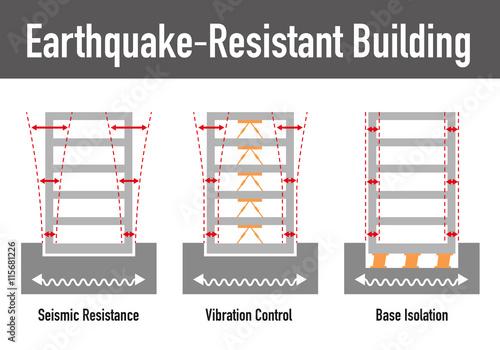
The center image employs the damping braces as in the 2nd photo above.

An alternative to this sort of damping brace system is the more expensive “Base Isolation System”

So why would anyone use an expensive system like base isolation?

Base isolation allows the entire building, from its base up, to move opposite the ground motion in the horizontal direction, reducing the induced sway, racking, and damage to its interior and systems and equipment stored inside. This level of protection is necessary if the building must continue to function uninterrupted immediately after a large earthquake. Hospitals, R&D centers, Data Centers and other sensitive buildings with lots of expensive equipment that must be kept running no matter what are often worth the cost of base isolation systems.

But in the case of an office building like the one in the photo, the owner decided some interior damage, and the business interruption repairs would entail after the earthquake, would be acceptable.

The photos below show two components of the typical base-isolation system.

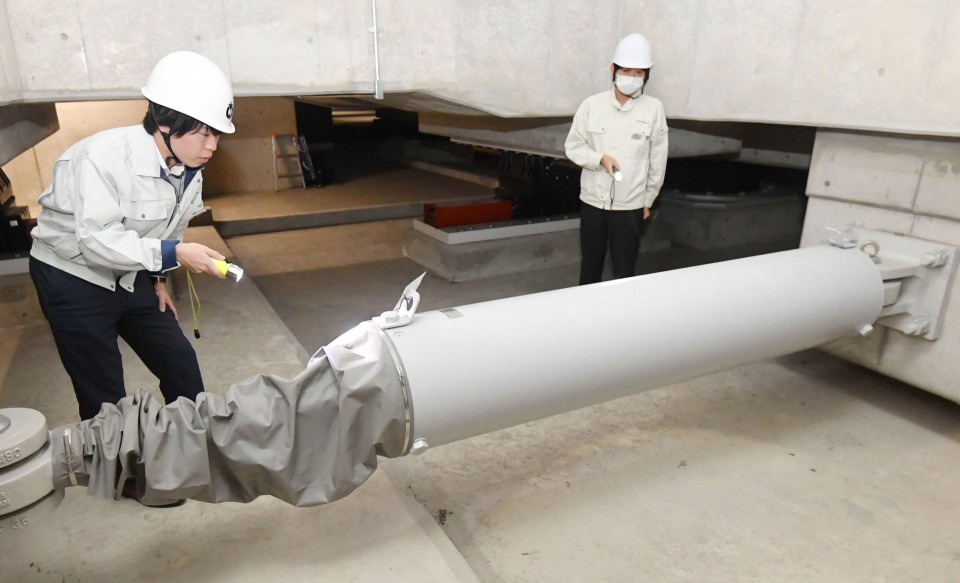
Base isolation bearings being tested. Very stiff in the vertical direction, but flexible in the horizontal direction. Two bearings are being tested in this photo, but they are never stacked like this in actual installations
Related image
Hydraulic damper combined with base isolation bearings in the background to form a base-isolation system. The building’s entire weight is supported on these bearings. The dampers keep the building’s movement from getting out-of-hand, like shock absorbers on an automobile.

I hope you found this post interesting. Let me know if you want to see more stuff like this.

YMHOS

If you have questions or would like to learn more about our tools, please use the questions form located immediately below. Please share your insights and comments with everyone in the form located further below labeled “Leave a Reply.” Your information will remain confidential (we’re not evil Google or incompetent facebook).

← Back

Thank you for your response. ✨

The Varieties of Japanese Chisels Part 11 – The Tsuba Nomi Guard Chisel (鍔鑿)

“The beginning of wisdom is to call things by their proper name.”

Confucius

The “Tsuba” in Tsuba Nomi is the Chinese character 鍔 which means “guard” as in a sword or knife guard.

Two nubs attached to opposing sides of the blade just below the handle look like the guard for a knife or sword. This chisel is driven with a hammer to quickly create a pilot hole for nails or screws. The blade becomes tightly wedged into the wood, but by striking up on these projections with a steel hammer, the blade can be extracted.

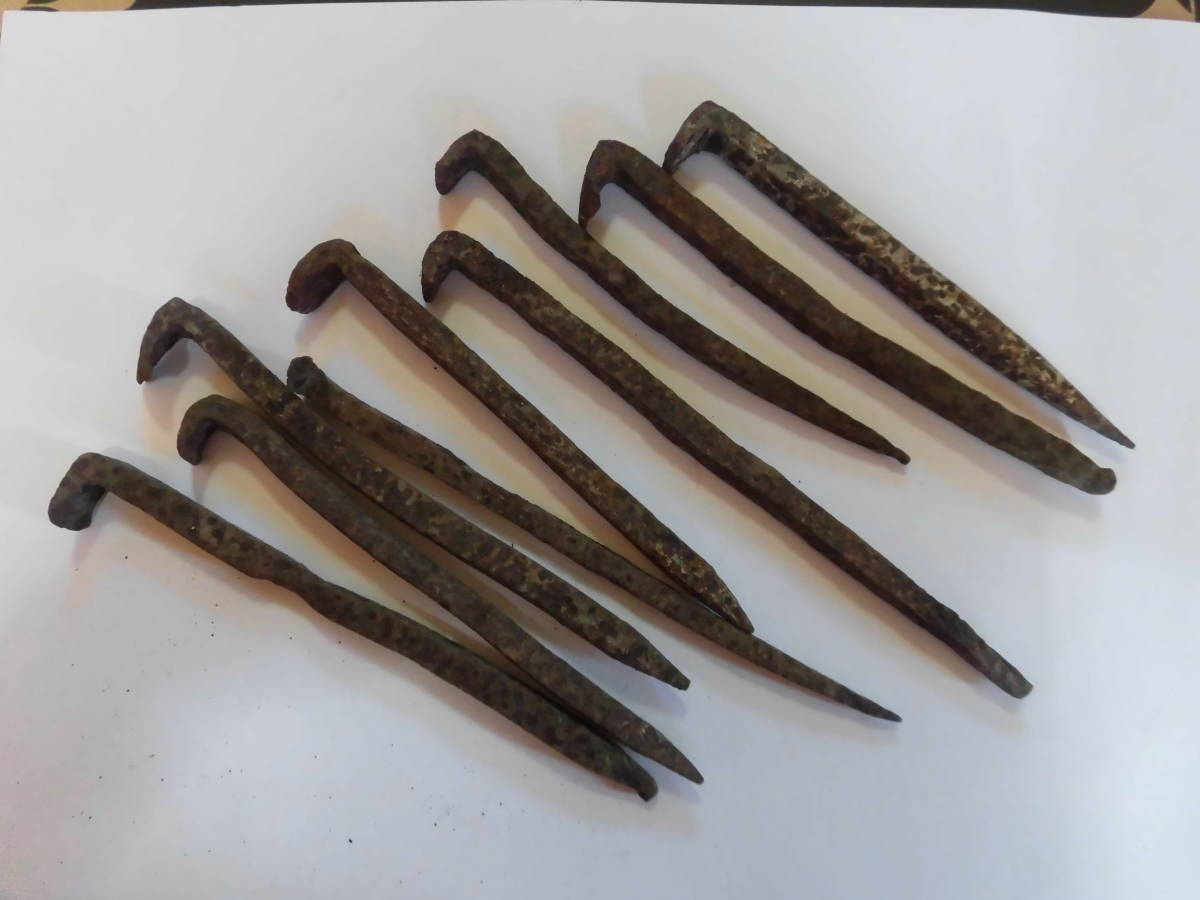
An old traditional Japanese boat made with tusbanomi chisels and nails.
Three styles of tsubanomi, and using a mallet to remove the blade after cutting a nail hole

This unique chisel comes with blades with round, square, or rectangular cross-sections.

Square and rectangular blades usually have a chisel-point beveled on two sides, but sometimes are beveled on just one side. Round blades may have simple pointed ends, but sometimes they have short triple tines to drive the crushed wood fibers into the hole.

While this chisel severs the wood fibres, unlike an auger, drill, or gimlet, it does not remove material from the hole. The ends of the severed fibers are angled down into the hole, and over time and exposure to humidity and water, will partially swell back to their original shape locking nails in tightly.

This chisel is still used in the wooden shipbuilding industry, but other than that sees very little practical use nowadays. Your humble servant owns one but has never used it in anger.

YMHOS

If you have questions or would like to learn more about our tools, please click the see the “Pricelist” link here or at the top of the page and use the “Contact Us” form located immediately below.

Please share your insights and comments with everyone by using the form located further below labeled “Leave a Reply.” We aren’t evil Google, fascist facebook, or thuggish Twitter and so won’t sell, share, or profitably “misplace” your information. If I lie may every nail I touch bend in half.

← Back

Thank you for your response. ✨

The Varieties of Japanese Chisels Part 10 – The Sotomaru Nomi Incannel Gouge (外丸鑿)

“There is a great satisfaction in building good tools for other people to use.”

Freeman Dyson

This is the second and final post about the heavy-duty Japanese carving gouges.

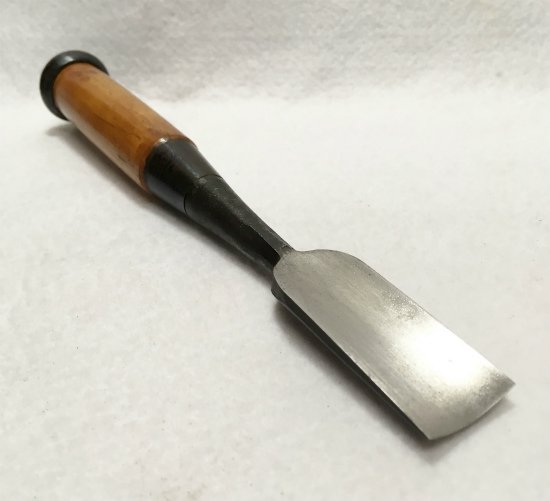
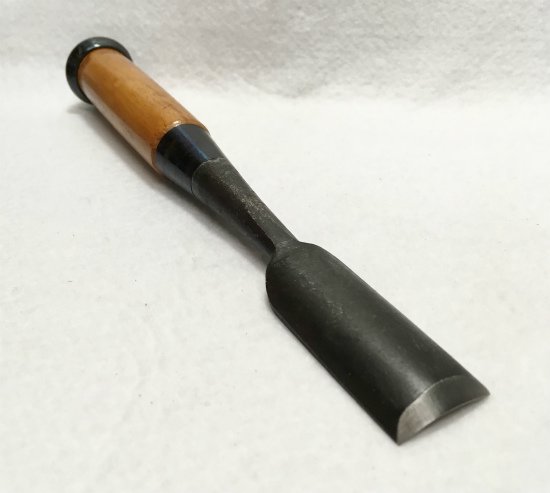
The Sotomaru Nomi” 外丸鑿 is what is called an “Incannel Gouge” in the West. “Soto” 外 means “outside” or “external,” “maru” 丸 means “round,” and “nomi” 鑿 means “chisel.”  The name corresponds closely to the English language term for incannel gouges.

As with other Japanese chisels, the Sotomaru Chisel has a thin layer of high-carbon steel laminated to a softer low-carbon steel body with a neck and tang. They also have the ferrule which compresses the handle’s wood to keep the blade’s tang firmly attached to the handle and prevent the handle from splitting, and a crown to prevent the handle from cracking when struck with a steel hammer.  Unlike most Japanese chisels, however, they do not have a hollow-ground ura.

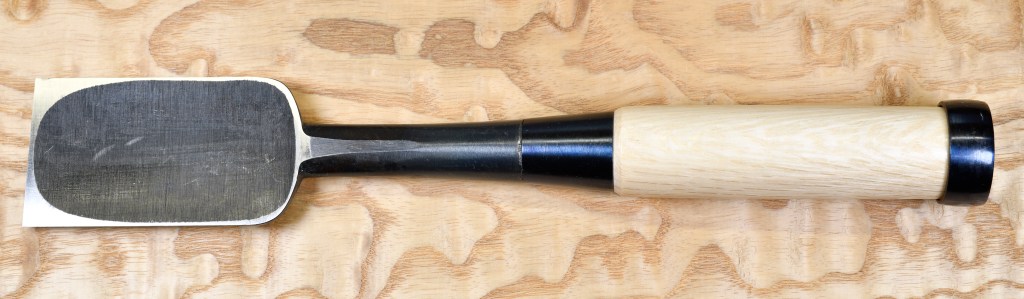
The cutting edges differ from their Western counterparts in that the bevel is a single, flat plane, instead of a curved surface. The advantage of this detail when sharpening would be difficult to overstate. The blade can be sharpened on a normal, flat sharpening stone without pesky slips, finger contortions, or heaven forfend, miniature die grinders.

APPLICATIONS

This is an unusual chisel outside Japan, but is indispensable for working round wood and bamboo used in Japan’s sukiya and teahouse construction traditions. Although this chisel has many advantages, and some disadvantages. For instance, it will not waste wood as rapidly as the uchimaru chisel we looked at in the previous post, but it tends to hold an edge longer and is definitely quicker/easier to make fiendishly sharp. In addition, its shape is much more conducive to cutting precisely curved surfaces than its concave sisters.

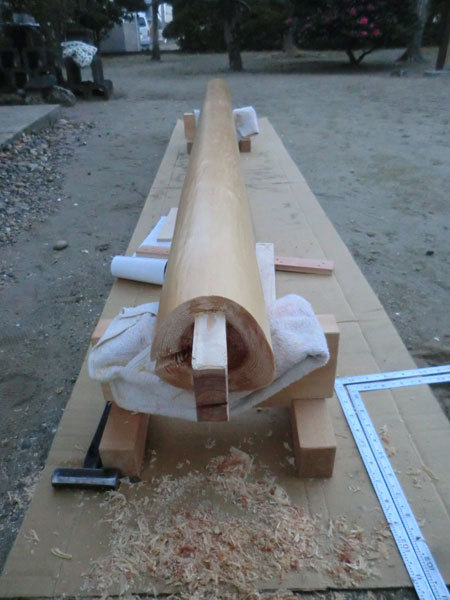
The coped end of a post to beam tenon joint cut with a sotomaru nomi.
Notice also the “sewari” kerf cut into the post in this and the next photo. I will discuss this interesting detail more in a future post, God willing and the creek don’t rise.
A “Sukiya” style exposed structural frame in peeled cedar wood with coped mortise and tenon joints, the ideal application of the Sotomaru Gouge.
“Round Work” in peeled cedar wood

SONY DSC

The hard steel lamination in this chisel has more support than its brother the uchimaru gouge we looked at in the previous post, making it a bit tougher.

Sharpening is easier and quicker than other gouges because the bevel can be treated as a single flat plane. The area called the “flat” or “ura” on conventional chisels is convex so it can be worked on a flat stone eliminating entirely the need for those pesky grooved stones and slips.

The disadvantage is that the flat bevel/curved cutting edge cannot make clean stopped cuts against 90 degree surfaces. This shortcoming is easily dealt with, however, by making a few more passes.

The sotomaru nomi is perfect for fitting straight line curved surfaces in some situations because its convex surface can ride and index directly on the concave surface being shaped, whereas the more common concave gouge must be tilted at an angle on its axis to cut, with less precision.

Since this chisel can cut parallel to its axis, and does not need to be angled up from the surface being worked to cut, it can cut and carve in much tighter locations than standard gouges.

If you need to make curved cuts at 90° to the workpiece’s surface, as in the photos above, then this chisel is indispensable. I’m sure you can see why this chisel is a must-have for the elegant ” round work” the Japanese love so much.

Another advantage is that the sloped cutting edge can easily make undercuts, something their Western counterpart cannot do. This is an essential performance criteria for accomplishing a few traditional Japanese architectural details such as the edge detail in the beam nose shown in the photo below. Good luck cutting that with a standard gouge!

It’s always nice to have the right tool for the job at hand.

Standard sizes are 9mm, 12mm, 15mm, 18mm, 24mm, 30mm, 36mm, and 42mm.

YMHOS

If you have questions or would like to learn more about our tools, please click the “Pricelist” link here or at the top of the page and use the “Contact Us” form located immediately below.

Please share your insights and comments with everyone in the form located further below labeled “Leave a Reply.” We aren’t evil Google, fascist facebook, or thuggish Twitter and so won’t sell, share, or profitably “misplace” your information. May I gag on a hairball if I lie.

← Back

Thank you for your response. ✨

The Varieties of Japanese Chisels Part 9 – The Uchimaru Nomi Gouge (内丸鑿)

Carving a wagatabon container using an uchimaru gouge

“A good tool improves the way you work. A great tool improves the way you think.”

Jeff Duntemann

The Uchimaru Nomi is a gouge, very much like those seen in the West

The name is composed of 3 Chinese characters (kanji): 内 pronounced “uchi “which means “ inside” or “interior,” 丸 pronounced “maru” which means “round,” and 鑿 “nomi” which means chisel.

This gouge has a blade very similar in cross section to its Western counterpart, but unlike Western gouges, it is made of laminated steel, has the combined tang and ferrule construction typical of Japanese chisels, and a crown to reinforce the handle and protect it from violent hammer blows. These are strong chisels used by carpenters to carve large-scale architectural components, and sculptors.

They come in different sizes and sweeps, although not as many as the Swiss make. Some are the size of typical oiirenomi bench chisels; others are the size of the larger heavy-duty atsunomi.


As you can see, these blades are are not hollow-ground.

The relatively hard layer of steel which forms the cutting edge is often subjected to more lateral forces when carving than their straight-bladed cousins, and are sometimes damaged as a result. Professional carvers will hold the thin cutting edge over a small candle flame to reduce the hardness over a small area to reduce this tendency. Your humble serrvant is not recommending this practice, just conveying information.

The technique used for sharpening Japanese gouges is identical to their Western counterparts. To sharpen the outside bevel, typically one will use dedicated sharpening stones with grooves worn into them that are slightly greater than or equal to the radius of the gouge. One removes the burr and polishes the inside curve by using a short stone with a radiused edge.

A piece of leather charged with polishing compound can be used to put a final polish to the bevel. One can also bend this piece of leather to polish the gouge’s inside surface. Easy peezy.

Standard sizes are 9mm, 12mm, 15mm, 18mm, 24mm, 30mm, 36mm, and 42mm.

There are also uchimaru gouges made as paring chisels, with longer blades and handles, slimmer necks, and without crowns.

If you need a gouge that that can hog a lot of wood, will take an exceptionally sharp edge and will maintain it a long time, then this is a tool you should consider.

In the next post, we will look at a different type of gouge, one you may not have seen before.

YMHOS

If you have questions or would like to learn more about our tools, please click the “Pricelist” link here or at the top of the page and use the “Contact Us” form located immediately below.

Please share your insights and comments with everyone in the form located further below labeled “Leave a Reply.” We aren’t evil Google, fascist facebook, or thuggish Twitter and so won’t sell, share, or profitably “misplace” your information. May I gag on a hairball if I lie.

← Back

Thank you for your response. ✨

The Varieties of Japanese Chisels Part 8 – The Atsunomi (厚鑿)

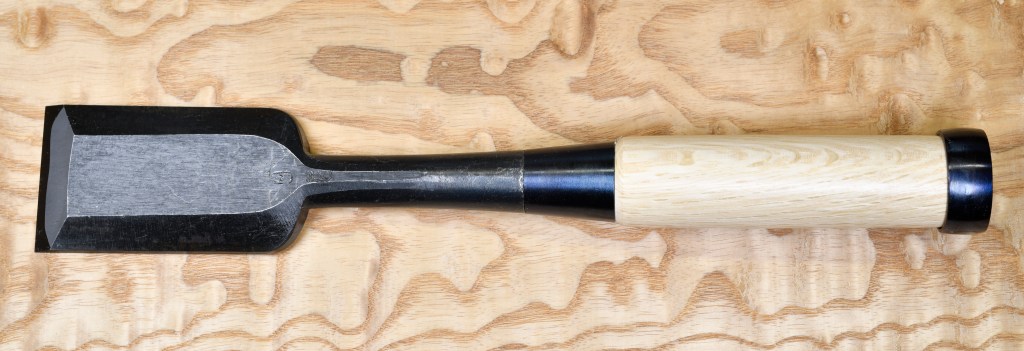
30mm Atsunomi by Hidari no Ichihiro

“Along with the milk of my nurse I received the knack of handling chisel and hammer, with which I make my figures.”

Michelangelo

In a previous post, we looked at various types of oiirenomi (bench chisels) and mortise chisels. In this post we will examine a type of tatakinomi called the “Atsunomi.”

DESCRIPTION

The ”Atsunomi, ” written 厚鑿, translates to “thick chisel.” This is the largest variety of tatakinomi readily available nowadays and is almost identical in design to its more petite oiirenomi sisters, but being larger, longer, heavier and stronger it is able to transmit and endure the impact forces of heavy hammer blows from sunup to sundown to cut a lot of wood. Indeed, I can remember times when the handles of my atsunomi in the photographs on this page became seriously hot after long hours of heavy hammer blows.

The 24mm chisel in the photograph below was the first atsunomi I owned, and has seen hard use with heavy hammers, but has held up well.

24mm Atsunomi by Kiyotada (Japanese White Oak handle)

If I can liken the bench chisel or oiirenomi to a 1/4″ cordless drill, then the atsunomi is a 9 amp 1/2″ corded drill (when combined with the right steel hammer). Serious business indeed.

APPLICATIONS

The atsunomi is ideal for heavy work such as timber framing and wasting large amounts of wood quickly. However, carpenters are not the only trade to use them. Many professional craftsmen in Japan, even those that never work on construction sites, prefer to use atsunomi even for delicate work because of their relatively longer blades, greater durability, and cost-effectiveness.

Because of its greater size and weight, the atsunomi is not as nimble as the smaller varieties of tataki nomi and demands the user to have greater strength and skill. But on the other hand, it’s very stable in the cut, and wastes wood with impressive gravitas.

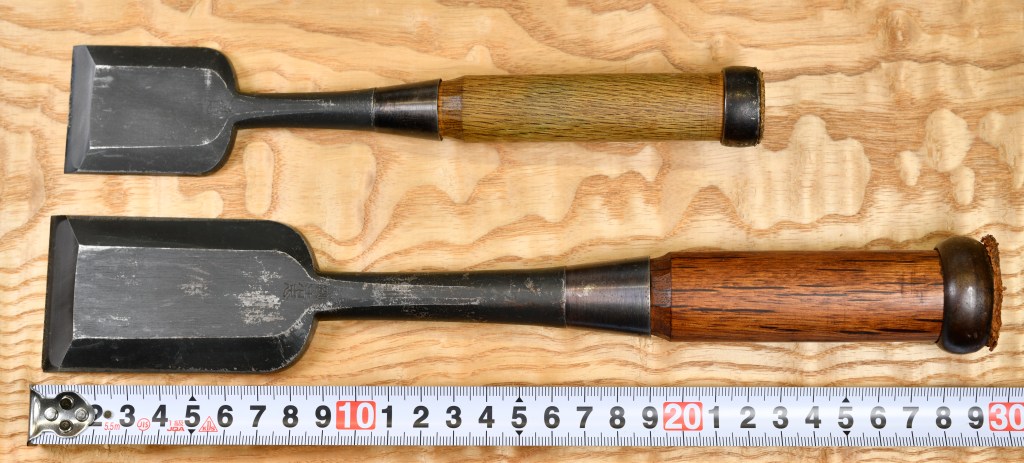
A comparison of a 42mm oiirenomi (top) and a 54mm atsunomi (bottom) by Kiyotada. The atsunomi is longer, thicker and stronger in every way.

As with all tataki nomi, the handle is big enough to use with one hand, but not two. Atsunomi always have a mild steel katsura crown installed at the end of the handle to reinforce it and prevent it from splitting under hammer blows.

Standard widths for atsunomi are: 12㎜, 15㎜, 18㎜, 21㎜, 24㎜, 30㎜, 36㎜, 42㎜, 48㎜, 54㎜.

There are several varieties of atsunomi, some with very wide blades and others with very long necks, but I will not go into that level of detail in this post.

In Part 9 of this saga of romance and derring-do, we will examine the Uchimaru Nomi.

YMHOS

48mm Sukemaru atsunomi w/ Japanese white oak handle. A serious tool for serious work

© 2021 Stanley Covington All Rights Reserved

If you have questions or would like to learn more about our tools, please click the “Pricelist” link here or at the top of the page and use the “Contact Us” form located immediately below.

Please share your insights and comments with everyone using the form located further below labeled “Leave a Reply.” We aren’t evil Google, fascist facebook, or thuggish Twitter and so won’t sell, share, or profitably “misplace” your information. If I lie, may all my chisel’s uras dissapear.

← Back

Thank you for your response. ✨

Leave a comment

The Varieties of Japanese Chisels Part 7 – The Nihon Mukomachi Nomi (二本向待鑿)

“You can complain because roses have thorns, or you can rejoice because thorns have roses.”

Tom Wilson
Nihon Mukomachinomi. Definitely in the Miki City style

This tool is a specialty mortise chisel with two blades for cutting twin mortises at the same time. It was developed specifically for cutting mortise joints in wooden stiles and rails for doors, shoji, cabinets and other joinery.

DESCRIPTION

Interestingly, double or twin tenons are not called ” nihon hozo” (hozo means ” tenon”) but “ nimai hozo “ (二枚ほぞ) with “ni “ meaning 2. In this case the number is combined with the counter “mai “ used to count flat things like a sheet of paper or tenons. Japanese is almost as messy as English… Your humble servant blames those pesky Buddhist priests for the complications involved in reading and writing Japanese, but I’m not sure who to blame for English.

The name is a variation of the name of the standard mortise chisel ” mukomachi nomi” in my previous post, and no, I still don’t know what it has to do with ” waiting over there.” In front of this is added ”nihon” (二本) with ” ni” meaning ”2” and ” hon” being a counter for longish things, like pencils or trees, or in this case, blades. The word is pronounced ” knee hone.”

Allow me to wander off the path a bit and talk about the Japanese language since you might find a few details interesting. If you don’t feel international today, please feel free to jump over the next few paragraphs.

The nation of Japan is called “Nihon” or “Nippon “ in the Japanese language and is written with the two characters “Ni “ 日  and ”Hon” 本 sometimes pronounced “pon.” Yes, the same pronunciation and one of the same characters used in nihon mukomachi nomi. Besides being a counter for pencils and trees and longish things, it also means ” book” and ” source. ” The word for the nation of Japan means “The source of the sun,” a jab by the Japanese at an arrogant Chinese emporer some millenia ago.

Spoken Japanese is not that difficult for English speakers to figure out, but the reading and writing are crazy difficult because of the vast quantity of Kanji, the multiple pronunciations possible for most of them, and the multiple meanings attached to many.

Elementary children are required to learn 1,006 kanji characters along with the various meanings and pronunciations. In total, a minimum of 4,272 characters are used in newspapers and magazines and must be learned before graduating middle school. Most educated people in Japan can read well over 6,000 of the over 13,000 registered kanji in Japan. Universal literacy requires a lot of study and memorization at a young age. This should give you an idea why education is so highly valued in Japan.

When I was a young missionary in Japan in the 1970’s, I spent several months stationed to Ehime prefecture in rural areas of the island of Shikoku, back when many farmhouses in that locale still had thatched roofs, no glass windows, and no electricty. Many of the older residents had spent their entire lives on their little farms and could not read or write, and had never seen a brown-haired blue-eyed foreigner before.

But the children in these mountain villages were always excited to see a foreigner and would swarm around and ask us where we were from. My standard response to this somewhat rude but innocent question was to point down at each of my legs and count them saying ”One leg, two legs. I’m a Nihonjin.”  The “nihon” I was was jokingly referring to was the same as the mortise chisel which is the subject of this post, not Japanese Nationality which is pronounced identically.

Now you know a stupid pun in Japanese, so never say you didn’t get your money’s worth at this blog!

The twin-blade mortise chisel is exceptionally difficult to make, and even new ones require the owner to perform a significant amount of tuning to convince them to perform well. They have never been common, and I am not aware of anyone forging them now.

APPLICATIONS

The twin tenons this chisel specializes in cutting are almost twice as strong as a larger single tenon, and are the preferred joint for high-stress wooden connections worldwide, especially joints in doors and windows. If you haven’t tried them before, you should. They look pretty cool as through tenons too.

Twin tenons have three advantages that justify the extra work. First, while they may have the same or even less cross-sectional area, they have more surface area than a single tenon in the same space, creating greater friction when assembled, if properly cut, creating a joint that is much more likely to stay assembled when stressed.

Second, this larger surface area also means a larger glue area, a big advantage with the right glue.

And finally, twin tenons are much more resistant to twisting, an huge advantage for highly stressed joints in operable doors and windows. This is their biggest advantage and is nothing to sneeze at. If you want a door to last, always use twin tenons, at least at the bottom rail.

Sokozarai chisel used to clean and shave the bottom of mortises

I purchased one of these chisels many years ago. They are difficult to tune. But even after all that work, the gentleman I learned tategu work from many years ago was not impressed with my clever tool insisting that a regular mortise chisel does a better job. There is an obscure structural reason why this makes sense, which I will not delve into here, but I did not ask Mr. Honda at the time for an explanation because it would have been improper to question a master who had been a professional joiner at his level for 60 years.

I can’t get these chisels made anymore, and know of no blacksmith that makes them nowadays. The time is not far away when handmade tools will not be available except as collectors items.

YMHOS

If you have questions or would like to learn more about our tools, please click the see the “Pricelist” link here or at the top of the page and use the “Contact Us” form located immediately below.

Please share your insights and comments with everyone in the form located further below labeled “Leave a Reply.” We aren’t evil Google, fascist facebook, or thuggish Twitter and so won’t sell, share, or profitably “misplace” your information. If I lie may my mortise chisel split asunder!

← Back

Thank you for your response. ✨