Japanese Handsaws: The Bukkiri Gagari

A 320mm (“shakuni”) bukkiri gagari handsaw with a kiri wood handle resting on your humble and obedient servant’s atedai workbench

Socialism is the philosophy of failure, the creed of ignorance, and the gospel of envy.

Winston Churchill

The goal of socialism is communism.

Vladimir Lenin

Thank you for visiting the C&S Tools Blog! This article will be a show and tell about a couple of unusual saws of a type not well know outside Japan. For that matter, they are no longer common inside Japan.

The Bukkiri Gagari Saw

The three saws pictured in this article are of a type of Japanese handsaw called a “bukkiri gagari.”

Terminology

Let’s begin with the second word in the name, “Gagari,” (gah/gah/rhi) which refers to a larger rip saw intended for rougher work. Usually forged heavier and stiffer than standard handsaws, these were once standard tools in every Japanese carpenter’s toolbox, used for ripping boards and cutting joints in timber frames. The teeth are made large to quickly eat lots of wood, but when properly sharpened, given the right set, and used correctly, they will make smooth cuts indeed.

Your humble servant has only seen the word gagari written using phonetic “hiragana” characters which are derived from Chinese characters but do not have any inherent or historic meaning, so while I can’t guess where the word came from, in exchange for a delicious chocolate chip cookie (with a glass of cold milk, please) I might be so bold as to suggest it came from the rough sound large rip saws make when ripping thinner boards.

Likewise, I’ve never seen the modifying first word, “bukkiri” (book/kee/reeh), written using other than hiragana, but even without a cookie bribe I can guess that “bukkiri” is a modification of the word “bukkiru,” which means to “chop off” something, for instance the head of a fish or an especially-corrupt politician. In this case, I believe it refers to the pointed tang having been chopped off short. So a bukkiri gagari is a larger rip saw with a shortened tang and an angled “shumoku” handle.

The Shumoku Handle

A shumoku mallet for striking small bells

The handle is especially unusual so let’s consider it next. The skewed handles in the photos in this article are called a “shumoku” (shoo/moh/kuh) 撞木 handle.

Shumoku is an interesting word. The Chinese character “Shu” 撞 means bell, while “Moku” 木means wood. In other words, a shumoku is a piece of wood for ringing bells. The image to the right is of a wooden mallet used to strike small tabletop bells during Buddhist ceremonies.

The shumoku in the video at this LINK is a tad larger, being motivated by a group of 17 jolly monks in a bell-ringing ceremony at Chion-in Temple (知恩院, Monastery of Gratitude, Jodoshu-sect) in Kyoto. Said to be the largest bronze bell in Japan, it seems to take a lot of work to make it sing!

I have no clue why this word is used for a saw handle, and those in the industry I’ve asked didn’t either. A mystery. Based on my long years of experience reading and writing in the Japanese language, it seems likely that the woodworkers that made and used this style of handle back in the mists of time gave it a name with a pronunciation similar to shumoku back in the days when few commoners could read or write, and centuries later when the came time to write the word using Chinese characters, someone decided to use the “bell wood” characters just to poke fun at the monks in their funny dresses (ツ).

Despite what those who like to portray the Japanese language as highly cultural and absolutely logical suggest, I can assure Gentle Reader it contains many instances of such strange “assignments,” just another reason why the written language is too often confusing.

Long, straight handles with oval cross-sections are more common in Japan, and certainly better known outside Japan. And the straight handle makes accurate cuts easier because one can readily sense if the blade wanders from a straight line in the cut. But, in some cases, the straight handle has three disadvantages. First, the handle’s length sometimes gets in the way when making long strokes in the tight spaces where carpenters are sometimes required to work, whereas a saw with a shumoku handle is shorter, and is easier to use from various angles, for example, when cutting a tenon or a housed dovetail from under a beam. Second, the straight handle depends on a high-friction grip by both hands to motivate powerfully, whereas the shumoku handle does not. And third, it’s more difficult to use as powerfully as the shumoku handle due to the angle of the user’s hands in-use.

Here’s are a Link to a video of a guitar luthier using a bukkiri gagari saw.

Two Examples of Bukkiri Gagari

The photo above shows two saws: the antique 320mm shakuni (1.2 shaku) bukkiri gagari as well as a longer 355mm “shakusan” (1.3 shaku) bukkiri gagari saw hand-forged and hand-sharpened for your humble servant by Nakaya Takijiro Masayuki, with teeth especially shaped for ripping hardwoods. A most excellent saw.

The shorter saw is over 150 years old, and according to the blacksmith’s hand engraving on the tang, was forged from “Tougo Reigo” steel, aka “Togo steel,” a British product made by the Andrews Steel Works and first imported into Japan by an officer who once served under Admiral Togo in the Japanese Imperial Navy and who borrowed the name of the famous military leader.

Admiral Togo was a small man who became a national hero for commanding the Imperial Japanese Navy’s forces when they kicked Imperial Russia’s butt. Job well done.

It’s a great saw, one your most humble and obedient servant has used frequently since purchasing it at a flea market in IIdabashi Tokyo many decades ago. I like the color it presents, the control it provides, and the compact size, but the teeth are little on the hard side as evidenced by a crack in one tooth. Togo reigo steel is well-known for being on the brittle side.

The shumoku handle attached to the Togo reigo steel saw is one your humble servant made from kiri wood with mulberry wood inserts and a black persimmon retaining wedge. These inserts are not standard, but an improvement I added to prevent the tang from wearing out the soft kiri wood. The wedge makes it easier to remove the handle for transport. It’s fancier than necessary, but I had fun making it. Another way to secure a shumoku handle is with a dovetail wedge inserted from the side, but I don’t like the weaker nature of this style, nor the feel of the wedge in the hand.

Gentle Reader will notice that the straight tang of the shorter saw has been cut off (“bukkiri”) square by the original owner long ago, and that the back of the blade curves away from the cutting edge. This curvature is standard for some rip saws.

The longer 355mm saw, by comparison, has a shumoku handle I made from tougher Japanese white oak with a more-or-less rectangular cross-section and is secured by friction alone.

The blade of the Takijiro saw is more-or-less straight, lacking the curve towards the end, and instead of the tang being straight it’s curved downwards in the direction of the teeth. This is not a standard blade converted into a gagari by chopping the tang short, but was planned to accept a shumoku handle from the time it was just a spark glowing in Takijiro’s forge, making it a dedicated, professional rip saw. Takijiro shaped this saw for me after one his master forged for a temple carpenter many decades ago, a craftsman I met at his workshop, and who gave me the opportunity to use, and fall in love with, his saw.

Please don’t tell my other saws I said this because they tend to be anthropomorphically jealous, and while saw cuts seldom make hearts bleed, they can make fingers fly.

Converting a Rip Saw to a Bukkiri Gagari

Gentle Reader can readily convert a standard Japanese rip saw into a bukkiri gagari by simply cutting the tang short and making a shumoku handle, as is the case of the shorter saw in this article, and making a simple handle to fit. The longer style saw is not available new, although Takijiro has forged a number of them over the years for our Most Beloved & Patient Customers.

While this article has been about dedicated rip saws, some craftsmen convert crosscut saws in the same way.

A safety warning is called for here, however, after all, they don’t call it the “nanny state” for nuttin. If you add a shumoku handle to a standard saw blade, be sure to at least cut off the pointy end of the tang. Otherwise, you’re likely to find your chest and/or arm leaking red sticky stuff compromising your color-coordinated woodworking togs, a simply devastating fashion faux pas. Herewith you’ve been duly warned.

Until we meet again, I have the honor to remain,

YMHOS

A bukkiri gagari rip saw This is one of a matched set of rip/crosscut saws custom-forged by Choujiro (Azuma-san) for a temple carpenter 30 or 40 years ago who never picked them up from the store where he placed the order. Notice the curved back peaking towards the end, the golden temper discoloration typical of handsaws made in Eastern Japan, and the old-fashioned forge-welded iron tang. With a toothline length of 330mm and progressive teeth (smaller towards the tang), this is a serious saw for serious work.

To learn more about and to peruse our tools, please click the “Pricelist” link here or at the top of the page. To ask questions, please the “Contact Us” form located immediately below. You won’t be ignored.

Please share your insights and comments with everyone in the form located further below labeled “Leave a Reply.” We aren’t evil Google, fascist facebook, treacherous X, Harvard University, or H. Clinton’s IT dude and so won’t sell, share, or profitably “misplace” your information. If I lie may the toothy gods of handsaws bukkiri my neck.

Relevant Articles

← Back

Thank you for your response. ✨

Please Leave a Reply

Sanity Retention Implements

This is how your humble servant often feels at the end of the day. I need my chisels, I need my planes!

To achieve great things, two things are needed: a plan and not quite enough time.

Leonard Bernstein

Does Gentle Reader ever feel tired, restless, or achy after a difficult experience? Do these symptoms ever progress to insomnia, headache, neck pain, backache, chest pain or even (heaven forfend, I need a fire extinguisher) untimely spontaneous human combustion? And do any of these symptoms persist even after the pressures that precipitated them are gone? If so, you may be a human, perhaps even one of those with a brain and a soul connected to your body.

In this article, your most humble and obedient servant will, as Tim the Toolman Taylor often did, dare to diverge just a step or two from the beaten path of tool talk to consider how tools and woodworking may help us mitigate the dangerous stress most modern humans experience daily. So hi ho neighbor, let’s have a conversation over the fence.

A Tale of Stupidity

I promise you nothing is as chaotic as it seems. Nothing is worth diminishing your health. Nothing is worth poisoning yourself into stress, anxiety, and fear.”

Steve Maraboli

Allow me to begin with a true story, one of stupidity and toxic stress, just another fun day at the office.

Many years ago when the world was bubbling with promise, my head was fuzzier, my beard was darker and my waist was slimmer I was employed by a mid-sized Midwest construction company doing a design/ build factory for a Japanese precision parts manufacturer. Besides the construction of the factory expansion, the work included installing foundations for carburizing ovens used to create a hard skin on the steel parts they manufactured. I was tasked with marking out a concrete slab for core-drilling a series of pier foundations to support these ovens.

Everything went well, my layout drawing was approved, the slab was cored and piers were cast on-time. But when the equipment supplier’s salesman came to inspect the foundations he informed my boss they were spaced incorrectly. A disaster!

BTW, I was never told why my layout was wrong, but once the ovens arrived it was as obvious as the bill on a duck’s face that the manufacturer’s drawings didn’t match. In any case, at the time I was certain the foundations would need to be reworked, delaying installation of the ovens, and consequently the Owner’s production start, so I was sick with embarrassment at probably having delayed the project, and felt obligated to repay my employer the cost of remediating my apparent mistake. So between personal shame, the fear of potential schedule delays, and the thought of paying thousands of dollars out of my own pocket to make things right I was seriously stressed for about a week. Headaches, stomach aches and chest pains ensued forthwith.

My boss was a steady guy named Jim who heard out my profound apology while squinting at me like Blondie frequently did at Tuco the Rat, then snorted and called me an “ijit.”

Jim explained that if everyone who worked on a construction project were to be held personally financially responsible for minor unintentional mistakes, no one would do anything. And even if they were held responsible for their screwups, the construction company would then be obligated to pay them for everything they did right as a percentage of the project’s profits. And that wasn’t the arrangement.

Although Jim was gruff, even insulting, the results of his impromptu jobsite trailer therapy session were undeniable, providing me with necessary perspective, quickly dissolving the emotional stress that was crushing me, even relieving the physical symptoms I was suffering. And all without a couch! We all need someone like Jim.

When the crew that came to install the carburizing ovens entirely ignored the footings we had installed, but bolted steel “I ” beams to the slab instead, and then mounted the ovens on them I was shocked, even a little angry! They explained that’s how they always installed their equipment. And yes, all my self-recrimination and stress had been silly.

No doubt many Gentle Readers have learned similar lessons, but there’s a quote I’m fond of by Winston Churchill, the Prime Minister of England during WWII, a former soldier and fearless leader who bravely persevered as bombs and missiles rained down around him, the nation’s cowardly bureaucrats and politicians hid like rats in rubbish piles, civilian women and children were being murdered, and his nation was about to be invaded by a brutal enemy, to be apropos to most (but not all) stressful situations:

When I look back on all these worries, I remember the story of the old man who said on his deathbed that he had had a lot trouble in his life, most of which had never happened.

Winston S. Churchill
An iconic photo by Yousuf Karsh of Winston Churchill taken at the Hotel Château Laurier in Ottawa, Canada. Known as The Roaring Lion, it was stolen from the hotel’s Reading Room sometime after 2019, but it still has wide circulation as the image on the Bank of England’s £5 note. The story goes that Churchill did not want to be photographed, but permitted Karsh a single shot. To make the photograph more interesting, Karsh suddenly plucked Churchill’s ever-present lit cigar from his lips just before triggering the shutter prompting the glowering visage.

Herding Cats

Since those halcyon days my philosophy towards life and work has changed.

I once vainly believed I could control the people around me, or at least those I was responsible for, but with experience came the realization that attempting to control people is like pushing cats towards a goal with a small broom while demanding they knit sweaters along the way. The truth is that I have never been in control, that I can never successfully make anyone do anything, and that whenever I try to, all semblance of goodwill and cooperation is lost as everyone scatters and stress levels skyrocket.

One can never successfully “herd” cats, but at best only “lead” them (and sometimes even people) to go where you want them to go, or to do what you want them to do, with fish in hand, an even tone of voice and frequent ear rubbing, if you know what I mean.

While I don’t push people nowadays, I frequently have Clients, mostly inexperienced, egotistical, mid-management types who don’t have a clue but are frantic to climb the corporate ladder, consequences be damned, who expect such counter-productive foolishness of me on their employer’s behalf. Without appearing to refuse or contradict, of course, I always try to find other solutions, but when this is not possible and the Client stubbornly insists on Marxist measures, I separate myself from such projects because I know they will not only fail, but will yield unpleasant consequences for everybody involved, including tons of shame and crushing stress for me.

Don’t get me wrong, construction projects involve coordinating the efforts of a lot people, and sometimes stern measures are necessary, but nowadays while I still plan, lead, encourage, monitor, track and report progress, remind, sound alarms, send warnings, chide, reward, and even contractually penalize when necessary, I don’t push.

So here’s your unworthy servant’s current philosophy about life and stress in a nutshell:

  1. Thoroughly understand your goals, objectives and responsibilities, plan how to accomplish them, be diligent in achieving them, and never blame others for your mistakes;
  2. Without exception, everyone makes mistakes, constantly, so be as kind and understanding as reasonably possible. If you’re lucky, they might just return the favor, but even if they don’t, it will help to decrease stress levels all around. They’re just cats after all;
  3. Don’t accept responsibility for anything for which you are not truly responsible;
  4. Although senior executives in both the private and public sectors frequently secure their high pay and lofty station by abusing the goodwill of others, no matter how cleverly or coercively they present it, don’t allow anyone to foist either their responsibilities, or their mistakes, off onto you (unless you agree to it in advance and they pay you oodles of money for the resulting stress);
  5. As taught by those Great Philosophers Lord Buddha of India and Red Green of Possum Lodge, always remember that life is suffering, all the time, and accept that Murphy will carnally poke you with his pointy purple pecker often and painfully, so don’t expect an easy time, and prepare Vaseline and bandages accordingly.

One last philosophical concept that I have found useful. In the West there’s the saying that goes “water off a duck’s back,” meaning “nothing bothers you.” In Japan they have a more colorful saying, one that many small boys have enacted, that goes “piss in a frog’s face.” To the duck it’s just another wet day in a wet place. To the frog, it’s just a warm shower. Since killing stress originates in the mind, the expectations of the duck and the frog are worth emulating. Seriously.

I believe that internalizing the 5 points listed above, perhaps urinating on frogs 𓆏 occasionally, and employing small remedies frequently rather than making big corrections too late, can minimize the need for Dr. Alonzo’s Pretty Purple Pills, those dreadfully unfashionable and scratchy canvas jackets with straps and buckles that chafe the crotch something fierce, and/or heart surgery.

Setting amphibian abuse, chest incisions and uncomfortable fashion aside for now, let us next consider one such small remedy.

Stress Reduction Measures

The criminal pharmaceutical companies and their well-paid “scientists” (aka “shills”) in the medical profession will happily sell you heaping pallets of pills to cure what ails you, but honest doctors frequently recommend less profitable, but no doubt more effective measures, including exercise, more sleep, vacations, music, reading, spending time with friends and family (even though they are frequently a cause of high stress), and hobbies. Some of these may work for you. I’ll touch on hobbies more below.

Many people like to imbibe a drop of grog at times to relieve accumulated stress. This is certainly the case here in Japan where people generally love demon rum but become inebriated easily due to a common genetic enzyme deficiency. But as someone who is frequently forced to spend time in the company of drinkers in business situations, I’ve concluded adult beverages don’t actually relieve stress but only make the drinker forget his problems for a few minutes as they worsen, turn him into a useless fool for a few hours, and destroy his liver forever. And don’t forget the injuries, traffic deaths, fights, jail time, divorce, poverty, suicides and murders cork-pulling always produces. Such an uplifting beverage.

One of the disadvantages of wine is that it makes a man mistake words for thoughts.

Samuel Johnson

A less addictive and more reliable method I have found effective for relieving the stress that originates inside my head and heart is to do selfless service for others, service that I will not be rewarded for, and ideally, service I will not receive recognition for. Are there lonely, stranded, hungry, poor, sick, handicapped or damaged people in the neighborhood? Can I help by picking up stuff for them up at the grocery store or pharmacy? Can I give them a ride to a doctor’s appointment? Are their doors, windows, locks, cabinets, furniture, water heater, car brakes or roof giving them grief? Do they need help paying a bill? Do they just need someone to talk with? To share a burden is to halve it. To carry a friend or neighbor’s burden is to lighten my own narcissistic burdens (everyone has them), at least partially. Serving others without expectation of reward or recognition is powerful medicine in so many ways.

Another method I know that works is meditation, as in spending time alone in a quiet setting, without distractions, pondering simple questions internally without seeking actual answers. No, you don’t need to be a navel-gazing monk or smelly swami to do it, but you do need privacy and quiet, conditions often difficult to secure at home, especially since, regardless of her age, the female of the human species congenitally cannot tolerate the sight of a man being content while doing nothing, and upon seeing such a pitiful fellow, cannot stop herself from insisting he get busy following her orders. Thus it has always been.

But there’s another form of meditation your humble servant has found to reliably relieve stress, performed not in a hidden Shaolin temple or in a secluded grove, but still in a private, if perhaps dusty, environment.

The Holy Workshop

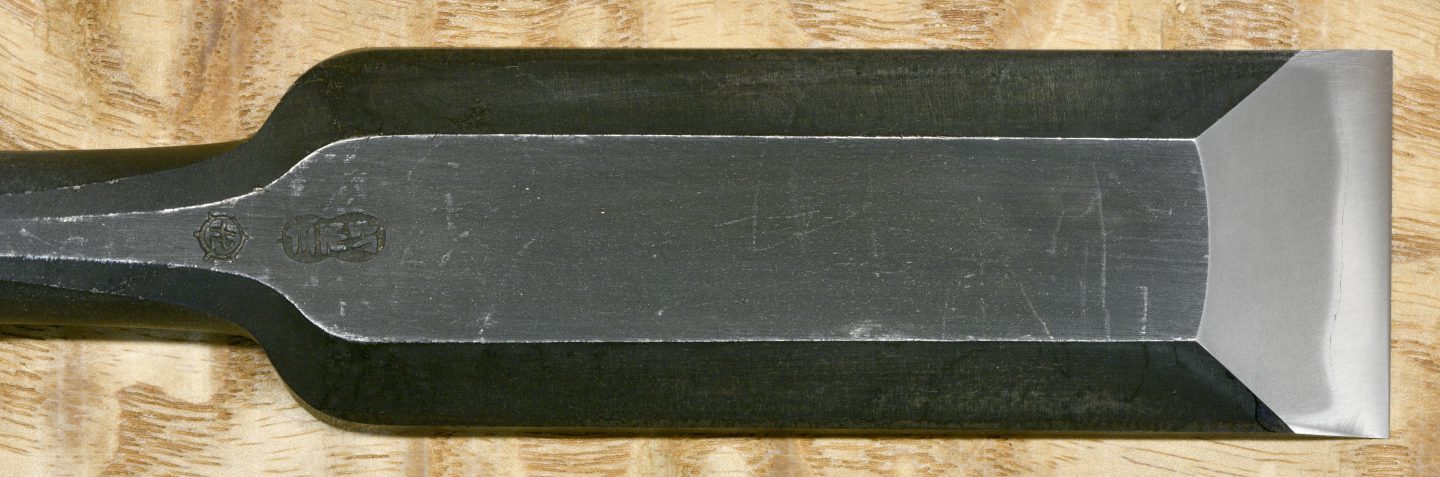
A beautiful 54mm Otsukinomi Paring Chisel by Nora.

Although I once worked wood professionally, it’s only my hobby now. But I find that, when done correctly, even meditatively, it can be highly effective at relieving stress. To do it correctly, however, a simple workshop is necessary, one without email, telephones or other distractions.

Big or small, light or dark, warm or cold, the design doesn’t matter so long as it has a door, even if it’s an imaginary one like that of the renowned radio News Director and anchorman Les Nessman (5 time winner of the coveted Buckey News Hawk Award, donchano). Once I close this door, no one but me is allowed to enter its sacred precincts or fiddle with the sanity retention implements (tools) housed therein. And that includes bench dogs and cats. But for it to be a serene, meditative, healing space, She Who Must be Obeyed and “The Spawn” must be ruthlessly conditioned to quiver at the very thought of removing my tools, and dread the consequences of chucking junk into or storing stuff in the holy workshop.

When I am in my workshop, I accept no demands to do this or do that. I don’t respond to email or the telephone, unannounced visitors ringing the doorbell, calls to dinner, much less demands to take out the garbage. It’s not that the holy workshop makes me rude and/or unresponsive, it’s simply that these distractions are lower priority than my health for a short time, and the restorative balm must be allowed to soak in, you see.

In this private space I work on my projects, usually simple woodworking or tool maintenance, using the woods I love in the company of the undemanding, sharp friends that reside, play dice and drink beer in the evenings in my toolchest. No schedules. No one to criticize or complain, no one to seek approval or payment from, and no one to please but myself. And while the fruits of my time here mostly go to others, in this bubble environment I only make what I want to make, when I want to make it, using the materials I want to use and tools that willingly link my mind and soul to the wood I am shaping.

But lo, one more thing is essential to the effectiveness of the holy workshop: When people ask me what I make in there, I always answer “wood shavings and sawdust,” for you see almost any other answer invites prying questions and ultimately stirs up invasions by curious people with too much time on their hands who will invariably request woodworking-related “favors,” responding to which will induce more stress into my ragged life. Oh, and when children ask me what I plan to give them for birthdays or Christmas, I pretend to sort through my tattered memory and then respond in a serious tone: “Do you prefer wood shavings or sawdust?”

In past years, this temple to woodworking has been a piece of old carpet laid for a few hours on a concrete slab in front of a dingy apartment for my shorty sawhorses and atedai to cavort upon. At other times, it has been a reed mat spread under quaking aspen or pine trees in a mountain glade. Most often it has been half or all of a garage with a workbench. Lately it has been a spare bedroom on the second floor of a small single-family house in Tokyo. Whatever shape it takes or amenities it may have, my workshop is for just me, my wood, and my tools.

Conclusion

Although it’s hardly worth the effort, perhaps Gentle Reader now understands the method to my madness when I call my beautiful, faithful, hand-forged tools “sanity retention implements.” I am convinced the time we spend together has, like water from a duck’s back, shed much deadly stress from my life, making my little workshop and simple handtools cheaper than therapy, tastier than Dr. Alonzo’s Pretty Purple Pills, and certainly more pleasant than heart surgery. I no longer use my tools to feed my family, but I’m convinced they “cure what ails me.” Cheap at twice the price, say I!

Let’s conclude this merry tale of mental illness with a final quote about Winston that Gentle Reader may find inspirational.

He was one of the finest orators of all time. And some of the phrases he used still resonate with us today, such as “Finest hour,” “Never surrender,’ and of course, “We shall fight them bitches.”

Philomena Cunk para-quoting Winston Churchill

YMHOS

Master carpenter Rokuza in Olde Edo with his plane and gennou hammer in hand, thinking about his lady instead of work. Some things never change.

To learn more about and to peruse our tools, please click the “Pricelist” link here or at the top of the page. To ask questions, please the “Contact Us” form located immediately below. You won’t be ignored.

Please share your insights and comments with everyone in the form located further below labeled “Leave a Reply.” We aren’t evil Google, fascist facebook or treacherous TikTok and so won’t sell, share, or profitably “misplace” your information. If I lie may frogs pee in my face.

← Back

Thank you for your response. ✨

Please Leave a Reply

Sharpening Part 2 – The Journey

You don’t have a soul, Doctor. You are a soul. You have a body, temporarily.” 

Walter M. Miller Jr., A Canticle for Leibowitz

Life is neither a dead-end course nor a race, but a hard journey along many paths all leading to a single gateway. Without exception, all the physical things, possessions, financial wealth, qualifications, status, accomplishments and accolades we value and struggle like fevered demons to obtain and preserve in this life, even our own bodies, will all return to shadows and dust. What truly matters are the friends and family that journey with us, the kind deeds we do, the joy we share, the things we experience and learn along the way, and most importantly, the quality of our souls at the journey’s end, for these are all that will pass through that last gateway into eternity with us; Nothing else matters a handful of beans.

Woodworking can be a wonderful diversion and even a source of joy during this journey, one that can make our lives and the lives of those around us more pleasant. For many it is a way to keep body and soul connected. For those that rely on their tools to feed their families, the efficiency of that work, and the joy they find in doing it are not trivial matters.

Thoughtful woodworkers on this path learn early that dull tools are an impediment to making excellent wooden products regardless of the skill of the hand and eye that manipulates them, because, being an extension of the user’s mind and hands, a dull tool will often darken the mind and leaden the hand of even an accomplished woodworker.

Sharpening has always been the most important woodworking skill. It is no coincidence that for millennia the first thing apprentices were taught once they were permitted to handle valuable tools was how to sharpen them properly.

In our time the prevalence of machinery with built-in precision and spinning cutters driven by motors and sharpened by others has made it possible for those lacking even basic sharpening skills to represent themselves as craftsmen. Although they may be skilled, I believe such individuals are less craftsmen in wood and more machinery operators.

Those thoughtful souls who aspire to become accomplished woodworkers, and not just machine operators, need minimal sharpening skills. Untold thousands of years of human history verify the truth that all other woodworking accomplishments flow from this bedrock skill.

I believe, perhaps because the men I learned from and respected also believed, that free-hand sharpening is the way a skilled craftsman maintains his tools. My experience and observations over many years have confirmed the efficiency of this technique. It is consistent with my work-driven philosophy about sharpening which I will explain in more detail in the next post in this series.

Sharpening a blade free-hand is a zen-like activity. It requires observation. It requires muscle memory. It requires consistency. It requires composure. It requires meditative focus. And at the pinnacle, it requires one to feel and hear work being done in a place one cannot see, a place where destruction creates order; where nothing becomes something.

Some will disagree with my beliefs about free-hand sharpening, especially the machinist-types, the scribblers and gurus promising instant results in a few hours for the price of a book, DVD, or class, and the purveyors of sharpening jigs disinclined to work without “training wheels.” No mystery there, so I won’t even try to please everyone, just professional woodworkers.

When professional woodworkers gather in the presence of edged tools, they often talk about sharpening techniques and rare stones, and they are always curious about the quality of other men’s tools. In Japan, it is considered rude to pick up another’s tools and examine the edges, or even to look at them too hard, but the desire is always there nonetheless because it is human nature to compare oneself to one’s peers. 

Indeed, much can be learned about a man’s quality standards and his skills from his blades. Perhaps the condition of one’s tools gives a tiny glimpse into the owner’s character.

What do your tools say about you? Some are terrible gossips, you know. (ツ)

The journey will continue in Part 3.

Allow me to end this article with a quote from the best-selling book of fiction in human history:

End? No, the journey doesn’t end here. Death is just another path. One that we all must take.

J.R.R. Tolkien, The Return of the King

YMHOS

Tianmen Gate, China. 999 steps to the natural gateway above.

If you have questions or would like to learn more about our tools, please click the “Pricelist” link here or at the top of the page and use the “Contact Us” form located immediately below.

Please share your insights and comments with everyone in the form located further below labeled “Leave a Reply.” We aren’t evil Google or fascist facebook and so won’t sell, share, or profitably “misplace” your information. If I lie may I never finish the journey.

← Back

Thank you for your response. ✨

Please Leave a Reply