
Simplicity is the ultimate sophistication.
Leonardo Da Vinci

n the previous post in this series about the Japanese gennou hammer we looked at an old-fashioned laminated gennou with some simple surface decoration by Hasegawa Kosaburo and discussed its construction and benefits.
In this post we will take a gander at some other styles of expensive heads with decoration for the sake of being decorative.
Decorative Gennou Heads

For a higher price, more decorative gennou heads can be had. Some of these have various surface textures and applied finishes, while others have designs etched into their surfaces, with the more expensive varieties even having designs of dragons, tigers, zodiac and religious figures deeply hand-engraved into their surfaces.
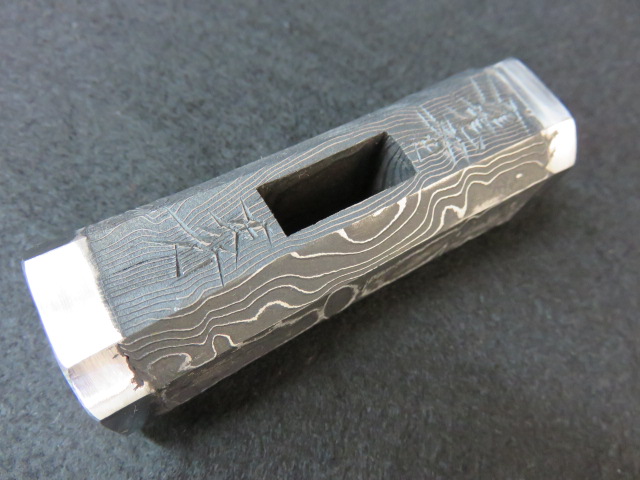
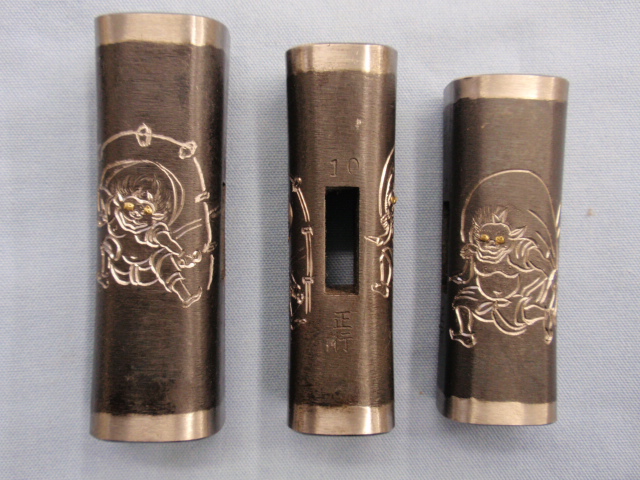
One of my favorite gennou is an 80monme square head with the figure of a monkey acid-etched on one side and some Chinese characters on the other referring to the patron god of those born in the Year of the Monkey, which I am. Sorry, I don’t have the hammer with me here in Tokyo, so no pictures. It was a gift from my Japanese Mother-in-Law (RIP) and so I value it highly although I don’t use it anymore.
She had it blessed by a Shinto Priest at the same time he came to perform the annual blessing of their book-binding factory in Sendai, so I consider it more of a good-luck charm than a working tool. It has not aged gracefully.
BTW, it’s not at all unusual for carpenters, construction companies and factories to have Shinto Priests perform similar ceremonies at least once a year to purify their tools and equipment and to bless their workplaces for safety purposes. Both of the large construction companies I worked for in Japan had Shinto “kamidana” shrines made of wood mounted high on the interior walls of their offices, and smaller ones installed at their major jobsites, to encourage deities and local spirits to protect the jobsite, people and tools, and to drive off malevolent spirits that might cause harm. Belt, suspenders, and safety harness.
Construction companies in Japan are especially old-fashioned this way. One large construction company I worked for in Japan was established 147 years ago, just a youngster by Japanese standards. Perhaps the oldest construction company in Japan is Kongo Gumi Co., Ltd. established in the year 578 AD. Other large and old Japanese construction companies include Kajima Corporation, established in 1840, Shimizu Corporation, established in 1804, and Takenaka Corporation, established in 1610. Long memories and deep traditions.

Of course, decorating a gennou head adds nothing to its functionality while significantly increasing cost, so highly-decorated heads are probably more suitable for ceremonial purposes, for displaying in a collection, or as gifts rather than practical tools. In fact, the older generation of Japanese craftsmen I learned from, now all either in their late 80’s and retired or passed on to the big lumberyard in the sky, considered such decorated tools frippery beneath the dignity of a respectable “shokunin” (a wabi sabi sorta thing) and would mercilessly rib someone who brought a gaudy tool to the jobsite or workshop.
Aging Gracefully
If you are considering purchasing a decorative gennou head, one factor you should seriously consider is the appearance of the head after many years of use. After all, a quality gennou head should be a lifetime investment and an heirloom tool. It may look as beautiful as Raquel in her fur bikini when new but will it look better than my scratched and rusty etched zodiac monkey head hammer after 20 years of use?

Some heads pictured in this article show a pattern-welded structure incorrectly called “damascus steel” in the West, or “suminagashi,” meaning “ flowing ink,” in Japan. This structure is not the famous damascus steel developed in the Levant centuries ago and made famous by swordsmiths. It is simply a mix of at least two different types of steel, one of which resists oxidation/discoloration (usually containing nickle) when exposed to an acid wash, producing a pattern. Theoretically, this construction neither improves nor harms the performance of the steel so long as the deferential hardening process is handled properly, but personally, while it looks fun, I distrust this material for gennou heads and blades that must do real work.

Other heads have received fancy decorative surface treatments that neither harm nor improve a hammer’s performance, supernatural effects aside. However, being decorative, one should consider the durability of such treatments. Chrome, nickel, copper plating, bluing, chemical pickling, or burnt-silk for instance, will not remain unchanged long in the case of a hammer used frequently on the jobsite or if laid on the concrete floor of a workshop frequently. Indeed, color case hardening, pickled finishes, paint, and even most bluing will look nasty and may rust before too long.
Perhaps the most durable surface finish is the black oxide that forms naturally on the steel surface during the heat-treatment process because it is reasonably rust resistant and naturally harder than the steel/iron it covers. It’s my favorite, but for some reason doesn’t seem to attract the ladies. Bummer. Decisions, decisions…
YMHOS

The following link is to a folder containing pricelists and photos of most of our products. If you have questions or would like to learn more, please use the form located immediately below titled “Contact Us,” or email us at Covingtonandsons@gmail.com.
Please share your insights and comments with everyone by using the form located further below labeled “Leave a Reply.” We aren’t evil Google, facist facebook, thuggish X or a US Congressman’s Chinese girlfriend and so won’t sell, share, or profitably “misplace” your information. May the bird of paradise fly up my nose if I lie.


All Posts in The Japanese Gennou Hammer & Handle Series
- Part 1 – Introduction
- Part 2 – Ergonomics
- Part 3 – What is a Gennou?
- Part 4 – The Varieties of Gennou: Kataguchi, Ryoguchi & Daruma
- Part 5 – Kigoroshi
- Part 6 – The Ergonomic Anaya
- Part 7 – The Unblinking Eye
- Part 8 – Head Style & Weight
- Part 9 – Factory vs. Hand-forged Gennou Heads
- Part 10 – Laminated Gennou Heads
- Part 11 – Decorative Gennou Heads
- Part 12 – The Drawing: Part 1/6
- Part 13 – The Drawing: Part 2/6
- Part 14 – The Drawing: Part 3/6
- Part 15 – The Drawing: Part 4/6
- Part 16 – The Drawing: Part 5/6
- Part 17 – The Drawing: Part 6/6
- Part 18 – Wood Selection
- Part 19 – Laying-out the Handle
- Part 20 – Making Sawdust
- Part 21 – Installing the Head
- Part 23 – Finishing the Job

 Covington & Sons Tools
Leave a reply to covingtonandsons Cancel reply