If a dog will not come to you after having looked you in the face, you should go home and examine your conscience.
Woodrow Wilson
The subject of how to use the face of your sharpening stone is so basic and seems so unimportant that few give it the attention it warrants. But it is not trivial: it deserves its own post because it can truly make a big difference in the time and money you spend sharpening.
Money Down the Drain
Instead of focusing his attention on the blade alone, a wise man will make a conscious effort to use the entire face of his sharpening stone from edge to edge, end to end, and corner to corner instead of digging an oval swamp in the center of it’s poor abused face.
This habit will help to keep a stone’s faces flatter over more strokes longer, saving time truing the stone, and extending its life thereby saving money.
Remember that you paid money for the stone, the entire stone, not just the hollowed-out oval area in the center most people create when carelessly sharpening. How much of a stone do most people throw away? Idunno,… 20% maybe? Assuming this approximation is correct, just for the sake of illustrating a point, if you paid $100 dollars for the stone, that means $20 was turned into mud and washed away without providing Beloved Customer any benefit at all. And don’t forget the time you spent cutting down those high spots to keep the stone’s face flat. That makes it more than a $20 loss if you count your time worth anything, which you should.
Why not use the sides, ends and corners of the stone’s face too?
Developing Good Habits
When developing these intelligent work habits, it helps to cross-hatch the stone’s surface with a carpenter’s pencil to help you keep track of the areas you have not yet touched. Never fear, for while industrial diamonds are made from graphite, the form of graphite in pencil lead is still softer than the finest sharpening stone and won’t affect the sharpening process a bit.
Also, before and while sharpening, frequently use a thin stainless steel ruler to check the stone’s face lengthwise and crosswise at various locations, and of course on the diagonals to monitor wear. Don’t guess, lazy bones, examine. Between ruler and pencil you may discover you have developed less-than-efficient sharpening habits. With some thought you will also figure out how to change those habits so your sharpening efforts will be quicker and more cost-effective.
Before long, you will be able to detect uneven wear and warpage fairly reliably without using either tool as much, so stick with it until you do.
Hang Ten
One conundrum you have probably already discovered is that it is impractical to use the extreme right and left sides and both ends of the stone’s face to sharpen a blade. Or is it?
Here is wisdom: Teach yourself how to sharpen a blade’s bevel with one corner of the blade hanging off the stone part of the time, alternating evenly and frequently between right and left corners, of course. Strange as it may seem this technique is effective at not only keeping your sharpening stone flatter and making it last longer, but for keeping the cutting edges of your blades straighter. If this doesn’t make sense to you, think about it real hard. Then give it a try and you will see what I mean.
And since you are taking short strokes anyway, why not work the blade crosswise at the ends of the stone? A lot of expensive stone going to waste there, I’d wager.
I hate to sound like a broken record, but you will find that making short strokes will make it much easier to use the entire face of the stone.
If you feel this post needlessly states the obvious, or is “verbose,” allow me to remind Gentle Reader once again that the purpose of this blog is not to provide entertainment, sell stuff, troll for clicks or to trip and roll subscribers into Google Analytics’ s*thole, but to help our Beloved Customers develop good work habits through education. Some of them are newbies, and others are old hands, but if I were to write only for the professionals then I would be neglecting the newbies, so if you know this stuff already please congratulate yourself and celebrate your good fortune by buying a new carpenter’s pencil.
YMHOS
If you have questions or would like to learn more about our tools, please click the see the “Pricelist” link here or at the top of the page and use the “Contact Us” form located immediately below.
Please share your insights and comments with everyone in the form located further below labeled “Leave a Reply.” We aren’t evil Google, fascist facebook, or thuggish Twitter and so won’t sell, share, or profitably “misplace” your information. If I lie may my face fall off.
My relationship to reality has been so utterly skewed for so long that I don’t even notice it any more. It’s just my reality.
Ethan Hawke
The Taming of the Skew
Beloved Customer has of course noticed that it is easier to keep a blade stable when sharpening its bevel if you skew it on the stone. There is nothing wrong with skewing the blade so long as you understand the natural consequences of doing so and compensate for them appropriately. In this article we will examine some of those consequences.
The first and most immediately obvious consequence of skewing the blade when sharpening it is that the blade tends to wear-out, or hollow-out, the center area of the sharpening stone’s face quicker. This is inefficient, wasting time and stones, but can be compensated for if you pay attention and work the blade evenly over the stone’s entire face, including the edges, ends and those pesky corners. BTW, this is not a kindly suggestion but a commandment.
Second, skewing the blade usually results in the nut holding the blade placing uneven pressure on it, with the natural result that the blade wears unevenly, and quite often, develops a skewed cutting edge. Think about it.
In addition, the leading corner is exposed to more fresher, sharper, larger grit particles (which cut more aggressively) than the trailing corner. As a result, the blade’s leading corner tends to be abraded more, causing the blade’s edge to gradually become skewed or rounded in shape over many sharpening sessions. This is definitely bad, and is often mistaken for the work of those devilish iron pixies, especially in the case of kiwaganna and other skewed-blade planes, causing self-doubt, mental anguish, and even piranha in the head (aka “going bananas“). But if you are aware this can happen, and pay attention, you can easily compensate for this tendency thereby avoiding months of expensive psychoanalysis by Dr. Alonzo and the need to consume pallets of his pretty purple pills.
Third, and I have no way to confirm this, I am told by the guys with microscopes that diagonal scratches at the extreme cutting edge leave it a tad weaker, causing it to dull just a bit quicker.
The way to remove problematic diagonal scratches, BTW, is to make the last few strokes on the finishing stone perpendicular to the cutting edge.
So in summary, habitually skewing a blade while sharpening it is not ideal and should be avoided, but is not catastrophic. It will make one’s sharpening efforts a little less efficient and may cause blades and stones to become distorted, but these negatives can be dealt with, at some cost.
Please read the quotation at the top of this article and consider whether or not your sharpening reality has become skewed without your realizing it. Your humble servant confesses, and Dr. Alonzo can confirm, that his was indeed skewed for a long time.
These aren’t things you wouldn’t have figured out for yourself eventually, Beloved Customer, but now, at least if you pay attention, you’re a few years ahead on the learning curve. In the worst case, at least ignorance isn’t an excuse anymore. And there’s always those pretty purple pills to take the edge off (ツ).
YMHOS
Shakespeare’s Shrew, Katherine Minola, played by Elizabeth Taylor in the 1987 movie. In this photograph she’s obviously watching someone skewing a plane or chisel blade while sharpening it. Clint Eastwood probably learned a thing or two about squinting from this lady.
If you have questions or would like to learn more about our tools, please click the “Pricelist” link here or at the top of the page and use the “Contact Us” form located immediately below.
Please share your insights and comments with everyone in the form located further below labeled “Leave a Reply.” We aren’t evil Google, fascist facebook, or thuggish Twitter and so won’t sell, share, or profitably “misplace” your information. If I lie may all my mental faculties become hopelessly skewed such that the only occupation I will be fit for is politics.
Festina Lente Doors in the Palazzo Vecchio, Florence, Italy
Long-term consistency beats short-term intensity.
Bruce Lee
We have discussed many details about sharpening in this series, and while this may be the shortest article of the bunch, it is by no means the most insignificant. For some it will be the most difficult technique to master, so classical references shouldn’t prove too onerous.
If Beloved Customer pays attention to their blade’s movement when sharpening, you will notice how each reversal of direction tends to cause the bevel to rock forward and backward on the stone’s face. And what happens when we let the blade go rock-n-rolla? That’s right, the crapulous bulging bevel rears its ugly head and spits stinky sticky stuff in our eye.
Using short strokes, somewhere around 1-½ inch in length, makes it much easier to keep the blade from rocking.
A Gentle Reader named Oskar observed that, following the logic in the previous sentence, shorter strokes result in more, not less, reversals in stroke direction, and therefore shorter strokes should lead to more rocking rather than less. I concur with Oskar’s analysis and conclusion, as far as it goes, and am adding the following clarification to avoid confusion.
A short stroke produces smaller changes in the angles of one’s joints during the stroke compared to the changes during a longer stroke, making it much easier to maintain the bevel at the correct angle on the stone’s face. In other words, the angles of the joints in hand, wrist, arm and shoulder change less during short strokes than in longer strokes, making it easier to manage joints and tendons yielding greater repeatability.
In addition, shorter strokes tend to focus one’s attention on properly indexing the bevel on the stone during each individual stroke, attention that tends to wander more during long strokes. It’s that darn badger again.
Please note that this analysis is simply your humble servant’s opinion, and perhaps not a weighty one at that because I am not a physician, nor have I conducted the physiological studies and dissections upon which a rigorous opinion should be based.
I know that making short strokes feels inefficient, and it is compared to a machine, but Beloved Customer is probably not a Cyberdyne Systems product with a titanium alloy combat chassis. However, with practice, you will find you are able to increase the distance and speed of each stroke, especially as your focus and hand-soul coordination improves and your wrists and elbows relax and become trained.
Long extravagant strokes on rough or medium grit stones are for sharpening axes and kitchen knives, not chisels or planes.
The exception to this rule is the finishing stone, as mentioned in the previous article.
Festina Lente
In conclusion, and in order to improve your classical education, let’s review our latin lesson from the previous article: “Festina lente” translates directly as “make hast slowly.” It is defined in the dictionary as “proceed expeditiously but prudently.” We chose to translate the phrase as “Slow is smooth; Smooth is fast. ”
At least two Roman emperors, one Pope, and the powerful Medici family of the City State of Firenze Italy, back in the days when emperors, popes, and noble merchants had real power measured in armies they controlled and cities and continents they ruled, thought these two words important enough to include in their mottos and coats of arms. The words even appear in the original French version of the tale of the “Hare and Tortoise.”
They are also relevant to sharpening if you are clever enough to understand why.
YMHOS
Bug-nibbled woodwork in the Laurencian Library in Florence Italy with the Medici’s motto of Festina Lente and the turtle with a sail carved into it.
If you have questions or would like to learn more about our tools, please click the “Pricelist” link here or at the top of the page and use the “Contact Us” form located immediately below.
Please share your insights and comments with everyone in the form located further below labeled “Leave a Reply.” We aren’t evil Google, fascist facebook, or thuggish Twitter and so won’t sell, share, or profitably “misplace” your information. If I lie may my food turn to ashes in my mouth (a very ancient curse indeed).
If you do not change direction, you may end up where you are heading.
Lao Tzu
When using rough stones ( ≤1000grit), and especially when learning basic sharpening skills, it is best to sharpen the bevel in one direction only, lifting the blade off the stone, or at least removing all downward pressure, on the return stroke. The reason for this seemingly inefficient movement is simply that, at least for most people, and until one’s hands and wrists beceome trained, trying to abrade the blade on both push and pull strokes is likely to cause the blade to rock creating the bilious bulging bevel.
There are certainly exceptions to this rule, and we actively encourage Beloved Customer to try to develop the concentration and muscle control required to sharpen in both directions on rough and medium stones, but be aware it may take some years. In the meantime, remember the ancient adage and imperial moto: festina lente, which we chose to translate as “Slow is smooth; Smooth is fast. “
Part of the difficulty of sharpening in both directions is the resulting loss of concentration: the swing of the thing and angle of the dangle are hard to sense. Perhaps another part of it is due to the difficulty of controlling the complicated and constantly-changing angles of bones and joints. Both of these natural mental and physical tendencies can be overcome by talented and determined people given time and daily practice, but in the case of everyone your humble servant has ever spoken with on the subject, it takes years of focused on-the-job practice, and extreme concentration at first to overcome pre-existing bad habits and to avoid developing importune muscle memory.
Which Direction?
At this point you need to make a decision, unless you have already made it inadvertently. That is, whether to sharpen on the push stroke (pushing the blade away from you) or on the pull stroke (pulling the blade towards you). Most people choose the push stroke, as do I, but in reality the pull stroke is actually a little more efficient because the pressure tends to focus closer to the bevel’s front instead of back, and rocking is reduced. Whichever direction you choose, use it consistently.
However, as mentioned in previous articles in this series, and this is critically important, when it comes to the final finishing stone, work the blade back and forth in both directions. The finishing stone is not abrasive enough to change the bevel’s shape, and since you need to polish the last few microns width of blade’s cutting edge, a very tiny amount of unintentional rocking is actually helpful.
Training Techniques
If Beloved Customer is determined to develop the ability to sharpen on both push and pull strokes, your humble servant can share some helpful guidance that was given to me many years ago by a sword polisher.
The first step in training yourself is to begin by lifting the blade from the stone’s surface entirely on the return stroke (either push or pull depending on your preferred direction). All the things mentioned above apply. Becoming proficient with this technique is foundational. Strive to project your senses into the blade traveling over the stone, indeed right down to the last few microns of the cutting edge, becoming Zen Master Bubba.
When you are able to create a sharp edge while maintaining a flat bevel consistently and without much concentration using this “one-way” technique, then move on to the second step, which is to keep the blade in contact with the stone on the return stroke, but relieve all downward pressure. Begin slowly with full concentration and strive for smooth motion. It’s at the transition from one direction to the other where Murphy will toss a banana peel under your heel.
And finally, when you have mastered the “light-touch” technique, try applying downward pressure in both directions, beginning slowly at first and with full concentration striving for smooth motion.
Remember, don’t grip the blade like a thrashing alligator, but hold it lightly in your hands like a small bird: too tightly and it will be crushed; too loosely and it will fly away.
Don’t lock your wrists or elbows, but actively and consciously rotate them to keep the blade’s bevel always perfectly flat on the stone (your stone is flat right, right?). This is very important.
And don’t forget to use your thin stainless steel straightedge and brass bevel gauge frequently to check the bevel for flatness and proper angle.
And as always, relentlessly beat down your inner badger, brutally crush and sow salt on bad habits, and don’t allow new bad ones to take root.
Sadly, this is a skill that, once learned, tends to deteriorate with time unless practiced frequently. As with cherry blossoms, muscles, tendons and eyes are neither static nor eternal. Setsunai, desu ne.
YMHOS
If you have questions or would like to learn more about our tools, please click the “Pricelist” link here or at the top of the page and use the “Contact Us” form located immediately below.
Please share your insights and comments with everyone in the form located further below labeled “Leave a Reply.” We aren’t evil Google, fascist facebook, or thuggish Twitter and so won’t sell, share, or profitably “misplace” your information. If I lie may my wife be plagued with runners in her hose.
When the show starts, I am in my SpongeBob stance, and I walk like SpongeBob, and the first step that I take, I am SpongeBob.
Ethan Slater
In this post in our series about sharpening Japanese woodworking blades, your humble servant will propose some useful stances and grips to employ when sharpening. I hope we can do a better job than Mr. Squarepants, at least.
Stances
There are several practical stances for sharpening, including standing, sitting on a bucket, a bench or a chair, squatting, kneeling on the floor, or sitting on the floor. With practice, all these stances can be made to work well.
When starting out, however, I think most people benefit from using a standing position with the stones placed on a workbench or table, or on a board spanning a sink.
Whichever stance you choose, locate and be conscious of your center of gravity, (usually just below your belly button), and try to keep it at the same elevation above the floor while moving the blade forward and back.
Flex your knee joints, and loosen your elbow joints and wrists, because locking up your wrists and elbows will make it impossible to avoid rocking the blade. This is important: You must actively concentrate on allowing your wrists to rotate so as to keep the blade’s bevel flat on the stone’s face, because it won’t happen by accident, or because Jesus loves you.
In the case of a normal resharpening job, instead of a major repair, remember the goal that craftsmen have endlessly sought for thousands of years: to abrade and polish the last few microns of steel at the extreme cutting edge, using the flat bevel as an alignment jig.
But don’t let yourself get lost in the weeds; Focus on abrading and polishing the entire bevel. If you do so, the last few microns, which the human eye can’t see, will be in good shape.
Focus the majority of your finger’s pressure on the extreme cutting edge, and less on the rear of the bevel, but without lifting the rear of the bevel off the stone. In the case of Japanese blades, the rear of the bevel is all soft jigane iron and will take care of itself. Yes, it is a balancing act. Yes, it takes focus. Yes, you will make mistakes, overbalance, gouge the stone and mess up the cutting edge a time or two. Everyone since the day the first caveman tried to grind his stone axe on another stone has made that mistake, so don’t worry about it. Remember, you fell off your bicycle the first few tries, scraped your knees and elbows, survived, and now ride like the wind! Yiiiiiihah!
Get a Grip
The way you hold your plane or chisel blade when sharpening it will influence the quality of the results and the stress on your hands and wrists, so it is worth paying attention to.
There are as many was to hold a plane or chisel blade when sharpening as Baskin Robbins has ice cream flavors. And like ice cream, none are right or wrong, except Burgundy Cherry, which of course is superior to all others (ツ)。 In the interest of brevity, we’ll only consider three grip methods here. If you are not using them now, give each a try over a couple of sharpening sessions to see if they are an improvement or not. Feel free to adapt these or develop your own.
The Gorilla Grip
First, let’s examine what I call the “Gorilla Grip.” With the plane blade resting ura facing up, the blade’s long axis pointing at 11:00, and the cutting edge furthest away from you, grip the blade’s sides with your right-hand’s thumb on the left side, ring finger and pinkie on the right, the tip of the middle finger resting on the right corner directly behind the cutting edge, and index finger extended alongside the middle finger. Then lift the blade and roll your ring and pinkie under it.
Rest the tip of the ring finger of your left hand on the left corner directly behind the cutting edge, with your middle finger and index fingers extended and their tips resting adjacent.
Extend your left palm over your right thumb’s last joint, and wrap your left thumb under the blade. You are now ready to rock-n-roll, without the rocking and rolling motion
The advantage to this grip is that it is very strong, ergo “ gorilla.” The downside is the blade tends to end up skewed on the stone because the right wrist must be twisted to keep the blade straight. Also, because the wrist joints are at very different angles with respect to the blade, and it is easy to apply a lot of force, extra care is necessary to keep the wrists firm but loose and rotating in harmony.
Notice how thumbs are poised to fit under the blade’s headFour fingers pressing down on the blade’s ura as close to the cutting edge as reasonably possible.Finger position on a chisel. The left hand thumb passes under the blade’s neck supporting it vertically, while the pad presses against the neck’s right side. The right hand thumb passes over the top of the neck, restraining the tool vertically, and presses against the neck’s left side firmly securing the neck between both thumbs. More fingers can press down on the ura in the case of wider blades. Conversely, only one finger can press on narrow blades.
The Three-finger Grip
The other grip is one I call “three-finger,”(指三本) after the most proper way of bowing in Japan when seated directly on the floor (preferably tatami mat) in the “seiza” posture with legs folded underneath the body, both hands touching side by side with the pads of three fingers of each hand extended and touching the floor in front of the knees, and the thumbs and pinkies tucked out of sight. Very proper, especially for elegant ladies.
In the case of the three-finger grip, the blade is oriented directly in front of and on the body’s centerline with cutting edge located furthest away. The hands hold the blade in a more symmetrical fashion than the gorilla grip, with the middle and index fingers pressing down on the blade’s corners closest the cutting edge (depending on the space available), with the thumbs curled under the blade’s head (end opposite the cutting edge), and either the ring fingers or pinkies touching the blade’s sides to assist in lifting it.
The advantages to this grip are less tendency to skew the blade, looser wrists, and better control of bevel angle. The disadvantage is slightly less power because it is harder to get the shoulders over the blade. This is the burgundy cherry version, in your humble servant’s opinion.
The Three-finger Monkey Grip
A hybrid of these two methods is one I call the “three-finger monkey.” Place the right-hand thumb alongside the blade’s left side, instead of under the head forming a combination of the gorilla grip and three-finger grip. This method provides a little more power than the three-finger grip, and less skew than the gorilla grip.
Is one of these grips best? It’s like riding a bike: None are wrong, but some work better than others.
In all three of these grips, most of the pressure will tend to focus at the blade’s corners which can create uneven wear on the ura and a rounded cutting edge. While this may be unavoidable, especially in the case of narrow blades, try to counteract this tendency by focusing the majority of pressure on the centerline of the cutting edge. It seems insignificant, but if left uncorrected, the resulting unbalanced pressure will cause the blade to wear quicker at the corners and become curved. Yes the blade is iron and steel and does not flex much, but it is a verifiable fact that the points where your fingers apply direct pressure will be abraded quicker.
There is a saying in Japan which is quite appropriate when talking about sharpening that says “Dripping water wears away stone.” In this case, just a little differential pressure from your fingertips will shape the blade over many weeks and many passes over the stone, wearing away both stone and steel in ways that can be either useful or not, depending on whether you are the sharp-eyed master of the process or the grunting badger. Please remain aware of this potential.
Chisel Grip
The grip I use on chisels is very similar to the grip for planes, and varies with width.
Like the famous Mexican weather babe Yanet Garcia, the chisel’s long handle shifts its center of gravity towards the butt making it a bit more difficult to manage, so a grip method that is absolutely stable in a single hand is advantageous.
Most solutions involve holding the chisel in the palm secured by middle finger, ring finger, and pinkie, with the index finger extended and centered right behind the cutting edge.
The index and middle fingers of the other hand can also be pressed near the edge and the thumb wrapped underneath the handle.
Polishing the Ura
Polishing a 70mm plane blade’s ura.
When polishing the ura of a blade, be it plane or chisel, make sure the stone is flat. If it isn’t, you will regret it later without realizing why.
Let’s look at a plane blade first. Notice in the photo above how my right hand is curled under the blade’s head supporting it while my thumb presses down on the bevel close to the cutting edge, a grip that makes it easy to apply a lot of pressure precisely while maintaining control of the blade.
Two fingertips of my left hand are pressing down on the bevel for a total of three pressure points. The thumb can press down as light or hard as you feel is necessary, but it typically applies the highest amount of pressure. It’s important the left hand fingertips apply equal downward pressure to avoid creating uneven wear (unless one corner of the blade specifically needs more pressure applied).
Try to remove nearly all the weight of the blade’s head from the stone so that all but a tiny amount of applied pressure is focused on the “itoura” cutting land at the blade’s extreme cutting edge. This too requires zen-like focus and strict control over one’s inner badger to avoid wearing notches into the ura’s side lands.
Move the blade in two directions at the same time: Mostly to and fro in line with the cutting edge; but also on and off the stone’s edge perpendicular to the cutting edge. This will help avoid wearing notches into the side lands, and produce a stronger cutting edge (IMO).
Keep the stone flat and reverse it frequently to ensure even wear and less wasted stone.
Concentrate your senses and develop hand-soul coordination : You are a leaf on the wind; Watch how you soar (Hoban “Wash” Washburne in Serenity). I hope you have better luck than Wash did…
In the case of chisels, I hold the handle in the palm of my right hand and place thumb and forefinger on opposite sides of the neck/shoulders pinching it between them. I place the tips of the fingers of my left hand on the bevel, and move right and left hand together. And as in the case of plane blades, I move the blade both forward and backwards and left to right at the same time.
Give it a try. What do you have to loose?
In the next post in this series on sharpening, we will look at which direction to sharpen. Few give this matter any thought, but most should.
YMHOS
The intrepid bucket of bolts Serenity.
If you have questions or would like to learn more about our tools, please click the “Pricelist” link here or at the top of the page and use the “Contact Us” form located immediately below.
Please share your insights and comments with everyone in the form located further below labeled “Leave a Reply.” We aren’t evil Google, fascist facebook, or thuggish Twitter and so won’t sell, share, or profitably “misplace” your information. If I lie may I grow a lucky third nose.
It is well with me only when I have a chisel in my hand – Michelangelo Buonarroti 1475-1564
The fool doth think he is wise, but the wise man knows himself to be a fool.
William Shakespeare, As You Like It
In the previous post in this series about sharpening Japanese tools, we looked at philosophical points such as making tools a long-term investment, as well as the upsides, downsides and causes of the beastly bulging bevel. In this part of the series, your humble servant will touch on a subject that will make thoughtful people think and unfuddle befuddled folks: The Double Bevel.
The Double-Bevel
Some people advocate creating double-bevels (primary and secondary bevels), or what is sometimes called “micro-bevels” on plane and chisel blades. Multiple bevels have three useful applications in your most humble and obedient servant’s opinion:
The first useful application is to repair a tool’s blade in the field when there is not enough time to do a proper sharpening job. For instance, if a blade dulls or chips in the course of a job, we can quickly add a secondary bevel at a steeper angle to the blade’s primary bevel in a few seconds and get right back to work, but never forget there will be a price to pay later over many sharpening sessions to restore the proper bevel, so it is only a temporary solution at best, and certainly not a useful long-term solution;
The second application is to quickly adjust a plane blade’s angle to reduce tearout immediately when proper sharpening is not possible. Once again, a lot of remedial sharpening becomes necessary afterwards. This application is usually restricted to the primary bevel, but we will look at a more esoteric and risky application below.
The third application is to efficiently restore a blade’s bevel to the correct angle in the case where pixies or our inattention has made the blade angle too shallow.
Case 3 above often goes like this: A blade that had cut well suddenly starts dulling quickly, maybe even chipping. Whiskey tango foxtrot!?!
When this happens, our Beloved Customers, being of exceptionally high intelligence, use the bevel angle gauge described in Part 11 of this series to check the bevel angle. They may discover the bevel angle has become too shallow for the wood it is being asked to cut.
We could increase the bevel angle by welding metal to the bevel and regrinding it, but such barbaric behavior would ruin the blade, so the most expedient way to correct the bevel is to add a steeper secondary bevel at the desired angle. We can grind this new bevel by hand, or by using a honing jig like the Lie-Nielson widget. I find I can apply more downward pressure using this jig to get the job done sooner and more precisely.
Honing jigs are undeniably useful, but they too often become an impediment to learning professional sharpening skills, and they are more time-consuming to use than freehand sharpening. Jigs can certainly make the sneaky snake of multiple bevels manageable, but please don’t ignore the inescapable fact that if one uses a jig properly, over multiple sharpening sessions the result will be… let me think about it…. wait a second while I make a little sketch here…. oh yea, a flat bevel. Hmmm….
Hey, I’ve got a crazy idea: When performing routine sharpening (not the 3 cases listed above), instead of taking shortcuts and adding micro-bevels which turn into secondary bevels and maybe even bulging bevels, why not start with a flat bevel and keep it flat? And then just maybe we could take advantage of the natural indexing properties of that flat bevel to sharpen freehand and save a lot of time NOT setting up honing jigs, or polishing skinny secondary bevels or fat bulging bevels? You know what, it just might work!
A honing jig is very helpful for making big angle corrections. I own several, but the Lie-Nielson model is my favorite: I use it every third blue moon. If you decide to use one, however, reserve it for emergency or drastic measures. Don’t let it become training wheels, kiddies.
The Nano-bevel
In this and previous posts we discussed bulging bevels, which are convex bevels on plane or chisel blades; secondary bevels and double bevels, which are additional bevels; and micro-bevels, which are a tiny secondary bevel. But there is another type of secondary bevel a clever Beloved Customer called a “nano-bevel.” I like this term and so will use it, but I caution you that, like all secondary bevels, you should employ this bevel judiciously.
We will go into freehand sharpening techniques in greater detail in future posts, but to avoid confusion when discussing the nano-bevel, we need to touch on some of those techniques now.
You may have noticed that, when sharpening freehand on every stone but the finish stone, most, but not all people do a better job by applying downward pressure on the blade only on either the push stroke away from their body or the pull stroke back towards their body, but not in both directions. This is because placing downward pressure in both directions tends to make the blade rock resulting in a less-than-flat bevel, or Saints preserve us, the barbaric bulging bevel. As you can imagine, if this rocking motion gets out of hand on the rougher stones the bevel angle can get out of control quickly resulting in unsightly bulges even the best elastic girdle can’t conceal.
However, on the finish stone, it is most efficient to apply light downward pressure in both directions. The advantage is that a teeny tiny bit of rocking helps to ensure the last few microns of the blade’s cutting edge are thoroughly polished. And because the abrasive power of a finish stone is so small, there is no danger the bevel will become rounded, at least if you don’t get carried away. From the wood-shaving’s eye view, this creates a tiny bevel at the last few microns of the cutting edge. This is one example of a “nano-bevel.” Stropping produces the same result on a larger scale.
There is also another type of nano-bevel for emergency use.
When using a finish plane on wood with twisty grain you have no doubt experienced frustrating tearout. The usual litany of solutions is to reduce the blade’s projection for finer depth of cut, skew the plane, oil and adjust the chipbreaker, resharpen the blade, adjust the plane’s sole and mouth, or even slightly dampen the wood with a planing fluid such as water, whiskey, or unicorn wee wee. All these methods can help.
Emergency Nano-bevel Modification
Another classic solution to reduce tearout of course is to use a plane with a steeper blade bedding angle, but what to do if you don’t have a high-angle plane handy?
A traditional, jobsite-expedient solution used by Japanese woodworkers is to create a nano-bevel on the ura side of the blade. This is accomplished during sharpening while polishing the ura on the finishing stone by lifting the head of the blade just a itsy bitsy teeny weeny nat’s buttfuzz thickness during the final stroke, pulling the blade towards you, of course, creating a “nano-bevel” on the last few microns of the cutting edge at the ura, effectively changing the approach angle of the blade.
Be forewarned that this is only for emergency use, and that if you overdo it, or do it too often, the nano-bevel will become a microbevel in a bad location, your blade will be damaged, efficient sharpening will become impossible, the chipbreaker will cease to function, and the gods of handsaws may curse you so all your hair falls out and your dog barfs on your shoes! Or is it your dog’s hair will fall out and you will barf up shoes? I forget.
Now where did I put that jar of planing fluid….?
Planing Fluid
Allow me to explain what “planing fluid” is and why I use it. This term refers to moisture applied to the surface of the wood to reduce tearout when planing by either hand or machine.
The good Lord designed trees to move water from the ground into the sky, so wood loves water. When a tree is cut down it immediately begins to loose cell water making the wood lighter in weight and much harder and stiffer structurally. But it still loves water.
If we apply a little moisture to the surface of a board the wood’s fibers become slightly softer, more flexible and less likely to develop tearout when planed, at least temporarily. The moisture is usually applied with a damp rag. Not too much, now!
Regarding the moisture source, water works well and is priced right, but it may dry slowly and produce inconvenient side effects. Unicorn products are dreadfully expensive nowadays, even on Amazon, so I prefer a smooth, inexpensive, industrial-grade busthead. Please ask Ken Hatch for a demonstration and recommendations for a good planing fluid next time he invites you over to his house for his world-famous tacos.
Please note that I don’t drink any planing fluid other than water. Of course unicorn wee wee is more addictive than OxyContin and drives mortals quite mad. And alcohol is yeast pee pee and deadly, but I prefer whiskey for a number of reasons.
Whiskey has a good water/alcohol ratio that wets the wood about the right amount and then evaporates cleanly. Too wet and it penetrates too deeply and can discolor the wood. Too dry and it evaporates too quickly.
I used Isopropyl alcohol when living in the US where it is dirt cheap, but it is considered a pharmaceutical in Japan and so is very expensive, another convenient case of collusion between manufacturers, retailers and government to fix prices. As with other alcohol products not intended for internal consumption, it contains actual poisonous additives demanded by greedy governments for the sole purpose of maximizing tax revenues. I don’t need those poisons touching my tools or my skin. Cheap whiskey, however, doesn’t contain such poisons (other than alcohol, of course), it’s cheaper and smells better.
Conclusion
A wise man will seek to avoid shortcuts that save a bit of time short-term only to waste more of his time and money long-term. If you simply make the effort to invest in basic sharpening skills, pay attention, and keep the bevel flat, time, steel, and stone-wasting monkeyshines such as double bevels will be unnecessary.
We have talked about the cutting edge’s proper shape. Beginning with the next post in this series, we will examine how to use sharpening stones to make it that way.
YMHOS
Well dudes and dudettes, I’m done sharpening using my most excellent honing jig for now and am off to the beach! Don’t wait up.
If you have questions or would like to learn more about our tools, please click the “Pricelist” link here or at the top of the page and use the “Contact Us” form located immediately below.
Please share your insights and comments with everyone in the form located further below labeled “Leave a Reply.” We aren’t evil Google, fascist facebook, or thuggish Twitter and so won’t sell, share, or profitably “misplace” your information. If I lie may my blade bevels multiply exponentially.
Outside of a dog, a book is man’s best friend. Inside of a dog it’s too dark to read.
Groucho Marx
Natural sharpening stones are wonderful things. At least the good ones are. Finding one that works well with our blades and sharpening style is a thrilling experience and a source of long-term joy. Such an excellent stone can be hard to find and will often be expensive, but whether dirt cheap or worth rubies, it will be delicate and need protection.
In this article we will examine some methods to ensure your natural sharpening stone provides you long reliable service. Your humble servant suggests you read this article aloud to your favorite stone to gauge its reaction. If you pay close attention, you may even see it wiggle just a tiny bit with gleeful anticipation, especially when you get to the parts about calligraphy, color selection, and skirts. Stones can be very fashion conscious, you know.
The Weaknesses of Natural Stones
The first thing to keep in mind is that Japanese natural stones are pieces of sedimentary layers that formed on the bottom of the ocean, essentially red-hot dust violently spewed high into the atmosphere by volcanoes, sifted and sorted by wind and waves and distance, and laid down on the seabed like pages in a book. They have defects even if you can’t see them. They naturally have top and bottom surfaces as well as side/end surfaces where the layers are exposed. Water tends to soak in-between these layers exposed at side and end surfaces sometimes causing the layers to separate and even crack in heartbreaking fashion.
Combined with the relative softness of the mineral particles, this structure makes most Japanese natural sharpening stones fragile.
The Stone Base: Objectives and Materials
So what can we do to avoid and/or mitigate these risks to our precious stones to ensure they are happy and will last a long time?
My first Ipe stone base. You can see the grooves on the surface cut for decking purposes.
The most important thing you can do to protect your stone is to make a durable base, and to attach your stone firmly to it. The base provides several benefits:
Seals the stone’s underside from water penetration, reducing the potential for separation and cracking;
Provides structural support reducing the risk of cracking, especially as the stone becomes thinner;
Makes the stone easier to handle, reduces the chances of dropping it, and protects it to some degree from bangs, dings and chipping;
Makes the stone more stable in use.
There are several options for materials from which to make a base. Probably the best material on paper is high-chromium stainless steel. I have never made a metal base but some friends have.
Most people, including me, choose to make their stone bases from wood; It’s the classic choice, but it has some downsides. For instance, it can warp, crack, rot and bugs might turn it into both home and dinner. So if you select wood be sure to choose a suitable species and develop a base design that sidesteps these shortcomings.
Most woods will work. I enjoy experimenting, so at various times I have made and used stone bases made from White Oak, Hinoki, Alaskan Cedar, Honduras Mahogany, Teak, and Ipe. Alaskan Cedar is an excellent wood for this purpose, but the best wood so far has been Ipe. It’s amazing: dense, but tough; It absorbs very little water and won’t crack or rot; Once stable, it doesn’t warp. At all. Bugs hate it. I love it.
Roppongi Hills Mori Tower Building, Tokyo
So how did I learn about Ipe? An architect specified Ipe to deck an exterior engawa at a balcony on a commercial project I managed some years back, so I decided I had better investigate this material on the Client’s behalf. What I found in various installations in Tokyo and Yokohama was eye opening. A good example is the Ipe decking installed at Roppongi Hills Mori Tower in Tokyo. This building was completed in 2003. I worked out of a Client’s offices in this building off and on for 5 years.
The exterior wooden deck at RH is exposed to more nasty weather conditions than a postman, not to mention heavy foot traffic, but although it has turned grey, it has not split, warped, or rotted. The screws are still tight, and the surface shows very little wear despite several thousand people walking across it each day. Tough stuff.
The Viewing Deck at the top of Roppongi Hills Mori Tower in Tokyo. The deck around the perimeter is planked with Ipe wood. The photo below is a closeup of this durable material, installed in 2002. The building is 238 meters (781 ft) tall with a floor space area of 379,408 square meters (4,083,910 sq ft) in the tower portion, making it one of the largest buildings in the world.
So around 2010 when I bought my last replacement stone, I bummed a couple of decking cutoffs a local lumberyard had been using as stickers directly on the ground for years. The wood was wet and muddy, but still in good shape. I laminated them together to make the base pictured above. It has been better than any I made before that time.
A few years ago, I did another building with an exterior Ipe deck, this time in Yokohama. The decking subcontractor had mixed in two very dark, almost black pieces of Ipe that didn’t match and at all. At first glance I thought they were ebony. I had the subcontractor replace them for aesthetic reasons. Instead of throwing the boards away (they were already cut to irregular lengths), I scrounged them and made a second base for my favorite natural stone. Once again, excellent performance. Testing is complete.
The Stone Base: Design and Fabrication
Before you start cutting wood for your base, first flatten the bottom of your stone. It doesn’t need to be perfect, but you want at least 75% contact. A carborundum stone or diamond plate will work fine, but a cheaper and easier option is to rub the underside of the stone on a section of concrete sidewalk wet with running water from a garden hose. Be careful to choose a place with low foot traffic because the concrete can become polished and quite slippery as a result.
Depending on the shape of the stone, you may want to grind off rough spots and projections on the sides and ends too. Be careful when you do this to prevent spalling and other damage.
If the stone has visible cracks, let the stone dry in a warm dry location for a few days, then apply masking tape to both sides of the crack, and carefully soak a few drops of super glue deep inside. Hopefully this will prevent the crack from promulgating further.
Now that you have the stone’s final dimensions, make the base. Whatever wood you choose, select quartersawn pieces if possible for maximum stability against warpage, or laminate the base if not. Regarding dimensions, it needs to be thick enough to resist flexing much when pressure is applied during sharpening, and long enough to remain stable when pushed back and forth. Shape the ends so water runs off. Thicker is usually better than thinner.
Stone bases in Japan are typically made with a raised foot at each end as seen in the two examples here. These feet have several purposes. First, compared to a flat board, they help keep the base stable on uneven surfaces by spanning irregularities. I promise it’s very irritating to have the base rock in use. Second, they make it easier to correct wind in the base if it warps a little. And third, if the feet are laminated to a flat base, the difference in the grain helps to reduce potential warpage. It really does.
You can make the base as attractive or as utilitarian as you like, but avoid creating too many nooks and crannies for stone mud to collect in. The base pictured above retains the beaded profile cut into the wood’s upper surface to drain water from a deck, and it does drain water away from the stone effectively, but mud tends to collect in between the grooves. Not a fatal flaw, but it takes a few extra seconds with a brush to clean.
Be sure to chamfer or round-over all the edges and corners
Place the stone in the exact position on the base you want it to remain forever and mark the stone’s perimeter on the base.
Sand the wood directly underneath where the stone will rest. Don’t sand with the grain, but diagonally to create a cross-hatched rough surface. Completely remove any dust and wipe well with acetone or lacquer thinner.
Apply masking tape to the wood base at the outside of the stone’s outline.
Place the stone right side up on a flat surface and wrap, bend and fold a single strip of thin cardboard or manila file folder paper tightly around the stone’s sides and ends and secure it in place with masking tape to form both a skirt that seals tightly against the surface, and a reservoir to contain the epoxy used to glue the stone to the base.
Mix up some 2-part epoxy, enough the fill the reservoir at the stone’s underside plus a little extra. You want the epoxy to be thick, not runny. Any epoxy that will allow plenty of working time will do.
Force a little epoxy deep into the wood grain and sandpaper scratches with a small spatula or wood stick. Next apply the same epoxy to the bottom of the stone with your little spatula, and forcefully drive it into the nooks and crannies.
Pour the remaining epoxy into the reservoir you created at the bottom of the stone all the way to the brim.
Without letting the epoxy harden or flow out, flip the stone over and set it in the prepared position on the base in precise alignment with the masking tape outline you created earlier. Wiggle the stone a little to work any air bubbles out, and push the stone down hard until you sense it is contacting the wood.
Once the epoxy starts to set and become rubbery, but before it hardens, run a razor knife carefully around the stone’s perimeter cutting just a tiny bit into the wooden base, and then peel up and remove the masking tape and any epoxy squeeze-out. Be warned: this will be an armor-plated, DMV-style nightmare to cleanup later if you wait until the epoxy sets hard.
After the epoxy sets, finish the base with whatever material appeals to you. I soak mine in polyurethane thinned 100% and wet sand several times. I then wipe off any PU that remains on the surface. I guarantee you that any finish material you apply that remains on the wood’s surface will fail and look nasty after a few years of use.
I also like to apply a thin coat of Titebond Type III glue to the underside of the feet and base just for good measure. Does it make a difference? I dunno, but I’m a belt, suspenders, and full-harness kinda guy.
My second Ipe stone base. Naturally black as ebony and almost as heavy. I wanted an unusual but subtle shape, one that could not be produced by power tools, so I made the far ends straight, transitioning into a radius at the base’s top surface. This stone is an irregular shape but it does wonderful things to steel. I’m sharpening a Keisaburo 70mm blade using all the stone’s surfaces.
The Stone: Protecting and Reinforcing the Sides
It’s important to limit water from soaking into the stone’s sides along the sedimentary layers to prevent separation. In Japan it’s SOP to paint the sides with natural urushi lacquer, a toxic tree-sap that loves water and doesn’t easily chip. This material may be difficult to obtain outside of Japan or China, I fear.
Another option is an extremely high-solids (aka “goopy”) natural urethane paint made from cashew tree sap called “Cashew.” The material is used extensively in Japan as a replacement for nature urushi lacquer because it is less expensive, much easier to use, and more resistant to UV ray degradation. It’s made in Thailand and sold in Japan, but it may be difficult to obtain outside Japan. Or you can just use a commercial high-solids urethane.
To use Cashew or polyurethane, clean the stone and let it dry thoroughly. I mean really super dry.
Thin the Cashew or PU 10:1 with the special thinner Cashew sells, or high-quality professional-grade mineral spirits. The crap sold at Home Despot sucks.
Apply a coat of this thin finish with a brush and let it dry. It should dry quickly. Repeat at least 5 times. The mixture will soak into the stone to form a tight bond, seal cracks and pores, and serve as a primer for subsequent coats.
Whatever finish you use, it is best to apply the manufacturer’s recommended primer, or at least a thinned initial coat of the same finish to the stone’s sides and ends so it will penetrate thoroughly into the cracks and crevices further reinforcing the stone. Subsequent coats should adhere well to this primer coat if applied before it cures entirely.
Any color will work. I have a habit of painting any tools I might take to a demonstration or jobsite orange. It seems to stunt darwinian leg growth. Besides, orange was the color of the first GC I worked for back in Las Vegas many moons ago and it brings back pleasant memories. They painted everything orange.
One other thing some people do to reinforce their stones is to apply a strip or two of washi paper (traditional Japanese paper made from mullberry tree fibers) to the sides and ends using urushi lacquer, or whatever material they used for the stone. Despite being paper, washi is made from continuous fibers and is surprisingly strong.
Some people go so far as to use washi with printed images or calligraphy on it, and apply a clear coat of Cashew over the top so the printing is visible. I have never done this before, but it does look interesting.
Here is a link to a blog by an artist named Mr. Kobayashi about his sharpening tools with some photos of pretty stone bases. It is written in Japanese, but the pictures are informative. Not sure how well Google Translate would work.
The Stone: Storing & Transporting
Finally, I recommend you wrap your natural stone and its base in clean cloth or newspaper immediately after each sharpening session, while it is still wet, to protect it from dust and dings. After it has dried, store it in a box with a lid. A wooden box is nice, but a plastic one is more practical.
Here’s a link to a video about making a simple traditional Japanese tool box from softwood. If you haven’t made one of these before, they can be fun and quite useful. They guy in the video uses mostly powertools, and the construction is basic, but it’s all that’s really needed. This style of box was once standard among all construction trades in Japan but you don’t see them much nowadays because the plastic ones are more durable and much better suited to loading/stacking onto construction vehicles.
The high-impact plastic box pictured below is one I use for my sharpening stones. Manufactured by Reese in Japan, it has “Tool Box” heat stenciled into the side. Tougher than boiled owl and stackable, these containers will keep the contents dry no matter how hard it rains so long as the water level stays below the lower lip of the lid. Spring clips at each end do a great job of keeping the lid closed and attached even if the box tumbles off the back of a moving truck onto the road. The road rash will be bad, but the tools will stay inside. The problem is the truck following too closely behind…. Don’t ask me how I know. (ಥ_ಥ)
A Reese brand toolbox. Made of high-impact plastic, these boxes are tough as boiled owl. Rainwater can’t get in, but water vapor can get out. And because they have a standardized footprint, they are stackable so they ride well in the bed of construction vehicles. Just make sure they are strapped down (ツ). This type of portable toolbox has almost entirely replaced the traditional wooden carpenter’s box for practical reasons.
YMHOS
If you have questions or would like to learn more about our tools, please use the questions form located immediately below. Please share your insights and comments with everyone in the form located further below labeled “Leave a Reply.” We aren’t evil Google or incompetent facebook and so won’t sell, share, or conveniently and profitably “misplace” your information.
For everybody in their busy lives, you need to invest in sharpening your tools, and you need to invest in longevity.
Ryan Holmes
In the previous article in this series about sharpening tools we looked at why and how to true the ura, the hollow-ground area on Japanese chisel and plane blades. This post will focus on the opposite side of the cutting edge: the bevel. This discussion is relevant to all plane and chisel blades, not just Japanese tools.
Preface
Before we dive in, your humble servant must clarify something.
Beloved Customers and Gentle Readers that have been blessed with the opportunity to learn about tools from accomplished Japanese craftsmen, as was I, or that have figured them out on their own, and consequently find this or other of our articles boring, should remember that the primary purpose of these scribbles is to provide instruction to our Beloved Customers, some of whom have not had similar opportunities.
These Beloved Customers are located in many countries and range in experience from newbies to professional woodworkers, so it would be unkind to dumb the explanation down to make it easy for newbies to follow but useless to professionals. The inverse is also true. The result is more comprehensive explanations than advanced and impatient Beloved Customers sometimes find enjoyable. Life is a bowl of cherries and half of it’s pits. I humbly request your kind indulgence on behalf of those who may benefit from extra words.
Investing in Longevity
The quote above by Mr. Holmes is applicable to the all the principles of sharpening I have described so far in this series. He is a computer dude, not a building contractor, joiner or furniture maker, but it is no coincidence he chose to use handtool terminology: it is encoded in human DNA.
His first point is a self-evident admonition, but what about this “investing in longevity” stuff? By definition, an investment is an expenditure of time, resources and/or effort intended to produce a return greater in value than the expenditure. Then how do we go about investing in the longevity of our chisels and planes, and what return should we expect?
While simply grinding sharp edges on our tools helps with making things from wood, I don’t see it as an investment in tools. Rather, if we train ourselves in professional sharpening techniques, and use those techniques to maintain our tools so they function more efficiently and last longer, we can hope to obtain a quantifiable real-world ROI.
The investment your humble servant encourages you to make, therefore, is not in stuff or lucre but in yourself, in your own skills.
The Pros and Cons of the Bulging Bevel
The “bulging bevel,” as I call it, is a deformation too frequently seen in plane, chisel and knife blades. It is simply a cutting edge bevel that is protruding and convex instead of flat. In most cases a bulging bevel can make it difficult to properly sharpen a blade adequately, so it deserves our attention.
Most bulging bevels are born unintentionally and are harmful, but indeed some are hatched with a purpose in mind. Let’s examine the pros and cons, and throw in some half-baked scientific results just for fun.
The geometry of the bulging bevel is clearly superior in a few applications such as carving chisels and knives used in a gouging or scooping motion where a rounded bevel provides better control in the cut. Another valid application is chisels used for cutting large and deep mortises where a rounded bevel helps pop out waste easier. Only timber framers cut these kind of mortises, however, and most of them use machines to at least rough out the mortises nowadays.
Hidari no Ichihiro 42mm Oiirenomi. Nothing obese about this sweetheart’s bevel.
Our Beloved Customers are, without exception, extremely intelligent people, so right now some are no doubt saying to themselves: “Self,” (that’s what BCs call themselves when they silently cogitate matters of great weight) does a rotund bevel make my blades sharper or duller?” Let us consider some scientific results.
Experimental Results
When I was a grad student in Japan, a fellow student wrote his thesis on the efficacy in plane blades of the bulging bevel versus the flat bevel in plane blades. He developed experiments, fabricated testing apparatus, and used scientific methodology and microscopic photography yielding indisputable results. We repeated some of his experiments, discussed his research, pored over photographs and fondled shavings late into the evenings at his lab in Building 11 at the University of Tokyo’s Hongo campus as I drank coke and he drank sake. I’m not sure he made it home some evenings.
The conclusion he reached was that, from the viewpoint of the wood, and based on the classic sharpness test of cutting rag typing paper, there is no difference in the cutting performance between flat and bulging bevels, so long as two conditions are met: (1) Both flat bevel and bulging bevel are sharpened to the same angle and same degree of sharpness where they meet the test medium (paper); and (2) The bulge is not so large as to interfere with the cut. The “same degree of sharpness” condition in proviso 1 is critical to this discussion.
Let’s examine the cutting edge closely. It’s effective scope is only the last few microns (μ) or so of the blade’s width at the extreme edge. 1μ = one millionth of a meter. A human hair is 90μ in diameter. We need to precisely repair and polish this narrow strip of steel using our sharpening stones, but remember that working anything beyond this strip contributes nothing to making the blade cut well.
Here’s an important point that can be learned from a careful examination: Given the same number of strokes to the same blade on the same stones over the same amount of time, it is difficult to make a bulging bevel as sharp as a flat bevel, unless one spends the time to use a sharpening machine and jigs as my grad school friend did during his research.
But the most important point, and one I want you to grasp violently with both hands, at least two legs, and all your teeth is that the time expended and amount of stone consumed when sharpening to a set level of sharpness at the last critical microns of a bulging bevel’s cutting edge is huge compared to a flat bevel. Sharpening using machines and/or honing jigs takes even longer.
In addition to time and cost, another factor we must consider is certainty, because if we are going to invest the time and stones to sharpen a tool, we need to be sure it will consistently achieve approximately the same level of sharpness every time. Unfortunately, the sharpness of the bulging bevel is often uncertain because, instead of guiding the blade to ensure consistent contact between steel and stone at the critical location on the cutting edge, the shape of the bulging bevel causes us to waste a significant number of strokes and time on polishing an irrelevant mound of metal that does nothing to make the blade sharper, but is simply in the way. Not convinced yet?
Consider the undeniable fact that, despite your best efforts, this miserable lump causes the blade to rock around on the stone’s surface like a boat over ocean swells, with the result that, given a fixed number of strokes, a high percentage of those strokes end up polishing the bulge instead of the cutting edge. This is important because, once again, the last few microns of the blade is the only part that actually does any cutting, not the bulge.
Please don’t misunderstand. I’m not saying that you can’t create a fiendishly sharp edge on a blade with an obese bevel. I’m also not saying that, within reasonable parameters, a convex bevel cuts less efficiently or dulls quicker than the same blade with a flat bevel. It absolutely doesn’t, as my fellow student’s research showed. Allow me to restate and summarize the facts so there is no confusion.
It takes longer to create a given level of sharpness at the extreme cutting edge of a bulging bevel than a flat bevel, all else equal;
It consumes more sharpening stone to achieve a given level of sharpness at the extreme cutting edge of a bulging bevel compared to a flat bevel, all else equal; and
There is greater uncertainty about the actual degree of sharpness achieved at the blade’s extreme cutting edge when sharpening a bulging bevel by hand compared to a flat bevel, all else equal.
If you doubt these statements, you must arrive at the truth yourself.
Buy or borrow a quality loupe or microscope with enough magnification to detect the scratches left by your usual finishing stone. Start with a dull blade with a truly flat bevel, sharpen it freehand using a pre-determined number of strokes, and observe the scratches at the last few microns of the cutting edge with your microscope. Then test the blade’s sharpness with your skin or fingernail. Next, repeat this test with a dull blade with a rounded bevel using the exact same sharpening tools and procedures and the exact same number of strokes. No deviations. Once again, observe the scratches and test the sharpness. My grad school friend and I performed this side-by-side experiment at the University of Tokyo several times, with consistent results. Actually, it was a bet and I won. He had to buy the drinks and snacks for a month.
The Causes of Bevel Obesity
Besides pernicious pixies, the most common cause of bevel bulge is simple carelessness, which Beloved Customer can take steps to avoid once you realize the causes.
It is human tendency to try to stabilize the blade’s bevel on the stone while sharpening by applying more pressure on the rear half of the bevel, resulting in the rear half of the bevel (which is all soft jigane in the case of Japanese plane blades, and mostly soft jigane in the case of chisels) being abraded quicker than the front half (which contains the harder steel lamination), causing the bevel angle to gradually decrease or even become rounded. Even the best craftsmen make this mistake sometimes.
To avoid this tendency, train yourself to focus pressure on the front half of the bevel closest to the cutting edge. At first, you may overbalance and dig the cutting edge into the stone a few times, but with practice and attention, it will become second nature. It is almost a meditative process. Every professional woodworker worth his salt must learn this skill.
There is nothing wrong with making mistakes when learning a muscle memory skill like freehand sharpening, but too many people can’t be bothered to learn, and then become frustrated when their skills don’t improve immediately. In the end, they become defensive, twist themselves into knots defending their inadequate techniques, and eventually adopt the self-justifying position that sharpness is overrated. Patience, grasshopper.
BTW, don’t forget to use your handy dandy brass bevel gauge to both check the bevel angle while sharpening and to keep those piratical pixies away.
Hidari no Ichihiro 30mm Atsunomi. What ignorant, smelly savage would grind multiple bevels on this work of art?
Another cause of the tumescent bevel is the use of secondary bevels or micro-bevels. We’ll look at these aberrations in the next article in this series.
To make multiple bevels work one almost must use a sharpening or honing jig of some sort. Many allow sharpening jigs to become a substitute for real sharpening skills they didn’t bother to learn. Such jigs can become, in effect, training wheels those who rely on them never grow out of. How amateurish.
Conclusion
I encourage you to “invest in longevity” with regards to your tools in three ways:
First setup your planes and chisels properly so they will provide you with long, reliable and efficient service. Setting up chisels improves not only their longevity but in many cases their performance too, strange though it may seem. I will post articles about setting up and maintaining Japanese planes in the future.
Second, true the ura of your plane and chisel blades efficiently without reducing their useful lifespan needlessly, as described in previous posts; and
Third, invest in yourself by developing and honing the hand skills necessary to sharpen your blades quickly and efficiently while consuming only the absolute minimum of valuable time, steel and stone.
Please master the ancient and bedrock-basic skill of freehand sharpening. All it takes is an understanding of correct principles, followed by concentration and practice; The rest will follow. I promise. “This is the way.”
We will look at other causes of bevel obesity in the next post in this series on science over barbarism.
YMHOS
If you have questions or would like to learn more about our tools, please click the “Pricelist” link here or at the top of the page and use the “Contact Us” form located immediately below.
Please share your insights and comments with everyone in the form located further below labeled “Leave a Reply.” We aren’t evil Google, fascist facebook, or thuggish Twitter and so won’t sell, share, or profitably “misplace” your information. If I lie may my eyeballs drip orange slime.
Shall I compare thee to a summer’s day? Thou art more lovely and more temperate: Rough winds do shake the darling buds of May, And summer’s lease hath all too short a date; Sometime too hot the eye of heaven shines, And often is his gold complexion dimm’d; And every fair from fair sometime declines, By chance or nature’s changing course untrimm’d; But thy eternal summer shall not fade, Nor lose possession of that fair thou ow’st; Nor shall death brag thou wander’st in his shade, When in eternal lines to time thou grow’st: So long as men can breathe or eyes can see, So long lives this, and this gives life to thee.
William Shakespeare, Sonnet 18
Your most humble and obedient servant began this post with the elegant sonnet quoted above, indisputably one of the most beautiful pieces of poetry ever written in the English language, instead of the usual pithy proverbs of Red Green, that towering Canadian Philosopher-Handyman and erudite Leader of Possum Lodge, just to show Gentle Readers how refined we at C&S Tools can be when no one is watching (ツ). But sadly we must now pause all such elegant distractions for a time to focus on the nuts-and-bolts of how to true the ura of a Japanese woodworking blade, the first step in making it sharp.
This tutorial is rather wordy because Beloved Customers sometimes find the task of managing the ura difficult at first. Indeed, while truing the ura of Japanese chisels and planes is a simple task, it’s one many get wrong the first time, occasionally resulting in emotional damage to both blade and it’s owner. I know it almost drove me non compos mentis the first few times I tried, but now that my psychiatric team has stumbled onto the right mix of meds, and Doctor Alonzo has released your humble servant from that unflattering canvas straight jacket, Beloved Customers have the opportunity to learn from my mistakes. Rejoice!
This is the first article in the series where we actually turn steel to mud, so let’s get to it.
Important GeneralPrinciples
All standard chisel blades and plane blades, whether Japanese or Western, need to have a planar “flat,” as it’s called in Western chisels or “ura,” in the case of Japanese chisels and planes opposite the bevel. When sharpening such blades it’s ideal for these areas be in contact with sharpening stones over their full width, and ideally, full length. Perfection is not necessary, however, so don’t let yourself become obsessive; That way lies madness.
A few lost souls mistakenly assume (just before they go barking mad) that the lands surrounding the hollow-ground uratsuki must be perfectly planar for the chisel to function, but such is not the case. Granted, it does make it easier to sharpen the blade, but it need not be achieved immediately, especially since a planar ura can be easily obtained gradually over multiple sharpening sessions.
If Beloved Customer’s chisel does not have a fully-planar set of lands surrounding the hollow-ground uratsuki when new, understand that it may be a hand-forged, hand-shaped, hand-sharpened tool with imperfections, and perhaps not a CAD-CAM designed, mass-produced, chisel-shaped, sharpened screwdriver. If so, please understand that this is not an aberration but is normal. However, if such natural irregularities distract to the point your eye starts twitching like that of Chief Inspector Dreyfus after spending time with Inspector Clouseau, perhaps hand-forged tools are not your cup of tea.
Procuring Perfect Tools
The previous sentence may seem to suggest that we at C&S Tools prefer to not provide our humble tools to perfectionists, but that is not the case. Rather, we insist Beloved Customers seeking the perfect chisel, plane, saw or knife adjust their expectations for perfection to match their expectations for financial outlay and fabrication time. What conditions? First, multiply your tool budget at least tenfold (seriously) and set aside that budgeted amount in hard cashy money, maybe in a thick roll in your sock drawer. You see, unlike your unworthy servant who many assume works for free, craftsmen with the skills required to produce perfect tools, and who are willing to invest their valuable time in doing so, are in high demand and do not work for free. If this seems steep, then perfection is not for you.
Next, plan your order carefully, and perhaps commission drawings. Not as easy as it sounds, mayhap.
Finally, steel yourself to wait a minimum of two years for the work to be completed, for you see, while many desire perfect tools and are willing to pay the price, you don’t need toes to count the number of overworked craftsmen that can actually forge them nowadays.
Oh yes, I almost forgot one thing. In the case of our Perfect Tool Blackmith, he has an unusual condition, one based on valid reasons I cannot disclose, that the recipient be a working professional craftsman, not an amateur, hobbyist or collector.
An option to having a perfect chisel custom-forged new is to seek out a genuine Hidari-no-Ichihiro chisel because the Yamazaki brother’s products, though very expensive back in the day and more expensive now, were pretty close to perfect in shape and appearance. But beware counterfeits.
On the other hand, the tools we sell to our regular Beloved Customers are extremely practical, they look OK, perform just as well as Perfect Tools, cost a helluvalot less, and most importantly they are waiting on our shelves right now quivering in anticipation of an airplane ride to new masters who will feed them oodles of yummy wood. So which do you think is is better? A perfect prima donna safe queen of a tool that takes years to procure and is too precious to use hard, or a reasonably-priced, hard-working, hand-forged, high-performance, eager but perhaps less than perfect tool you can have right away?
Working With the Imperfect Ura
In any case, please be aware that a chisel with an imperfect ura (nearly all of them have some problems when new) can be perfected over time and will work just fine as-is if you are patient, remain aware of the blades tendencies, and compensate using your eyes and hands accordingly. After all, the chisel only does what you direct it do, so please direct the blade instead of just going along for the ride while drinking adult beverages and smokin wacky-tabaccy in the back seat with Murphy. 〜(シ) 〜
If the plane formed by the ura’s lands is concave, the chisel will tend to undercut the end walls of a mortise, not difficult to avoid with some caution of the sort one must always exercise.
On the other hand (the one with 6 fingers) if the plane is convex, the chisel will tend to scoop away from the end walls of a mortise. All things considered, however, concave is far better than convex.
But whether concave or convex, such irregularities always exist to some degree from time to time in all chisels made by humans and sharpened by hand. It’s the craftsman’s job to manage his tools. Of course, this means we must strive to create and maintain a reasonably flat ura, so let’s consider some practical time-proven solutions that avoid wasting a lot of time, stone and steel, and at the same time don’t prematurely wear out the hollow-ground uratsuki in the process.
Let us begin by observing that the surface area (square millimeters) of the hard steel encompassed within the lands at the ura that we need to eventually make planar can be divided into four areas:
The land immediately adjacent and parallel to the cutting edge (aka “itoura”);
The land where the neck meets the blade, also kind sorta parallel to the cutting edge;
The two skinny side lands, (aka “ashi” meaning “leg”) are more-or-less parallel with the blade’s long axis and located on the right and left sides of the hollow-ground area called the uratsuki;
All four lands are necessary to the chisel’s function, but the one that matters most when sharpening and cutting is the last couple of millimeters at the itoura touching the cutting edge. Please make sure you understand this.
While some people fixate on it, the land near the neck matters least of the four.
The side lands are important bearing surfaces for aligning the chisel in the cut, but they are less important than the cutting edge land, the itoura. If you like your chisels and planes, prefer they remain as easy as possible to sharpen, and intend to use them for a long time, it’s important to understand that working the ura over-agressively on rough stones is the quickest way to wear the side lands down prematurely, thereby making the uratsuki shallower quicker, gradually defeating the subtle genius of the design of Japanese woodworking blades before their time. We want to maintain the ura as deep, long and wide as reasonably possible for as long as reasonably possible.
Allow me to explain this further. As we inevitably grind away on the skinny side lands they will become gradually wider while the hollow-ground uratsuki becomes gradually shallower, with the result that the amount of hard steel we must sharpen/polish will gradually increase, which is inconvenient in so many ways. Sadly, too many people make their chisel’s side lands fat as a sumo wrestler soon after purchasing a chisel in their anal-retentive quest for the totally flat ura. Makes me wanna cry.
The cost-efficient and time-efficient solution is to focus on the important itoura, and make small corrections to the ura’s three other lands over multiple sharpening sessions thereby saving valuable time as well as expensive stones and steel while preserving the ura as long as possible. How to do this? Focus all your attention on the most important area, the itoura, and patiently plan on accomplishing the job over 5~10 sharpening sessions, using the chisel between each sharpening session.
Don’t attempt to correct/polish the ura full-length from cutting edge to neck at first, instead work only the area behind the cutting edge on the stones (which must be flat). To do this, focus finger pressure nearest the cutting edge only. An effective approach is press down on the land nearest the cutting edge while moving the blade on the stones, while the rest of the blade hangs off the stone.
In other words, while pressing down with the fingertip(s) on the face of the blade (the surface opposite the ura with the brand on it) as near as possible to the cutting edge, move the last 5~15mm of the blade onto and off of the stone in a back-and-forth diagonal motion concentrating abrasion where it is needed most. This requires the ability to sense the balance of the blade on the stone, and to apply fingertip pressure where it is needed most. Wow, imagine that.. real hand skills.
If you don’t have these skills now, they are easy to develop with concentration and practice, but it doesn’t happen by accident, and if left unleashed and unmuzzled, your impatient, careless inner badger will try to make a mess of things.
During each subsequent sharpening session, increase the width of the area you work on the stones a tiny bit until the entire ura is flat and can be worked on the stones.
Through this technique and over multiple sharpening sessions, you will notice the ura’s lands will gradually become planar while only the lands nearest the cutting edge increase in width. Honest.
It helps to apply either marking pen ink or machinist’s blue to the blade to confirm whether or not you are applying pressure where it is need most and that abrasion is proceeding as desired.
It is human nature to want to rely on the flatness of the ura’s lands to keep the blade flat on the stone, and therefore we tend to apply pressure at the midpoint of the back so that the pressure on the ura’s land is even at all points of contact. This feels good; It feels stable.
But if you consider the narrow width (and small area) of the hard steel exposed at the side lands compared to the lands at the ito-ura cutting edge and the corners of the blade, you will see why this technique will wear the skinny side lands quickly and prematurely.
Allow me to restate an important point: The goal is to focus hand/finger pressure nearest the cutting with much less pressure focused on the sides lands thereby preserving them, and the depth of the ura, as long as possible. This technique will also save time and expensive steel. It is an advanced skill, but one Beloved Customer should aim to perfect.
Once the ura of your chisel is flat and true, you should not need to true it again unless the blade needs major repairs.
With much use, the itoura will dissapear, and the bevel must be tapped-out (“uradshi”) and the ura re-flattened (“uraoshi”) to restore it. I won’t delve into the subject of “tapping out” the ura of plane blades in this post but a detailed explanation can be found in Part 30of this series.
A detailed example follows.
Evaluate the Ura
The first step in flattening or truing an ura is to evaluate its condition. Don’t start grinding away willy nilly without first checking it and making a plan. If you find you cannot stop yourself, don’t walk but run to the nearest pharmacy and buy a bucket of the medicine discussed in part 19 in this series about maintaining sharpening stones.
There are several ways to check the ura’s condition. A thin straightedge works well in most cases. A thick straightedge may be easier to keep stable on the ura, but it will shut out too much light making observation difficult. Place the straightedge edge-down on top of the full length of the side lands all the way to the cutting edge. Keep the straightedge touching the land; Don’t let it span the hollow-ground uratsuki. Hold the straightedge and blade up to a strong light source and look for light passing between them. This technique is quick and dirty and will suffice in most cases, but does not tell you a lot about twist.
Use a straightedge to check the right and left lands for flatness. It doesn’t do any good to span the hollow-ground urasuki, so don’t bother. These photos are taken from above for clarity, but you want to hold the blade and straightedge together up to a strong light to observe any light showing between them indicating a gap. I am using a small square, but a simple small straightedge is more convenient. This takes a bit of coordination so be careful not to drop a chisel on your toe. I’ve done this once or twice before. Monkey meet football.This is a 30mm Sukemaru atsunomi, a famous brand and an excellent and powerful chisel hand-forged by Mr. Usui from Shirogami No.1 Steel. It’s in pretty good shape, but can benefit from a little truing as can most new chisels and plane blades.
Another method to check the ura for planar is to paint the shiny lands with dark marking pen ink or Dykem liquid, apply a tiny bit of fine sharpening stone mud to a piece of flat glass, like the piece mentioned in Part 17, and rub the blade’s flat or ura over the glass. The high spots will become obvious. If the ura is banana shaped (convex), mark the high spot with your marking pen. More often than not, the ura of chisels will be generally flat, but sometimes the last 2mm or so of the cutting edge will be curved upwards towards the chisel’s face.
I learned two things from my examination of this atsunomi. First, there is a high spot (convex) at the skinny land on one side located approximately 1/2 to 5/8 the blades’ distance from the cutting edge. The land on the other side seems a little low. Hmm, curious. This is a bit unusual, but it happens when a blade warps during heat treat, which Shirogami steels tends to do frequently.
The second problem I observed was that the last 3~4mm of the itoura land at the cutting edge curves downward away from the ura just a tiny bit, enough to cause problems.
I next must formulate a plan to resolve these problems with a minimum of time and effort and without making things worse.
Make a Plan
The temptation to start grinding away immediately will be powerful. But… I must… resist… the… stupidity impulse!!
If it becomes too much, I’ll take a coffee cup or three of the medicine mentioned in the previous post and slather it on my head forcefully. Don’t hold back, for Pete’s sake, rub it in really good now. Some say my excessive use of this medicine is why I am as bald as an egg, but I prefer to believe it is caused by the high-intensity psychic waves radiating from my gigantic brain (ツ). Thank goodness for my aluminum foil skull cap with its artfully protruding copper wires or the radiating light might blind airline pilots passing overhead!
But getting back to practical matters, a useful plan must have goals and objectives. In this case the goal is a perfectly planar ura, but if this goal is difficult to achieve quickly there is an objective you achieve immediately in any case, one that may make it possible to achieve the larger goal over multiple routine sharpening sessions without any special effort.
As I keep harping, to make a chisel or plane work well, you need a sharp, flat bevel and a sharp flat area right at the thin land (itoura) adjacent the cutting edge. This is where the cutting occurs and the area I need to keep sharp, so I will make creating this flat area the first objective in my plan, and then determine the steps to achieve it. I make certain every step in my plan and every stroke I make on the stones gets me closer to this objective, not further away. This means working smart, ruthlessly calming my inner badger (you know, that nearsighted, short-legged snuffling beast that just keeps digging) and repeatedly stomping my stupidity impulse into the ground. Frequent applications of idiot ointment help too.
If the blade is arched (concave), touching at two points, one near the neck of the chisel blade, or head of the plane blade, and at the other at the cutting edge, and not in between, all is well. I recommend you leave a blade like this as-is because after a few sharpening sessions the ura will become flat and twist-free without any special effort, and the blade will become very sharp and be entirely functional (assuming the faces of your stones are flat).
If the blade is wavy (rare) or banana-shaped (convex), your plan needs to take those details into account.
In this example I located the highest point of the bulging area at the ura and marked a line across it with my marking pen. I then measured halfway between this line and the cutting edge and made another line. which I will call the “focus line.” It is here where I need to focus the most pressure when grinding down the ura, NOT the entire length of the blade, despite what my inner badger demands.
The purpose of doing all this prissy planning and layout work is to protect the right and left side lands from being wasted unnecessarily. Newbies and those with poor badger control often insist on working the entire length of the blade on the stones, but this is illogical and ignores three points.
The first point often overlooked or ignored is that the majority of the metal I need to waste is usually located to the right and left of the itoura land nearest the cutting edge, not the full length of the blade, so there is little benefit to grinding the entire ura.
The second point is that the side lands are thin as a blade of grass and will abrade very quickly with almost no effort. Besides, without using large plates and stones, it is very difficult to work the blade’s full length accurately without wearing steps into the side lands anyway.
The third point often ignored is that it makes no sense at all to try to grind down the land nearest the neck since the plane of the ura hinges on this land anyway. Best to leave it alone and focus my efforts where they will make a useful improvement.
Plane blades don’t even have a land near the head, so the futility of working the entire ura on plane blades is even more obvious than for a chisel.
The left photo shows a line drawn at the highest point in the convex ura (bottom arrow), and another line halfway between it and the cutting edge (upper arrow). The second photo shows tape on the blade’s back with the high point line, and the halfway line, or “focus line” at the upper edge of the tape. Use these marks to ensure you have a plan and follow the plan without wasting too much valuable steel at the ura. Notice how narrow the right and left side lands are before we begin working the ura.
Work the Plan
The traditional Japanese tool used to flatten and/or correct ura is a smooth steel lapping plate called a kanaban, meaning “metal plate.” To use it, carborundum powder and water are placed on the plate, and the blade is lapped. This is not a difficult process at all, but there is a tendency for the blade’s perimeter to be ground more than the interior areas as the grit is forced in between the kanaban and the blade’s perimeter. To avoid this tendency, and to speed the process up, I prefer to use diamond plates or diamond stones instead of kanaban.
Whatever plan you developed, and whichever tool you selected for this job, the time has come to work the plan. Do you need more idiot-b-gone medicine? A bigger coffee cup?
First, color the ura’s perimeter lands with a marking pen or Dykem to help you see where the ura is being ground down. Don’t ever guess.
Place the most pressure on the focus line selected above. Move the blade back and forth (not side to side) onto and off of the diamond plate, diamond stone or kanaban with the cutting edge and the focus line always touching the diamond plate or kanaban. Don’t go past the high point for now. Be careful to not grind a notch into the narrow side lands where they meet the edge of the diamond plate or kanaban. Most people make this mistake at first. Please don’t you make it more than once.
Grind the ura down so the line at the highest point and the cutting edge is fairly flat.
Work the blade on and off the edge of the diamond plate using short strokes and without going much past the highest point marked earlier. This works because the right and left side lands are thin and can be abraded in just a few strokes. I have moved my fingers to reveal the lines, but in actuality my fingers will press down hard on the focus line while working the blade.Using a stick to apply more pressure to the blade. I am holding the end of the stick and the chisel’s handle together in my right hand. This is simply illustrating a technique. This chisel did not actually require this sort of aggressive attention.The same stick technique works even better for plane blades and makes it easier to apply pressure right behind the cutting edge. When doing this, however, be sure to work the blade both forward and backward while moving it right and left, on and off the plate’s edge to avoid digging a trench into the narrow side lands.
Remember, the narrow lands at the sides of the hollow-ground urasuki will abrade down quickly. And the rest of the ura can be gradually flattened during subsequent sharpening sessions using regular sharpening stones. It doesn’t need to be made perfect immediately. What matters most is the steel on the itoura land right at the cutting edge.
The high spot on the side land near the top of the photo has been relieved after just a few passes on the #400 diamond plate. The side lands are now both in fair condition, and the land behind the cutting edge (itoura) needs just a little more work.After a few more passes on the diamond plate, the itoura is in good shape. Please observe that the side land at the bottom of the photo is not in full contact, but the opposite side is. This is will not impact the blade’s performance, and will work itself out during future sharpening sessions without special attention.Flattening my stones before using them. Notice I am using two 1,000 grit stones to save time and stones. Don’t neglect flattening your stones, whether you use waterstones, novaculite stones, coticule, or even sandpaper.Working the ura on the flat 1000 grit waterstone. Did I mention it is flat? Notice that I am working on and off the stone, not side to side, to save the right and left lands. Just a few strokes are required. I am now focusing pressure nearest the cutting edge. Some but not all strokes are full length. The goal is simply to remove the deep scratches on the itoura left by the diamond plate. All other deep scratches can be left alone for now and removed during future sharpening sessions a little at a time.The ura after polishing on the flat 1000 grit waterstone. At this point the ura is in good shape. Notice how the land at the photo’s left is wider that elsewhere. This increase in width developed because this location was the high spot on this convex ura. Notice how the land on the right side is not even touching the plane in one area. What you should take away from this photo is the realization that if I had focused my efforts on this high location first and ignored the downward curvature of the land nearest the cutting edge, I would have wasted a lot more time and valuable metal only to shorten the useful life of this excellent chisel. Do you see the benefit of carefully checking the ura’s condition, making a plan with clear goals and objectives, and then working the plan? Did the medicine work? Next, we’ll work on the bevel, make a tiny burr, polish it off by making a few strokes alternating from bevel to ura, and be ready for the finishing stone.Working the bevel on the flat 1,000 grit waterstone. Notice the mud piling up in front of the blade indicating the extreme cutting edge is in contact with the stone. I am applying pressure only on the push stroke to prevent the stone from rocking and developing a “bulging bevel,” A honing jig is not necessary.The bevel after working on the 1,000 grit waterstone. No jigs were used. No “tricks” involving rulers were used. A silly, inefficient “micro-bevel” was neither wanted nor needed. The bevel is perfectly flat. Flattening the ura and polishing both ura and bevel to this level took less than ten minutes. When the purchaser of this blade eventually dulls the edge, he should not need to spend more than 2~3 minutes to sharpen it once his gear is ready, assuming he is able to sharpen freehand.
This flattening process is seldom required except on new blades.
Polish a blade’s ura up to the level of your finest finishing stone once, and don’t touch it with rougher stones again unless it is absolutely necessary, or further gradual flattening is required. This means that in normal sharpening sessions you must remove all the damage at the cutting edge by abrading the bevel with the rougher stones, and only when the bevel is ready for the finish stone, do you work on the flat or ura, alternating from bevel to flat/ura until all defects, burrs, and even visible scratches are polished away.
If you condition the flat (ura) side of the blade correctly, and keep it polished, you should not need to work it on anything but your finish stone until it is time to tap out and grind the ura or back in the case of plane blades. Therefore, the bevel side of the blade is where we spend most of our time and effort.
Now that the ura is in good shape, we will look at sharpening the other side of the wedge, the blade’s bevel, in the next post in the series. In the meantime, keep yer stick on the ice.
YMHOS
If you have questions or would like to learn more about our tools, please click the “Pricelist” link here or at the top of the page and use the “Contact Us” form located immediately below.
Please share your insights and comments with everyone in the form located further below labeled “Leave a Reply.” We aren’t evil Google, fascist facebook, or thuggish Twitter and so won’t sell, share, or profitably “misplace” your information. If I lie may an elephant caress me with his toes.
Give me six hours to chop down a tree and I will spend the first four sharpening the axe.
Abraham Lincoln
Sharpening stones must be maintained if they are to perform effectively. Abe Lincoln’s quote above is especially relevant to this subject.
There is a lot of hogwash taught as holy gospel on this subject, so in this article your humble servant will suggest some more or less traditional methods that both work well, and are cost-effective. Do with them as you will.
Key Principles
Let’s begin with a few basic but critical principles about sharpening that Beloved Customer should understand and use:
For the majority, but not all, applications, your blades need to meet the following standards:
Flat back/ura: perfection is not necessary but it must be flat enough for you to be able to consistently polish the last few millimeters of steel at the ito-ura (flat adjacent the cutting edge) on your finishing stone;
Flat bevel, for the same reason mentioned above;
Straight cutting edge (except when a curved cutting edge is required).
All Stones get out of tolerance with use. Working a steel blade on a sharpening stone of any kind, whether waterstone, novaculite, coticule or carborundum, wears the stone a little bit with each stroke, creating a dished-out, twisted surface to one degree or another, even if you can’t detect the distortion with Mark-1 eyeball. Therefore, you need to develop the habit of frequently checking the flatness of your stones when in use and truing them when necessary;
Despite what many imagine, a hollowed-out stone like the one shown above cannot reliably maintain a blade with a planar ura, a flat bevel, and a straight cutting edge, but it can damage any blade and quickly.
The Rule of Seven applies, so reread these three critical points three times, click your heels three times, and ask the gods of handsaws to help you remember them.
Melencolia I by Albrecht Dürer 1514 What are the angel and her little buddy pondering? Sharpening, no doubt.
Pretty simple stuff, right? I apologize if Beloved Customer already knows these things, but you would be surprised how many people know them but still ignore them, and then wonder why their blades won’t behave. Iron Pixies? Nah. Perhaps Mifune Toshiro said it best in Akira Kurosawa’s movie Yojimbo when he quoted the old Japanese proverb: “There’s no medicinal cure for foolishness” (馬鹿に付ける薬はない).
A scene from Akira Kurosawa’s classic movie Yojimbo (1961), the inspiration for the later spaghetti westerns beginning in 1964 and even the more recent TV show The Mandalorian. In this scene, the nameless loner anti-hero is warning off some hired ruffians who have bragged about their judicial tattoos, and the death sentences hanging over their heads, and informed him they aren’t afraid of him or the pain of being cut. The hero responds with the proverb “There’s no medicine for a fool,” then tests their resolve by cutting 3 of them. Ouchy! A hard lesson easily avoided. BTW, if you have tattoos and visit Japan, best to keep them covered since they have an old and indelible association with criminal organizations and judicial branding. On the other hand, if you enjoy being mistaken for a lowlife, violent, thieving piece of scum, by all means show off your ink.
Here’s the scene on YouTube. Please don’t watch it if you are squeamish. Never call the Man With No Name’s bluff.
The Man With No Name (aka Kawabatake Sanjuro played by Mifune Toshiro) pondering the interesting financial opportunities awaiting him in the troubled little post town. His older swordsmith friend (Tono Eijiro) bitterly objects to his plans. The old boy was right.
Although it has only happened once or twice in my recollection (my saintly wife of the jaundiced eye may disagree (ツ)), on those few occasions when I have made a stupid mistake I have been known to ask subordinates to fetch a large bucket of “Idiot Salve” for me from the drugstore. The jury is still out on the effectiveness of this ointment, but I would like some credit for writing this entire article without applying any.
But I digress.
Obviously, if every stroke wears the stone a little, then we must constantly check our stones with a stainless steel straightedge for flatness (length and width) and wind (diagonals) as we use them. It takes 3 seconds. Even if your stones are brand new, you may find distortions. Time spent checking is not wasted if it results in improvement, which it usually does. This is the heart of quality control, and is applicable to everything in life.
Truing Stones
When your check reveals the stone is out of tolerance, you need to flatten/true it. Don’t put it off.
There are many ways to get this job done. Some people advocate using diamond plates to flatten stones. Others insist that sandpaper is best. And then there are the specialty flattening stones. It ain’t rocket surgery. All these methods work, but are unnecessarily costly and time consuming in my humble opinion. The following is the procedure I use. I know it sounds weird. I didn’t invent it but I’ve used it for many decades and highly recommend it. Give it a try, Beloved Customer, before you dismiss it.
Always have two of each of your rougher stones soaked and ready to go when you start sharpening, space and weight permitting. This means 2 – 1,000 grit stones, and 2 – 2,000 grit stones in my case. If you use your tools, owning these extra stones is never wasted money and can improve your efficiency. For instance, beginning the day with two flat 1000 grit stones (the grit your humble servant uses the most) ready to rock n roll means I have 4 flat faces to use before I absolutely must stop work and true them.
If the blade is damaged, for instance chipped or dinged, begin with a rougher stone or diamond plate, whatever you have that will waste metal quickly and easily while keeping the blade’s bevel flat. Don’t waste time frikin around with medium-grit stones when steel must be removed.
If your blade is not damaged, begin the sharpening process with a fresh, flat stone, for instance 1,000 grit if the blade is fairly dull, or 2,000 grit if it’s just partway to dull. Turn the stone end-for-end halfway through the estimated number of required strokes and continue sharpening. This is important to keep your stones true. Yes, you need to keep track of your strokes, at least approximately. This will become second nature with practice.
Occasionally check the stone for dishing and wind using your thin stainless steel straightedge. With practice you will develop a sense of the stone’s condition without the need to use a straightedge, but check each stone frequently while you’re developing your advanced sharpening skills. Stop using the stone when the distortion becomes noticeable.
Switch the distorted stone with your flat stone of the same grit and continue sharpening.
When both stones of the same grit become distorted to the same degree, cross-hatch the faces of both with a carpenter’s pencil, then rub them against each other under running water if possible, or while frequently adding water if running water is not available. Take short strokes and be careful to apply even pressure to the stones. This requires self-control, switching the stones end for end frequently, and making an effort to apply even pressure with your hands, and is more difficult than it sounds until you get used to doing it. The friction and water will wear the high spots down, I promise.
Monitor the pencil marks to track progress.
Check with a straightedge frequently, and stop when both stones are flat, or maybe even a tiny bit convex.
With practice, and if you don’t let your stone’s condition get out of hand, this process should take only a few seconds, but it will ensure you are always working on flat stones.
If you think this technique is slower than using a diamond plate, specialty flattening stone, or sandpaper, you may be overlooking a key point, namely, that using this method one can flatten the faces of two stones at the same time, in the same time period, and with the same hand movements. It may be slower than flattening a single stone with a diamond plate, but it is definitely quicker than using the same diamond plate to true two stones one at a time. Think about it.
It’s also cheaper because diamond plates are costly, and wear out. The specialty flattening stones are not cheap, and they too wear out. Both methods can contaminate stones, in my experience. And sandpaper sheds the most contaminating grit, and is the most expensive method long-term. No-brainer.
Now you have two stones of the same grit on-hand that are flat, free of contamination, and ready to rock-n-roll without wasting time or money on diamond plates, sandpaper, or special flattening tools. These are four fresh, flat surfaces to use before you need to take time away from your paying job. And if you pay attention when sharpening, and take care to use each stone’s entire face, the time between sharpening sessions can be increased while saving significant amounts of cashy money.
Truing Stones Using a Glass Lapping Plate
Finishing stones seldom require flattening, but the same procedure can be used when necessary. A better solution is to the use the float-glass lapping plate described next.
If you need to get a stone extra flat, rub the stone on the ⅜~1/2” (9~12mm) or thicker plate glass mentioned in the previous post. You can often bum scrap pieces of suitable glass from glass stores or contractors. Dumpster diving behind a glazing shop may prove useful if you are careful and don’t cut your arm off. Don’t forget to remove the sharp corners and edges with a carborundum stone or you might end up like the annoying guy in the video linked to above.
To turn the plate glass into a lapping plate, aggressively roughen one side with a carborundum stone or diamond plate, and clean it thoroughly using a scrub brush, soap and running water to remove every trace of glass and stone particles. Then clean your brush and scrub the glass again.
The scratches you just made will turn it into an inexpensive and efficient lapping plate. Trust me. Just wet the glass and rub the stone on it while rinsing frequently. Try to use the entire surface of the plate, not just the center. And be sure to apply uniform pressure to the stone.
If a stone becomes grossly distorted, you can use a rougher stone or diamond plate to true it. Even a concrete sidewalk and garden hose will do the job. However, if you do this, remember that there is no way to avoid contaminating the finer stone with embedded grit from the rougher stone or concrete. This embedded grit must be dealt with before using the stone.
To remove the offending stone particles, scrub the stone’s faces, sides and ends with a rough bristle brush under running water. Finish by polishing the stone’s face with a nagura stone, and rinsing well.
You should also use your nagura stone frequently to dress and true the faces of your finishing stones.
And for Pete’s sake, don’t forget to maintain the edge chamfers on your stones and keep them free of contamination and pixies too.
As with all things, moderation is best. It can be be time-consuming and expensive to keep one’s sharpening stones perfectly flat, but perfect stones are not especially better for general woodworking than a pretty-flat stone.
Beware! For the rabbit-hole of perfect flatness is dark and deep, and sleepless nights and gibbering insanity afflict many who strive to plumb its furthest depths.
Rough Stone vs. Finer Stone
Here is an important factoid you should remember: A stone trued using a rougher stone or diamond plate will be effectively of rougher grit than its designation until its surface is worn smooth again. And it will wear faster too. But if you use identical grit stones (same brand is best) to true each other, the effective grit of each will remain unchanged.
Reread the last paragraph three times, click your heels three times, and do that prayer thing again. Namu Amida Butsu.
Conclusion
It’s important to keep ones’ stones flat and free of wind, and it’s not difficult or time-consuming to accomplish. In this article we looked at inexpensive traditional ways to effectively flatten and maintain our sharpening stones long-term. Give them a try.
Now that our stones are looking good, in the next post in this series of hogwash refutation we will be ready to consider how to use them to flatten and polish the ura of our blades. Y’all come back now y’hear.
YMHOS
I don’t want to hear no more cracks about hogwash. You said to clean the stones, didn’cha!?
If you have questions or would like to learn more about our tools, please click the “Pricelist” link here or at the top of the page and use the “Contact Us” form located immediately below.
Please share your insights and comments with everyone in the form located further below labeled “Leave a Reply.” We aren’t evil Google, fascist facebook, or thuggish Twitter and so won’t sell, share, or profitably “misplace” your information. If I lie may a family of hogs move into my shorts.
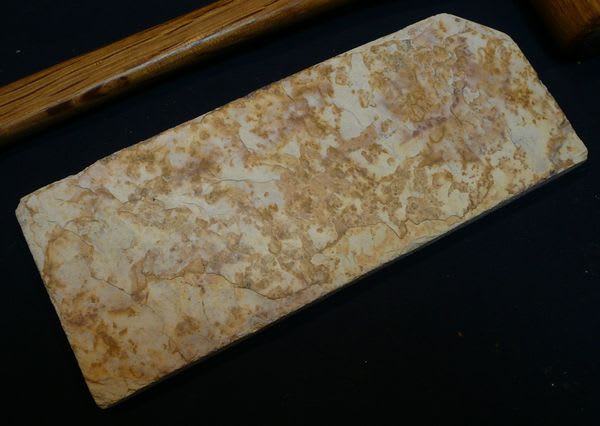
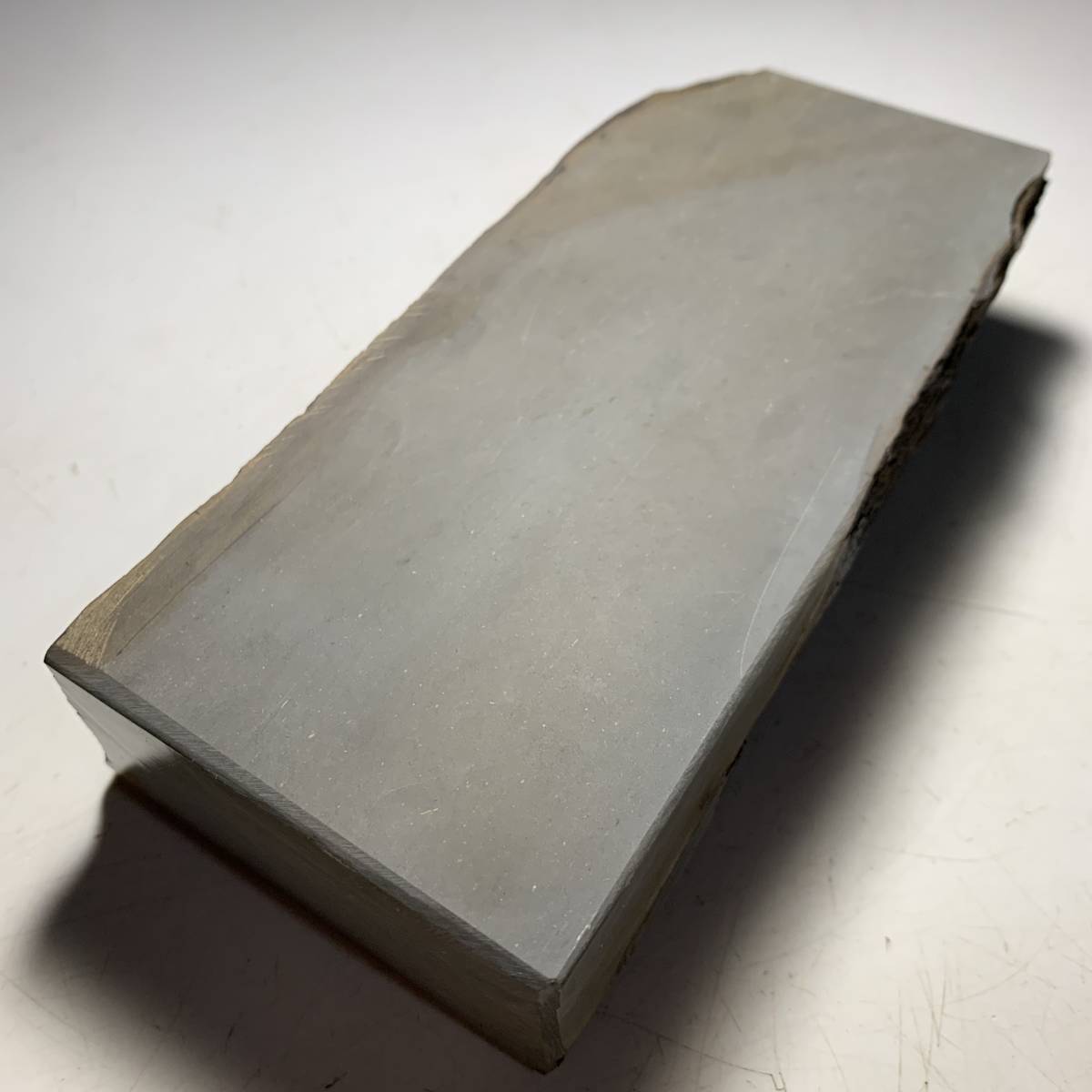




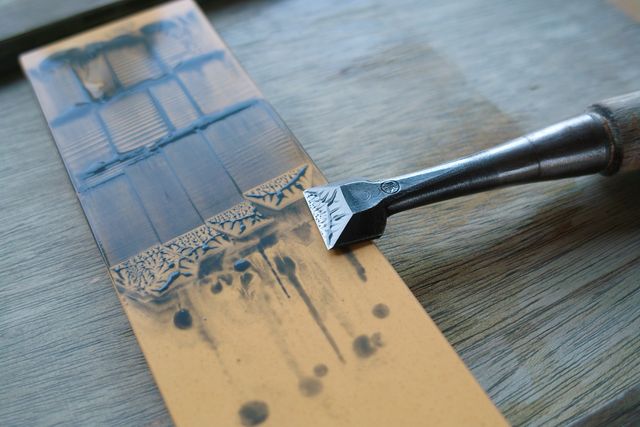


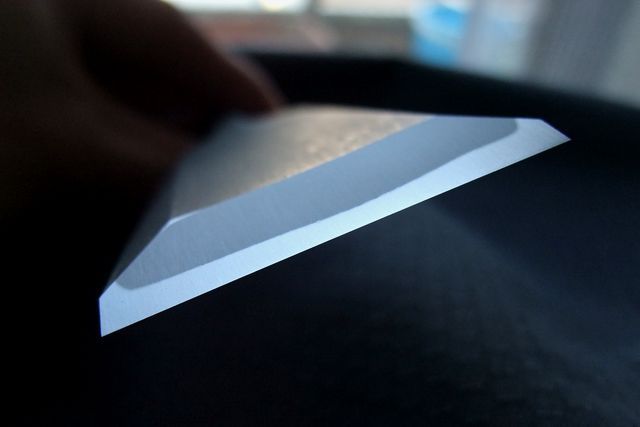



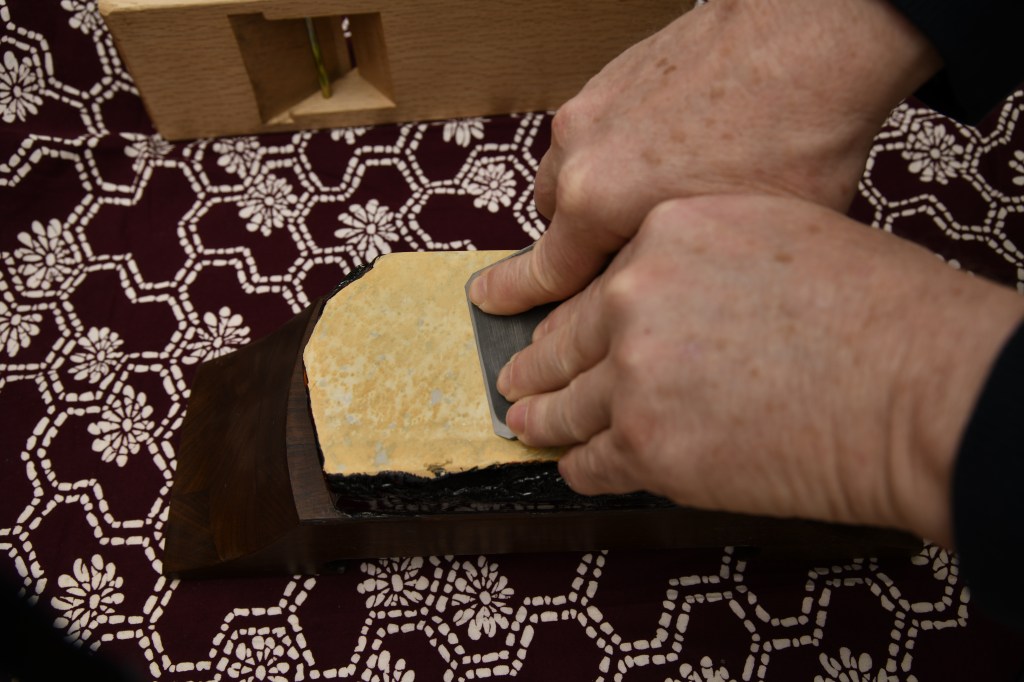


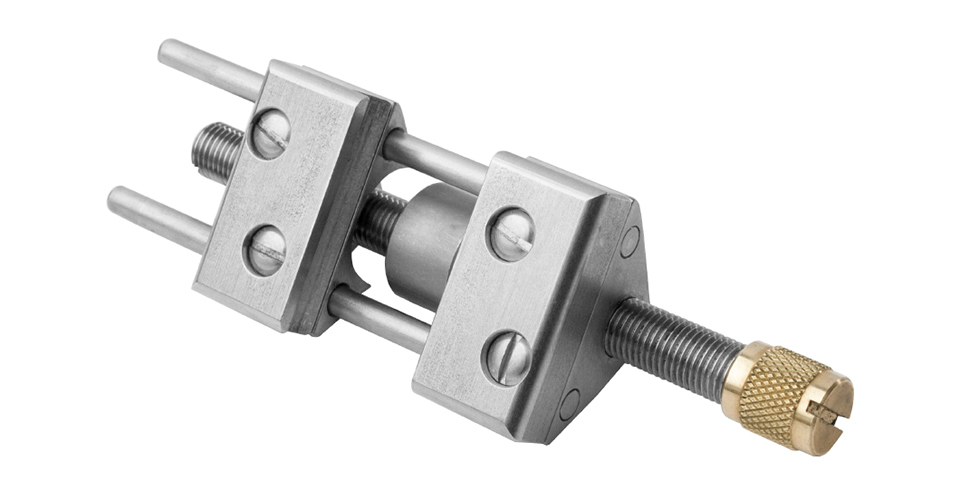






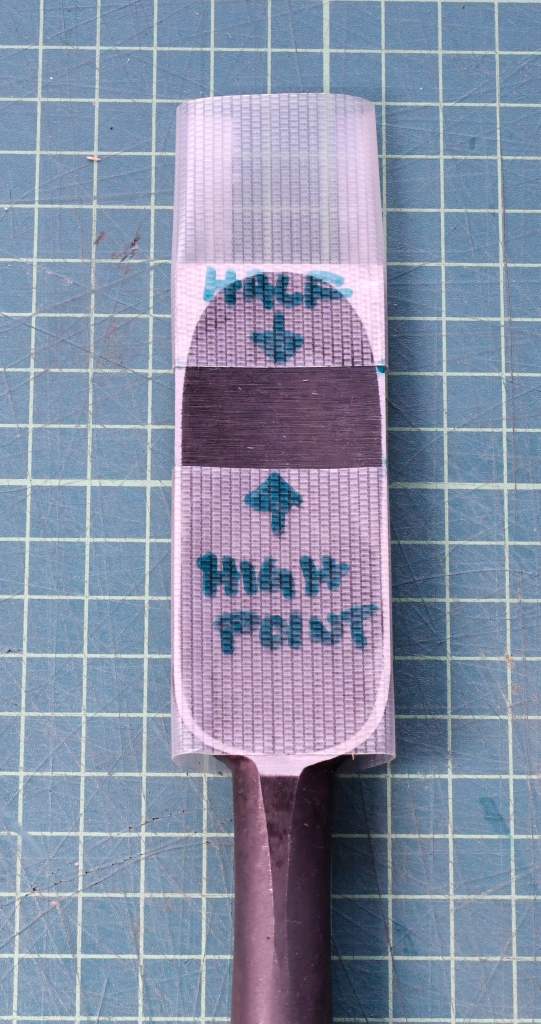


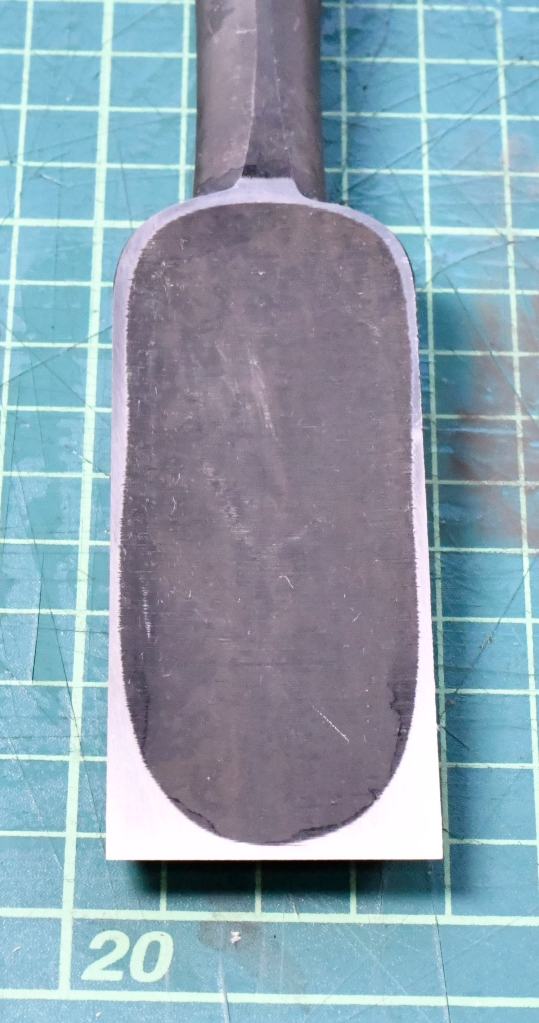


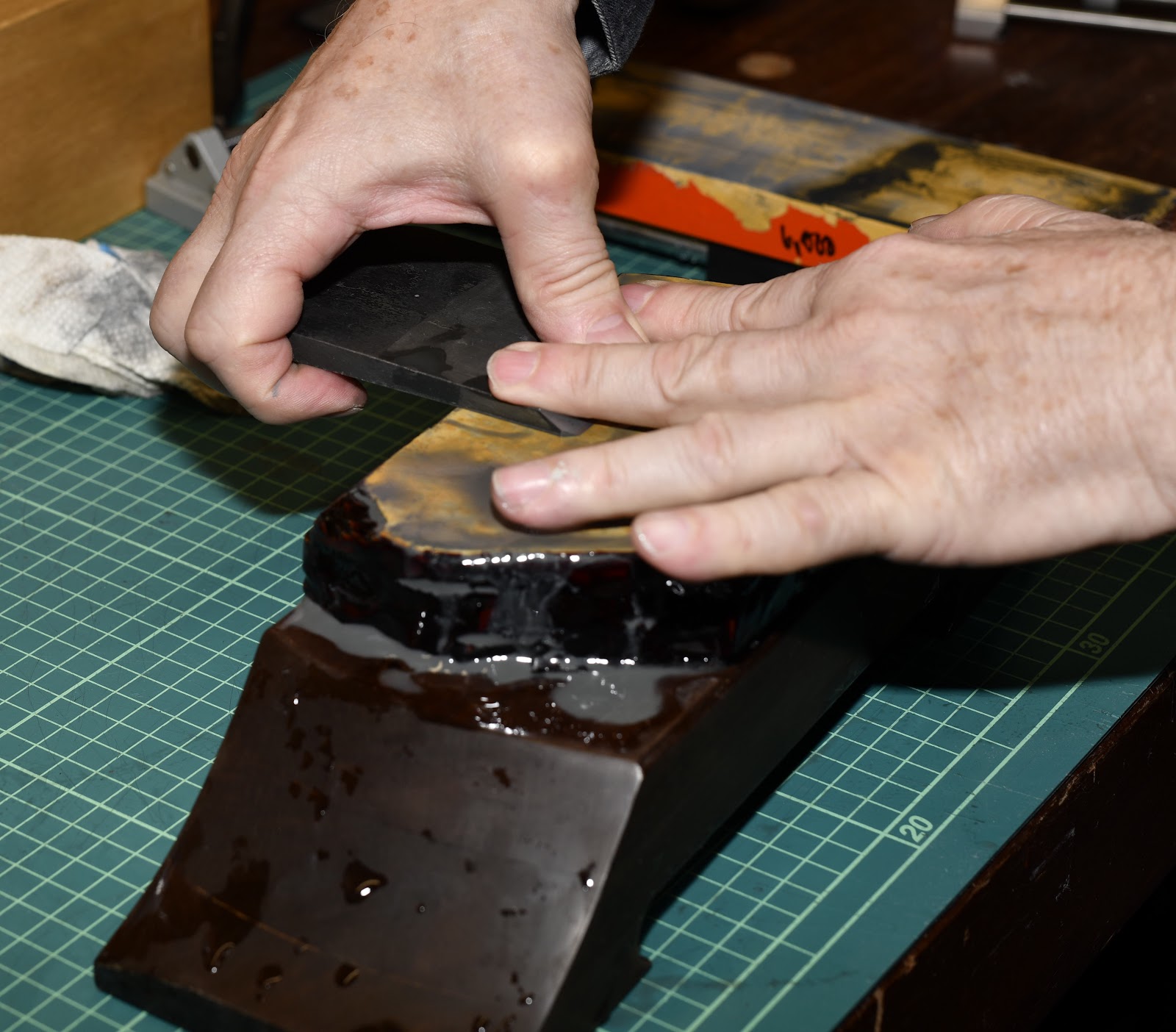
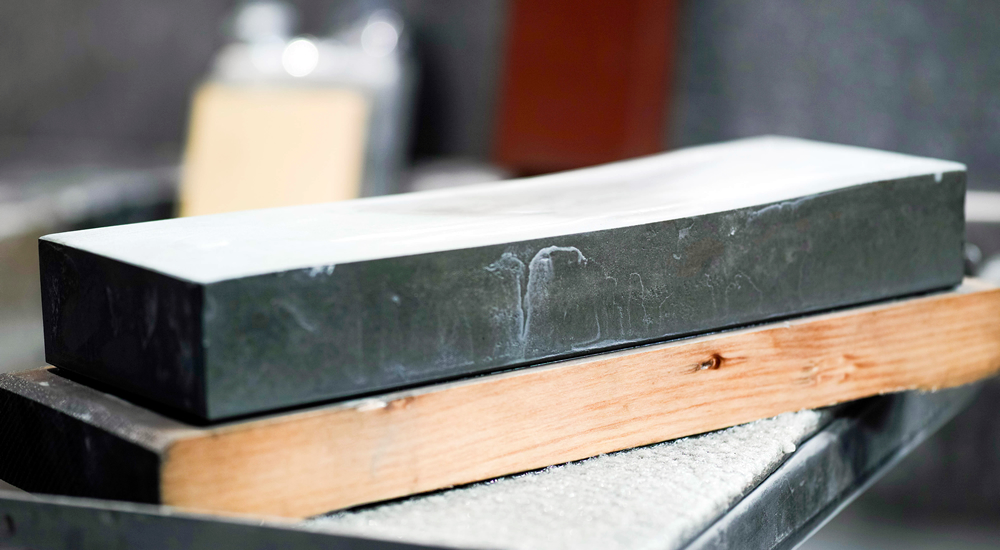





 Covington & Sons Tools
Leave a comment