If you do not change direction, you may end up where you are heading.
Lao Tzu
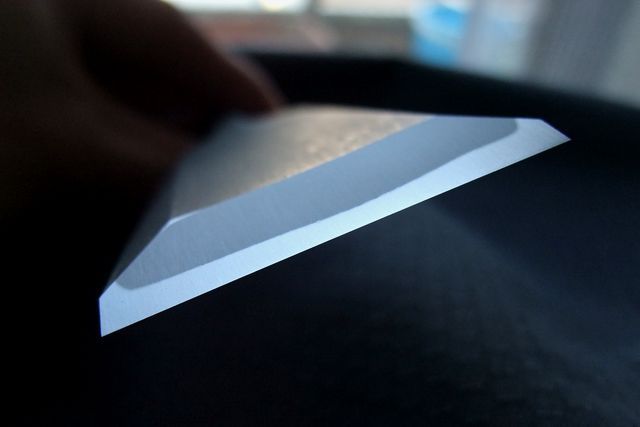
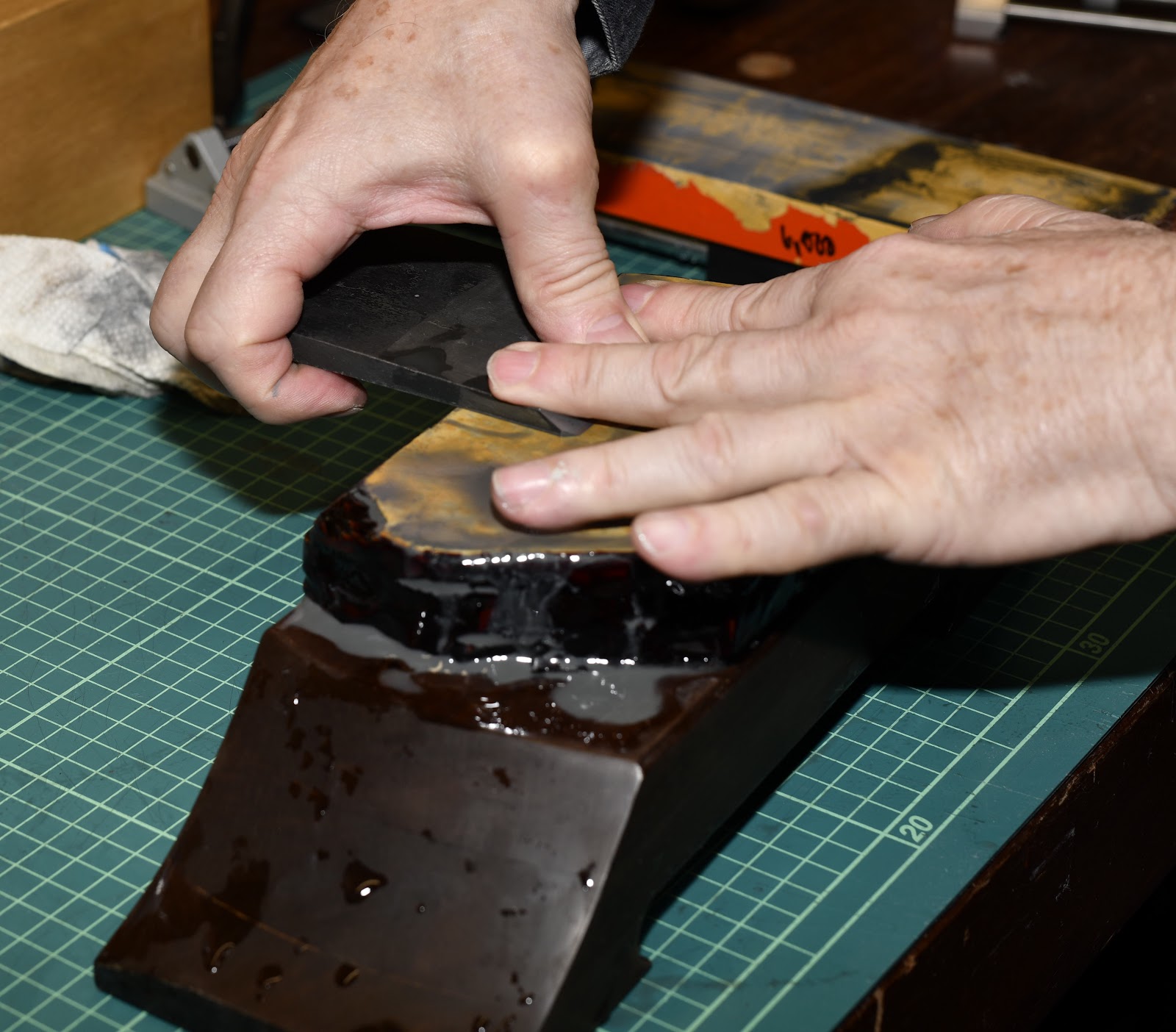
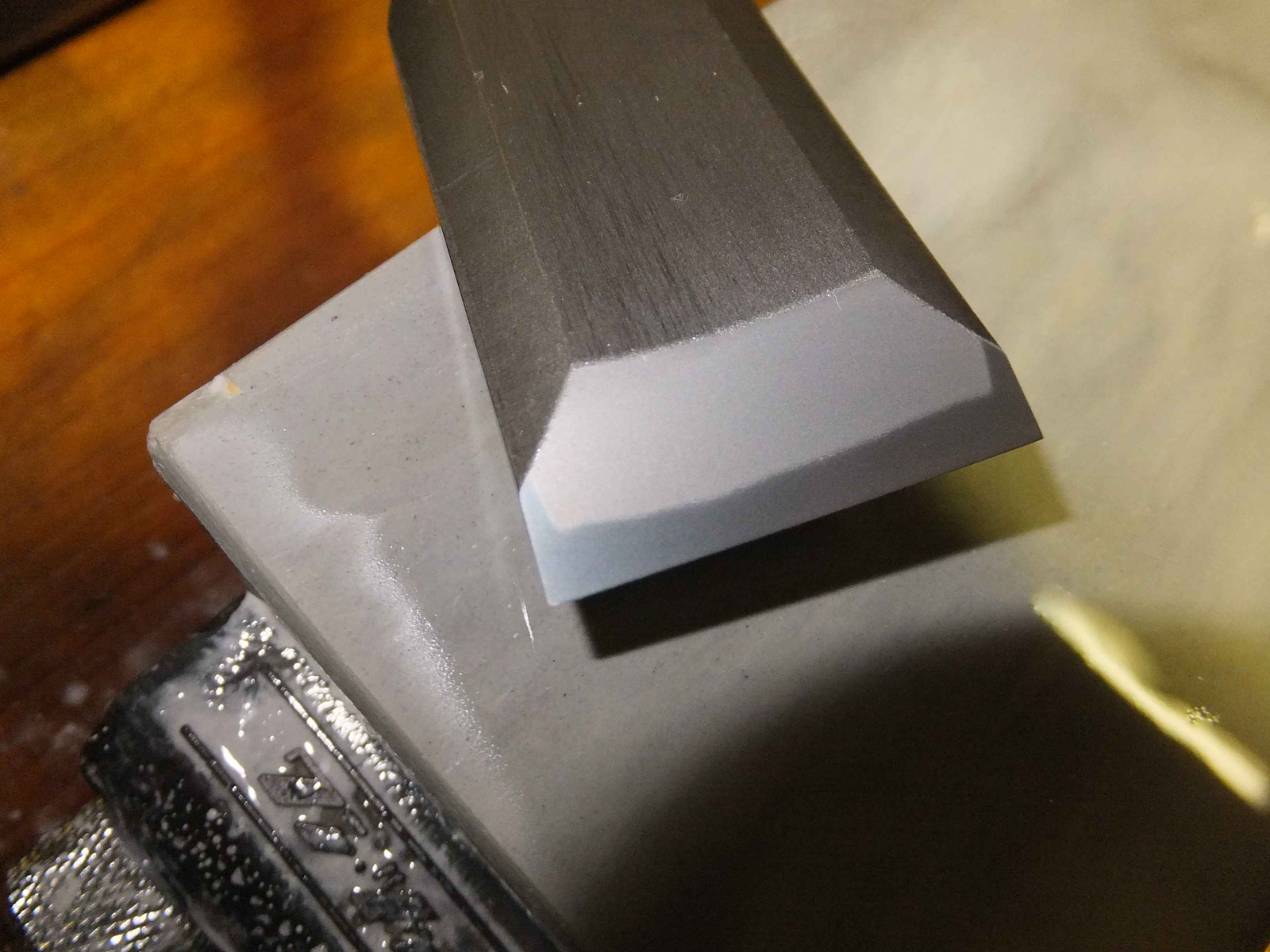
When using rough stones ( ≤1000grit), and especially when learning basic sharpening skills, it is best to sharpen the bevel in one direction only, lifting the blade off the stone, or at least removing all downward pressure, on the return stroke. The reason for this seemingly inefficient movement is simply that, at least for most people, and until one’s hands and wrists beceome trained, trying to abrade the blade on both push and pull strokes is likely to cause the blade to rock creating the bilious bulging bevel.
There are certainly exceptions to this rule, and we actively encourage Beloved Customer to try to develop the concentration and muscle control required to sharpen in both directions on rough and medium stones, but be aware it may take some years. In the meantime, remember the ancient adage and imperial moto: festina lente, which we chose to translate as “Slow is smooth; Smooth is fast. “
Part of the difficulty of sharpening in both directions is the resulting loss of concentration: the swing of the thing and angle of the dangle are hard to sense. Perhaps another part of it is due to the difficulty of controlling the complicated and constantly-changing angles of bones and joints. Both of these natural mental and physical tendencies can be overcome by talented and determined people given time and daily practice, but in the case of everyone your humble servant has ever spoken with on the subject, it takes years of focused on-the-job practice, and extreme concentration at first to overcome pre-existing bad habits and to avoid developing importune muscle memory.
Which Direction?
At this point you need to make a decision, unless you have already made it inadvertently. That is, whether to sharpen on the push stroke (pushing the blade away from you) or on the pull stroke (pulling the blade towards you). Most people choose the push stroke, as do I, but in reality the pull stroke is actually a little more efficient because the pressure tends to focus closer to the bevel’s front instead of back, and rocking is reduced. Whichever direction you choose, use it consistently.
However, as mentioned in previous articles in this series, and this is critically important, when it comes to the final finishing stone, work the blade back and forth in both directions. The finishing stone is not abrasive enough to change the bevel’s shape, and since you need to polish the last few microns width of blade’s cutting edge, a very tiny amount of unintentional rocking is actually helpful.
Training Techniques
If Beloved Customer is determined to develop the ability to sharpen on both push and pull strokes, your humble servant can share some helpful guidance that was given to me many years ago by a sword polisher.
The first step in training yourself is to begin by lifting the blade from the stone’s surface entirely on the return stroke (either push or pull depending on your preferred direction). All the things mentioned above apply. Becoming proficient with this technique is foundational. Strive to project your senses into the blade traveling over the stone, indeed right down to the last few microns of the cutting edge, becoming Zen Master Bubba.
When you are able to create a sharp edge while maintaining a flat bevel consistently and without much concentration using this “one-way” technique, then move on to the second step, which is to keep the blade in contact with the stone on the return stroke, but relieve all downward pressure. Begin slowly with full concentration and strive for smooth motion. It’s at the transition from one direction to the other where Murphy will toss a banana peel under your heel.
And finally, when you have mastered the “light-touch” technique, try applying downward pressure in both directions, beginning slowly at first and with full concentration striving for smooth motion.
Remember, don’t grip the blade like a thrashing alligator, but hold it lightly in your hands like a small bird: too tightly and it will be crushed; too loosely and it will fly away.
Don’t lock your wrists or elbows, but actively and consciously rotate them to keep the blade’s bevel always perfectly flat on the stone (your stone is flat right, right?). This is very important.
And don’t forget to use your thin stainless steel straightedge and brass bevel gauge frequently to check the bevel for flatness and proper angle.
And as always, relentlessly beat down your inner badger, brutally crush and sow salt on bad habits, and don’t allow new bad ones to take root.
Sadly, this is a skill that, once learned, tends to deteriorate with time unless practiced frequently. As with cherry blossoms, muscles, tendons and eyes are neither static nor eternal. Setsunai, desu ne.
YMHOS
If you have questions or would like to learn more about our tools, please click the “Pricelist” link here or at the top of the page and use the “Contact Us” form located immediately below.
Please share your insights and comments with everyone in the form located further below labeled “Leave a Reply.” We aren’t evil Google, fascist facebook, or thuggish Twitter and so won’t sell, share, or profitably “misplace” your information. If I lie may my wife be plagued with runners in her hose.
Shall I compare thee to a summer’s day? Thou art more lovely and more temperate: Rough winds do shake the darling buds of May, And summer’s lease hath all too short a date; Sometime too hot the eye of heaven shines, And often is his gold complexion dimm’d; And every fair from fair sometime declines, By chance or nature’s changing course untrimm’d; But thy eternal summer shall not fade, Nor lose possession of that fair thou ow’st; Nor shall death brag thou wander’st in his shade, When in eternal lines to time thou grow’st: So long as men can breathe or eyes can see, So long lives this, and this gives life to thee.
William Shakespeare, Sonnet 18
Your most humble and obedient servant began this post with the elegant sonnet quoted above, indisputably one of the most beautiful pieces of poetry ever written in the English language, instead of the usual pithy proverbs of Red Green, that towering Canadian Philosopher-Handyman and erudite Leader of Possum Lodge, just to show Gentle Readers how refined we at C&S Tools can be when no one is watching (ツ). But sadly we must now pause all such elegant distractions for a time to focus on the nuts-and-bolts of how to true the ura of a Japanese woodworking blade, the first step in making it sharp.
This tutorial is rather wordy because Beloved Customers sometimes find the task of managing the ura difficult at first. Indeed, while truing the ura of Japanese chisels and planes is a simple task, it’s one many get wrong the first time, occasionally resulting in emotional damage to both blade and it’s owner. I know it almost drove me non compos mentis the first few times I tried, but now that my psychiatric team has stumbled onto the right mix of meds, and Doctor Alonzo has released your humble servant from that unflattering canvas straight jacket, Beloved Customers have the opportunity to learn from my mistakes. Rejoice!
This is the first article in the series where we actually turn steel to mud, so let’s get to it.
Important GeneralPrinciples
All standard chisel blades and plane blades, whether Japanese or Western, need to have a planar “flat,” as it’s called in Western chisels or “ura,” in the case of Japanese chisels and planes opposite the bevel. When sharpening such blades it’s ideal for these areas be in contact with sharpening stones over their full width, and ideally, full length. Perfection is not necessary, however, so don’t let yourself become obsessive; That way lies madness.
A few lost souls mistakenly assume (just before they go barking mad) that the lands surrounding the hollow-ground uratsuki must be perfectly planar for the chisel to function, but such is not the case. Granted, it does make it easier to sharpen the blade, but it need not be achieved immediately, especially since a planar ura can be easily obtained gradually over multiple sharpening sessions.
If Beloved Customer’s chisel does not have a fully-planar set of lands surrounding the hollow-ground uratsuki when new, understand that it may be a hand-forged, hand-shaped, hand-sharpened tool with imperfections, and perhaps not a CAD-CAM designed, mass-produced, chisel-shaped, sharpened screwdriver. If so, please understand that this is not an aberration but is normal. However, if such natural irregularities distract to the point your eye starts twitching like that of Chief Inspector Dreyfus after spending time with Inspector Clouseau, perhaps hand-forged tools are not your cup of tea.
Procuring Perfect Tools
The previous sentence may seem to suggest that we at C&S Tools prefer to not provide our humble tools to perfectionists, but that is not the case. Rather, we insist Beloved Customers seeking the perfect chisel, plane, saw or knife adjust their expectations for perfection to match their expectations for financial outlay and fabrication time. What conditions? First, multiply your tool budget at least tenfold (seriously) and set aside that budgeted amount in hard cashy money, maybe in a thick roll in your sock drawer. You see, unlike your unworthy servant who many assume works for free, craftsmen with the skills required to produce perfect tools, and who are willing to invest their valuable time in doing so, are in high demand and do not work for free. If this seems steep, then perfection is not for you.
Next, plan your order carefully, and perhaps commission drawings. Not as easy as it sounds, mayhap.
Finally, steel yourself to wait a minimum of two years for the work to be completed, for you see, while many desire perfect tools and are willing to pay the price, you don’t need toes to count the number of overworked craftsmen that can actually forge them nowadays.
Oh yes, I almost forgot one thing. In the case of our Perfect Tool Blackmith, he has an unusual condition, one based on valid reasons I cannot disclose, that the recipient be a working professional craftsman, not an amateur, hobbyist or collector.
An option to having a perfect chisel custom-forged new is to seek out a genuine Hidari-no-Ichihiro chisel because the Yamazaki brother’s products, though very expensive back in the day and more expensive now, were pretty close to perfect in shape and appearance. But beware counterfeits.
On the other hand, the tools we sell to our regular Beloved Customers are extremely practical, they look OK, perform just as well as Perfect Tools, cost a helluvalot less, and most importantly they are waiting on our shelves right now quivering in anticipation of an airplane ride to new masters who will feed them oodles of yummy wood. So which do you think is is better? A perfect prima donna safe queen of a tool that takes years to procure and is too precious to use hard, or a reasonably-priced, hard-working, hand-forged, high-performance, eager but perhaps less than perfect tool you can have right away?
Working With the Imperfect Ura
In any case, please be aware that a chisel with an imperfect ura (nearly all of them have some problems when new) can be perfected over time and will work just fine as-is if you are patient, remain aware of the blades tendencies, and compensate using your eyes and hands accordingly. After all, the chisel only does what you direct it do, so please direct the blade instead of just going along for the ride while drinking adult beverages and smokin wacky-tabaccy in the back seat with Murphy. 〜(シ) 〜
If the plane formed by the ura’s lands is concave, the chisel will tend to undercut the end walls of a mortise, not difficult to avoid with some caution of the sort one must always exercise.
On the other hand (the one with 6 fingers) if the plane is convex, the chisel will tend to scoop away from the end walls of a mortise. All things considered, however, concave is far better than convex.
But whether concave or convex, such irregularities always exist to some degree from time to time in all chisels made by humans and sharpened by hand. It’s the craftsman’s job to manage his tools. Of course, this means we must strive to create and maintain a reasonably flat ura, so let’s consider some practical time-proven solutions that avoid wasting a lot of time, stone and steel, and at the same time don’t prematurely wear out the hollow-ground uratsuki in the process.
Let us begin by observing that the surface area (square millimeters) of the hard steel encompassed within the lands at the ura that we need to eventually make planar can be divided into four areas:
The land immediately adjacent and parallel to the cutting edge (aka “itoura”);
The land where the neck meets the blade, also kind sorta parallel to the cutting edge;
The two skinny side lands, (aka “ashi” meaning “leg”) are more-or-less parallel with the blade’s long axis and located on the right and left sides of the hollow-ground area called the uratsuki;
All four lands are necessary to the chisel’s function, but the one that matters most when sharpening and cutting is the last couple of millimeters at the itoura touching the cutting edge. Please make sure you understand this.
While some people fixate on it, the land near the neck matters least of the four.
The side lands are important bearing surfaces for aligning the chisel in the cut, but they are less important than the cutting edge land, the itoura. If you like your chisels and planes, prefer they remain as easy as possible to sharpen, and intend to use them for a long time, it’s important to understand that working the ura over-agressively on rough stones is the quickest way to wear the side lands down prematurely, thereby making the uratsuki shallower quicker, gradually defeating the subtle genius of the design of Japanese woodworking blades before their time. We want to maintain the ura as deep, long and wide as reasonably possible for as long as reasonably possible.
Allow me to explain this further. As we inevitably grind away on the skinny side lands they will become gradually wider while the hollow-ground uratsuki becomes gradually shallower, with the result that the amount of hard steel we must sharpen/polish will gradually increase, which is inconvenient in so many ways. Sadly, too many people make their chisel’s side lands fat as a sumo wrestler soon after purchasing a chisel in their anal-retentive quest for the totally flat ura. Makes me wanna cry.
The cost-efficient and time-efficient solution is to focus on the important itoura, and make small corrections to the ura’s three other lands over multiple sharpening sessions thereby saving valuable time as well as expensive stones and steel while preserving the ura as long as possible. How to do this? Focus all your attention on the most important area, the itoura, and patiently plan on accomplishing the job over 5~10 sharpening sessions, using the chisel between each sharpening session.
Don’t attempt to correct/polish the ura full-length from cutting edge to neck at first, instead work only the area behind the cutting edge on the stones (which must be flat). To do this, focus finger pressure nearest the cutting edge only. An effective approach is press down on the land nearest the cutting edge while moving the blade on the stones, while the rest of the blade hangs off the stone.
In other words, while pressing down with the fingertip(s) on the face of the blade (the surface opposite the ura with the brand on it) as near as possible to the cutting edge, move the last 5~15mm of the blade onto and off of the stone in a back-and-forth diagonal motion concentrating abrasion where it is needed most. This requires the ability to sense the balance of the blade on the stone, and to apply fingertip pressure where it is needed most. Wow, imagine that.. real hand skills.
If you don’t have these skills now, they are easy to develop with concentration and practice, but it doesn’t happen by accident, and if left unleashed and unmuzzled, your impatient, careless inner badger will try to make a mess of things.
During each subsequent sharpening session, increase the width of the area you work on the stones a tiny bit until the entire ura is flat and can be worked on the stones.
Through this technique and over multiple sharpening sessions, you will notice the ura’s lands will gradually become planar while only the lands nearest the cutting edge increase in width. Honest.
It helps to apply either marking pen ink or machinist’s blue to the blade to confirm whether or not you are applying pressure where it is need most and that abrasion is proceeding as desired.
It is human nature to want to rely on the flatness of the ura’s lands to keep the blade flat on the stone, and therefore we tend to apply pressure at the midpoint of the back so that the pressure on the ura’s land is even at all points of contact. This feels good; It feels stable.
But if you consider the narrow width (and small area) of the hard steel exposed at the side lands compared to the lands at the ito-ura cutting edge and the corners of the blade, you will see why this technique will wear the skinny side lands quickly and prematurely.
Allow me to restate an important point: The goal is to focus hand/finger pressure nearest the cutting with much less pressure focused on the sides lands thereby preserving them, and the depth of the ura, as long as possible. This technique will also save time and expensive steel. It is an advanced skill, but one Beloved Customer should aim to perfect.
Once the ura of your chisel is flat and true, you should not need to true it again unless the blade needs major repairs.
With much use, the itoura will dissapear, and the bevel must be tapped-out (“uradshi”) and the ura re-flattened (“uraoshi”) to restore it. I won’t delve into the subject of “tapping out” the ura of plane blades in this post but a detailed explanation can be found in Part 30of this series.
A detailed example follows.
Evaluate the Ura
The first step in flattening or truing an ura is to evaluate its condition. Don’t start grinding away willy nilly without first checking it and making a plan. If you find you cannot stop yourself, don’t walk but run to the nearest pharmacy and buy a bucket of the medicine discussed in part 19 in this series about maintaining sharpening stones.
There are several ways to check the ura’s condition. A thin straightedge works well in most cases. A thick straightedge may be easier to keep stable on the ura, but it will shut out too much light making observation difficult. Place the straightedge edge-down on top of the full length of the side lands all the way to the cutting edge. Keep the straightedge touching the land; Don’t let it span the hollow-ground uratsuki. Hold the straightedge and blade up to a strong light source and look for light passing between them. This technique is quick and dirty and will suffice in most cases, but does not tell you a lot about twist.
Use a straightedge to check the right and left lands for flatness. It doesn’t do any good to span the hollow-ground urasuki, so don’t bother. These photos are taken from above for clarity, but you want to hold the blade and straightedge together up to a strong light to observe any light showing between them indicating a gap. I am using a small square, but a simple small straightedge is more convenient. This takes a bit of coordination so be careful not to drop a chisel on your toe. I’ve done this once or twice before. Monkey meet football.This is a 30mm Sukemaru atsunomi, a famous brand and an excellent and powerful chisel hand-forged by Mr. Usui from Shirogami No.1 Steel. It’s in pretty good shape, but can benefit from a little truing as can most new chisels and plane blades.
Another method to check the ura for planar is to paint the shiny lands with dark marking pen ink or Dykem liquid, apply a tiny bit of fine sharpening stone mud to a piece of flat glass, like the piece mentioned in Part 17, and rub the blade’s flat or ura over the glass. The high spots will become obvious. If the ura is banana shaped (convex), mark the high spot with your marking pen. More often than not, the ura of chisels will be generally flat, but sometimes the last 2mm or so of the cutting edge will be curved upwards towards the chisel’s face.
I learned two things from my examination of this atsunomi. First, there is a high spot (convex) at the skinny land on one side located approximately 1/2 to 5/8 the blades’ distance from the cutting edge. The land on the other side seems a little low. Hmm, curious. This is a bit unusual, but it happens when a blade warps during heat treat, which Shirogami steels tends to do frequently.
The second problem I observed was that the last 3~4mm of the itoura land at the cutting edge curves downward away from the ura just a tiny bit, enough to cause problems.
I next must formulate a plan to resolve these problems with a minimum of time and effort and without making things worse.
Make a Plan
The temptation to start grinding away immediately will be powerful. But… I must… resist… the… stupidity impulse!!
If it becomes too much, I’ll take a coffee cup or three of the medicine mentioned in the previous post and slather it on my head forcefully. Don’t hold back, for Pete’s sake, rub it in really good now. Some say my excessive use of this medicine is why I am as bald as an egg, but I prefer to believe it is caused by the high-intensity psychic waves radiating from my gigantic brain (ツ). Thank goodness for my aluminum foil skull cap with its artfully protruding copper wires or the radiating light might blind airline pilots passing overhead!
But getting back to practical matters, a useful plan must have goals and objectives. In this case the goal is a perfectly planar ura, but if this goal is difficult to achieve quickly there is an objective you achieve immediately in any case, one that may make it possible to achieve the larger goal over multiple routine sharpening sessions without any special effort.
As I keep harping, to make a chisel or plane work well, you need a sharp, flat bevel and a sharp flat area right at the thin land (itoura) adjacent the cutting edge. This is where the cutting occurs and the area I need to keep sharp, so I will make creating this flat area the first objective in my plan, and then determine the steps to achieve it. I make certain every step in my plan and every stroke I make on the stones gets me closer to this objective, not further away. This means working smart, ruthlessly calming my inner badger (you know, that nearsighted, short-legged snuffling beast that just keeps digging) and repeatedly stomping my stupidity impulse into the ground. Frequent applications of idiot ointment help too.
If the blade is arched (concave), touching at two points, one near the neck of the chisel blade, or head of the plane blade, and at the other at the cutting edge, and not in between, all is well. I recommend you leave a blade like this as-is because after a few sharpening sessions the ura will become flat and twist-free without any special effort, and the blade will become very sharp and be entirely functional (assuming the faces of your stones are flat).
If the blade is wavy (rare) or banana-shaped (convex), your plan needs to take those details into account.
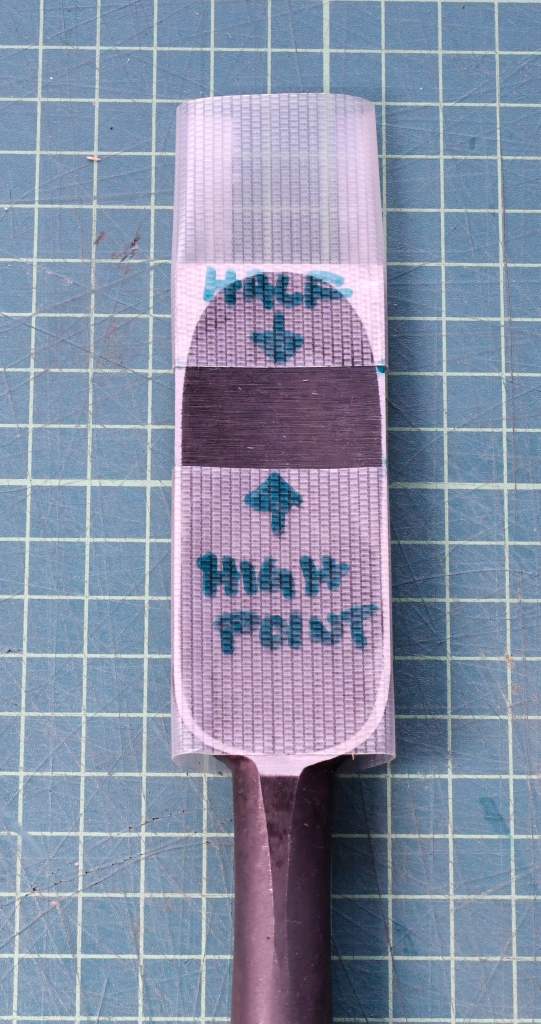
In this example I located the highest point of the bulging area at the ura and marked a line across it with my marking pen. I then measured halfway between this line and the cutting edge and made another line. which I will call the “focus line.” It is here where I need to focus the most pressure when grinding down the ura, NOT the entire length of the blade, despite what my inner badger demands.
The purpose of doing all this prissy planning and layout work is to protect the right and left side lands from being wasted unnecessarily. Newbies and those with poor badger control often insist on working the entire length of the blade on the stones, but this is illogical and ignores three points.
The first point often overlooked or ignored is that the majority of the metal I need to waste is usually located to the right and left of the itoura land nearest the cutting edge, not the full length of the blade, so there is little benefit to grinding the entire ura.
The second point is that the side lands are thin as a blade of grass and will abrade very quickly with almost no effort. Besides, without using large plates and stones, it is very difficult to work the blade’s full length accurately without wearing steps into the side lands anyway.
The third point often ignored is that it makes no sense at all to try to grind down the land nearest the neck since the plane of the ura hinges on this land anyway. Best to leave it alone and focus my efforts where they will make a useful improvement.
Plane blades don’t even have a land near the head, so the futility of working the entire ura on plane blades is even more obvious than for a chisel.
The left photo shows a line drawn at the highest point in the convex ura (bottom arrow), and another line halfway between it and the cutting edge (upper arrow). The second photo shows tape on the blade’s back with the high point line, and the halfway line, or “focus line” at the upper edge of the tape. Use these marks to ensure you have a plan and follow the plan without wasting too much valuable steel at the ura. Notice how narrow the right and left side lands are before we begin working the ura.
Work the Plan
The traditional Japanese tool used to flatten and/or correct ura is a smooth steel lapping plate called a kanaban, meaning “metal plate.” To use it, carborundum powder and water are placed on the plate, and the blade is lapped. This is not a difficult process at all, but there is a tendency for the blade’s perimeter to be ground more than the interior areas as the grit is forced in between the kanaban and the blade’s perimeter. To avoid this tendency, and to speed the process up, I prefer to use diamond plates or diamond stones instead of kanaban.
Whatever plan you developed, and whichever tool you selected for this job, the time has come to work the plan. Do you need more idiot-b-gone medicine? A bigger coffee cup?
First, color the ura’s perimeter lands with a marking pen or Dykem to help you see where the ura is being ground down. Don’t ever guess.
Place the most pressure on the focus line selected above. Move the blade back and forth (not side to side) onto and off of the diamond plate, diamond stone or kanaban with the cutting edge and the focus line always touching the diamond plate or kanaban. Don’t go past the high point for now. Be careful to not grind a notch into the narrow side lands where they meet the edge of the diamond plate or kanaban. Most people make this mistake at first. Please don’t you make it more than once.
Grind the ura down so the line at the highest point and the cutting edge is fairly flat.
Work the blade on and off the edge of the diamond plate using short strokes and without going much past the highest point marked earlier. This works because the right and left side lands are thin and can be abraded in just a few strokes. I have moved my fingers to reveal the lines, but in actuality my fingers will press down hard on the focus line while working the blade.Using a stick to apply more pressure to the blade. I am holding the end of the stick and the chisel’s handle together in my right hand. This is simply illustrating a technique. This chisel did not actually require this sort of aggressive attention.The same stick technique works even better for plane blades and makes it easier to apply pressure right behind the cutting edge. When doing this, however, be sure to work the blade both forward and backward while moving it right and left, on and off the plate’s edge to avoid digging a trench into the narrow side lands.
Remember, the narrow lands at the sides of the hollow-ground urasuki will abrade down quickly. And the rest of the ura can be gradually flattened during subsequent sharpening sessions using regular sharpening stones. It doesn’t need to be made perfect immediately. What matters most is the steel on the itoura land right at the cutting edge.
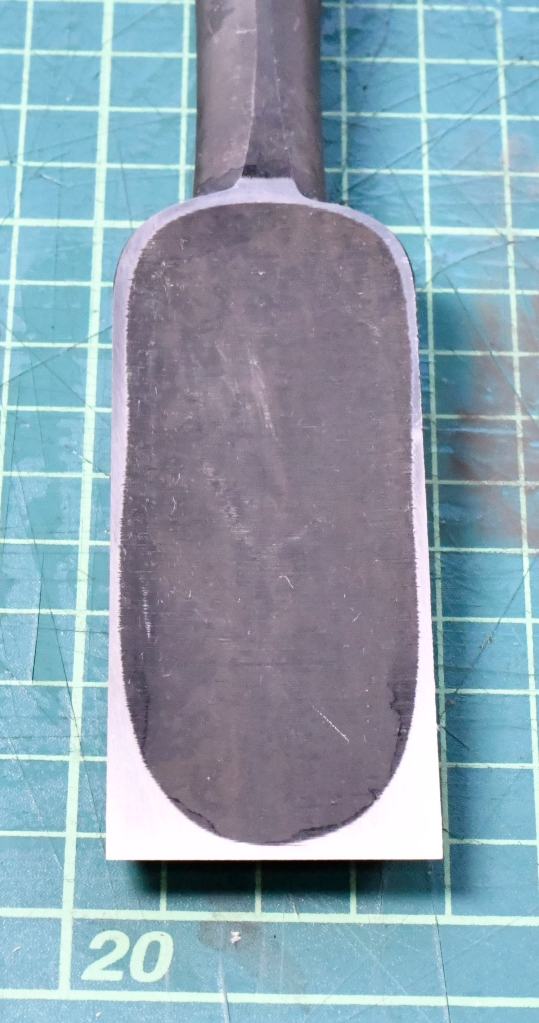
The high spot on the side land near the top of the photo has been relieved after just a few passes on the #400 diamond plate. The side lands are now both in fair condition, and the land behind the cutting edge (itoura) needs just a little more work.After a few more passes on the diamond plate, the itoura is in good shape. Please observe that the side land at the bottom of the photo is not in full contact, but the opposite side is. This is will not impact the blade’s performance, and will work itself out during future sharpening sessions without special attention.Flattening my stones before using them. Notice I am using two 1,000 grit stones to save time and stones. Don’t neglect flattening your stones, whether you use waterstones, novaculite stones, coticule, or even sandpaper.Working the ura on the flat 1000 grit waterstone. Did I mention it is flat? Notice that I am working on and off the stone, not side to side, to save the right and left lands. Just a few strokes are required. I am now focusing pressure nearest the cutting edge. Some but not all strokes are full length. The goal is simply to remove the deep scratches on the itoura left by the diamond plate. All other deep scratches can be left alone for now and removed during future sharpening sessions a little at a time.The ura after polishing on the flat 1000 grit waterstone. At this point the ura is in good shape. Notice how the land at the photo’s left is wider that elsewhere. This increase in width developed because this location was the high spot on this convex ura. Notice how the land on the right side is not even touching the plane in one area. What you should take away from this photo is the realization that if I had focused my efforts on this high location first and ignored the downward curvature of the land nearest the cutting edge, I would have wasted a lot more time and valuable metal only to shorten the useful life of this excellent chisel. Do you see the benefit of carefully checking the ura’s condition, making a plan with clear goals and objectives, and then working the plan? Did the medicine work? Next, we’ll work on the bevel, make a tiny burr, polish it off by making a few strokes alternating from bevel to ura, and be ready for the finishing stone.Working the bevel on the flat 1,000 grit waterstone. Notice the mud piling up in front of the blade indicating the extreme cutting edge is in contact with the stone. I am applying pressure only on the push stroke to prevent the stone from rocking and developing a “bulging bevel,” A honing jig is not necessary.The bevel after working on the 1,000 grit waterstone. No jigs were used. No “tricks” involving rulers were used. A silly, inefficient “micro-bevel” was neither wanted nor needed. The bevel is perfectly flat. Flattening the ura and polishing both ura and bevel to this level took less than ten minutes. When the purchaser of this blade eventually dulls the edge, he should not need to spend more than 2~3 minutes to sharpen it once his gear is ready, assuming he is able to sharpen freehand.
This flattening process is seldom required except on new blades.
Polish a blade’s ura up to the level of your finest finishing stone once, and don’t touch it with rougher stones again unless it is absolutely necessary, or further gradual flattening is required. This means that in normal sharpening sessions you must remove all the damage at the cutting edge by abrading the bevel with the rougher stones, and only when the bevel is ready for the finish stone, do you work on the flat or ura, alternating from bevel to flat/ura until all defects, burrs, and even visible scratches are polished away.
If you condition the flat (ura) side of the blade correctly, and keep it polished, you should not need to work it on anything but your finish stone until it is time to tap out and grind the ura or back in the case of plane blades. Therefore, the bevel side of the blade is where we spend most of our time and effort.
Now that the ura is in good shape, we will look at sharpening the other side of the wedge, the blade’s bevel, in the next post in the series. In the meantime, keep yer stick on the ice.
YMHOS
If you have questions or would like to learn more about our tools, please click the “Pricelist” link here or at the top of the page and use the “Contact Us” form located immediately below.
Please share your insights and comments with everyone in the form located further below labeled “Leave a Reply.” We aren’t evil Google, fascist facebook, or thuggish Twitter and so won’t sell, share, or profitably “misplace” your information. If I lie may an elephant caress me with his toes.
A famous wood carving of 3 monkeys located at Nikko Toshogu Shrine post re-construction that illustrates a famous saying originating in China that also works as a pun in the Japanese language. From right to left: See no evil; Speak no evil; Hear no evil (見えざる、聞かざる、言わざる).
Even monkeys fall from trees (猿も木から落ちる)
Japanese saying
Ideally, a tool blade will have absolutely uniform dimensions: the right thickness and taper, perfect cross-sections, uniform curvature, straight edges and flat surfaces. However, professional grade Japanese tools are not made on CNC machines, but are hand forged and so may include some dimensional imperfections. Indeed, imperfections are part and parcel of all human endeavors. Most imperfections don’t matter; sometimes they make the tool better, sometimes they need to be remedied.
At sometime in Beloved Customer’s woodworking career you may experience one of your blades producing less than ideal, “skewampus” results. These poor results may reflect the influence of predacious, pernicious or perhaps even perfidious pixies. Perhaps you don’t acknowledge the existence of supernatural pests and instead blame the trouble on your technique in using the tool, or even on the irregular grain of the wood you are working. But if not pixies, please consider that the real culprit may be the shape of the blade’s cross-section, or perhaps your unintentionally sharpening the blade with a skew. We will examine some of these problems in this installment in our series on romance and monkeyshines.
We will also look at the curved or “cambered” cutting edge profile in plane blades, the benefits and undesirable results it can produce, and how to incorporate this blade profile intelligently into your woodworking repertoire.
Many people, like monkeys in trees, learn bad habits from their friends and teachers. We hope this article will help you understand what’s going on with your woodworking blades, and how to better shape and sharpen them intelligently instead of just monkeying around. Please be sure to BYOB (bring your own bananas).
A serious craftsman doing Fine Woodworking in a pixie-free, clothing-optional workshop (notice the strategically-placed boots).
Dealing With SkewampusBlades
Skewampus is an interesting word I learned from my mother. I am told it is a combination of the word “Cattywampus” meaning “in disarray,” and “askew.” I think it is the perfect word for describing the ailments some blades suffer.
While less than ideal, it is not unusual for the thickness of a chisel blade’s cross section to vary slightly across its width, with one side being thicker than the other, forming an irregular quadrilateral cross section. This irregularity is frequently found in plane blades too. Since there is more steel on the thicker side of such a blade, unless care is taken, it will abrade differentially during sharpening and tend to develop a skew.
As discussed in previous articles in this series, Japanese plane and chisel blades are formed by laminating a layer of hard steel to a much softer body made of low-carbon steel or iron. If the lamination exposed at the cutting edge is not uniform, all else equal, the area of the blade with more hard steel touching the sharpening stone will abrade slower than areas with less exposed hard steel such that the cutting edge will tend to become skewed during sharpening. Perfection is neither attainable nor necessary, but the uniformity of the lamination is an important detail to observe when purchasing and sharpening Japanese tools.
Likewise, plane and chisel blades that are not uniformly heat-treated but that exhibit differential hardening across the bevel’s width will tend to become skewed during sharpening as one side of the bevel abrades quicker than the other. This problem is more common than you might imagine, especially in the case of inexpensive tools where appearance and low price are given priority over quality control.
Anyone that has experienced bidding high-dollar construction projects will understand the adage “the most profitable job may be the one you lose.” Cheap tools are much the same way: that low-cost chisel or plane you buy on PeeBay may look good in online photos and even during the unboxing ceremony, but if you count your time worth anything, if you dislike headaches, and if real-world performance matters to your bottom line, then such tools are often prove disastrous. Caveat emptor, Skippy.
A chisel or plane blade that has an irregular cross section or a skewed cutting edge often works just fine for many cutting operations. However, when cutting mortises, a chisel blade with a skewed cutting edge or irregular cross section will tend to drift to the side gouging the mortise’s walls and ruining tolerances. If you find that your mortise walls are gouged, or that tolerances are poor, check your chisel blade’s shape, and correct any deformities. It usually isn’t difficult to do.
Like all human work spaces, Japan’s smithies are not immune from pixie infestation despite annual blessings by Shinto priests and periodic offerings of salt, rice, and wine to the spirits. I will refer you to this previous post and another wherein we discussed supernatural predators and described some antidotes for the pixie pox. But the deformities we are examining in this post are more often the natural result of the human eye misreading temperature gauges, or the hand misjudging hammer blows or the non-judicious use of grinder wheels rather than precocious pixies at play.
If your blade’s deformity is not excessive, you can often correct or compensate by applying a little extra pressure on the blade’s thicker side while sharpening it.
It’s interesting how a little off-center pressure on a blade being sharpened over many strokes can change its shape. Many people unintentionally deform their cutting edges by not paying attention to the amount and location of the pressure their fingers apply, or by skewing the blade on their stones. A word to the wise.
On the other hand, purposefully skewing one’s blade in relation to the direction of travel when sharpening the bevel can be useful in gradually and economically correcting a skewed cutting edge. This works because the leading corner of a blade held in a skewed orientation on the sharpening stones is abraded quicker than the trailing corner. But once again, inattention causes many people to skew their blades when moving them around on their sharpening stones unintentionally creating, instead of intentionally correcting, skewed cutting edges. BTW, there’s nothing wrong with skewing the blade when sharpening so long as you are aware of the distortion this practice can produce and compensate accordingly. Another word to the wise.
If these methods don’t mitigate adequately, you may want to grind and lap a chisel blade to a more uniform cross-sectional shape. A chemical bluing solution used afterwards will help conceal the shiny metal exposed by this operation if your chisel objects to shiny spots. Some of them can be quite vain, you know.
A chisel with a nicely uniform lamination and cross-section, and pretty polish produced using a natural finishing stone.
Cutting Edge Profiles
Many people have access to electrical jointers and planers, but relatively few have industrial equipment with the capacity to dimension wide boards such as tabletops. And of course architectural beams and columns are typically too long and heavy to dimension with most stationary electrical equipment.
The choices available to most people for dimensioning such materials therefore are either handheld electrical power planers and/or sanders, or axes, adzes and hand planes. Powerplaners, sanders, axes and adzes are beyond the scope of this article, but let’s consider hand planes.
I need more than one plane? You can’t be serious!
Although the very idea gives some woodworkers vapors (I don’t mean gas), an efficient craftsman will have multiple planes with cutting edges honed to profiles matched to specific operations. It doesn’t take many but it does take more than one, unless results don’t matter.
Everyone that dimensions larger pieces of lumber by hand needs a plane with a wide mouth and a curved or “cambered,” cutting edge called a “scrub plane” in the West, and “arashiko kanna” in Japan.
This variety of plane excels at hogging a lot of wood quickly when the craftsman needs to significantly reduce the thickness or width of his lumber. If the blade is narrow, curvature is deep, and the mouth is wide this plane will hog wood quickly, but it will often leave a deeply rippled surface, often with bad tearout.
One might also have a second arashiko, essentially a jack plane with a wider blade with a shallower curvature for the next steps in the dimensioning process. Such a plane will not hog wood as quickly, but it will produce a surface that is closer to flat and smoother with less tearout. You can see the advantage of having two arashiko planes, or a scrub plane and a jack plane, with different cutting edge profiles when dimensioning lumber.
Many Beloved Customers use electrical-powered planes to dimension lumber before turning it into furniture, doors, chairs, or sawdust, etc. and are aware that planers always leave tiny ripple-like scalloped cuts on the wood’s surface, often with some tearout, that is unacceptable as a final surface. A hand-planed finish is far superior, but it doesn’t make sense to remove more than the bare minimum of wood necessary to remove this washboard.
A finish plane, in fact, is the perfect tool for removing these ripples and producing a smooth, uniform, even shiny surface on condition that the plane is sharp, it has a fine mouth, its set to a fine cut, its chipbreaker is tuned and set properly, the blade profile is appropriate for the width of the wood to be finished, and the wood does not have too many large knots. In one or two passes such a plane can easily remove all the ripples and leave the wood clean and shiny without changing its thickness much at all.
Assuming the wood is cooperative and one knows how to sharpen and setup their plane properly, blade profile frequently remains a key factor many fail to grasp. Obviously, the curved cutting edge of a scrub plane cannot produce the perfectly flat surfaces required for joining two pieces of wood together, nor a smooth surface. On the other hand, the corners of a perfectly straight blade will leave clearly visible steps or unsightly tracks on the surface of a board wider than the blade, which is not a problem when rough-dimensioning a board, but is not ideal for joined surfaces and painful to look at if the board’s surface is to be left with just a planed finish.
So how do we solve this conundrum? When finish planing, the professional approach is to use two finish planes each with a different cutting edge profile.
The first type of finish plane has a perfectly straight cutting edge used to plane pieces narrower than the blade’s width. Since the blade’s corners are not riding on the wood but are straddling either side of the board while cutting, they won’t leave tracks or ridges, and the finished surface will be truly flat, perfect for joinery.
The second type of finish plane found in the professional’s toolchest has a curved cutting edge, or more correctly, curved just at the right and left corners to prevent it from leaving tracks and ridges when planing boards wider than the blade. Nearly all the cutting edge is left straight, but creating this tiny amount of curvature at the right and left corners causes them to smoothly disappear into the plane’s mouth so no tracks are made and any ridges are nearly impossible to see or feel. In other words, the corners of the cutting edge never touch the surface of the board, and so don’t leave discernible tracks or ridges. The finer the cut made the smaller any ridges created will be. Indeed, where a high-quality surface is required, the final cut with the finish plane will produce shavings thin enough to see one’s fingerprints through.
You may want to reread the previous two paragraphs to make sure you understand what these two cutting edge profiles are and what they can accomplish before you read further.
Naturally, a professional doing high-quality work needs at least two finish planes, one with a straight cutting edge used to produce flat, precisely-dimensioned surfaces on wood narrower than the blade’s width, and another finish plane with a cutting edge very slightly curved at the corners used to finish surfaces wider than the plane blade.
There are those that advocate using a curved blade, sometimes dramatically “cambered,” as some call this shape, for all applications. Those who advocate this sloppy technique twist themselves into knots justifying tricks to approximate flat surfaces using such blades. I have no doubt this is an ancient technique, but I suspect it is a sad practice that sprung from the carelessness of some craftsmen in flattening their sharpening stones, and with time this bad habit became a tradition in some quarters. I strongly suspect fans of this strange way of doing business habitually sand all visible surfaces anyway so tracks and ridges are not a problem for them. But the fact remains that perfectly flat, track/ridge-free surfaces work best for joinery.
Tradition and “monkey see monkey do” are a useful place to start, but as his skill level increases, the thoughtful craftsman will eventually seek to confirm the validity of the traditions he has been taught. I urge Beloved Customer to get started early.
Sadly, too many people never notice the strange instruction label pasted to their boot’s sole, nor that smelly stuff sloshing around inside.(ツ)
Mommy monkey teaching baby monkey bad habits. Will they ever learn?
Conclusion
As we come to the end of this article allow your humble servant to leave Beloved Customer with a word or two of advice about two bedrock basic skills you should master.
First, learn how to keep your sharpening stones flat. This will save you much grief.
And second, learn how to sharpen your blades to have a straight cutting edge. Everything else will flow naturally from these skills. Your blades deserve it. We will talk more about these subjects in the future.
In this article, we have discussed 12 serious points about plane and chisel blades and how to use and improve them all but a few woodworkers in the West are unaware of, or ignore, but which are common knowledge among professional Japanese woodworkers in advanced trades. While condensed, it is enough information to fill a book. But in return for this river of knowledge all your humble servant requests is the bananas you have in your back pocketses right now (BYOB, remember?). You didn’t sit on them did you?
The next installment in this simian soap opera of sharpening will focus less on monkeyshines, and more on stones and techniques. Please stay tuned. Until then, I have the honor to remain,
YMHOS
Oh my! I can’t wait to read more!!
If you have questions or would like to learn more about our tools, please click the “Pricelist” link here or at the top of the page and use the “Contact Us” form located immediately below.
Please share your insights and comments with everyone in the form located further below labeled “Leave a Reply.” We aren’t evil Google, fascist facebook, or a Minnesota congresswoman and so won’t sell, share, or profitably “misplace” your information. If I lie may icky boils burst forth on my nose daily.











 Covington & Sons Tools
Leave a comment