Hammers to Use With Chisels Part 4 – The Chisel Cha-Cha

Your Most Humble and Obedient Servant hard at work. A dab of skin lotion may be called for.
Stan Laurel

You can lead a horse to water, but a pencil must be led.

Stan Laurel

In previous articles in this series about hammers to use with our chisels, your humble servant discussed the varieties of suitable hammers, the appropriate faces on those hammers, and recommended some weight guidelines. In this article we will examine some important hammer and chisel techniques Beloved Customer should consider to make your chisel work more efficient and your chisels last longer

The Chisel Wiggle

Something to keep in mind about our chisels when beating on them is that their cutting edges are intentionally and carefully hand-forged and heat treated by experienced blacksmiths (none with less than 40 years independent experience) to be especially hard to meet the demands of professional craftsmen for the extra sharpness and cutting longevity only hard, fine-grained steel makes possible. They are not the sharpened Chinese screwdrivers sold by the big corporations that amateurs are accustomed to using nowadays.

To maximize the advantage such excellent steel affords, Beloved Customer must avoid driving the chisel so deeply into the wood when cutting mortises, for example, that the extreme cutting edge binds in the wood forcing the user to wiggle the chisel forward and back to loosen and extract it from the cut. I call this undignified movement the “chisel wiggle.”

Your humble servant realizes this is contrary to what many woodworking gurus with their soft-as-butta chisels teach, but I unabashedly assert that it is irresponsible behavior in the case of our professional-grade tools because binding the blade in the wood this way creates what I call a “high pressure cut” situation, placing a tremendous amount of clamping force on the thin metal at the extreme cutting edge. Doing the “chisel wiggle” in this situation will damage the cutting edge dulling it quickly. If you doubt this, please dig out your hand-dandy loupe and do a before-after comparison.

In addition, the time lost extracting the wedged-in-place chisel and the resulting interruption in the workflow caused by repositioning one’s hands, and perhaps even setting aside the hammer (egads!) while doing the chisel wiggle, makes it impossible to maintain an efficient cutting rhythm. If you doubt this, we double-dog dare you to do timed comparative tests. The difference in efficiency will become instantly clear.

People accustomed to using Western chisels with their softer, plasticy blades made from high-alloy high-scrap metal content steel with higgledy piggledy crystalline structure are actively taught to use the chisel like a crowbar to lever waste out of cuts. This is another type of “high-pressure cut” that damages the tool’s cutting edge at the microscopic level.

The mass-produced screwdrivers sold as chisels in the West nowadays are tough but relatively soft, can’t be made that sharp to begin with, and they dull significantly during the first few hammer strikes anyway, so most people can’t detect the edge degradation the chisel wiggle and prying create.

Those who are satisfied with sharpened screwdrivers don’t buy our chisels anyway so I have no advice for those poor benighted souls, only prayers: Namu Amida Butsu. But it is of little matter because they seldom have the sharpening and tool skills required to tell the difference. Horse, meet water; Ah… not thirsty I see.

The Chisel Cha-Cha

Now that we have explained what not to do, let us examine what we should do instead.

Here is wisdom: There are at least three techniques the efficient craftsman should employ, or at least develop skills adequate to deploy, when cutting joints in wood:

  1. Limit the amount of wood included in each cut to an amount easily and quickly cut and easily and quickly removed. Strict control of one’s inner-badger is required;
  2. Stop striking the chisel with hammer during each cut just before the chisel binds in a high-pressure situation, or just before waste clogs the joint. Once again, control of one’s impertinent inner-badger is essential, and the consumption of buckets of methamphetamine is not recommended when performing chisel work.
  3. And then, without changing your grip on its handle, or losing a beat in your cutting rhythm, flick your wrist forwards or backwards so the chisel blade flips the waste out of the joint you are cutting without any silly levering.

And Voila! No time lost extracting a stuck blade or setting down and picking up your hammer and repositioning your grip on the chisel. And the cutting work can continue uninterrupted without the wasted time and effort of extracting a bound chisel all while avoiding a damaged cutting edge.

It’s very much a crisp dance step performed by hammer and chisel with a rhythm something like: “chop, chop, flick, (reposition chisel for next cut)… chop, chop, flick, (reposition chisel for next cut) … chop chop flick.” With each “flick” bits of cleanly cut wood fly out of the joint. I call this series of controlled movements the “ chisel cha cha.”

Next let’s examine the nexus between hammer weight and avoiding the dreaded chisel wiggle.

The Dance of the Hammer and the Chisel

Cha Cha

As mentioned above, the way to avoid the chisel wiggle and instead dance the more efficient and sophisticated chisel cha-cha is to avoid banging the chisel into the cut too deeply/tightly and to limit the waste made with each cut to an easily-removable amount. To dance this dance you need to stop hammering just before the blade binds in the cut, precisely controlling the depth to which your hammer drives your chisel. Easy to say but difficult to accomplish if the hammer is too heavy. On the other hand, too light a hammer is also inefficient. Therefore, there is no one-size-fits-all-situations hammer weight.

A well-balanced, stable hammer with a handle that fits your hand/arm, and of a controllable weight makes it easier to develop and maintain this precise, unconscious control. Lots of factors are involved but the weight of the hammer/chisel combination is the most important one of the bunch.

How to determine the best weight? Of necessity it varies with the chisel, the type of cut being made, the nature of the wood being cut, and the nut holding the hammer so trial and error is the only practical solution. But generally, a hammer that feels a bit on the light side is best. And a good handle makes a world of difference. More on that in future posts, so stay tuned.

Summary

The following summarizes the points you should take away from this series of articles so far.

  1. Select a hammer weight that balances well with the width and weight of the chisel, the hardness of the wood you are cutting, your body, and the type of cuts you are making.
  2. The hammer should not be so heavy that you cannot precisely control the chisel’s depth of cut while maintaining an efficient cutting rhythm close to the natural frequency of the hand/arm/hammer assembly;
  3. Don’t drive the chisel so deeply into the wood that it binds forcing you to wiggle the chisel, or heaven forfend, demands wasteful movements like setting down your hammer to extract it;
  4. Use your sharp chisel for cutting wood, not as a crowbar for levering out waste. Instead, use your sharp blade to quickly cut the waste loose and then remove it from the joint by flicking your wrist without stopping, disrupting your cutting rhythm, or setting down your hammer.

With this, there is nothing to stop you, your hammer, and your chisel from performing as a precise and graceful, but oh so violent team, so shall we dance!

In the next installment in this tale of bold hammers and graceful chisels we will examine in more detail the rhythmical motions involved in doing chisel-work efficiently and the role of the hammer in that dance. Sorry, no champagne or pretty girls but there just might be a song or two. Until then, I have the honor to remain,

YMHOS

If you have questions or would like to learn more about our tools, please click the “Pricelist” link here or at the top of the page and use the “Contact Us” form located immediately below.

Please share your insights and comments with everyone in the form located further below labeled “Leave a Reply.” We aren’t evil Google, fascist facebook, or thuggish Twitter and so won’t sell, share, or profitably “misplace” your information. May my chisel forever wiggle if I lie.

Go back

Your message has been sent

Warning
Warning
Warning
Warning
Warning.

Leave a comment

Hammers to Use With Chisels Part 1 – Hammer Varieties

A modern-style 750gm gennou head hand-forged by Kosaburo, hung with a black persimmon handle. I purchased this high-quality head over 33 years ago. An heirloom tool and a good buddy.

Yet such is oft the course of deeds that move the wheels of the world: small hands do them because they must, while the eyes of the great are elsewhere.

Elrond

This is the first article in a six-part series that condenses the advice your humble servant has given to our Beloved Customers over the years regarding the hammers they should use with our chisels. While some of this information is relevant to our warranty, all of it is relevant to how well our chisels will perform and the pleasure Beloved Customers will enjoy using them.

In this first part we will focus on the varieties of hammers we recommend. Subsequent articles in this series will focus on appropriate hammer weights and faces, how to use a chisel efficiently, the “chisel cha-cha,” the importance of rhythm, as well as a discussion about health and hammers. There may even be a song or two to hum along with. Helluvalot better than a performance of Cats, and cheaper too!

In the future we will present several different series, one with more details about hammer heads, and another explaining why and describing how to make a handle for a Japanese gennou hammer (or any hammer for that matter), with scaled reference drawings. We will of course provide the entire contents of these articles wrapped up in a happy wiggling bundle to Beloved Customers that purchase one of our gennou heads. Yes, there are more perks to being a Beloved Customer than simple toe-curling joy (ツ)。As Blackadder’s little buddy Baldrick often said: ” I have a cunning plan.”

Hammer Materials

30mm Atsunomi by Kiyotada

We sell tatakinomi chisels such as oiirenomi, hantataki chisels, mukomachinomi (mortise chisels), or atsunomi all designed to be motivated by the most efficient method available, namely a steel hammer swung by human hand and arm. I won’t debate the pros/cons of steel hammers versus wooden mallets versus plastic mallets versus brass hammers in this post because the physics are as obvious as a lemur in a lingerie shop (they’re a bit hairy, they jump and climb all over the displays and bra straps are forever slipping off their skinny shoulders, but not in a seductive manner!) beyond noting that a hardened steel hammer imparts more energy to a chisel in a more easily focused and controllable manner than any other type of beater. Some may disagree; A mind is a terrible thing to taste.

Occasionally Gentle Readers, and sometimes even Beloved Customers, ask if it’s OK to use a mallet of wood or plastic. Of course, it’s entirely acceptable, but no more necessary in the case of our professional-grade chisels than a speed governor set at 45mph is in a Ferrari.

The advantages of using a steel hammer to motivate chisels are quite obvious, even without doing energy calculations, but are there any disadvantages? Mochiron (Japanese for “of course”).

Steel hammers can concentrate so much energy on a tool handle so efficiently and so quickly that they routinely destroy the handles of the sharpened screwdrivers sold as chisels nowadays in Western countries due to faulty handle design.

At this point, wise Gentle Reader will ask themself why the handles of modern chisels are so fragile. Is it just an accident? If intentional, is modern wood softer and easier to cut than wood a few hundred years ago? Or has modern man become demented forgetting all the lessons of the past regarding chisel design, just as some have forgotten what the word “woman” means?

While dementia, sexual perversion and corruption among the leaders of the nations is obviously a serious problem nowadays, it is likely many marketing gurus, e-commerce pukes and cad operators never learned much about the tools they manufacture and sell. It’s also as obvious as lingerie on a lemur that most modern chisels are designed not to provide good service but rather to maximize profits through: (1) Lowest possible manufacturing costs; (2) Attractive appearance while hanging on hooks in the hardware store; and (3) Future purchases to replace chisels with broken handles, in other words, a cheap, eye-catching product incorporating planned obsolescence.

Prosimians flouncing around in lacy unmentionables aside, the tataki nomi chisels we sell are professional-grade tools designed to be struck by hardened-steel flat-faced hammers all day long and need not be coddled. They have tough Japanese oak handles protected by a cleverly-designed mild-steel kuchigane (coned ferrule) fitted where the handle meets the blade, and a mild-steel hoop, or crown, seated at the butt end of the handle, so they will not split or break when setup and used properly.

We have provided clear instructions for how to perform this setup job here.

But there is more to hammers than just materials, so let’s continue onto the next subject.

Japanese Hammer Types

A Kosaburo head with a brand-new nuclear-flash colored Osage Orange handle

The traditional hammer used in Eastern Japan for striking chisels and general carpentry work is called a “gennou” pronounced “ghen/noh.”

The gennou common to Eastern Japan is a simple symmetrical cylinder of one sort or another with a flat face on one end and a domed face on the other, often called the “ryoguchi gennou.” No claws, no pointy tail. The flat face is used for striking chisels and pounding nails. The domed face is used for something called “kigoroshi” and for the last stroke when setting nails. It’s a handy tool and more stable in the swing than a claw hammer. It’s just a matter of physics.

Japanese carpenters use a specialized nail bar for pulling nails effectively increasing the lifespan of their hammer handles, so claws are not necessary.

3 gennou heads. The far left head is a simple economy head. The center head is a higher-grade head slightly flared towards the ends. The far right head is an entirely hand-forged classic head by Kosaburo.

The Yamakichi style gennou head (see photo below) is another variety popular primarily in Western Japan. The tail is not pointy but tapers to a small square face that is useful for starting small nails and for “ tapping out” plane blades. The striking face typically has a slight curvature which is helpful for setting nails, but not enough to damage a chisel. The moment of inertia is less than the symmetrical gennou head so it is not as stable in the swing, but it is still a fine head and very sexy looking.

A “Yamakichi” style head by Hiroki with a mellowed Osage Orange handle

The pictures below are of a gennou head called “Funate,” which translates to “boat hand.” I have heard it originated with ship carpenters, but am uncertain. The tail end is a small square as you can see from the photo, and is handy for setting nails. It makes a great finish hammer, but as a hammer for striking gennou it never appealed to me. But there are plenty of craftsmen that love this hammer.

a Funate gennou with a bubinga handle

Any of these hammers will do the job: it’s all personal preference.

Western Hammer Types

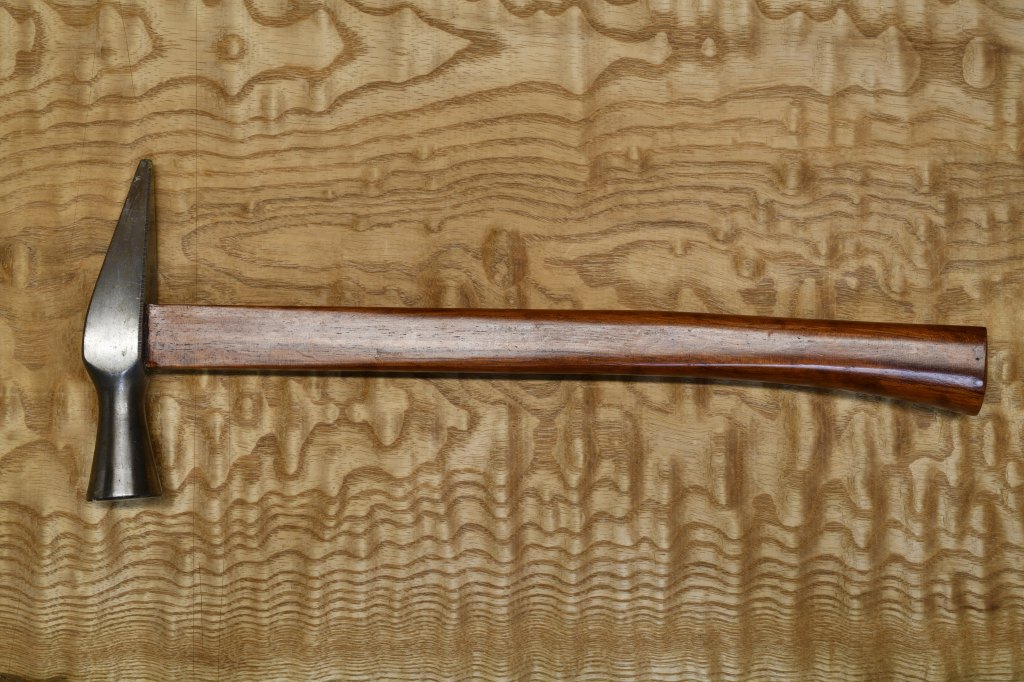
The purpose of this article is is not to suggest that Beloved Customers must use a Japanese gennou hammer when beating on our chisels. In fact, nearly any variety of quality steel hammer can be easily modified to do the job more-or-less satisfactorily, including claw hammers, engineer’s hammers, warrington hammers, or even ball peen hammers, so it isn’t necessary to buy a special hammer. In fact, we’ll discuss those modifications in detail as well as the relevant physics of hammers in future articles in this series. Rejoice for there will be formulas!

In the next post in this series we will examine the type of face a hammer used to strike our chisels should have. Please come back and bring your fuzzy primate friends.

YMHOS

Do you have something extra-slinky with red Chantilly lace trim?

If you have questions or would like to learn more about our tools, please click the see the “Pricelist” link here or at the top of the page and use the “Contact Us” form located immediately below.

Please share your insights and comments with everyone in the form located further below labeled “Leave a Reply.” We aren’t evil Google, fascist facebook, or thuggish Twitter and so won’t sell, share, or profitably “misplace” your information. If I lie may my nose grow to the size of a watermelon.

Go back

Your message has been sent

Warning
Warning
Warning
Warning.

Leave a comment