The Japanese Gennou & Handle Part 8 – Head Style & Weight

This image has an empty alt attribute; its file name is dsc_0048.jpg
A comparison of two styles of hand-forged gennou heads. Top: A Yamakichi gennou head by Hiroki. Bottom: A classical ryouguchi head by Kosaburo with the antique “swollen eye.” Both handles are made from American Osage Orange, an excellent wood for hammer handles. The top handle still exhibits the neon yellow color typical of OO, while the bottom handle has been exposed to sunlight for a few weeks and turned a nice but unusual brown color.

Better a bald head than no head at all.

Seamus MacManus

In the previous post in this series about Japanese hammers we examined a feature found in all modern hammer heads: the essential, unblinking, unseeing eye. In this post we will touch on the style of heads recommend for using with Japanese chisels. We discussed this subject in this post as well.

Gennou Head Shapes

The most popular head shapes commonly available in Japan nowadays are: ryoguchi, daruma, funate, yamakichi and various hybrids thereof.

Ryouguchi

Ryouguch is the most common style of head, at least in Eastern Japan. It has two faces: A flat one for striking chisels and nails, and a slightly domed opposing face for kigoroshi and setting nails below the surface of boards.

While a simple design, this style of head has a relatively high moment of inertia, making it is more stable than other styles and therefore less likely to twist out of alignment during the swing, or twitch upon impact, a positive thing if you are a card-carrying member of NBA (Nail Benders Anonymous). (ツ)

Face designs in this style vary widely including round, oval, square, rectangular (usually with corners removed for a more octagonal shape) true octagonal, and the “Ichimonji” style with roundish sides and a flat top and bottom. We prefer the rectangular shape with cut corners best, but one style is no better than another. We don’t recommend, however, faces with 90 degree corners as the corners are counter-productive during kigoroshi operations and are structurally weaker.

If you are worried about pulling nails, we encourage you to use a nail bar to reduce the number of broken hammer handles wandering the world sad and lonely as a cloud.

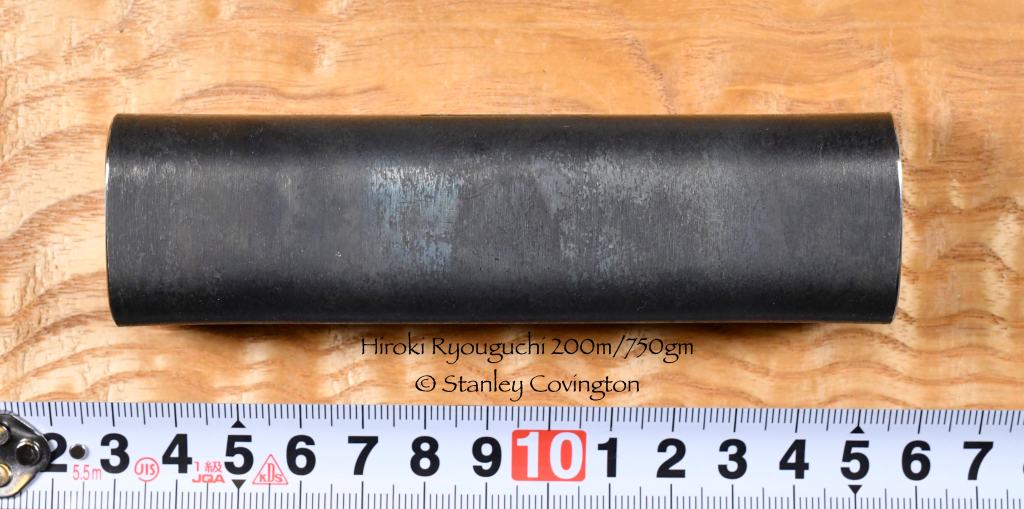
A 200monme/ 750gram/ 26oz Modern-style ryouguchi gennou by Kosaburo. Notice the symmetrical shape, slightly flared ends, and the polished “hachimaki” band near each striking face.

The Daruma

The enlightened Bodhisattva Dharma meditating like a house afire

The Daruma (pronounced dah/rhu/mah) gennou head takes its name from a famous Buddhist priest of oval stature who lost both arms and legs through excessive meditation, a blessed state doubtless achieved by many of our enlightened Beloved Customers (spiritual enlightenment that is, not quadriplegia). This gennou head is a stubbier version of the ryouguchi gennou, and always has a round face.

It’s more popular outside of Japan than domestically, for reasons your most humble servant fails to understand. From a physics viewpoint, at a given weight and because of its lower moment of inertia, it is less stable than other styles of gennou, but because it has a bigger face, and is intended to be used at constantly differing angles such that stability is less critical, this style is preferred by carvers. Joiners like it too for cutting repetitive mortise and tenon joints, but it is not favored by most other trades and may invite remarks at jobsites from other workers about the owner being unable to find his derriere with a mirror on a stick and a GPS. That said, your humble servant frequently uses daruma heads for cutting precise mortise joints in joinery.

An 80monme/ 300gm/ 11oz daruma head with an rock maple handle.

The Funate

A funate gennou with bubinga handle.
The tail of a funate gennou. This point can be sharpened for creating pilot holes for nails when shipbuilding, or left as a rectangle of starting and setting nails. The face is slightly domed, but still flat enough for striking chisels. A good multi-purpose head that favors nails more than chisels.

The funate gennou is closer in appearance to Western hammers with a skinnier neck behind the striking face, but without the split-tail “piano chisel” a foreman from my misspent youth named Jack Frost called the claw on his 28oz waffle-face framing hammer.

The funate gennou is more commonly seen in the Western Japan than Eastern Japan where I learned Japanese woodworking. It’s useful for finish work involving nails and for tapping-out plane blades, but less useful for wacking chisels.

The Yamakichi

Yamakichi was the name of a gennou blacksmith working in Fukuoka on Kyushu Island that originated this style of head and gave it his name. Kosaburo introduced this style to Tokyo in response to customer demand and with Yamakichi’s permission, we are told, improved the design somewhat.

This style is a heavy-duty stubbier version of the funate with a slightly domed face and a kinda sorta pointy tail, perhaps better suited to starting/setting nails than the ryouguchi head, but certainly better for striking chisels than the funate style.

Better with nails than the ryouguchi style, this head makes an excellent all-round hammer for working in the field, and can even handle tapping-out tasks.

The design has a unique and interesting appearance which reminds this humble scribbler of a 1956 Ford F100 truck in that, while neither sleek nor smooth, it has a sculptural quality not seen in the other styles that “grows on you.” It feels good in the hand too.

There are other in-between head shapes, but these are the four basic styles generally available for woodworking today.
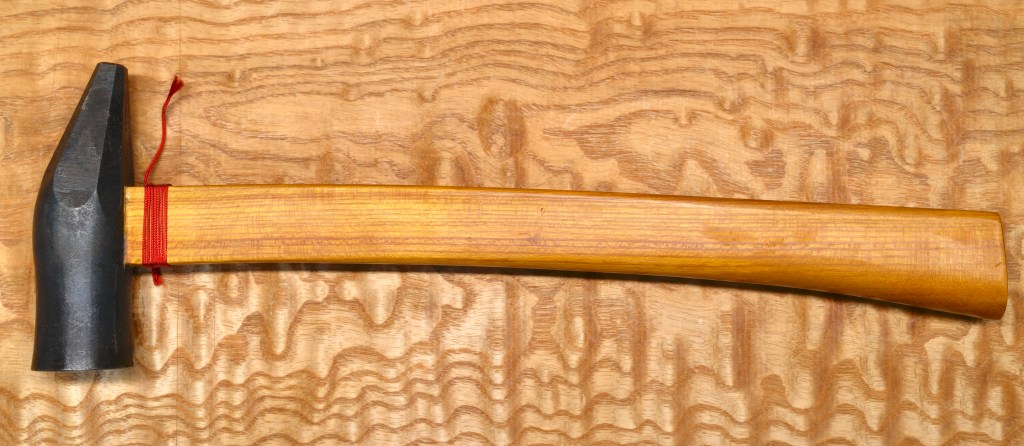
Another view of the Yamakichi gennou pictured at the top of this article after the color has mellowed through exposure to sunlight. This is 300monme/375gram/ 11oz head by Hiroki has an American Osage Orange handle. (The decorative twine was added at the tool’s request. It has a thing for the color red).

Weight

The subject of gennou head weight was examined at some length in a previous post.

Regardless of the type of gennou head you select, weight is a critical factor that will depend on what you plan to hit, your height above the thing you are hitting, how hard you need to hit it, and how precisely you need to hit it. Your own practical experience is the best basis for selecting the genno weight for a particular job, but some guidelines can be suggested.

To begin, the traditional measure used for gennou in Japan is the “monme,” with 100 monme equaling 375 grams or 13.2 ounces (1 ounce = 28.35 grams). 

The standard middle-of-the-road weight for gennou used by carpenters in Japan ranges from around 100monme (375grams/ 13.2 ounces) to 120monme (16oz). The most common hammer used for finish carpentry in the United States weighs 16oz. So if you are going to buy your first gennou, and you intend to use it for general finish carpentry or furniture making, a 100 or 120 monme head is a good place to start. 

For finer work, 50-80 monme (7~11 oz) is a good choice. If you intend to make furniture or joinery, one in this weight range is a must-have.

For cutting deep mortises in heavy timbers with large chisels, as in timber framing or boat work, a 200monme (26oz) hammer is frequently used, but 250 (33oz) and even 300monme (40oz) heads are available. I own and use them when necessary.

Some factors to consider when selecting a heavy gennou are that with greater weight comes greater impact force, and greater penetration, but heavier gennou are more tiring to swing and harder to control precisely, especially depth of cut.

Other factors to consider are the weight of chisels to be used, the width of their blades, and the hardness of the wood to be cut because a heavier chisel with a wider blade cutting white oak requires more force to cut to a given depth than, for instance, a 3mm oiirenomi (bench chisel) cutting sassafras. Only experience can instruct Gentle Reader what weight will work best in a given situation. Just be aware that, unlike athletic socks and gubmint health care (aka medical fraud collusion), there is no such thing as one-size-fits-all.

Conclusion

We hope this article has answered some of Gentle Reader’s questions on the subject of selecting a gennou head. If you have additional questions or need clarification, please use the “Leave a Reply” form below.

In the next article in our ongoing quest for spiritual enlightenment and metaphysical stability we will discuss the differences between mass-produced and hand-forged gennou heads. We will also consider the necessary attributes of woods suitable for making handles along with more design details in future posts, I promise. Until then, I have the honor to remain,

YMHOS

The following link is to a folder containing pricelists and photos of most of our products. If you have questions or would like to learn more, please use the form located immediately below titled “Contact Us.”

Please share your insights and comments with everyone by using the form located further below labeled “Leave a Reply.” We aren’t evil Google, facist facebook, thuggish Twitter, or a US Congressman’s Chinese girlfriend and so won’t sell, share, or profitably “misplace” your information. May my toes all grow black, stinky mushrooms if I lie.

The Japanese Gennou & Handle Part 3 – What is a Gennou?

Kiyomizu Temple, Kyoto, Japan

What we have is given by God; To teach it to others is to return it to him.

Gian Lorenzo Bernini

There are as many varieties of hammers in Japan as there are in Western countries. With one notable exception, and in one specific application, Japanese hammers are not especially superior to their Western counterparts. That exception is the gennou (pronounced gen/noh), a hammer intended specifically for striking chisels, adjusting plane blades, and strategically crushing wood included in joints (i.e. “kigoroshi” or “wood killing”). This article will provide a further introduction to the gennou hammer.

What Is a Gennou?

A box-stock, hardware store-grade Japanese gennou hammer with a one-size-fits-somebody handle

The Japanese have different terms for different hammers, of course. A hammer used strictly for driving nails, or banging sheet metal, or driving stakes is called a “kanazuchi” meaning “steel mallet.” A common slang term for this tool is “tonkachi.” The gennou, on the other hand, can of course be used to drive nails, but it’s especially suited to striking chisels and adjusting planes.

I’m told the word “gennou” was borrowed from the name of a Buddhist priest who lived, or so the story goes, in the 1300’s and used a steel hammer to destroy a poisonous rock that was troubling the common folk. I’m not sure what one has to do with the other, but there you are.

The Attraction of the Gennou

Many Japanese craftsmen develop an emotional attachment to their gennou, perhaps because, unlike saws, chisels, and planes that are gradually but inevitably sharpened away till little remains, or squares or marking gauges that loose tolerance, get bent or wear out, a quality gennou will last for a lifetime relatively unchanged other than the occasional replacement handle. A good gennou is a simple, reliable, hardworking friend that never complains. It doesn’t have a tail limiting it’s movement and greedily swilling electricity, or batteries that die at Murphy’s whim; It never needs to be sharpened. And most importantly, it will never ask to borrow your truck, or pose a dangerous question like “do these pants make my butt look huge?”

Why Use a Gennou for Chiselwork?

This is a questions we addressed in a previous post, but which we also examine further here.

Almost any striking tool, from steel hammer to leather mallet, can be used to strike a chisel. The problem is that, unless one is either gentle or the handle of the chisel is reinforced, a steel or even brass hammer will eventually destroy the chisel’s handle. The solution in the West has been to use a mallet made of wood, leather, rubber, or plastic instead to cushion the blow and preserve the handle. Let’s consider this for a moment. 

The purpose of striking a chisel with a hammer is to transfer the energy of the user’s arm and hand into the chisel via the movement of the hammer head driving it into and through the wood cutting it, right? But a soft-faced hammer/mallet, be it made of wood, plastic, rawhide or rubber deforms when it impacts the chisel cushioning the blow and wasting energy through deformation and heat generation. It may also unnecessarily waste energy through air drag, as we discussed in the Part 2 of this series. Since energy is lost, more mallet strikes are necessary, wasting time. This is demonstrably counter-productive.

Besides being relatively soft, a fat-faced mallet is bulkier, slower to swing, and is therefore less precise than a slimmer steel hammer of the same weight. While there may be some that are thrilled with cutting slowly and expending extra time and energy in the process of cutting a joint, most people want to cut as much wood as possible, as precisely as possible, in the shortest amount of time as possible, and with the least energy expenditure possible.

But if a chisel handle is so fragile that one must expend extra time and energy to keep it intact, then it is only logical to conclude that there is something wrong with the design of the chisel.

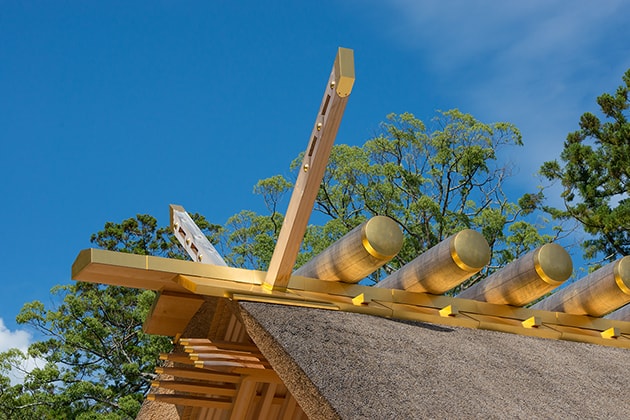
Ise Jingu Shrine, Mie Prefecture, Japan

The Japanese are very serious about woodworking, as anyone who has gone to Kyoto or Nara and seen the ancient wooden temples there can attest. When it comes to chisel work, Japanese carpenters don’t tolerate such silly nonsense as a chisel that must be coddled, and so early-on Japanese craftsmen developed a wooden-handled chisel that can be struck hard with a steel hammer all day long without breaking. 

The excellent design of the Japanese chisel combined with the quality of steel, and the forging, lamination, and heat treatment techniques used in manufacturing most Japanese chisels provides a tough cutting edge that stays sharper longer, placing Japanese chisels at the very top of the evolutionary pyramid of chisels, IMHO. And as the Japanese are wont to do, they developed a hammer specifically for striking chisels.

Technical Matters

The gennou is a simple tool consisting of a steel body of one shape or another attached to a wooden handle. The head has a rectangular hole or mortise called the “eye” in English and “hitsu” in Japanese that receives the wooden handle’s tenon.

The steel used for modern gennou is typically a standard, high-carbon Japanese tool steel used for making hammers, axes, farming implements and many other tools and designated “SK.” Chemically, it is very similar to 01 steel in the Americas; Not as pure as Hitachi Metal’s Shirogami or Aogami steels, of course, but still completely adequate for hammers. I wouldn’t pay extra for a gennou head made from Shirogami steel, much less rainbow-anodized unobtanium, and you shouldn’t either.

Mass-produced gennou are either cast or drop-forged very inexpensively. The eyes are rough and the handles are secured with wedges. Indeed, the eyes are typically so irregular that the head will not stay on the handle without wedges, but a high-quality gennou with a good eye and a handle made by a skilled craftsman doesn’t need wedges or other silly contrivances that compensate for sloppy tolerances to connect the two. “High-quality” is the key word.

Irregularities

A low-quality gennou head with a rough and/or irregular eye can create unnecessary problems for the user so it is important to understand and properly evaluate this negative space.

“Irregular” has several connotations in this context, but one common irregularity is an eye that is skewampus (please forgive your humble servant’s use of a few technical terms). For instance, it may have curved, twisted walls, wonky interior dimensions, or interior corners that are not clean and square. Not only is it a right pain in the tuckus to make a handle to fit such an eye, but you can bet your sweet bippy it will produce strange vibrations and cause the handle tenon to loosen up sooner.

Another irregularity commonly seen in the eyes of poor-quality gennou is rough interior walls. You would think that rough walls would generate higher friction and grip the tenon better, and perhaps they do compared to highly-polished walls, but rough, uneven walls tend to wear-out the wooden tenon of the handle quicker causing it to loosen over time. Imagine the vibrations the tenon is forced to absorb through those walls and the grinding action between wall surface and handle that results.

An intentional irregularity frequently seen in consumer-grade hammers is end walls (versus the longer side walls) that are sloped from each opening towards the center of the eye, essentially making the eye bulge inwards at its center. The purpose of these bulges is to crush the wood of the tenon when it is forced into the eye, increasing friction, while also providing a dovetail-like area for the steel wedge to expand the eye back into. It’s a reasonable solution for rough, irregular eyes in low-cost hammers to be used by amateurs, but one that the craftsmen who truly understands gennou and wants a lifetime tool finds undesirable. We will touch on this detail more in future posts.

Still another irregularity the careful craftsman must watch out for is an eye that is not perfectly centered in both axis in the head.

You might think that an eye that is a little off-center wouldn’t make a big difference, but it does because, not only is the balance and center of mass of such a head also skewampus so that the head tends to twist during the swing and then wiggle on impact, but because making handles for such a head is unnecessarily troublesome. A clean, uniform, straight, properly-centered eye is worth every penny it costs, especially if you are a professional and consider your time and sanity of any value.

Correcting Irregularities

A difficult question your humble servant is frequently asked is “how much irregularity is acceptable?” The answer is simple: If you think it is too irregular, then it is, because the work to correct the defect or compensate for it will all be on you. Sadly, most, including YMHOS, learn the answer to this question only through aggravating experience

Please understand that correcting major defects in hammer eyes is hard work. It takes time, concentration, a good eye, a flashlight, and a deft hand with skinny files and rulers to remove just the right amount of metal in just the right places inside that narrow eye, a task that is much more difficult than removing metal on an exposed surface because the files are thin and bendy, it’s hard to see what you’re doing, you don’t have much leverage, and consistently making a straight pass is not easy. Blisters will bloom. Patience will be tried. Sanity may quiver. Try it yourself and you will quickly see why.

This is the whole point of high-quality heads like those made by Kosaburo and now Hiroki and why they are worth the high cost: Their eyes are true when new, no adjustment necessary, saving the purchaser many hours of tedious work and blisters over a lifetime of hard use. Every time you make a handle for a high-quality head it saves time and leaves you with a good feeling. It’s a true friend, one whose dog never craps on your lawn.

On the other hand, a poorly-made head is a curse, a money-pit (if your time is worth anything), and a frequent source of irritation, especially when it inexplicably abandons its handle and soars as free as a hardened-steel bird (ツ)。

The Pig’s Ear

I hate to say it, but Beloved Customers and Gentle Readers should beware of one last defect when purchasing an expensive handmade gennou head. A perfect eye is truly a difficult thing to make, certainly more difficult than making a head cosmetically beautiful. Unfortunately, one or two famous blacksmiths (who shall remain unnamed in this series of articles, so don’t ask) have earned a reputation among knowledgeable professional woodworkers in Japan for occasionally making aesthetically beautiful gennou with skewampus, eyes. Caveat emptor, baby. She may wear high-heels, a short skirt and be beautifully made-up, but if she has a curly tail and oinks she’s probably a pig in a wig, unless she’s a trans-boor.

If you cannot hold and inspect an expensive gennou head in-person before concluding the transaction, at least make sure you purchase from someone with a solid guarantee, one without weasel-words and that reimburses you for return shipping, like C&S Tools’ guarantee does. A guarantee that you must argue about and then spend more money to benefit from is less than half a guarantee IMO.

We will delve further into the tempering and differential hardening of gennou, as well as laminated gennou heads in future posts in this series, same bat time same bat channel.

The Flawed Face

When it comes to wacking chisels, the garden variety hammer sold in both Japan and Western countries has a distinct design flaw. Namely, a domed face which works well for driving finish nails below the surface of lumber and gypboard, but with much use tends to damage the wooden handles of Japanese chisels by dishing in the handle’s end causing the katsura hoop to loosen, eventually deforming the hoop to the point the hoop in turn gouges and damages the handle. This can even result in the handle cracking or splitting. Yikes!

Using a flat-faced hammer easily solves this failing. The Japanese “ryouguchi” double-faced gennou has one face that is forged flat, for striking chisels, and an opposing domed face for driving nails or performing “kigoroshi.”

And while one absolutely can grind the face of a Western claw hammer flat and use it to strike Japanese chisels without any problems, the gennou is designed specifically for striking chisels. In your humble servant’s opinion, it is a superior tool for the intended purpose.

In the next post in this series we will examine three varieties of gennou to help you decide which is best for you.

YMHOS

The 5-layer Pagoda at Horyuji Temple, registered as one of Japan’s National Treasures. Yessireebob, a lot of hammer and chisel work went into making this structure.

The following link is to a folder containing pricelists and photos of most of our products. If you have questions or would like to learn more, please use the form located immediately below titled “Contact Us.”

Please share your insights and comments with everyone by using the form located further below labeled “Leave a Reply.” We aren’t evil Google, facist facebook, thuggish Twitter, or the IT dude for Hillary Clinton’s bathroom server farm and so won’t sell, share, or profitably “misplace” your information. May my hammer heads all fly away to stinky adventures if I lie.

Go back

Your message has been sent

Warning
Warning
Warning
Warning
Warning.

Leave a comment

Previous Posts in The Japanese Gennou & Handle Series

The Japanese Gennou & Handle Part 1 – Introduction

I do think a carpenter needs a good hammer to bang in the nail.

Oliver Reed

Introduction

This is the first in a series of articles about the Japanese gennou hammer in general (written 玄翁 in Chinese characters and pronounced “gen/noh”) and in particular how to design and make a unique one that perfectly fits your body and style of work.

The objective of these articles is to share with you, Gentle Reader, what your humble servant has learned over the years about gennou handles to help you design and make your own.

I will gladly share the entire series, including the drawings, as a single document with Beloved Customers upon request.

The True Craftsman Makes His Own Tools

A handful of generations ago quality high-carbon steel was difficult to make and expensive, so woodworkers worldwide, especially Japan, could not afford many tools, and the ones they did own or inherit were very important to them.

At least partly to reduce costs, it was standard practice back then for a woodworker (or his master) to commission the metal parts of his tools, such as the heads of his axe, hatchet, adze and hammer, and the blades of his chisels and planes from the local blacksmith. In the United States or other British colonies a craftsman may have purchased chisel and plane blades imported from Sheffield, but he would not want to pay the high costs of shipping wooden components across oceans and over mountains when he could make them himself. After all, woodworking was his business, so a self-respecting craftsman would make all the wooden components of his tools himself as a matter of course. Needless to say, those old boys knew how to make handles.

But things have changed. You may not realize it, but we live in a time of extreme wealth where even the poor live better than kings did 200 years ago, partly due to widespread industrialization making the necessities of life, and even what would have been called luxuries, available to everyone cheaply. This industrialization combined with cheap transportation has resulted in the prevalence of craftsmen purchasing pre-manufactured things, including tool handles.

Accustomed to the easy availability of standard mass-produced tools, lacking a clue about performance and focused like a laser on lowest cost, most woodworkers nowadays get by with colorful but poor quality tools designed by kids using computers working in marketing departments that have never used a handtool professionally, and fabricated by farmers in Chinese factories from higgily-piggily scrap metal. These tools may look great on the internet or wrapped in theft-proof plastic containers hanging on pegs in the big-box retailers, but how do they perform? And how long will they last? And what do they say about the men using them? Tools are terrible gossips, you know.

Gentle Reader cannot purchase a hammer handle like the one we will discuss in this series, and no one can make it for you. A hand-forged gennou head fitted with a handle made in accordance with the guidelines presented in this series will become a unique lifetime tool and the sure sign of a superior craftsman. More importantly, it will help you work more efficiently and precisely, make the joints in your shoulders, arms and hands hurt less, and give you greater confidence in your skills.

If you think this all sounds too good to be true, I challenge you to put it to the test. In fact, there is a series of performance tests listed in the last post of this series (when it is published, see link at the end of this post) that will allow you to generate hard proof of the truth of these claims for yourself. You will be impressed with the results.

While Japanese hammers are the primary focus of this series, you can apply the ergonomic principles and solutions I will describe to all varieties of hammer handles.

Modern Tools: Marketing, Design & Manufacturing

I grew up using hammers designed for maximum sales in a competitive marketplace of amateurs, of the type I call “One Size Fits Nobody.” Back then they were made in the USA, but nowadays they are cheaply mass-produced in China. Prices are rock-bottom, and quality is focused solely on getting an attractive product to the big-box retailers at the right price-point while fending off the slavering hordes of snaggle-tooth lawyers that specialize in product liability and personal injury lawsuits. To these corporations, you and I are beasts in a herd, of no import beyond the contents of our wallets and our willingness to empty them.

Like the cover of a manga comic book, mass-produced modern tools are carefully designed to immediately draw the eye and excite the senses of those passing by. Bright colors and futuristic shapes war with each other for attention on the pegboards of big-box retailers. Handles are made of plastic and rubber fitted over cast steel or molded fiberglass, secured with globs of glue intended to hide malformed ulcerous eyes.

The designers of these blister-makers and nail-benders intend their products to age poorly so they will be discarded by purchasers after just a few years to ensure unending sales of “new-and-improved” replacements. Plastic and rubber are the materials of choice because they are cheap to fabricate, easy to make into colorful, exciting shapes, and speedily surf the spiral wave into the depths of the toilet of planned obsolescence. 

The international playboy that Billy Crystal introduced the world to in “Nando’s Hideaway” might have been talking to one of these hammers when he said “This is from my heart which is deep inside my body: You look mahvelous, absolutely mahvelous dahling. Remember, it is better to look good than to feel good.”

Perhaps these tools do look mahvelous hanging on those pegboards. But how good do they feel?

The tool conglomerate’s product development departments and marketing geniuses have taken the Latin Lover’s philosophy to heart. They know that tools that look good and turn to garbage quickly are more profitable than efficient tools that merely feel good. I am sure ‘Nando would go “crazy nuts” if he observed modern hammers in their natural environment, but alas my friends (saludos, my darlings, you know who you are), Nando will not make the journey to a big-box home center to inspect their pegboard tools because he does not feel good.

Clever people, these marketing strategists, stuffing their pockets with money and landfills with plastic and scrap metal by selling imitation tools to the herd. But as for me, I’ll have none of that churlish fraud, thank you very much.

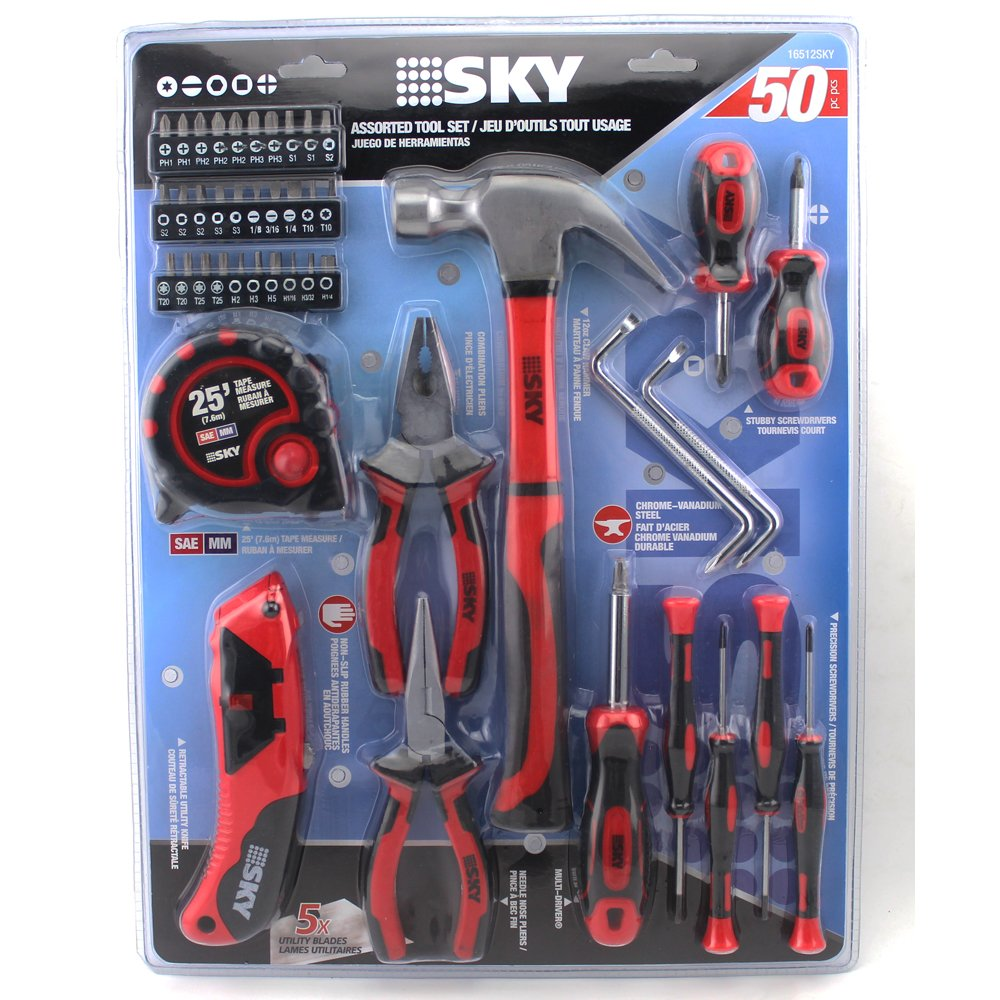
Would you buy a hammer like this? If so, please don’t call yourself a craftsman or operate heavy equipment.
Wow, a comprehensive torture kit. And just the right color too. Please don’t puke on your computer or smartphone.

Hammer Handle Morphology

The hammer is an extremely simple tool, literally as old as humanity. I suspect humans made the first multi-component tools by attaching wooden handles to stones to make hammers, axes and clubs. 

But despite millennia of history, modern folks have all but forgotten how to make a proper tool handle. It wasn’t always that way.  Everyone made their own replacement handles only five generations ago, and their expectations were guided by sweat and blisters. They didn’t need product development departments in Shanghai to tell them what handle worked best.

Axes are an obvious example of how marketing has morphed handle design. Take a gander at an old tool catalog and notice how axe handles have become thicker in the last 120 years. Do these changes mean that for millennia humans didn’t know how to use axes or make proper handles for them? Do modern human joints and tendons endure the higher vibration and impact forces a thicker, heavier, stiffer handle transmits better than those of our forefathers? Has the nature of modern trees changed such that grain runout no longer weakens a needlessly recurved handle made from their wood?

No, these recent changes in handle design are not intended to make tools more functional or more durable, but are rather to increase sales of cheaply mass-produced tools of apparently innovative design, mediocre quality and disposable utility. They simply look mahvelous, absolutely mahvelous dahling, especially as a picture on a website or hanging on a peg in a hardware store.

Please, don’t get me started on modern mass-market saw handles.

In the next article in this series about beaters we will look at the ergonomics of hammers. Until then, I am profoundly honored to remain,

YMHOS

PS: Here is an excellent article about the “Devolution of Axe Handles” that jives well with my research and experience, and the advice my grandfather gave me about making an axe handle 50+ years ago. And just to prove that we at C&S Tools have refined tastes, here’s some music from Fernando.

The following link is to a folder containing pricelists and photos of most of our products. If you have questions or would like to learn more, please use the form located immediately below titled “Contact Us.”

Please share your insights and comments with everyone by using the form located further below labeled “Leave a Reply.” We aren’t evil Google, facist facebook, thuggish Twitter, or a US Congressman’s Chinese girlfriend and so won’t sell, share, or profitably “misplace” your information. May I never know love or sunshine if I lie.

Go back

Your message has been sent

Warning
Warning
Warning
Warning
Warning.

Subsequent Posts in The Japanese Gennou & Handle Series