We Wish You a Ripper Christmas: A Guest Reviews 3 Handsaws

by Antone Martinho-Truswell

[This article was written by the energetic Doctor Antone Martinho-Truswell, a Most Beloved Customer and Dean at St Paul’s College, University of Sydney. While not as scholarly as his fascinating and romantic earlier guest post titled Permanence, in this article Antone has graciously shared an aspect of his woodworking experience that will resonate with many Gentle Readers. Please enjoy.]

“Arise and be merry

And sing out while you can

The world will never see the likes 

Of dear old Stan.”

From “Dear Old Stan”, by the Dreadnoughts, concerning a different Stan, equally worthy of your meticulous study.

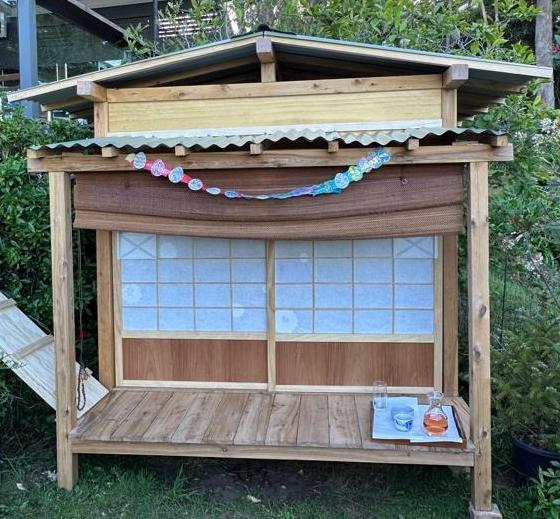
A few weeks ago, I was putting the final touches on my most recently finished, and largest, woodworking project to date. Over the past 18 months, interspersed with dozens of smaller and more pressing projects, I’ve constructed this tea-house styled cubby house for my daughters, complete with engawa, shoji screens (already torn and patched), Aussie-style “tin roof”, and tiny roofed reading nook overlooking Australia’s Blue Mountains National Park. My daughters made the paper garland to celebrate the opening of their new palace.

With this project I set myself the challenge of making the entire structure using only handtools (save a cordless drill for the roofing screws), and to use primarily reclaimed timbers. The timber frame, floors, and inside surfaces of the wooden walls were all hand-planed with a kanna, and all of the joints hand-cut. This involved cutting some 300 joints, and an almighty amount of handplaning.

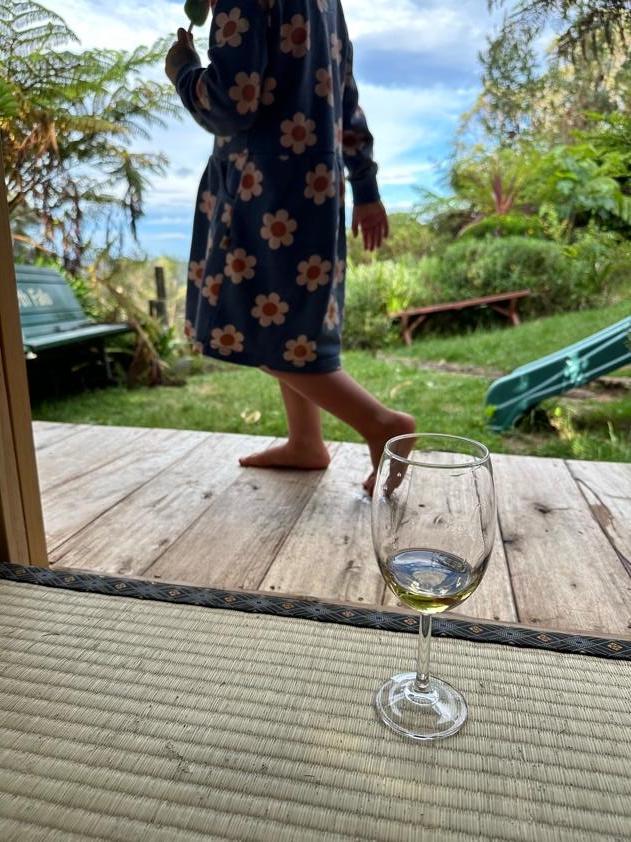
But it was the ripping that did me in. Or rather, did in my tools. Between the wall panels, floorboards, shoji frames, and the joints themselves, this involved a tremendous length of rip cuts in very hard Australian woods. As I celebrated the completion of the project with a glass of vintage Château Thames Embankment while gazing across the verdant valley, I considered the small collection of exhausted Japanese rip saws the project had left in its wake.

 I had been using modern, disposable-blade, induction-hardened Japanese saws on this project, and two, in particular, gave the ultimate sacrifice in the process.

One saw was a rip single-edged kataba already fairly used up on other projects, the other a fresh but inexpensive ryouba that I dedicated to this project in particular. As Stan has noted before, these induction-hardened and mass-produced Japanese saws are excellent tools – sharp, effective, and long-lasting. Moreover, I had been putting them to more punishing work than usual – “in the field” rather than the workshop, cutting reclaimed timber replete with grit, dirt, and other dulling faeries that grinded away their cutting edges.

I am normally meticulous in following Stan’s advice to clean one’s timber and remove dirty, gritty surfaces with dedicated roughing tools before putting quality blades to work, but this project called for a different approach – there was too much timber to efficiently clean before working it, and the inexpensive saw was purchased and dedicated to the project in order to prevent needless back-and-forth while assembling the structure in the garden, so it served as both roughing and finishing tool.

Later, while enjoying a refreshing beaker of Château Fleet Street, I realized two things. First, that my much older furniture-making ryouba had also been dulled by local faeries; and second, that I needed to replace my other workhorse handsaws.

Naturally, this meant contacting Dear Old Stan, the only solution when tools that work are wanted. (Stan, I’m waiving my copywriting fees for that tagline.)

After some back-and-forth with our reliable proprietor, I settled on three saws to renew the capabilities of my saw-box. Our discussion covered a few considerations:

  1. I have no shortage of fine-tooth saws like dozukis and hozohikis, all of which are working fine and providing good service.
  2. I am up for the challenge of re-sharpening rip teeth, but am wary of the time investment versus benefit of trying to sharpen the complex shape of Japanese crosscut teeth.
  3. These new saws would be used for sawing stock to rough dimensions. I frequently make furniture from locally-sawn slabs, and so need to make long rips and crosscuts to efficiently break these down into smaller components.
  4. I wanted saws that are nicer, more real, and more meaningful than mass-produced tools, if possible.

Gentle Reader will not be surprised to learn that Stan delivered all I needed and then some. 

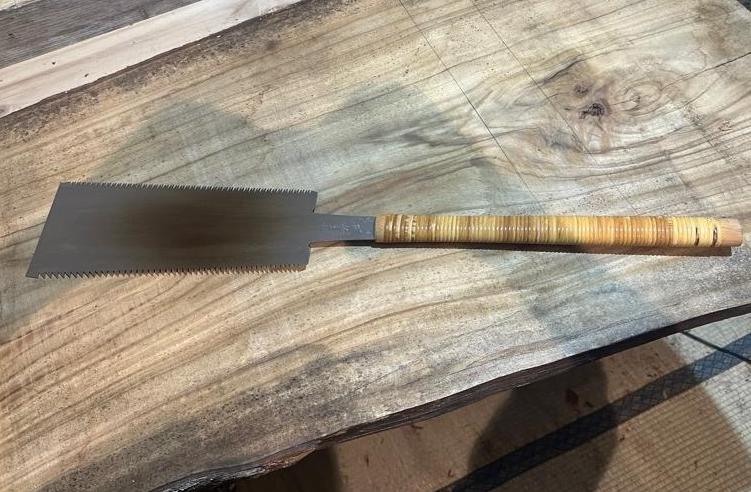
The first cab off the rank was an antique 300mm ryouba labeled as being made of Tougou steel – a now rare tool steel produced by Andrews Steel of Britain. This is a stiff bladed, large ryouba, and a very handsome saw. Stan offered, and I enthusiastically agreed, to have this saw tuned, sharpened, and teeth re-profiled for hardwood by his saw-smith, Takijiro.

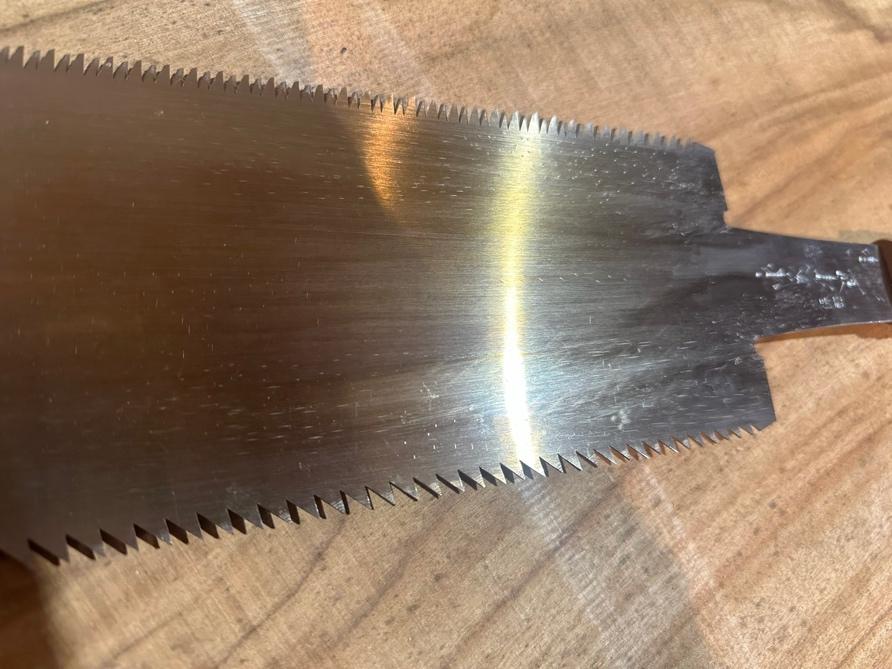
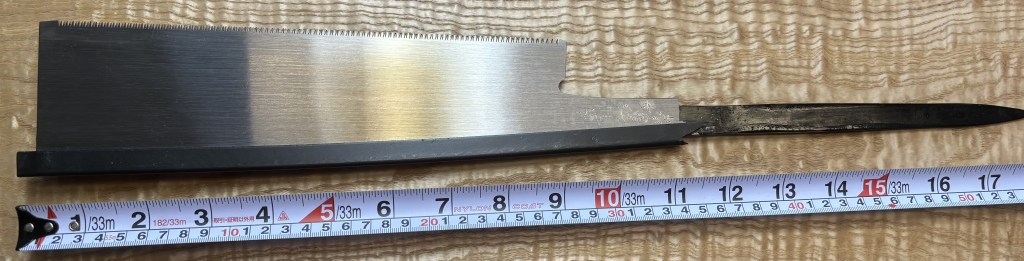
Takijiro trued and tensioned the blade, leaving behind the telltale henpecks seen on the sides of the blades.

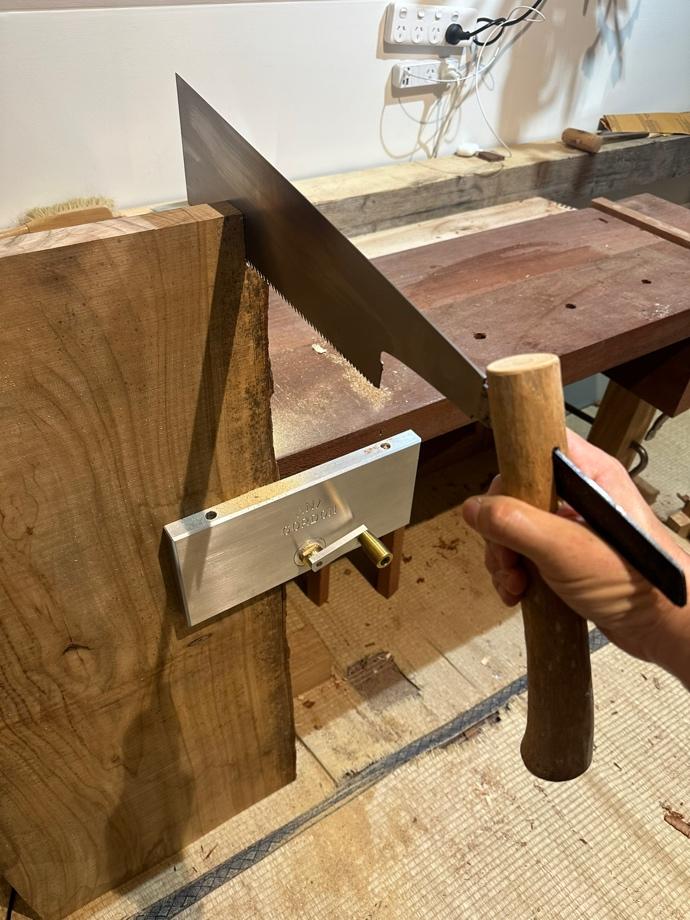
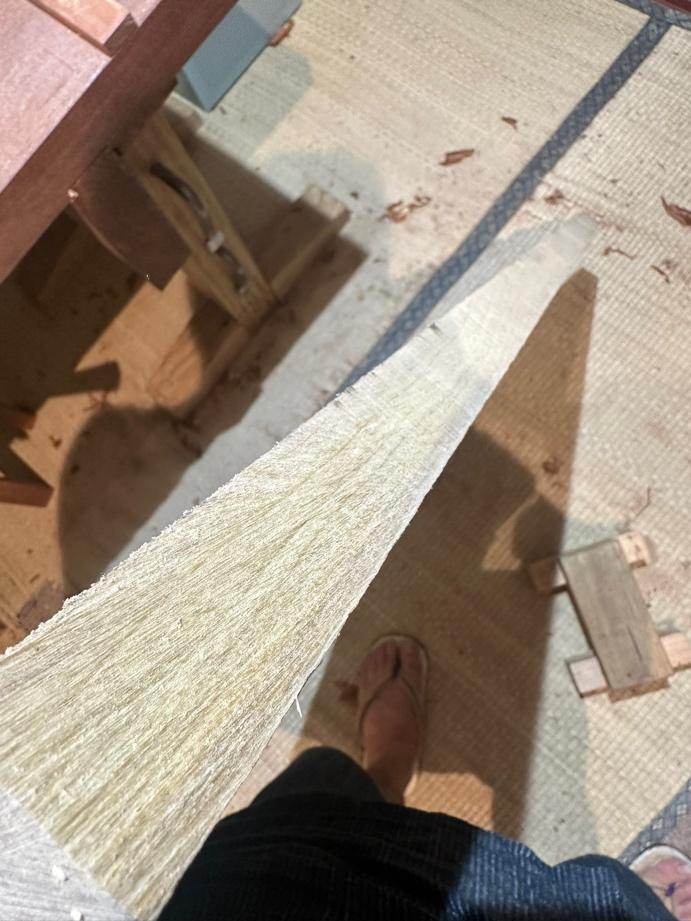
This new saw’s first challenge was crosscutting a slab of camphor laurel planned for a coffee-table top, about 650mm wide and 40mm thick (after giving the slab a good scrub with a wire brush first). It took me about 2 minutes to complete this cut, and it was exceptionally easy to keep straight. I followed this with a 1200mm long rip cut through the same in about 4 minutes and equally satisfying. The cut surfaces were exceptional – very smooth and very straight, even with my paltry skills.

I could not have been happier with this saw, which came from Stan’s “miscellaneous ryouba” selection, and the decision to have the blade tuned and the original teeth replaced with dedicated hardwood teeth is something entirely to be recommended to all potential purchasers.

But one is never enough. And after years of reading Stan’s enthusiastic praise of them, I also wanted my own bukiri gagari, a much rarer and more specialized saw. Here, Stan was able to provide this beautiful 330mm blade made by Takijiro, again, sharpened, trued, tensioned, with hardwood teeth, and with a beautiful natural wooden handle to boot. 

Nakaya Takijiro Masayuki, sawsmith extraordinaire

This saw is a joy to use. It’s much bigger than its 330mm size might suggest on first read. It feels like a much bigger, more substantial tool than the 300mm ryouba, despite the blades being notionally similar in size.

I soon became accustomed to using a pull saw with a “pistol grip” handle (aka “shumoku” handle), and sure enough it delivered a straight cut and quickly. I put this saw to the task of making the matching 1200mm rip cut on the other side of the slab, and the results were, as expected, fantastic.

I can’t overstate how much easier it was to make quality cuts with these quality tools. I’m not a professional carpenter, but neither am I a turnip, and can usually make a fist of accurate work even with subpar tools. And while I have some higher-end dozukis and other fine-toothed saws, I had kept my ryoubas and rough work kataba saws cheap and cheerful to this point. These saws were, if not quite like the light that shone round Saul on the road to Damascus, at least a bit like scales falling from my eyes.

The third saw I ordered from Stan was a mass-produced and induction-hardened crosscut ryouba, with an exchangeable 300mm blade – larger than is easily found here in Australia. The reason for this choice was explicitly related to one of my purchasing criteria above, namely that I suspect that I will not be attempting much crosscut saw sharpening any time soon.

The aforementioned ryouba and bukkiri gagari saws are both traditional, handmade saws with teeth that will require regular sharpening.

Stan kindly included in his package a tiny specialized saw file to accomplish this task. But I will be babying the crosscut teeth on the ryouba out of my own hesitancy to try to sharpen them. As such, I thought it wise to make use of the best of modern technology in this affordable, induction-hardened saw to be used whenever extensive rough cross-cutting, sometimes through less than immaculate timber, is required. It cuts very well indeed, and quickly, if without some of the romance and spirit of the handmade saws.

These saws are already the new front-benchers in my workshop, and doing excellent work. The only thing I recommend more strongly than Stan’s tools are his advice and counsel in selecting, using, and caring for them.

There are many people selling tools. But the world will never see the likes of dear old Stan.

As we say in Australia, here’s wishing you a Ripper Christmas! May the greatest of all carpenters be a light unto you and your loved ones.
Antone

Christ in the House of His Parents, oil on canvas by John Everett Millais (1849-1850), at the time a controversial painting much criticized by the likes of Charles Dickens because of its realistic depiction of a country carpentry workshop, especially the dirt, sawdust and shavings on the floor. But surely this is what a poor carpenter’s workshop in rural Nazareth would have looked like when Jesus was a small boy. Joseph is shown working on a simple battened door joined with nails, a standard carpenter’s job in all places at all times, but he’s stopped work to examine an injury on Jesus’s hand, perhaps caused by one of those nasty nails, foreshadowing future wounds, while Mary comforts her boy with a kiss. By no coincidence, a drop or two of blood has dripped onto the child’s foot further hinting of unpleasantness to come. In the background grandmother Anne takes over the job the injured child had been doing prior to the accident of clipping clinched nails, while young cousin John on the right (later known as John the Baptist) brings water to cleanse the wound, another ominous foreshadowing indeed. The apprentice shown on the left is said to represent Jesus’s future apostles while the sheep seen gawking through the open workshop door are said to represent the flock of Christianity. The ladder and the dove resting on it are also symbolic.

If you have questions or would like to learn more about our tools, please click the “Pricelist” link here or at the top of the page and use the “Contact Us” form located immediately below.

Please share your insights and comments with everyone in the form located further below labeled “Leave a Reply.” We aren’t evil Google, fascist facebook, or the Chinese Communist Party’s coordinator for blackmail, and so won’t sell, share, or profitably “misplace” your information. If I lie, may the tang of my bukkiri gagari saw break off.

Go back

Your message has been sent

Warning
Warning
Warning
Warning.

Leave a comment

Relevant Articles

Japanese Saws: The Carpenter’s Dozuki & Hozohiki

“I see!” said the blind carpenter as he picked up his hammer and saw.

– Old wellerism.

n this article your most humble and obedient servant will be so bold as to do a show and tell of a matched pair of custom-forged Japanese handsaws of a type seldom seen nowadays.

In previous articles we examined similar saws, the famous Japanese dozuki handsaw, the tool that first brought attention to Japanese woodworking tools in North America, and the hozohiki handsaw, a rip version of the dozuki crosscut saw, identical in all aspects save the quantity and shape of their teeth.

The shaku (270mm) carpenter’s dozuki crosscut handsaw (handle not attached). The tape measure displays centimeters/millimeters on the lower scale and Japanese sun on the upper. Please notice the mysterious but intentional brown discoloration on the blade. This blade was shaped, beautifully finished, and tapered using a hand scraper called a “sen,” not grinder or sandpaper. The small dings visible on the plate’s surface are tiny hammer marks left by Takijiro when truing and tensioning the plate, an almost entirely forgotten skill nowadays, one at which Takijiro has not match.

As described in the pages linked to above, the dozuki is a crosscut saw specialized in, and named for, the task of cutting the shoulders of tenons quickly and precisely obviating the wasteful step commonly thought mandatory in the West of paring shoulders to final dimensions. It can perform many other crosscut tasks too, of course, but for making tenons it is indispensable.

The hozohiki saw, on the other hand, is a rip saw, one that takes its name from its primary task of precisely and cleanly cutting tenon cheeks.

Because the quality and precision of the shoulders and cheeks of the tenons a craftsman cuts determines not only the quality of the products he makes, but also the ease and speed of assembly of his joinery efforts, the tasks these two handsaws are specialized in accomplishing are critical to the professional woodworker in making tight, beautiful joinery quickly.

So what’s the difference between a regular dozuki and the carpenter’s dozuki? Ah, another of those perspicacious questions with which Beloved Customer is constantly illuminating the world!

The shaku (270mm) carpenter’s Hozohiki rip handsaw (handle not attached).

Well, the carpenter’s dozuki is extraordinarily similar to the standard 210mm dozuki handsaw, essentially a thin, high-precision saw used by joiners, furniture makers, cabinetmakers and sashimonoshi for making joints requiring fairly shallow cuts, except in this case, the saw’s cutting edge is longer (270mm), the plate is accordingly wider, and it has more teeth.

Indeed, except for a few cuts in the larger components of furniture and cabinetry, few need to be very long or deep, so keeping the sawblade of the standard dozuki and hozohiki narrow and short not only saves steel, cost and time but makes the saw more rigid while retaining a thin blade.

On the other hand, carpenters, especially temple carpenters and architectural joiners, often need to make many extremely precise, clean cuts for the complicated, elegant joinery included in their customer’s projects. But because the members they need to work are frequently much larger than those used in other trades, a saw larger than the standard dozuki or hozohiki to make deeper, but no less precise, cuts is necessary. Ergo pergo ipso facto, the carpenter’s crosscut dozuki and rip hozohiki came into being somewhere back in the swirling mists of time.

But because only the most accomplished and trusted craftsmen are given the opportunity to do fine work in larger timbers, and because they are more expensive to forge, these big girl saws never gained the same degree of popularity as their daintier, more fashionable sisters.

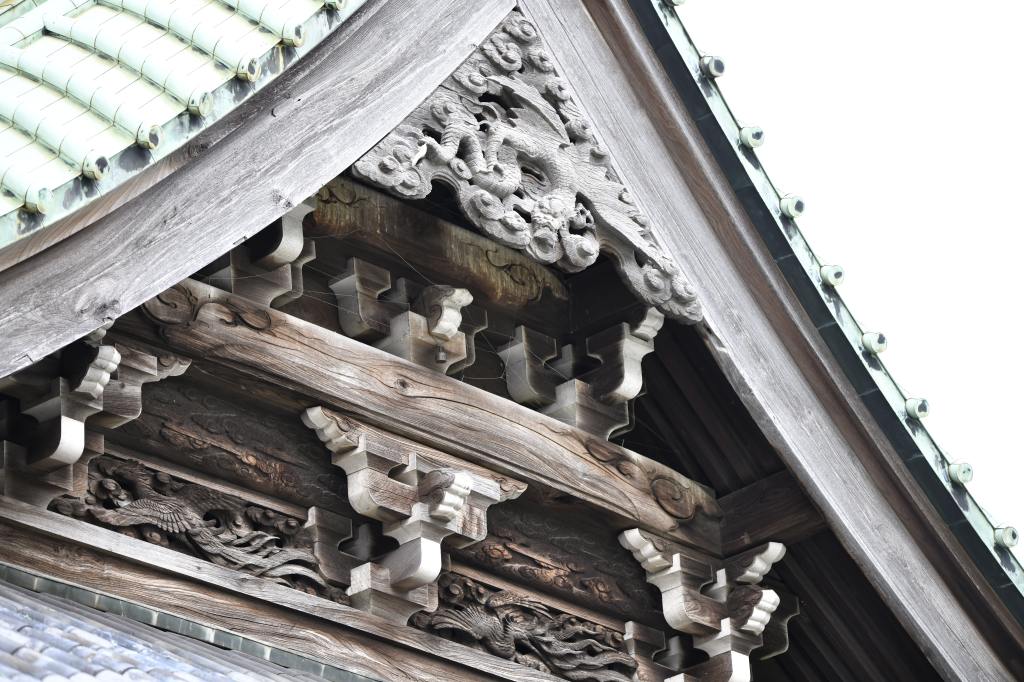
A view of the kumimono and nijibari at the main entrance roof of a buddhist temple known as Shibamata Taisahkuten founded in 1629 in Tokyo. Constructed mostly from keyaki wood (zelkova), this is exactly the sort of work the saws presented herein are intended to execute.

As you can see in the photos, a piece of folded mild steel is attached to the back of these saws by friction to provide a higher degree of rigidity to the ultra-thin, tapered, hammer-tensioned blade, thereby improving the precision of the cuts it can make while with the same stone reducing the likelihood of the plate buckling, the bane of thin saws.

These backs are handmade and hand-filed from mild steel, and are finished in traditional burnt silk.

Backs are fine and necessary additions, but alas not all is blue bunnies and fairy farts because the back’s downside is that it physically limits the saw’s maximum depth of cut, a problem for some jobs. But by making the sawplate wider and the distance between the back and teeth greater, the carpenter’s dozuki, and its sister the carpenter’s hozohiki, are superior at cutting precise joinery in larger pieces of wood.

These saws are also used by joiners who perform high-end interior and architectural woodworking. For example, stairs, handrails, built-up moldings, fancy doors and windows, and coffered ceilings are a few types of work for which these saws are indispensable.

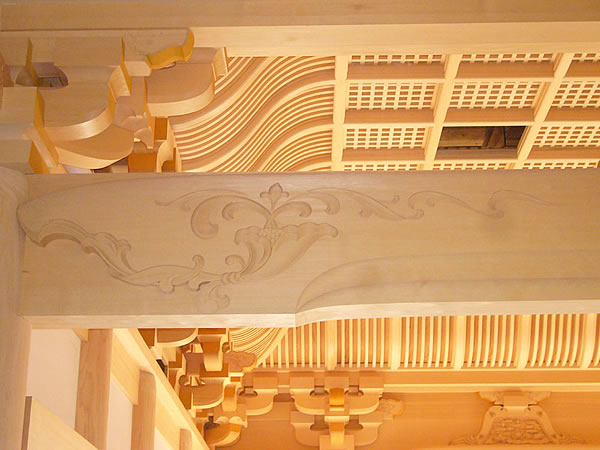
A temple interior with hand-planed and hand-carved beams, elbows, kaerumata, and coffered ceiling all of hinoki wood. Gorgeous work.

The saws shown in this article are a recently-completed matched set custom forged by Nakaya Takijiro for an exceptionally Beloved Customer. The nominal (versus actual) length of their cutting edge matches the traditional Japanese unit of measurement called a “shaku (approximately 12” = 0.33 meter), but the actual length of this type of saw varies by area and blacksmith. In this case, Master Takijiro forged the cutting edge 270mm (9-sun) long.

But what about the all-important teeth? Master Takijiro forges handsaws almost exclusively for elite Japanese craftsmen such as joiners, cabinetmakers, furniture makers, sashimonoshi and luthiers, etc., professionals who are very particular about their requirements for, and performance expectations of, their handsaws, especially the teeth.

Therefore, in accordance with tradition and Takijiro’s standard procedures, this Beloved Customer provided physical samples of the wood he uses most in his business, including, among other species, the North American varieties of maple, cherry, white oak, and black walnut.

After test-cutting these samples, Takijiro hand-filed the crosscut teeth of the dozuki saw at 18.4T/in., and the rip teeth of the hozohiki saw at 15T/in (non-progressive), and shaped them to quickly and precisely to best cut the samples provided, a big improvement over standard teeth specifications.

As of this scribbling these two toothy sisters should be gleefully winging their way to the USA to meet their new master. I only hope don’t they attract too much unwanted attention in US Customs by wiggling and giggling too impatiently! You know how young ladies can be (ツ)。

YMHOS

If you have questions or would like to learn more about our tools, please use the “Contact Us” form located immediately below. Please share your insights and comments with other Gentle Readers in the form located further below labeled “Leave a Reply.” We aren’t evil Google, incompetent facebook, or sketchy X and so won’t sell, share, or profitably “misplace” your information. If I lie may I suffer the fate of Simon the Zealot.

Simon the Zealot, Helsinki Cathedral. Notice the large saw.
Simon the Zealot (Acts 1:13). Notice the large two-man saw. Your humble servant does not recommend this application for safety reasons.

Relevant Articles

Contact Form:

Go back

Your message has been sent

Warning
Warning
Warning
Warning.

Leave a comment

The Forgotten Sumitsubo 忘れ物の墨壺

The Forgotten Sumitsubo

Remember me when I am gone away,
Gone far away into the silent land;
When you can no more hold me by the hand,
Nor I half turn to go yet turning stay …

Christina Rossetti

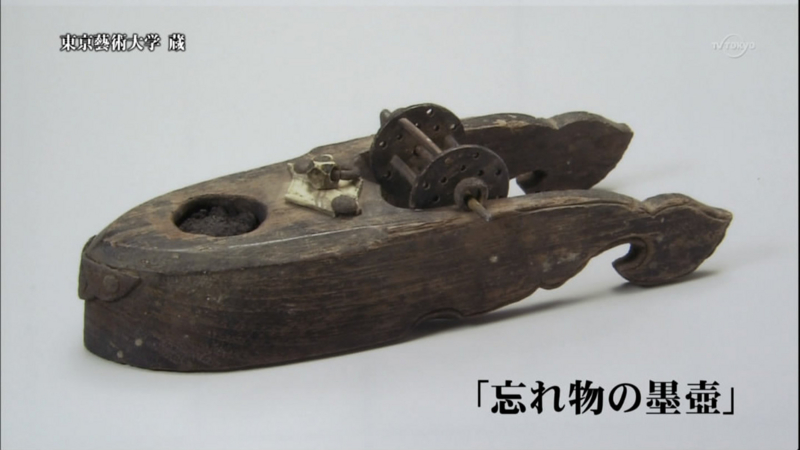
The tool pictured above is a very old “split-tail” variety of “sumitsubo” inkpot.

Versions of this tool are used in many trades worldwide to mark a straight layout line on material being worked. In the West, the line is coated in chalk to produce a “chalkline” when snapped, but in Japan a silk line wound on the spool near the tail of the tool is soaked in ink as it passes through the “pond” near the pointy front of the tool to produce the same sort of layout line when snapped.

This particular tool is unusual not only because it is one of the best-preserved examples of Japanese sumitsubo in existence, but also because it was discovered during restoration work on the 27m tall Nandaimon gate of Todaiji temple in Nara Japan in 1879. Since its discovery it has become famous as the so-called “Forgotten Sumitsubo.”

The reason for the unusual name, indeed the very reason it has survived in such a good state of preservation, is that Todaiji Temple’s Nandaimon gatehouse where this sumitsubo was found perched peacefully on top of a beam high in the structure that was built in the year 1199, so it is likely this sumitsubo had remained there undisturbed for around 680 years, a long time for a wooden tool.

Was it really forgotten? I like to think some carpenter left it there on purpose to look after his work. But that’s just me…

Related image
Front elevation of the Nandaimon gate of Todaiji temple, Nara, Japan. The deer of Nara are like pigeons. The stall to the left is selling “deer crackers” for tourists to feed them.
The eaves of Nandaimon Gate
Related image
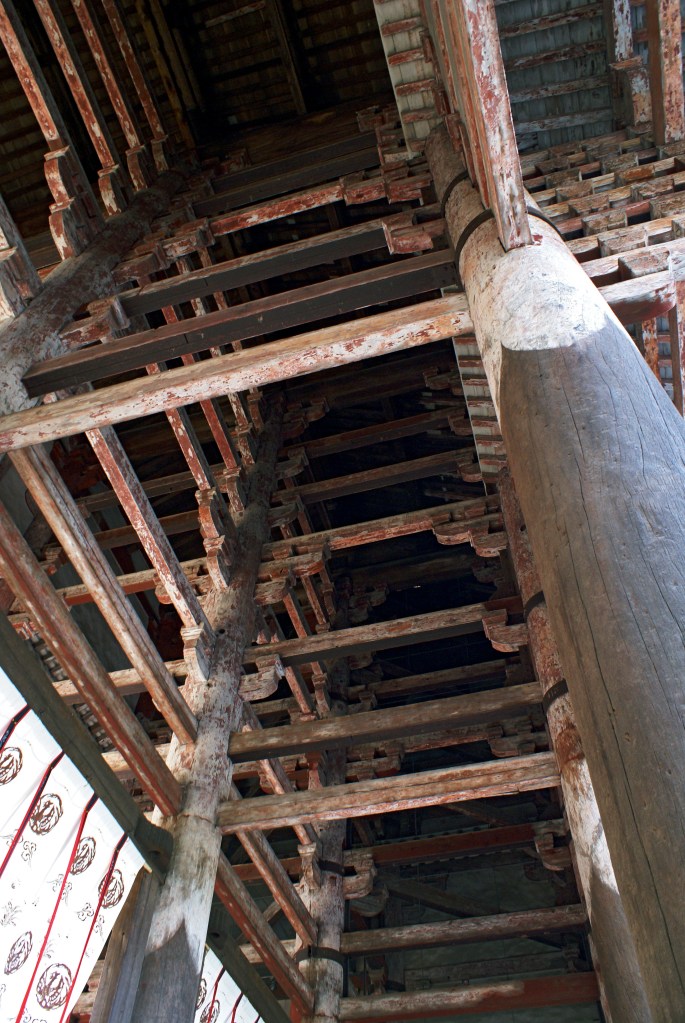
Looking up into the structure of Todaiji’s Nandaimon Gatehouse
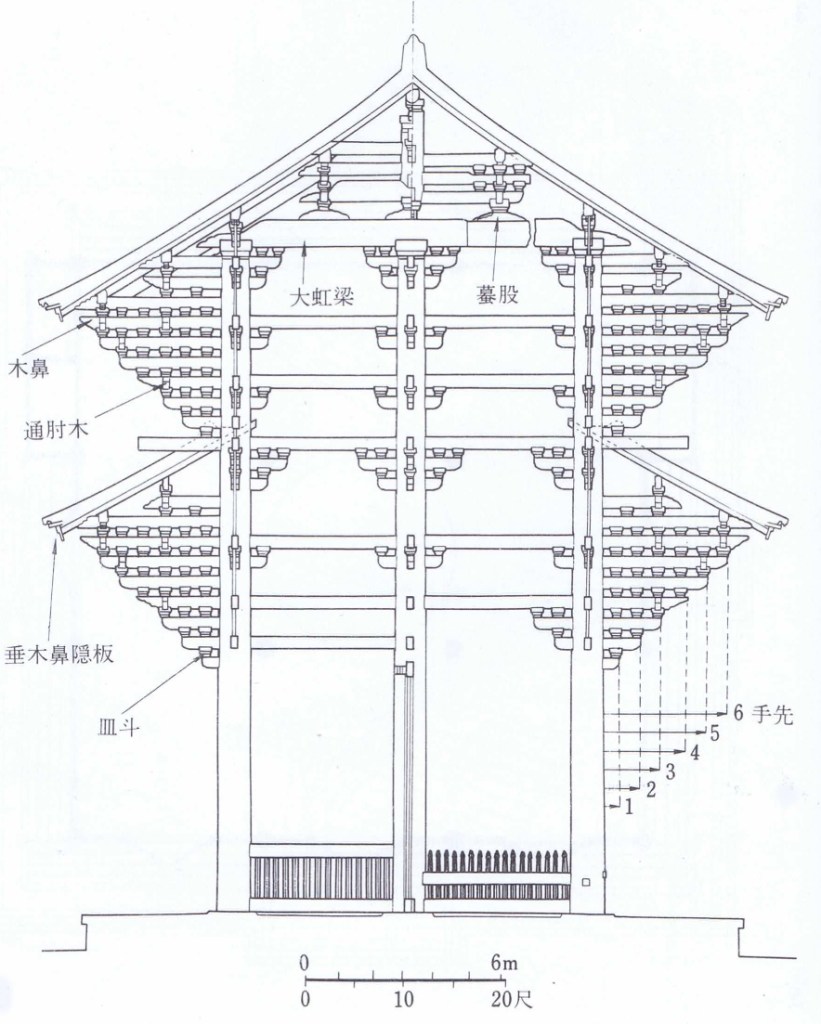
Cross-section sketch of Todaiji’s Nadaimon Gate

So, if you ever misplace a tool at a jobsite, instead of fretting about it, just imagine that someone, someday, will find it hidden inside the building 700 years later and reverently put it in a museum. Certainly more romantic than any other more likely option. (ツ)

YMHOS

If you have questions or would like to learn more about our tools, please click the “Pricelist” link here or at the top of the page and use the “Contact Us” form located immediately below.

Please share your insights and comments with everyone in the form located further below labeled “Leave a Reply.” We aren’t evil Google, fascist facebook, or thuggish Twitter and so won’t sell, share, or profitably “misplace” your information. If I lie may the two guardian kings above refuse to let me shower alone.

Go back

Your message has been sent

Warning
Warning
Warning
Warning.

Leave a comment

Other Posts in Japanese Sumitsubo Inkpot Series

The Strongmen Under the Veranda

Art is born of craftsmen. Art is not born of those called artists.

Tsunekazu Nishioka and Horin Matsuhisa “The Heart of Trees, the Heart of Buddha”

Having worked in architecture and construction in Japan for more than half of my life, your humble servant is fond of Japanese traditional wooden architecture. It has much to recommend it, not only for the visual beauty of the designs and the spacial experiences it often provides, but also the excellence of much of it’s execution, made possible through craftsmen’s skill with Japan’s excellent woodworking tools.

In this post we will examine a few details of Japanese traditional architecture, and the Japanese language phrase one structural member engendered, the origin of which even most Japanese are unaware. Perhaps Gentle Readers will find this obscure phrase as interesting as your humble servant does.

The linguistically-intriguing architectural detail that is the primary subject of this article is a wooden structural member called the “en no shita no chikara mochi.”(縁の下の力持ち)which translates to “Strongman under the veranda.”

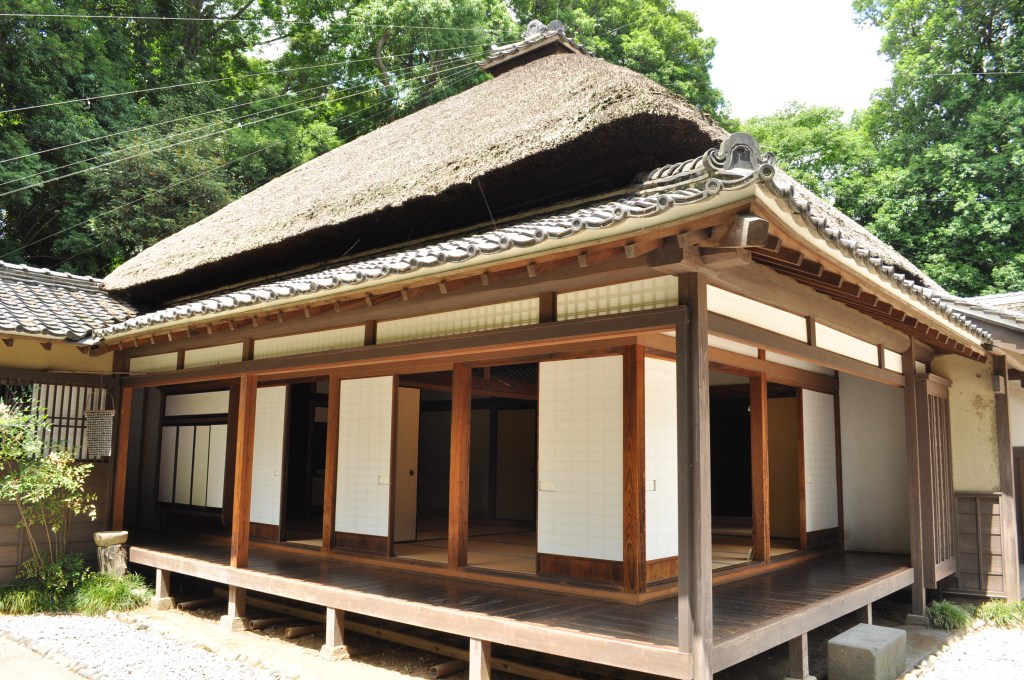
Some background is called for. As you can see from the photo at the top of this page, traditional wooden Japanese buildings are raised above the surrounding ground by a step or three with an ventilated crawl space beneath the floor. This is a practical feature commonly found in many countries, especially those with high groundwater levels, where it serves to keep soil dampness from penetrating the interior spaces thereby forestalling mold and wood rot.

In Japan, where exterior spaces, such as gardens, landscapes and even celestial spaces (e.g. moon viewing platforms) have been incorporated into buildings, the step up into the building is an important division between interior and exterior spaces. One may wear shoes into the entryway “genkan” of a building, but they must be removed before stepping up and entering the building proper. The genkan, therefore, being behind doors, is both an interior and exterior space. The wooden elevated veranda walkway around the perimeter of the building, called the “engawa” 縁側 in traditional Japanese architecture even moreso.

An engawa veranda in a traditional wooden structure. Notice the step-up from the ground level to the wooden veranda and an additional elevation change when entering the building’s interior with tatami-mat floors. Notice also the worse-for-wear sliding shoji screen doors to the left which separate interior and exterior spaces when closed, but expand the room into the garden when open. Please also notice, if you can, the groove cut into the floor of the veranda near the exterior edge in which lightweight wooden sliding doors called “amado,” meaning “rain doors” slide to enclose and protect the veranda when necessary. To the right of the veranda you can see a gravel-filled drainage trench constructed to receive rainwater dripping from the eaves instead of obtrusive, rudely gurgling rain gutters and pipes. Sitting on fragrant tatami mats, or on the wooden engawa floor with the shoji screens open of a spring evening or autumn afternoon while gazing out at a beautiful garden and listening to the sound of rainwater gently pattering on this gravel is a combination of sensory delights with which I hope Gentle Readers will someday be blessed.
Sorakuen in Kobe, Japan

The floor of the building is supported by a series of beams and purlins called “ Strongmen.” Those at the veranda are called “en no shita no chikaramochi” 縁の下の力持ち meaning “strongmen under the veranda.” In traditional Japanese architecture the veranda structure is designed so that these beams are both cantilevered and partially concealed creating a lightweight feeling, even giving the impression that the veranda floor is almost floating in air when viewed from some angles. The chikaramochi (chee/kah/rah/moh/chee) beams are seldom seen by the building’s residents, but without them, a building could not have a raised floor and would inevitably fail.

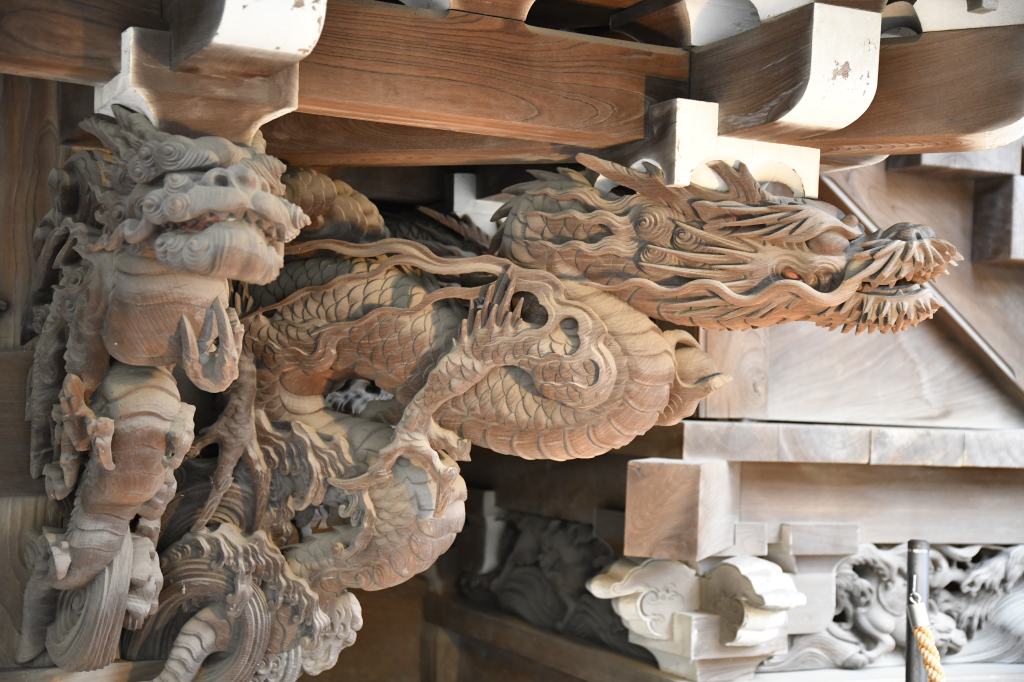
A phalanx of noble dragons supporting the first floor of the Taishakuten temple in Tokyo. In traditional Japanese architecture, ordinary uncarved beams supporting the floor in this way are called “En no shita no chikara mochi.”(縁の下の力持ち)which translates to “Strongman under the floor.” In the Japanese tradition, the dragon is a benevolent, noble creature that travels between oceans and heaven. The brackets supported on each dragon’s head in this photo represent clouds, as if the dragon team of strongmen are carrying the building through the heavens. In this case, the dragons have three toes on each foot, indicating that this is a private temple. Only dragons in imperial temples were allowed five toes.
Another noble dragon with waves at his feet and the kumimono clouds on his head. Amazing carving work.

Most Japanese people know and use the idiom without realizing it refers to this structural support.

To refer to someone as being a “Strongman Under the Floor” is to imply they are an “unsung hero,” or a person who quietly, selflessly and competently serves society and others by performing important but unseen tasks as a member of a team. From the Japanese dictionary it means “someone who toils diligently to support others in unseen ways and without recognition.” I salute all such strongmen, especially in the crafts and construction industry.

In our times we see an increasing trend for people in the public eye, especially actors, artists, musicians, politicians, journalists and the so-called “influencers” to display ghastly and even pyrotechnic levels of psychotic narcissism, the less talent and fewer accomplishments possessed the greater their frenzy to attract attention. These foul-mouthed, low-intelligence, often wealthy sociopaths, devoted to self-aggrandizement and the debasement of anything truly admirable, demand not only our unreserved celebration of their psychosis, but compliance with their ever-changing immoral opinions.

In situations in recorded history, where individuals with a similar psychosis have managed to grab unlimited power, they have shed rivers of innocent blood. A former leader of the Soviet Union, himself a remorseless dictator dedicated to the destruction of Western democracies, enslavement of entire nations, and with the blood of millions on his hands once called such narcissists “useful idiots,” and made a science of how to foster and effectively use them to destroy entire nations. His work continues even today.

But while narcissists, sociopaths and their sycophant useful idiots receive all the attention, and sadly, praise, it is the stable, moral, selfless, hard-working common people that build, renew, defend and perpetuate decent societies. In your humble servant’s opinion it is these good people that are the “Strongmen Under the Vernda” that deserve our true respect.

The photos above and below show a happy team of noble three-toed dragons serving as “en no shita no chikara mochi” supporting the first floor of the Taishakuten Buddhist temple in Tokyo. A thankless but important task these several-dozen hand-carved zelkova-wood dragons perform with energetic poise and a toothy grin. Bravo!

{D8E32672-70C5-4FEC-A49A-BAAE900538A2}
A phalanx of noble “strongmen” supporting a lavish veranda. These brave dragons straddle the waves of the oceans below them, and support wooden kumimono brackets which represent the clouds of heaven, on their prickly heads. The symbolism of these intricate carvings and complicated structural details is by no means haphazard.

Many professional woodworkers and blacksmiths are much the same as these dragons: inconspicuous, honest, hard-working, competently supporting the world within their scope without complaint, often with understated style.

YMHOS

The main entry into the Taishakuten temple. The carved figures at the top of the columns facing outwards to the left are Chinese Lions whose job it is to protect the holy precinct from demons and evil spirits. The figure with the elephant-like nose carved into the beam-end facing Gentle Reader is a mythical creature called a “Baku” 貘, a generally benevolent creature that eats bad dreams. The complicated brackets (called “kumimono”) supported on the columns have a structural purpose, of course, but in traditional Buddhist architecture they represent clouds, reflecting the link between the building and the heavens. Can’t have demons, evil spirits or bad dreams nesting up in there! Notice that, while the ends of the kumimono brackets have been painted white, the carved beams and columns are unvarnished, hand-planed, never-sanded Zelkova wood. Counter-intuitive though it may seem, hand-planed wood exposed to the environment lasts longer than if it was finished with abrasives and varnished or painted.

If you have questions or would like to learn more about our tools, please click the see the “Pricelist” link here or at the top of the page and use the “Contact Us” form located immediately below.

Please share your insights and comments with everyone in the form located further below labeled “Leave a Reply.” We aren’t evil Google, fascist facebook, or treacherous TikTok and so won’t sell, share, or profitably “misplace” your information. If I lie may Mama Shishi bite my head off.

Just ask the next baku you meet if it ain’t so. They can’t tell a lie you know.

Go back

Your message has been sent

Warning
Warning
Warning
Warning.

Leave a comment