
“I see!” said the blind carpenter as he picked up his hammer and saw.
– Old wellerism.

n this article your most humble and obedient servant will be so bold as to do a show and tell of a matched pair of custom-forged Japanese handsaws of a type seldom seen nowadays.
In previous articles we examined similar saws, the famous Japanese dozuki handsaw, the tool that first brought attention to Japanese woodworking tools in North America, and the hozohiki handsaw, a rip version of the dozuki crosscut saw, identical in all aspects save the quantity and shape of their teeth.
As described in the pages linked to above, the dozuki is a crosscut saw specialized in, and named for, the task of cutting the shoulders of tenons quickly and precisely obviating the wasteful step commonly thought mandatory in the West of paring shoulders to final dimensions. It can perform many other crosscut tasks too, of course, but for making tenons it is indispensable.


The hozohiki saw, on the other hand, is a rip saw, one that takes its name from its primary task of precisely and cleanly cutting tenon cheeks.
Because the quality and precision of the shoulders and cheeks of the tenons a craftsman cuts determines not only the quality of the products he makes, but also the ease and speed of assembly of his joinery efforts, the tasks these two handsaws are specialized in accomplishing are critical to the professional woodworker in making tight, beautiful joinery quickly.
So what’s the difference between a regular dozuki and the carpenter’s dozuki? Ah, another of those perspicacious questions with which Beloved Customer is constantly illuminating the world!


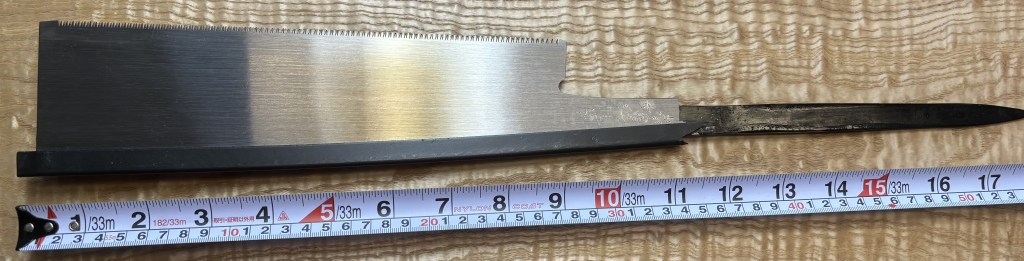
Well, the carpenter’s dozuki is extraordinarily similar to the standard 210mm dozuki handsaw, essentially a thin, high-precision saw used by joiners, furniture makers, cabinetmakers and sashimonoshi for making joints requiring fairly shallow cuts, except in this case, the saw’s cutting edge is longer (270mm), the plate is accordingly wider, and it has more teeth.
Indeed, except for a few cuts in the larger components of furniture and cabinetry, few need to be very long or deep, so keeping the sawblade of the standard dozuki and hozohiki narrow and short not only saves steel, cost and time but makes the saw more rigid while retaining a thin blade.

On the other hand, carpenters, especially temple carpenters and architectural joiners, often need to make many extremely precise, clean cuts for the complicated, elegant joinery included in their customer’s projects. But because the members they need to work are frequently much larger than those used in other trades, a saw larger than the standard dozuki or hozohiki to make deeper, but no less precise, cuts is necessary. Ergo pergo ipso facto, the carpenter’s crosscut dozuki and rip hozohiki came into being somewhere back in the swirling mists of time.
But because only the most accomplished and trusted craftsmen are given the opportunity to do fine work in larger timbers, and because they are more expensive to forge, these big girl saws never gained the same degree of popularity as their daintier, more fashionable sisters.

As you can see in the photos, a piece of folded mild steel is attached to the back of these saws by friction to provide a higher degree of rigidity to the ultra-thin, tapered, hammer-tensioned blade, thereby improving the precision of the cuts it can make while with the same stone reducing the likelihood of the plate buckling, the bane of thin saws.
These backs are handmade and hand-filed from mild steel, and are finished in traditional burnt silk.
Backs are fine and necessary additions, but alas not all is blue bunnies and fairy farts because the back’s downside is that it physically limits the saw’s maximum depth of cut, a problem for some jobs. But by making the sawplate wider and the distance between the back and teeth greater, the carpenter’s dozuki, and its sister the carpenter’s hozohiki, are superior at cutting precise joinery in larger pieces of wood.
These saws are also used by joiners who perform high-end interior and architectural woodworking. For example, stairs, handrails, built-up moldings, fancy doors and windows, and coffered ceilings are a few types of work for which these saws are indispensable.
The saws shown in this article are a recently-completed matched set custom forged by Nakaya Takijiro for an exceptionally Beloved Customer. The nominal (versus actual) length of their cutting edge matches the traditional Japanese unit of measurement called a “shaku (approximately 12” = 0.33 meter), but the actual length of this type of saw varies by area and blacksmith. In this case, Master Takijiro forged the cutting edge 270mm (9-sun) long.
But what about the all-important teeth? Master Takijiro forges handsaws almost exclusively for elite Japanese craftsmen such as joiners, cabinetmakers, furniture makers, sashimonoshi and luthiers, etc., professionals who are very particular about their requirements for, and performance expectations of, their handsaws, especially the teeth.
Therefore, in accordance with tradition and Takijiro’s standard procedures, this Beloved Customer provided physical samples of the wood he uses most in his business, including, among other species, the North American varieties of maple, cherry, white oak, and black walnut.
After test-cutting these samples, Takijiro hand-filed the crosscut teeth of the dozuki saw at 18.4T/in., and the rip teeth of the hozohiki saw at 15T/in (non-progressive), and shaped them to quickly and precisely to best cut the samples provided, a big improvement over standard teeth specifications.
As of this scribbling these two toothy sisters should be gleefully winging their way to the USA to meet their new master. I only hope don’t they attract too much unwanted attention in US Customs by wiggling and giggling too impatiently! You know how young ladies can be (ツ)。
YMHOS
If you have questions or would like to learn more about our tools, please use the “Contact Us” form located immediately below. Please share your insights and comments with other Gentle Readers in the form located further below labeled “Leave a Reply.” We aren’t evil Google, incompetent facebook, or sketchy X and so won’t sell, share, or profitably “misplace” your information. If I lie may I suffer the fate of Simon the Zealot.


Relevant Articles
- Japanese Handsaws: The Hozohiki Precision Rip Saw
- Japanese Handsaws: The Dozuki Precision Crosscut Saw
- Japanese Saws: The Carpenter’s Dozuki & Hozohiki
- Japanese Handsaws: The Twins
- Japanese Handsaws: The Maebiki Oga
- Japanese Handsaws: The Bukkiri Gagari
- A Guest Reviews 3 Handsaws
- The Mystery of the Burnt Blade
- Handsaws: Some Guidelines to Aid Precision
Contact Form:


 Covington & Sons Tools
Leave a comment