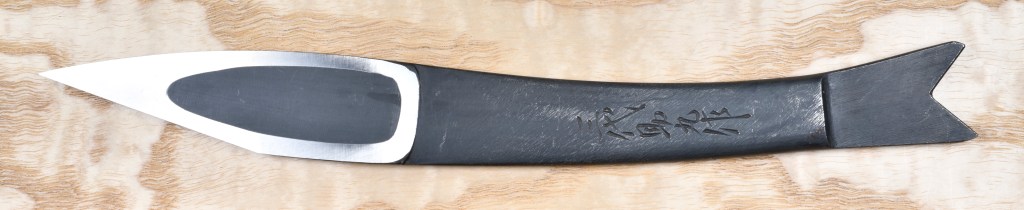
Only the knife knows the heart of the pumpkin.
Simone Schwarz-Bart
In this post I would like to introduce a uniquely Japanese tool, a handy and extremely sharp little knife called the Kiridashi Kogatana.
Introduction
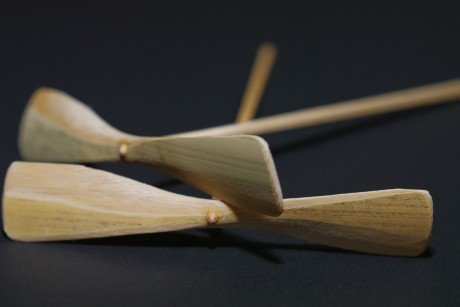
The Kiridashi Kogatana is a handy, general-purpose knife traditionally used by craftsmen in many trades in Japan. It was once a standard tool in every Japanese child’s school bag for sharpening pencils and carving toys such as taketombo before willfully-ignorant nanny-state paranoia equated small useful tools in the hands of children with machine-guns wielded by mentally-deranged murderers.
Your humble servant won’t presume to speak for others, but it may be that, like me, Gentle Reader frequently needs a sharp knife not just for opening boxes, sharpening pencils and occasionally fending of hordes of snaggle-toothed zombie lawyers (an especially smelly variety of ambulance-chaser), but for serious woodworking tasks such as carving gennou handles, carrying molding details around the inside corners of casework and joinery, carving Buddhist statuary, and whittling toys for children. For refined woodworking nothing beats a super-sharp kiridashi kogatana knife.
In this article we will examine this traditional and uniquely Japanese tool.
Definitions
This tool’s name is pronounced kee/ree/dah/shee koh/gah/tah/nah, often shortened to “kiridashi,” and written 切り出し小刀 in Kanji. It translates directly as “small cutout sword.”
This simple but sophisticated tool is used, without exception, by all woodworkers in Japan including carpenters, joiners, wood carvers, cabinetmakers, sashimonoshi, bamboo workers, umbrella makers, printers, glazers and many other trades.
Performance Criteria
Gentle Reader may wonder why Japanese professional craftsmen insist on using a tool made from expensive and difficult materials requiring advanced blacksmithing techniques instead of an inexpensive, disposable, Chinese-made utility knife. The short answer is that they have strict performance criteria that tool-shaped landfill-stuffing simply can’t satisfy. Let’s examine some of those criteria, shall we?
One characteristic a useful woodworking knife needs is rigidity without bulk. Flexible, floppy blades cannot easily be directed by our minds. Their cuts tend to wander. This is typical of utility knives, box cutters, and knives with replaceable blades. Utility knives are especially hopeless in this regard, having floppy blades and fat handles, not to mention garbage steel.
Another important characteristic needed in a woodworking knife is the ability to get one’s fingers close to the cutting edge and point without leaking red sticky stuff; You need your fingers.
In the case of the kiridashi, while it lacks a long cutting edge for slicing and dicing veggies, it also lacks a long cutting edge that would prevent the craftsman from choking up on the knife to maximize control. That’s because it’s a woodworking knife, not a kitchen or skinning knife.
The kiridashi lacks the fat, fancy handles that are so popular nowadays. Handles look cool and may feel comfortable when making a cob salad, but are bulky and get in the way when woodworking, preventing the craftsman from getting his fingers close to the cutting edge for maximum control. I don’t know about you, Gentle Reader, but as for your humble servant and thousands of Japanese craftsmen, we prefer to spend our money on an excellent blade capable of hard work and precision cuts without a handle rather than a bulky, pretty handle with a sucky blade attached. Do you share these priorities?
But of all the performance criteria the professional woodworker needs to consider when evaluating a woodworking knife, absolute sharpness is the most important, followed by ease of sharpening, two things at which the kiridashi is superior to every other small knife or cutter ever invented.
If you suppose your humble servant is exaggerating, remember that I have used kiridashi to shape wood for 40+ years, and at times they were critical to feeding the wife and babies. Of course, sharpness ultimately depends on the quality of the knife’s blade, and the skills of the sharpener, but the fact that the kiridashi can be made sharper quicker than any type of woodworking knife ever made is a big advantage for those who need a sharp blade for their work.
Let’s next examine those troublesome materials and blacksmithing techniques and consider what benefits they provide to the woodworker.
Materials & Forge-welded Lamination
Let’s begin with an explanation of the materials and techniques involved in making the traditional hand-forged kiridashi. We will look at cheap consumer-grade kiridashi in a separate section below.
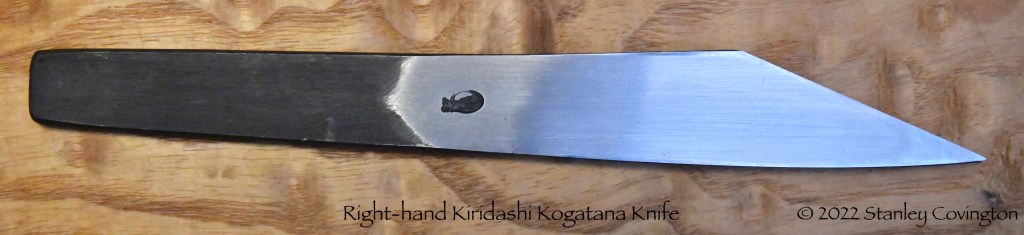
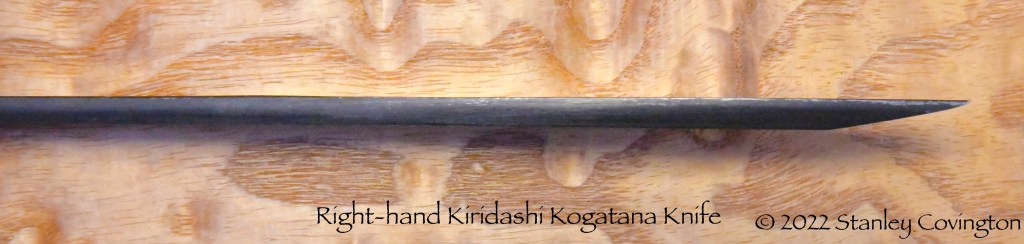
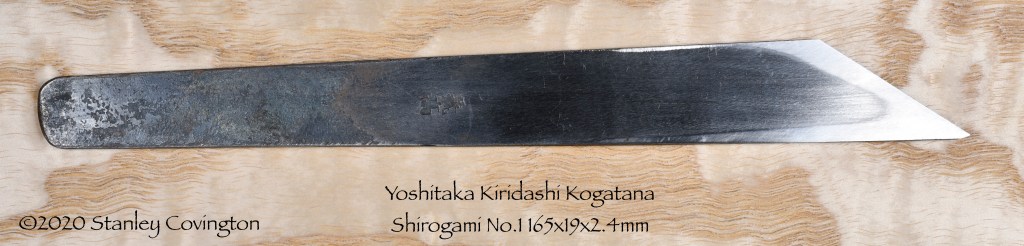
Quality kiridashi are made using a traditional blacksmithing technique called “forge-welding” to laminate a layer of high-carbon steel called “Hagane” in Japan (mostly either Hitachi Yaguki Shirogami No.1 (White Label Steel), Aogami No.1 (Blue Label steel), or Swedish Steel (Asaab SK120) to an iron or low/no-carbon iron body called “Jigane” similar to that used for blades of Japanese planes, chisels, scythes, and even many styles of traditional kitchen knives. C&S Tools’ kiridashi are hand-forged in the traditional manner to maximize the performance required by our Beloved Customers that work wood professionally.
Inexpensive kiridashi knives are made from SK steel, another variety of Japanese high-carbon steel but of lower purity used for many commercial and agricultural products. This is an inexpensive and useful tool steel, but due to the additional impurities it contains, unavoidably produces an inferior-quality crystalline structure negatively impacting cutting and edge-retention performance.
Because kiridashi kogatana are relatively narrow, thin knives, Aogami steel is often preferred by blacksmiths over Shirogami or Swedish Steel because it tends to warp and crack less during heat treatment yielding fewer rejects.
C&S Tools’ kiridashi are made from Shirogami No.1 steel.
Let’s briefly examine why this lamination is necessary below. For more details, please read the longer articles on this subject linked to above and below.

The Hollow-ground Ura
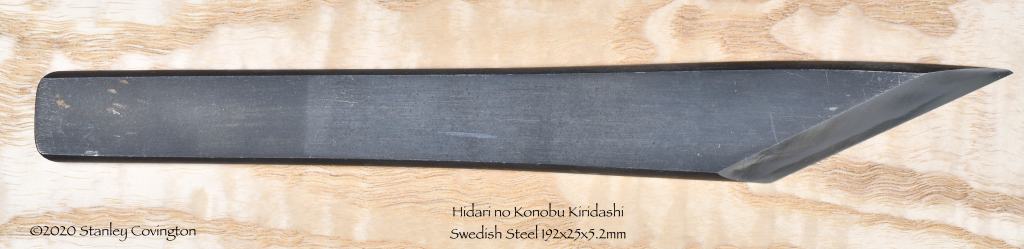
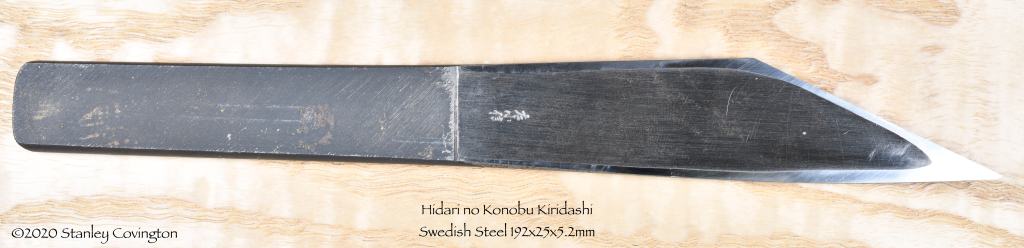
Most kiridashi kogatana have a hollow-ground Ura, just like Japanese chisel and plane blades. The advantage of the Ura is that it makes it easy to quickly sharpen the exceptionally hard steel that forms the blade’s cutting edge. There are some inexperienced people who mistakenly imagine the ura is unnecessary, so allow me to clarify why it is critical.
To begin with, the layer of cutting steel in the kiridashi, or at least C&S Tools’ kiridashi, is hardened to Rc65~66, substantially harder than woodworking blades in the West. This hardness, combined with the excellent crystalline structure made possible through proper hand-forging and heat-treating by an experienced blacksmith produces a blade that meets the following essential requirements of a professional woodworking tool:
- The cutting edge can be made extremely sharp;
- The cutting edge will stay sharp a relatively long time;
- The cutting edge won’t easily chip, crumble, roll or break; and
- The knife is easily and quickly sharpened.
Items 1~3 above are normally satisfied when an experienced blacksmith skillfully forges and properly heat-treats high-quality high-carbon steel, but because the steel in the finished product is so hard, satisfying the fourth criteria focused on sharpening becomes difficult without some innovation.
The conundrum the blacksmith must resolve is that, in accordance with materials science, given a fixed area of steel (measured in square millimeters, for instance), the harder the steel is, the more difficult and time consuming it will be to sharpen. The solution is to hollow-grind the hardened steel lamination to effectively reduce the square millimeters of hard steel touching the sharpening stone and that must be abraded thereby reducing the time, elbow grease and sharpening stone mud expended in maintaining the blade. This detail is called the “Ura” in Japanese and is explained in more detail in the article at this link. If your time is worth anything, then this feature is worth every penny.
Another problem one faces when trying to sharpen a large area of flat, hard steel is that, over many sharpening sessions the perimeter of the flat area always wears faster than the center, eventually resulting in a high spot at the center of what was once a flat area. This too is a fact some inexperienced folk dispute; We wish them many joyful hours popping their pink bubble wrap while drinking Sunny Delight from sippy cups.
This unintentional high spot matters because it makes it more difficult to keep the flat at the cutting edge in tight contact with the sharpening stone, which in turn makes it more difficult to cleanly and quickly polish away the burr. Clearly the flat side of the blade needs to be reasonably flat if we are to quickly and consistently achieve a sharp edge. The Ura solves this problem.
And finally, since it would be time consuming and financially inefficient to abrade a bevel of uniformly hardened steel, the lamination replaces most of the hard steel exposed at the bevel with soft, easily abraded iron.
Despite this knife’s simple appearance, it’s a very clever and sophisticated design.


Pre-laminated Steel & Mass Production
Except for those sold by C&S Tools, most kiridashi kogatana sold nowadays are made from pre-laminated steel called “rikizai,” (利機材) or “fukugozai” (複合材) a material invented for mass-producing consumer-grade kitchen knives inexpensively and in high-volume. Dies and presses in factories are used to cut blanks from strips and sheets of this laminated steel/iron which are then ground and sanded by automated machines and heat-treated in large lots in ovens. The result is a knife that is cheap to produce (despite the high price often charged to unaware consumers) and quite usable, but since the blade has not been forged through multiple heats, or been normalized and subjected to multiple quenches, the crystalline structure of the cutting edge is inferior such that the knife cannot be made as sharp, it will dull quicker, and may be harder to sharpen. Such kiridashi kogatana also tend to be thinner, like kitchen knives, and are not as comfortable in the hand for hard work over long hours.
We prefer the performance and ease of use of hand-forged traditional kiridashi, so this is the only type we sell. Along with most professional woodworkers in Japan, we feel they are worth the extra cost. But if you decide to try a cheaper mass-produced kiridashi, please be careful you are not sold a pimped-out mass-produced blade at the price of a more labor-intensive, skill-intensive hand-forged traditional knife. Caveat emptor baby.


Right & Left
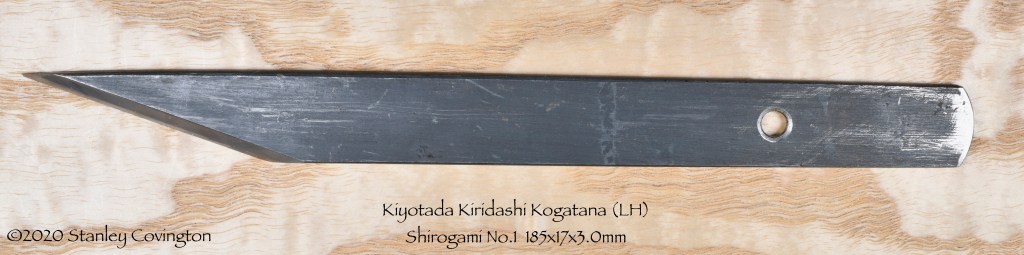
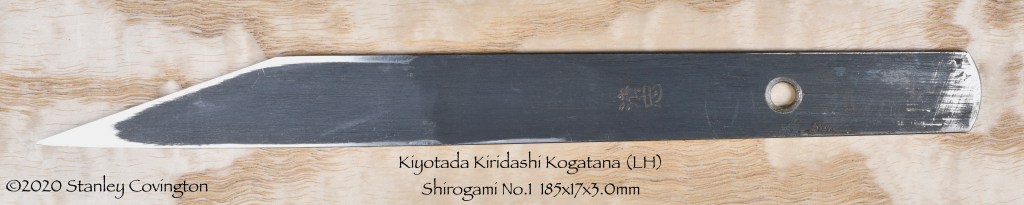
Kiridashi kogatana come in right-hand and left-hand configurations, with the right-hand variety being most common. To differentiate a right-handed knife from a left-handed one simply hold the knife with the cutting edge facing downward. The bevel of a right-handed knife will be on the right side as seen from above.
Craftsmen in many trades, especially cabinetmakers, shashimonoshi, joiners and woodcarvers will often own both left and right-hand versions because the type of work they do requires a different bevel orientation for some jobs particularly when shaving wood contrary to the grain, for example when shaping the inside corners of curved wooden components.
Blade Width & Thickness
The width and thickness of the blade and the angle of the cutting edge to the centerline of the blade are matters of individual preference. Generally speaking, a wider blade is easier to grip than a narrower blade, and is also easier to power through cuts. On the other hand, if too wide, it will feel clumsy in the hand, it will not rotate as dexterously when making inside-corner cuts, and may not fit into tight spaces as well.
Likewise a thicker blade is easier to grip and easier on the hand when making high-pressure cuts for long periods of time than a thin blade. On the other hand, a thicker, wider blade weighs more and may take longer to sharpen.
It’s worth figuring out which style works best for you.
The Point
The angle of the cutting edge (not the bevel angle) is easily adjusted to personal preference within limits. In general, a steep angle forming a relatively oblique tip is better suited to making deep, powerful cuts, while a shallower angle provides a more slender, pointer tip that is preferred by many for finer cuts, especially long diagonal slices, in narrow spaces.
The downside to the slender pointy knife is that the point tends to be more fragile, it’s more difficult to apply heavy pressure to, and it’s more difficult to sharpen. The C&S Tools kiridashi has a cutting edge at a medium angle suited to a wide range of cuts.
Shapes
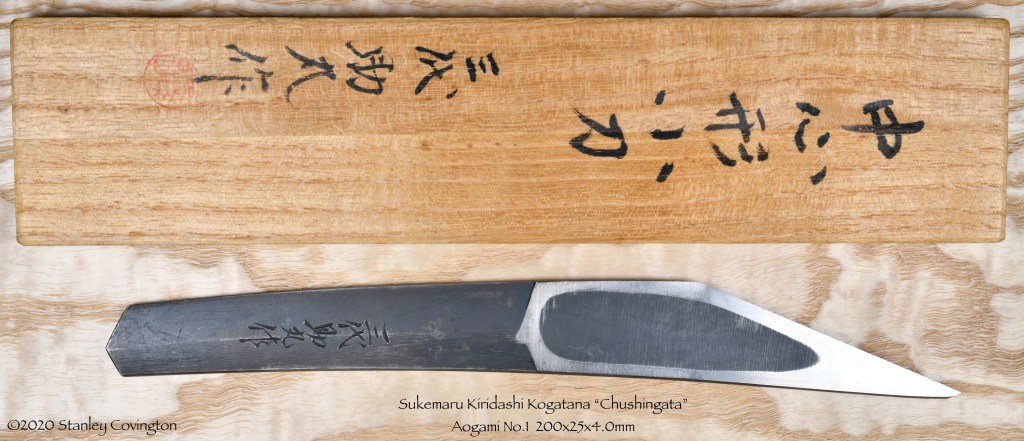
Despite its simple appearance, the kiridashi kogatana is a sophisticated and unusually effective knife. There are, however, many examples of kiridashi with artistic and even anthropomorphic shapes such as vegetables, and even fish in the knife pictured at the top and end of this article.

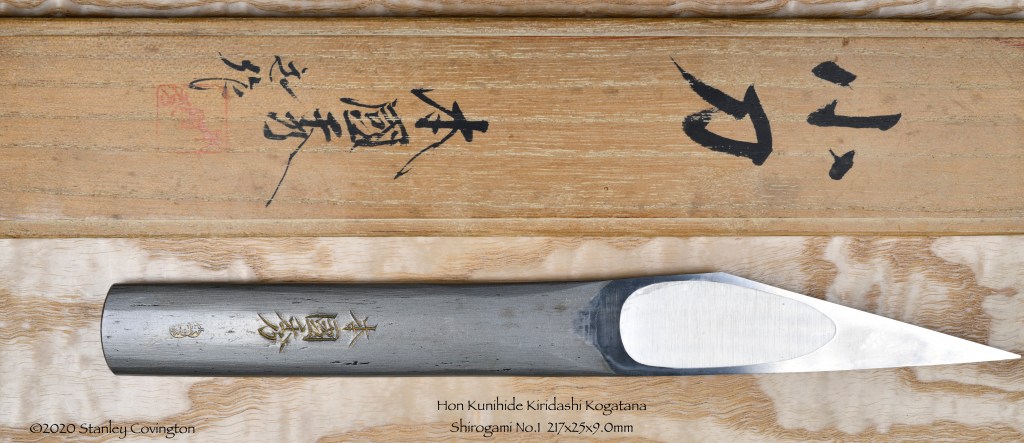
We are not opposed to fanciful shapes and some decorative surface treatments on condition they don’t reduce the tool’s functionality nor make the tool appear less attractive over many years of hard use, difficult conditions to satisfy.
Handles and Scabbards
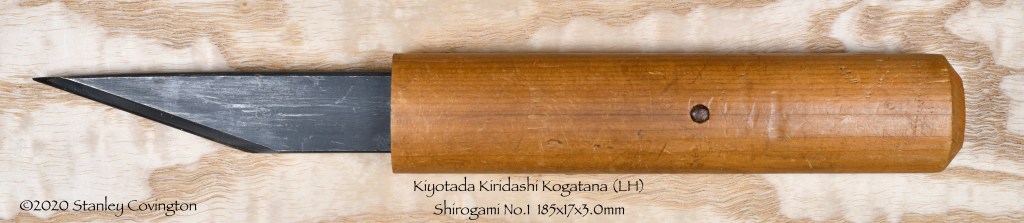
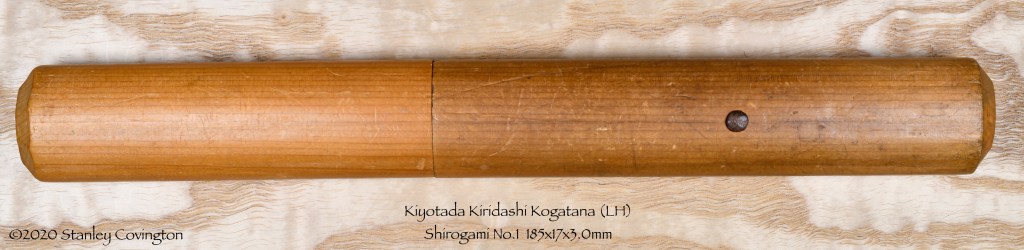
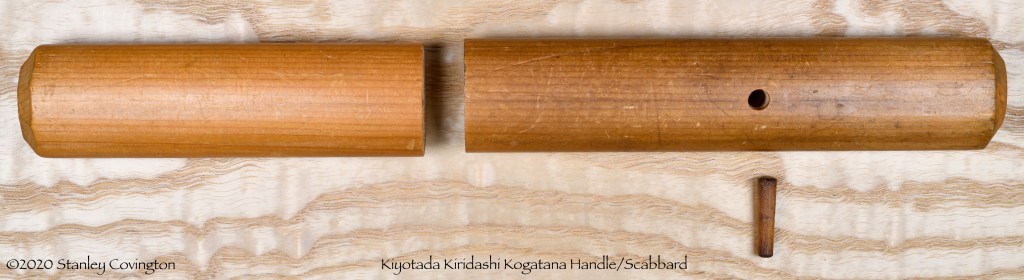
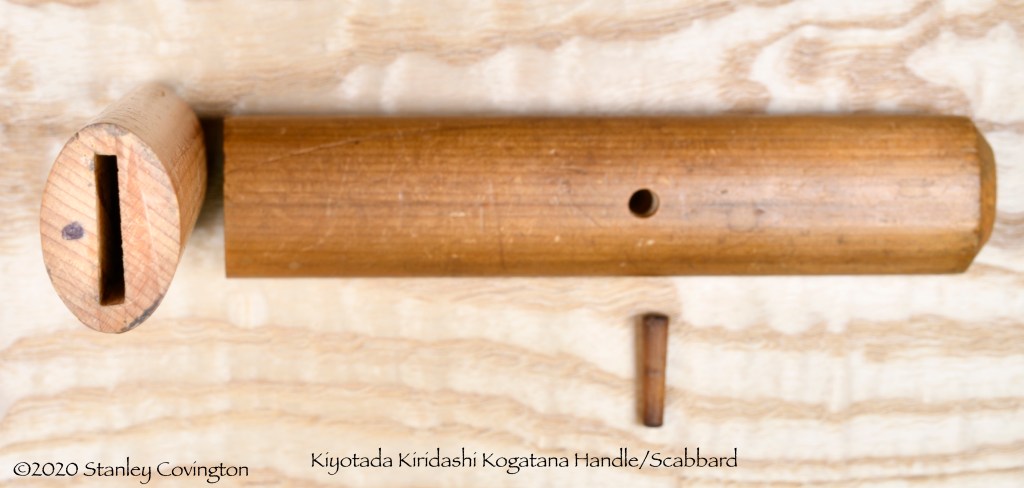
Some people prefer a kiridashi with a handle of sorts, although most professional craftsmen, in our experience, prefer the bare metal.
A wise craftsman will have some means to protect the blade from becoming damaged when not in use, and to protect other tools and fingers from its frightfully-sharp cutting edge. A no-cost, thin scabbard or sheath can easily be made from cardboard or plastic, but the wooden combination handle/scabbard pictured above is a clever solution taught to me many years ago by a master joiner of great renown.
In a future post we will discuss how to make a convenient combination handle and scabbard for the kiridashi kogatana.
Decorative Finishes
There was a time in Japan when kiridashi knives with fancy surface finishes were very popular. Nowadays there are few blacksmiths left with the skills required to forge high-quality kiridashi knives, much less apply fancy-nancy surface treatments.
In general, your humble servant has always viewed pimped-out tools with a jaundiced eye dripping yellow goo. Why? First, because with few exceptions, decorative surface treatments contribute absolutely nothing to a tool’s functionality; and second, they almost always look nasty as a roadkill rat after a bit of hard use. Woodworking tool should be long-term possessions that serve well and age well, not like flashy but fragile hooker heels.
“But, whisky tango foxtrot!” I can almost hear some Beloved Customers and Gentle Readers sputter with exquisite gentility, “doesn’t C&S Tools sell a kiridashi knife with a tsuchime finish!” An astute observation indeed. Allow me to relate a brief explanation.
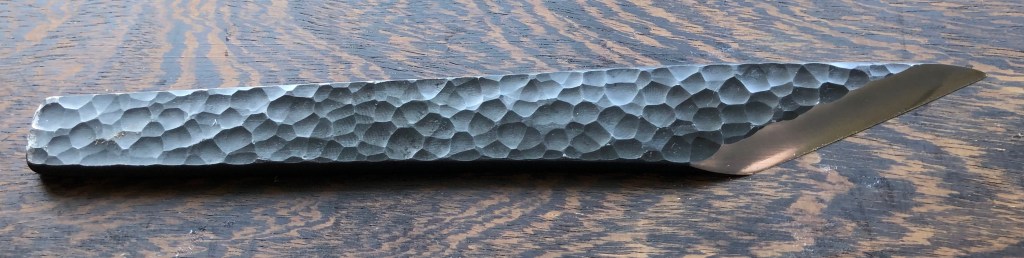
Our kiridashi were previously forged by a small-scale but very famous Tokyo blacksmith called Konobu. In fact, photos of some of his products are shown in this very article. When Konobu retired some years ago we were extremely fortunate to enlist the services of a highly-capable, small-scale father and son forge who produce only kiridashi knives. After sharing their products with our Beloved Customers for a few years, and in response to customer requests for something a little more pleasing to the eye, we asked our blacksmith to propose some unusual surface treatments.
We asked our new blacksmith to propose some surface treatments he could apply in-house that would make the tool work better, look more beautiful when new, and improve in appearance with age and hard use. We ultimately selected the tsuchime finish (“hammered finish) shown in the photo above.
It exceeds all our expectations for performance, including, sharpness, edge retention, ease of sharpening, durability and appearance, and I’m confident you will find it to be a good friend and beautiful companion for the rest of your hopefully very long life.
So why is this surface treatment superior, you ask? Another excellent question! I have two answers that cover multiple facets.
First, it creates a non-slip surface that’s a significant improvement over the standard forge oxide finish, does not irritate the hand, works even when the blade is wet with sweat, and that, unlike most metal surface treatments, will not degrade with time and hard use.
Second, since it’s applied by physically hammering hundreds of dimples into the surface of the blade’s low-carbon jigane layer, and is not just a shallow surface decoration applied using paint, chemicals, rust or hot bluing, or electro-plating, there’s simply nothing to discolor, corrode, or wear away. In fact, it improves with age and hard use becoming the lovely face of a good friend.
Why Should You Use a Kiridashi Kogatana?
I can’t tell you why you need a kiridashi, but I can tell you why I and many others use them. Perhaps some of these reasons apply to you.
One can get by with disposable-blade utility knives for low-quality and rough work such as opening boxes, cutting gypboard, or discouraging icky deadish members of the legal profession, but such knives are not up to most serious woodworking jobs for several reasons.
First, while utility knives are sometimes called razor knives and may even use razor blades for cutting edges, they are nowhere near as sharp as a good kiridashi. The fact is that surgical scalpels are not as sharp as a good kiridashi sharpened skillfully. And utility knives dull quickly because the steel is soft and of miserable quality. You’ve not doubt noticed this poor performance.
Second, while your approach to life may be different, in my decrepitude I have come to despise stuffing landfills with throw-away tools, especially those made in the increasingly-despotic and murderous kingdom of China. It doesn’t make sense environmentally or morally. I prefer a faithful, high-quality kiridashi knife that can easily be made sharper than any commercial razor and will serve faithfully for decades without complaining.
Third, a good kiridashi is a compact tool with a stiff blade to which one can apply heavy pressure for serious cutting, a single-bevel that provides exceptional control for detailed carving and trimming tasks, and can be easily and quickly resharpened. It’s a tool that becomes an extension of my mind when it is in my hand. Can’t do any of that with a flimsy, clumsy utility knife.
And finally, while conventional double beveled knives are useful, because they lack the lamination of fine-grained exceptionally hard steel and the clever ura, they dull quickly and can never be made as sharp as a good kiridashi.
As they say in Japan: “The difference between the moon and a mud turtle.”
If you use knives in your work and you need them to be literally sharper than a razor and stay that way a long time without spending tons of time and attention, then nothing beats a good hand-forged kiridashi kogatana knife. All those generations of Japanese craftsmen can’t be wrong.

YMHOS

If you have questions or would like to learn more about our tools, please click the “Pricelist” link here or at the top of the page and use the “Contact Us” form located immediately below.
Please share your insights and comments with other Gentle Readers by using the form located further below labeled “Leave a Reply.” We aren’t evil Google, fascist facebook, or thuggish Twitter and so won’t sell, share, or profitably “misplace” your information. If I lie may my sweetfish knife swim away.


 Covington & Sons Tools
Leave a comment