“I see!” said the blind carpenter as he picked up his hammer and saw.
– Old wellerism.
n this article your most humble and obedient servant will be so bold as to do a show and tell of a matched pair of custom-forged Japanese handsaws of a type seldom seen nowadays.
In previous articles we examined similar saws, the famous Japanese dozuki handsaw, the tool that first brought attention to Japanese woodworking tools in North America, and the hozohiki handsaw, a rip version of the dozuki crosscut saw, identical in all aspects save the quantity and shape of their teeth.
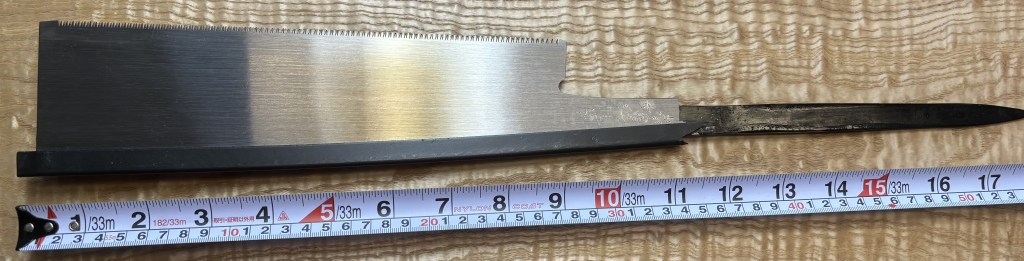
The shaku (270mm) carpenter’s dozuki crosscut handsaw (handle not attached). The tape measure displays centimeters/millimeters on the lower scale and Japanese sun on the upper. Please notice the mysterious but intentional brown discoloration on the blade. This blade was shaped, beautifully finished, and tapered using a hand scraper called a “sen,” not grinder or sandpaper. The small dings visible on the plate’s surface are tiny hammer marks left by Takijiro when truing and tensioning the plate, an almost entirely forgotten skill nowadays, one at which Takijiro has not match.
As described in the pages linked to above, the dozuki is a crosscut saw specialized in, and named for, the task of cutting the shoulders of tenons quickly and precisely obviating the wasteful step commonly thought mandatory in the West of paring shoulders to final dimensions. It can perform many other crosscut tasks too, of course, but for making tenons it is indispensable.
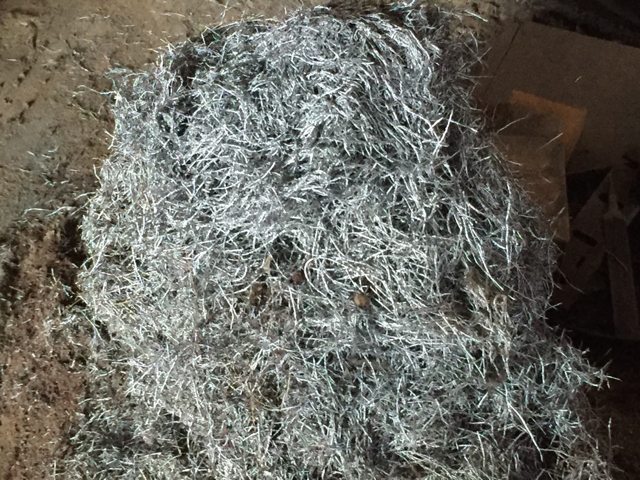
Some of Takijiro’s scrapers (“sen”) on a rack in his forge (left). He uses these to scrape and shave steel from sawblades to taper and finish them A pile of shavings produced by his sen are seen on the right.
The hozohiki saw, on the other hand, is a rip saw, one that takes its name from its primary task of precisely and cleanly cutting tenon cheeks.
Because the quality and precision of the shoulders and cheeks of the tenons a craftsman cuts determines not only the quality of the products he makes, but also the ease and speed of assembly of his joinery efforts, the tasks these two handsaws are specialized in accomplishing are critical to the professional woodworker in making tight, beautiful joinery quickly.
So what’s the difference between a regular dozuki and the carpenter’s dozuki? Ah, another of those perspicacious questions with which Beloved Customer is constantly illuminating the world!
The shaku (270mm) carpenter’s Hozohiki rip handsaw (handle not attached).
Well, the carpenter’s dozuki is extraordinarily similar to the standard 210mm dozuki handsaw, essentially a thin, high-precision saw used by joiners, furniture makers, cabinetmakers and sashimonoshi for making joints requiring fairly shallow cuts, except in this case, the saw’s cutting edge is longer (270mm), the plate is accordingly wider, and it has more teeth.
Indeed, except for a few cuts in the larger components of furniture and cabinetry, few need to be very long or deep, so keeping the sawblade of the standard dozuki and hozohiki narrow and short not only saves steel, cost and time but makes the saw more rigid while retaining a thin blade.
On the other hand, carpenters, especially temple carpenters and architectural joiners, often need to make many extremely precise, clean cuts for the complicated, elegant joinery included in their customer’s projects. But because the members they need to work are frequently much larger than those used in other trades, a saw larger than the standard dozuki or hozohiki to make deeper, but no less precise, cuts is necessary. Ergo pergo ipso facto, the carpenter’s crosscut dozuki and rip hozohiki came into being somewhere back in the swirling mists of time.
But because only the most accomplished and trusted craftsmen are given the opportunity to do fine work in larger timbers, and because they are more expensive to forge, these big girl saws never gained the same degree of popularity as their daintier, more fashionable sisters.
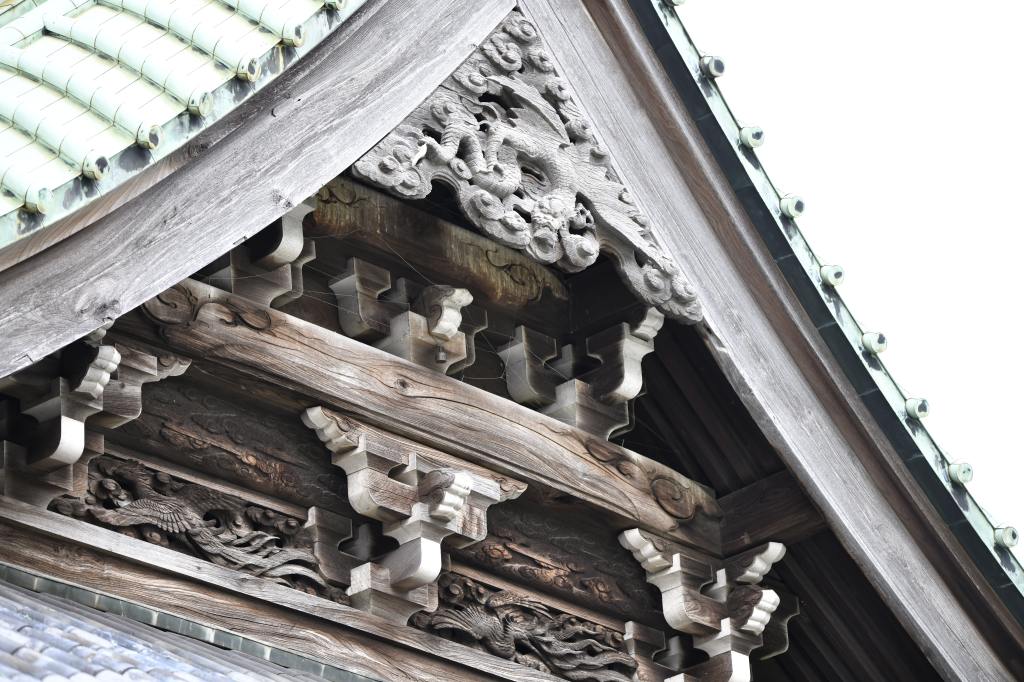
A view of the kumimono and nijibari at the main entrance roof of a buddhist temple known as Shibamata Taisahkuten founded in 1629 in Tokyo. Constructed mostly from keyaki wood (zelkova), this is exactly the sort of work the saws presented herein are intended to execute.
As you can see in the photos, a piece of folded mild steel is attached to the back of these saws by friction to provide a higher degree of rigidity to the ultra-thin, tapered, hammer-tensioned blade, thereby improving the precision of the cuts it can make while with the same stone reducing the likelihood of the plate buckling, the bane of thin saws.
These backs are handmade and hand-filed from mild steel, and are finished in traditional burnt silk.
Backs are fine and necessary additions, but alas not all is blue bunnies and fairy farts because the back’s downside is that it physically limits the saw’s maximum depth of cut, a problem for some jobs. But by making the sawplate wider and the distance between the back and teeth greater, the carpenter’s dozuki, and its sister the carpenter’s hozohiki, are superior at cutting precise joinery in larger pieces of wood.
These saws are also used by joiners who perform high-end interior and architectural woodworking. For example, stairs, handrails, built-up moldings, fancy doors and windows, and coffered ceilings are a few types of work for which these saws are indispensable.
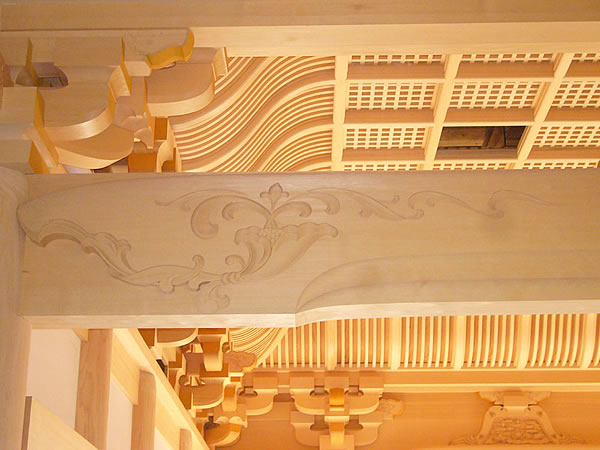
A temple interior with hand-planed and hand-carved beams, elbows, kaerumata, and coffered ceiling all of hinoki wood. Gorgeous work.
The saws shown in this article are a recently-completed matched set custom forged by Nakaya Takijiro for an exceptionally Beloved Customer. The nominal (versus actual) length of their cutting edge matches the traditional Japanese unit of measurement called a “shaku (approximately 12” = 0.33 meter), but the actual length of this type of saw varies by area and blacksmith. In this case, Master Takijiro forged the cutting edge 270mm (9-sun) long.
But what about the all-important teeth? Master Takijiro forges handsaws almost exclusively for elite Japanese craftsmen such as joiners, cabinetmakers, furniture makers, sashimonoshi and luthiers, etc., professionals who are very particular about their requirements for, and performance expectations of, their handsaws, especially the teeth.
Therefore, in accordance with tradition and Takijiro’s standard procedures, this Beloved Customer provided physical samples of the wood he uses most in his business, including, among other species, the North American varieties of maple, cherry, white oak, and black walnut.
After test-cutting these samples, Takijiro hand-filed the crosscut teeth of the dozuki saw at 18.4T/in., and the rip teeth of the hozohiki saw at 15T/in (non-progressive), and shaped them to quickly and precisely to best cut the samples provided, a big improvement over standard teeth specifications.
As of this scribbling these two toothy sisters should be gleefully winging their way to the USA to meet their new master. I only hope don’t they attract too much unwanted attention in US Customs by wiggling and giggling too impatiently! You know how young ladies can be (ツ)。
YMHOS
If you have questions or would like to learn more about our tools, please use the “Contact Us” form located immediately below. Please share your insights and comments with other Gentle Readers in the form located further below labeled “Leave a Reply.” We aren’t evil Google, incompetent facebook, or sketchy X and so won’t sell, share, or profitably “misplace” your information. If I lie may I suffer the fate of Simon the Zealot.
Simon the Zealot, Helsinki Cathedral. Notice the large saw.
Simon the Zealot (Acts 1:13). Notice the large two-man saw. Your humble servant does not recommend this application for safety reasons.
Everything in life is risk, from the minute you wake up in the morning and stick your tongue into a toaster.
Anon
Introduction
In this article your most humble and obedient servant will present an obscure fact about traditional Japanese handsaws I call the “Mystery of the Burnt Blade,” as well as a related psychedelic conundrum called “Black Light!”
I will also provide a brief description of how one of the last sawsmiths in the world hand-forges his custom handsaws, and explain how these two mysteries are linked to this ancient, even magical, process.
If you have a metallurgical psychologist’s hat, as I do, perhaps one made of aluminum foil, or better yet, brass with attached wires, bells or baubles, now is the time to secure it to your “seat of knowledge.”
In a world boiling-over with mysteries, however, prioritizing them is sometimes vexingly difficult. For example, is the “Meaning of Life” more important than “Were Bert and Ernie in Love?” Or is the question “When will the Entwives return from shopping at the mall?” weightier than “Are the four surviving Nazgul running just Shat Fransisco or all of Calipornia?”
Cogitating such mysteries has worn my thinking cap down to just a button and a bit of lint, but before I forget (I’m supposed to take some bitter little green pills for my memory, but keep forgetting) I would like to address the subject of this article. As mysteries go, it’s nowhere near as high on the priority list as the whereabouts of the Nazgul’s missing PAC funds, but nonetheless it still puzzles many. Being exceptionally perspicacious, Gentle Reader may find a worthwhile gem or two hidden among the rubble.
And the story goes something like this.
The Story
The curtain on this mystery doesn’t open on a moonless night, black and ragged as a Chicago politician’s soul, concealing a MacBethan circle of wart-covered witches chanting incantations while stirring a cauldron bubbling over purple flames.
Nor is the scene of this mystery a locked cell in a curiously vacated wing of Gotham’s Metropolitan Correctional Center where the guardsmen all nap cherubically, security cameras have all malfunctioned magically (perhaps due to a “Nox” spell?), and where a millionaire child nookie bookie has shuffled off his mortal coil by hanging himself with a bedsheet after breaking his own neck. Harry Houdini must be proud!
No, the curtain on this mystery opens of an early evening in Tokyo almost 40 years ago in front of a rickety old wooden building facing a busy street erected in the warm ashes produced by 174 B-29s on the nights of March 9th and 10th 1945 when the city and many souls burned brightly.
Gentle Reader, we find ourselves in front of the shop and residence of a small, pipe-smoking saw sharpener and his family. They live on its second floor, with a workshop on the ground floor adjoining a dirt-floored doma with a single rickety sliding door opening to the street. There’s space in the poorly lighted entry for perhaps three people who don’t despise each other to stand, but no more. The shop space doesn’t have shelves or glass cases, just teetering stacks of newspapers and magazines wrapped in twine crowding in from the walls permeated by the perfume of oil and steel filings. I don’t know about you, but it’s an atmosphere I love.
Prior to that time my experience with Japanese handsaws was limited to inexpensive hardware store products with bright shiny blades. I didn’t know much about who made them or how they were made, but they seemed to work OK. On the day of this mystery I was looking for a more specialized saw for ripping 6X6 timbers, one not sold by the average hardware store, so I visited the shop of this professional saw sharpener.
As I opened the rickety wood and glass sliding door and called a greeting the little saw sharpener came out from the back, kneeled seiza-style on the raised floor of his workspace, and smiled like a wood carving of a buddhist saint.
After introductions, I described the job I needed to do, the type of wood I had to cut, and the type of saw I thought would work best. He made a thoughtful face as he sorted through his stock of saws in his mind, bobbed his head decisively once, stood up, and without saying a word went into the back. He returned with a saw blade wrapped in newspaper.
When I unwrapped the blade (no handle) my heart sang as I gazed upon its unadorned, elegant lines and subtle beauty. I could feel the blade quivering with excitement at the prospect of being fed some yummy wood after a boring confinement in the back of the shop. It was a 300mm single-edged kataba rip saw with the brand “Nakaya Genji” hand-chiseled into the steel blade.
The saw sharpener told me it was made in Tokyo (yes there were still many sawsmiths living and working in Tokyo back then) by a reputable and skilled blacksmith, but not a famous one, that it was a hand-forged, top-quality working tool, one he had sharpened himself, and that he thought it would satisfy my requirements.
The only problem was cost, about thrice what I had budgeted, but pretending I knew what I was doing, I flexed the blade, held it up to the dim light to check the plate for untoward distortions, and the teeth for cavities. I even pressed my palm against them to check their sharpness. After all this posturing I agreed with the saw sharpener that it was a fine blade. With one reservation….
Mysterious Colors
A hozohiki rip saw hand-forged many years ago by Takijiro for your YMHOS
Now, at the time of my visit to the little saw sharpener’s curious shop I didn’t have enough experience or specialized knowledge to ask intelligent questions about the steel and techniques used to forge and tooth the saw, but although I was ignorant, my eyeballs were still not “fushiana” (“knot holes 節穴”), as the saying goes in Japanese, for they noticed something that wasn’t quite right.
What was this smudge on the saw’s face that shocked me but did not faze a professional saw sharpener? It was a localized discoloration at the center of the blade, a vaguely-shaped area golden brown in color, possibly indicative of the blade having been exposed to high temperatures, perhaps hot enough to soften the steel, a serious defect indeed in the case of chisel and plane blades.
The saw sharpener was not impressed in the least with my knothole’s perception, but exercising extreme patience, gave me a partial explanation.
As he clarified at the time, and as I was able to confirm in more detail during the intervening years, this area of color is commonly seen on the plates of quality saws made in Eastern Japan, which included Tokyo where I purchased the saw in question, but it is not commonly seen on saws made in Western Japan, which have simple bright steel blades instead. Likewise, inexpensive, mass-produced handsaws, including exchangeable-blade kaeba saws, never have this colorization. Ahah! The thot plickened.
C&S Tools’ hozohiki rip saw hand-forged by Nakaya Takijiro. Please notice the colorization.C&S Tools’ dozuki crosscut saw hand-forged by Nakaya Takijiro. Please notice the colorization.
So what I deduced from his comment was that this spot of color is neither strange nor suspicious, but is actually desirable, indeed seen as an indicator of quality, depending upon geography. Sound hinky to you? It did to me too.
An Historical Example
Years ago the following example was related to me by a reliable source with personal knowledge, and I while I am extremely fond of daring fashion statements, I have not seen it with my own knotholes and so won’t accept any bets about its veracity that involve a forfeit of wearing lady’s underwear on my head out in public again, so please don’t offer.
From 1639 to 1834 Japan was closed to foreign countries with the sole exception of Holland, and even then access was severely limited.
In the early 1800’s a Dutch doctor purchased a bunch of Japanese woodworking tools which he took back to Holland. Those tools recently returned to Japan and observers noted they had the same appearance as modern handsaws saws made in Eastern Japan, evidence that this colorization is not just a modern feature of Japanese handsaws.
How to Make a Traditional Japanese Handsaw
In order to explain the metallurgical roots of the Mystery of the Burnt Blade I humbly beg Gentle Reader’s kind indulgence as I relate the following summary of the process of making a hand-forged professional-grade handsaw in Eastern Japan as explained to me by Nakaya Takijiro Masayoshi, one for the few remaining master sawsmiths in the world. Any errors are the sole responsibility of your humble servant.
Takijiro posing in front of his forge.Takijiro applying a final polish to your humble servants bukkiri gagari saw. Two of his anvils are visible. Please notice the scraper marks and colorization of the blade
Steel Selection
Saw blades do not require high levels of carbon. Indeed, too much will make the teeth fragile. Shirogami Saw steel and Shirogami No.2 steel have been popular for many years, and Takijiro uses S-2, but he prefers Yellow Paper steel with its lower amount of carbon for the extra toughness it affords.
With materials now in hand, let’s get to smithing.
Cutting the Plate
The sawsmith first cuts the steel plates for a run of saws using manual shears. These are not embroidery shears held in one hand, but rather a hand-powered single-bladed mechanism operated while sitting on the floor.
Initial Forging
Using a gas/charcoal forge, springhammer, hand hammers, and rectangular steel anvil he then heats and shapes the plates.
At the conclusion of this stage the saw plate is an approximately saw shaped piece of thin steel, burnt in appearance and warped. The iron tang will be attached later by forge-welding.
Nakaya Takijiro forging a saw tangNakaya Takijiro’s forge set into the floor of his smithy.
Annealing/Normalization
The next step is to annealthe saw plate. Sometimes this process is called “normalizing.” While it involves heating and cooling the blade, instead of making the steel hard, it makes it as soft as possible.
The purpose of this step is to relieve stresses, create a uniform and relaxed crystalline structure in the steel, and to soften the steel to prevent cracking during forging.
Annealing and normalization are very similar processes, both performed by heating the steel to a specific “recrystallization” temperature”(about 750˚C or 1380˚F for Shirogami No. 2), and allowing it to “soak” at that temperature for a specific amount of time. In the case of annealing, steel is left in an oven while temperature is slowly reduced in accordance with a specific heat curve. But when performing normalization, the white-hot steel is removed from the forge/oven and allowed to cool at room temperature, a faster, more economical process.
The traditional Japanese annealing/normalization process Takijiro employs at this stage is technically not pure annealing, but neither is it simple normalization. He heats the blades and upon removing them from the forge immediately places them to soak and slowly cool overnight inside a sealed, but neither airtight nor temperature-controlled, container filled with rice straw ashes, a low-oxygen, high-carbon atmosphere.
This annealing/normalization process is hot and dirty work, unsuited to either impatient factory workers or to mass-production, one that it adds considerable time and cost to production while yielding few benefits purchasers nowadays can discern using Mark-1 Eyeball, as seen through the lens of what I call “Chinese Logic.“
Why Chinese logic, you say? Because the benefits it imparts to the crystalline structure of a steel blade are not only impossible to analyze without using an expensive SEM, but are difficult to check through conventional non-destructive quality control procedures, and impossible to judge from an illustration in a catalog (harking back to the Sears Catalog days) or a digital photo on the internet, all reasons why this critical step is always neglected by other than well-trained, dedicated craftsmen like the blacksmiths C&S Tools works with, who refuse to cut corners.
The next morning, the blades are removed from their resting place in the ash box. At this point they are still too hot to handle without gloves or tongs.
Cold-forging
Now that the saw plates are roughly shaped and annealed, the next step is to further refine their crystalline structure by forging them using hammer, tongs and anvil. Takijiro does not, however, heat the blades during this step.
During this stage Takijiro prefers to forge blades by hammer and hand two at a time, one stacked on top of the other. The position of the blades in the stack is changed frequently so approximately the same number of blows directly strike both faces of both blades. Not only does this save time, but it cushions and better distributes the force of the hammer blows.
He then repeats this process by hammering both sides of a single blade.
The purpose of all this violence is to “tighten up” (shimeru 締める) and improve the blade’s crystalline structure, the primary benefit of “hand-forging” tools and weapons. This is not possible in a mass-production situation.
Obviously, if this step is performed carelessly, or by untrained factory workers and without properly annealing beforehand, a blade will crack sure as eggses is eggses. Just another of those jobs not suited to the amateur.
Quenching
The purpose of quenching the blade, of course, is to create a rigid, hard, even brittle crystalline structure.
Quenching Step 1: Heat the blade in a gas/charcoal fire to 800 degrees beginning at the blade’s tang end.
Quenching Step 2: When the blade is properly heated, plunge it it into rapeseed oil (canola oil is genetically-modified rapeseed oil) cooling it quickly. For more details, please read The Story of a few Steels.
Forge-weld the Tang to the Blade
The next task is to attach the soft iron tang to the hard steel blade by lapping the tang over the blade, heating the lap, and hammering until the two pieces meld. This technique, called “forge welding,” is as old as blacksmithing but has not been standard practice in Japan for the past three or four decades having been entirely replaced by electrical welding.
Takijiro does not use a welder.
Performance-wise, a forge-welded tang is not superior to an electrically welded one, but since it’s a sure sign of a hand-forged sawblade and indicative of traditional craftsmanship, it’s a detail highly desired by those who know the difference.
A forge-welded tang identified by the curved line crossing the blade just above the “machi” step-down to the tang.
Tempering the Blade
Quenching makes the blade hard, but also brittle and quite useless as-is. The purpose of tempering therefore is to slightly break-down steel’s crystalline structure while reducing the amount of carbides, thereby making the blade flexible and much tougher.
Proper tempering also greatly improves a blade’s edge-retention performance. This is a key step in the Mystery of Steel, and in the case of Takijiro’s handsaws, is accomplished in four steps.
Tempering Step 1: Heat the blade to 300 °C (570˚F) beginning at the toe (tip) end of the blade, allowing the temperature increase to spread to the tang.
Tempering Step 2: Place the blade on the floor to air-cool.
Tempering Step 3: Reheat the blade to 400˚C (750˚F) beginning at the tang end of the blade, allowing the temperature increase to spread to the toe end.
Tempering Step 4: Place the blade on the floor to air-cool.
The portion of the blade near the forge-welded tang needs to be left a little softer for toughness and to allow the blacksmith to chisel his signature, one reason for the two-step process.
Removing Warpage from the Blade
Subjecting a thin piece of high-carbon steel to extreme violence by fire, hammer, and sudden cooling in oil during the operations described above will always make it warp, so it must next be straightened by the precise use of hammer, tongs and anvil. This is a task that requires patience and much experience. Once again, a task impractical if not impossible in a mass-production situation.
Adjusting the Thickness and Taper of the Blade.
Two customer ryouba saws, one made in Tokyo and the other Niigata, with handmade handles of larch wood. The colorization is especially dramatic, and although the blacksmiths are different, the color is nearly identical.
The faces of a true high-quality hand-forged saw blade are not tapered willy nilly, nor in the simple parallel planes typical of mass-produced ground-and-sanded blades. Instead it must be shaped in a “double-taper.” In the case of a kataba (single-edge) saw, the first taper is from the teeth to the blade’s back, meaning the blade is thickest at the teeth, becoming gradually thinner towards the back.
The second taper is the blade becoming thinner from tang to toe.
Combining these two tapers results not in the creation of two flat planes in the saw blade, but curved surfaces on both faces of the sawblade. Please make sure you understand this detail well.
Let’s examine this double-tapered surface in a bit more detail. A case in point is the more complicated double-edged ryouba saw. If we examine a cross-sectional cut across a high-quality ryouba sawblade’s width (perpendicular to the long axis of the blade), we will observe that the blade is thinnest at its long center axis and thickens moving outwards towards the teeth on both sides so that, as the blade cuts deeper into the wood, the gap between the blade and hairy sides of the cut increases.
If we next examine a cross-sectional cut through the length of the blade, we will see the plate is thickest at the tang-end and thinnest at the toe, such that as the blade is pulled towards the user, the portion of the blade cutting the kerf is always thinner than the kerf itself, thereby reducing friction and the tendency to bind and buckle. The combination of these two tapers on each face of a sawblade is what your humble servant calls a “double taper.”
Restating the previous paragraph, as result of this double-taper the thickness of the sawblade inside the kerf being cut measurably decreases as a stroke progresses, incrementally reducing the pinching forces acting on the blade in the kerf, as well as the friction of hairy wood fibers on the blade. The net result is that the energy necessary to motivate the blade is decreased, cutting precision is improved, and the blade is less likely to be damaged by buckling.
In the case of double-edged ryouba saws, this increase in thickness from the plate’s centerline to the teeth has limited usefulness, however, because, as the blade cuts into the wood deeper than its centerline, the blade gradually becomes thicker increasing friction in the kerf. This is one reason why some craftsmen, including your humble servant, prefer single-edged “kataba” saws over the more cost-effective and convenient ryouba saw.
These pinching/ friction forces can also be reduced, of course, by adding extra set to the teeth. But set is not all blue bunnies and fairy farts because, while it’s indeed effective at reducing pinching/friction forces acting on the blade in the direction of the blade’s width, it is not effective in the direction of the blade’s length, unless a large amount of set is added.
Applying minimal set matters because the greater the set, the more wood must be cut, the more time and energy must be expended, and the more cutting precision is reduced. Cheap saws and replaceable-blade saws lacking taper must have a humongous amount of applied set, BTW, an ungainly and wasteful feature despised by knowledgeable craftsmen.
A high-quality handsaw with a good double-taper will cut with less effort, in less time, without binding, and with greater control and precision than a plain, flat saw, even one with adequate set. Contingent, of course, on the skills and perception of the user.
I don’t know where this subtle idea was first developed, but I understand it has been used by advanced blacksmiths throughout the world for centuries. Why? because it works.
So how does the sawsmith impart double taper to a blade? It begins with having a vision of the finished blade in-mind when shaping and forging the blade with fire, hammer and tongs. But there are practical limits to the precision achievable with fire and hammer, so the master sawsmith will adjust the blade’s thickness using two-handed scrapers to shave steel from the plate.
Takijiro’s toolrack of two-handed sen scrapers.A pile of hardened steel shavings from a saw plate produced by Takijiro’s sen scrapers.
Although few know them and even fewer use them nowadays, scrapers were once tools found in every metal working shop around the world. In trained hands they are capable of achieving amazing precision, such that all metalworkers and even college students studying machinery engineering in the USA as late as the 1960’s were trained extensively in their use.
Expensive 3-axis CNC grinders can do the job, but conventional grinding and sanding equipment is unable to achieve the quality of taper that hand-scraping can.
The marks hand scrapers leave on a sawblade are obvious and very different from those left by grinders and sanders, and being the results of handwork, are something to look for when evaluating a saw. On the other hand, ground, sanded and polished blades are shinier and prettier than scraped blades, and if the polishing was done after tapering by hand with a scraper, I can find no fault with it.
But please be aware that extensive sanding and polishing contribute nothing to a saw’s performance, while on the other hand are highly effective at concealing grinding failures. More sizzle less bacon.
Caveat emptor baby.
Cut the Teeth
The sawsmith uses a hand-powered shear contraption with tooth-shaped blades (kinda sorta like the teeth in pinking shears) to cut (or punch) the teeth. The teeth produced during this step are quite rough.
Rough Filing
The sawsmith uses hand files to shape and refine the teeth cut in the previous step.
This first filing operation produces properly-shaped but not perfectly sharpened teeth.
Applying Set
Now that the teeth are properly shaped, the sawsmith applies right-left set to the teeth using an anvil and a special hammer. The following videos YouTube videos show the process, although at a much slower pace than real life.
The next step in the process is for the sawsmith to use a hammer, anvil and chisel to carve his legal, registered signature into the blade just above the tang, as seen in the photos in this article. This feature was perhaps borrowed from the sword world, but no one knows. In any case, it’s this unique signature and the way it was cut that witnesses the handmade nature of the saw as well as the name of the craftsman that made it.
Sometimes this brand name is easily read, but often the characters are stylized to the point of illegibility. For instance, not only your humble servant, but most Japanese are unable to read even one of the six characters in Takijiro’s signature. “The signature is the signature” he explains.
Sharpening
With the teeth shaped and set applied, the teeth are now ready for their final sharpening.
Traditionally, most blacksmiths simplify this step to a quick and dirty sharpening, but for an extra fee, they would send the blade to a professional sharpener for a more refined sharpening job called “Honmetate” (hohn/meh/tah/teh 本目立て). Takijiro, however, was trained by his master to a higher level of proficiency, and for the first 3 years of his apprenticeship was tasked with sharpening saws exclusively, skills that are wonderfully obvious in the performance of his saws. All of his saws receive honmetate by him.
I was unable to find a video showing a professional sharpening job on a cabinet-grade saw in-action, only jobs on larger saws, mostly for trimming apple trees. But while the tools and process are much the same, the skill and speed required to sharpen the numerous fine teeth of a dozuki crosscut saw are awe-inspiring.
The Answer to the Mystery of the Burnt Blade: Coloration (Irozuke 色付け)
In the Japanese language this final step in the saw making process is called “irozuke” (ee/ro/zoo/keh 色付け) which I’ve translated as “colorization.” In the Japanese language this translates directly to “apply color.” It’s also called kesho ( keh/sho) 化粧), which is the same word used for makeup, as in the gunk and powdered pigments women and actors apply to their faces.
In this step, the sawsmith uses a deformed truncated cone, simply a piece of sheet metal bent into a cone with the pointy end cut off and smashed into an oval shape.
He places the wide end of this cone in his forge, or on a gas stove, so the heat will rise and be funneled into an oval shape. He rests the sawblade on the narrower, upper end of the cone so it focuses heat onto a specific area of the blade. When the blade reaches the right temperature, as judged by color changes, he removes the blade and allows it to air-cool.
The answer to the Mystery of the Burnt Blade, therefore, is this “colorization.”
As described above, the first time your humble dogsbody saw a professional-grade handsaw in Tokyo I was shocked at the sight of the golden-brown spot of color on its blade. Since then, I’ve heard many suppositions for its existence, most pungent BS, but the true reasons for this additional step are threefold.
Colorization is the final step in the tempering process, one that slightly softens the steel in a critical spot to make the blade tougher. This is one application of “differential hardening” a technique of which blacksmiths are extremely fond, one that is important to a saw’s performance.
Second, the resulting differential hardness slightly reduces the blade’s springiness by damping the tendency in a thin hardened-steel plate to develop resonant harmonic vibration, a problem that inflicts many saws. Gentle Reader may have experienced this while using large Western panel saws when the blade tends to vibrate and quickly “waggle” right and left towards the end of the return stroke, movement that is not only distracting but wastes time and can harm precision. This characteristic too is important to those with the skills adequate to tell the difference.
And last, at least in Eastern Japan, colorization is clear evidence that the saw was properly forged without taking any shortcuts, much like an actress will take care in applying her makeup before a performance, except that, unlike bottle and powder makeup, colorization on a sawblade reveals instead of conceals. Oh yes, and it costs a hell of a lot less than Gucci Beauty‘s foundation gunk.
Theatrical makeup tastefully applied to a lady performer at the Beijing Opera. Were a trowel and sandpaper involved or just Photoshop?Colorization applied to a Japanese Kabuki actor. Obviously a different kind of theater.
The Black Light Mystery
I will conclude by relating another mystery about handsaws Master Nakaya Takijiro shared with me
According to Takijiro, scraping a sawblade by hand can reveal the quality of the forging and heat-treatment of a saw blade in ways no other methodology can, because shavings freshly scraped from an expertly-forged and heat-treated blade will, for a brief moment, exhibit a shiny black color, what he calls “black light” (kurobikari 黒光). On the other hand, shavings scraped from an inferior blade will always be plain bright steel.
A grinder is unable to provide this quality insight.
Conclusion
Despite the subject of this article being somewhat obscure, I pray it has has been informative.
Until we meet again, I have the honor to remain,
YMHOS
A cherry blossom lake in Shakujikoen Park in Tokyo
If you have questions or would like to learn more about our tools, please click the “Pricelist” link here to view our tools, and use the “Contact Us” form located immediately below.
Please share your insights and comments with everyone in the form located further below labeled “Leave a Reply.” We aren’t evil Google, fascist facebook, or the US Congress’s corrupt January 6th Committee and so won’t sell, share, or profitably “misplace” your information. If I lie may the Nazgul piss on my roses.
When God means to punish a man He sends him stupid friends and clever enemies.
Joe Abercrombie, Best Served Cold
Introduction
Gentle Readers are probably familiar with the modern mass-produced mass-marketed exchangeable-blade handsaws made in Japan. In this first part of a two part series we will briefly examine the history of how these saws came to be, how they are manufactured, and the market forces that made them so popular in Japan and even overseas.
In Part 2, to be published later, your most humble and obedient servant will list pros and cons and share some techniques for improving their performance.
Gentle Reader may already be aware of these saws and even own and use them at work daily, but in this article your humble servant will share details about them not available elsewhere. I pray it proves informative, or at least entertaining.
Terminology
In the Japanese language the type of consumer-grade handsaw I mentioned above with blades that can be removed and reattached to a handle mechanism are called “kaeba nokogiri” (kah/eh/bah nokogiri 替刃鋸) meaning, of course, “exchangeable-blade saw.” From this point forward I will call them “kaeba saws” for brevity. They have entirely replaced traditional forged handsaws in Japan for good and valid reasons, and indeed are popular throughout Asia as well as Western countries too.
So let’s begin this adventure by considering the history of this new version of an old tool that shook the handsaw world like a terrier does a rat.
Historical Background
In the late 1970’s the kaeba handsaw appeared in the Japanese market changing everything.
I’m not sure who first developed the concept, but there’s no doubt it was inspired by the convenient and highly-profitable bits and blades used with powertools. The first automated equipment for making these sawblades was developed by a 150 year old company located in Sanjo, Japan that shifted their traditional saw sharpening business to producing and selling CNC saw sharpening machines. Later, inspired by automated circular-saw blade production techniques, they went on to develop CNC machinery to fabricate handsaw blades in an automated production line.
Production Methods
The manufacturing process begins with materials, of course. The primary material is pre-hardened sheet steel sanded to uniform thickness in rolling mills, and delivered to the blade manufacturer in large, heavy rolls. This product means the blade manufacturer doesn’t have to sort, forge, heat-treat, stress-relieve, or thickness-grind the steel. In fact, he couldn’t even if he wanted to.
As this roll of sheet steel is unspooled into the production line, CNC machines cut-out the blade blanks using dies, deburr the blanks, punch the teeth, and shape and sharpen them with special abrasives, after which set is applied by machine. Unlike traditional hand-forged fixed-blade saws, the plates are not forged, taper-ground or heat treated by the saw manufacturer at all. This is an important distinction to those who know saws from shinola.
Some but by no means all such blades are tensioned between two steel rollers in imitation of the techniques used during the manufacture of circular saw blades.
Most kaeba manufacturers induction-harden just the tips of the teeth of some blades for extra durability as the blades are fed between, and instantaneously heated red hot by, electrically-charged copper blocks, then immediately quenched in coolant spray after exiting the induction blocks leaving them a darker oxidized color. These blades cannot be sharpened by hand using conventional files because the teeth are too hard. Special files coated with diamond grit can do the job, however.
Handles
Kaeba saw’s handles are sometimes made of wood, sometimes of plastic, and sometimes of rubber over plastic. The blade is secured to the handle by metal mechanical widgets and sometimes screws integral to the handle.
The blades can be quickly and easily changed encouraging consumers to do so frequently to the profit of the blade manufacturers. Indeed, each manufacturer’s blades will fit only their proprietary handle locking the consumer into buying proprietary replacement blades, much like printers and ink/toner cartridges, because as the O’Jays sang on Soul Train, it’s the blade that makes the money, money, money, money, mo-ney, but it’s the handle that drives market share.
And with labor costs to produce such a handsaw a single digit percentage of what’s required for a traditional handsaw, the few manufacturers of kaeba saws find it difficult betimes to wade through the mountains of mad stacks scattered underfoot.
With the production technology perfected, compatible materials available, and CNC machinery in the hands of a few manufacturers, it was only a hop skip and a jump to widespread sales of kaeba handsaws, and if I may paraphrase my old carpenter foreman Uglúk, it looks like rats are back on the menu, boys.
Some prefer their rodent roasted on rye with horseradish sauce, but I prefer mine sauteed with a drop o’ Tabasco Sauce, or as Bert suggested, maybe even a floater for delicately piquant flavor! What about you?
The Societal Impacts of Kaeba Handsaws 替刃鋸の波及
I mentioned above that this new type of saw changed everything. Of course, that’s a bit of an exaggeration because babies still love boobies and politicians graft, but some things changed drastically in Japan.
The first big change the kaeba manufacturers wrought was putting nearly all the traditional sawsmiths in Japan out of work in a matter of a few decades. Indeed, the number of sawsmiths still forging traditional saws full-time nowadays can be numbered on the fingers of one hand after a performing a close manicure using a tablesaw.
The second domino to topple was the near destruction of the saw handle industry. As the demand for exchangeable-blade handsaws ramped up, the production of traditional handsaws, along with the need for traditional handles, crashed.
You see, exchangeable-blade saws have patented brand-specific wooden handles with integral metal mounting plates/screws/clips to which the specific blade-maker’s replacement blade is attached. The maker of each brand of exchangeable-blade handsaw subcontracts the production of their handle to specific suppliers, and since the producers of handsaws are now few, so are the handle suppliers. Sadly, your humble servant is aware of only one, and occasionally two producers of traditional handles still operating. I believe they still have all their fingers but I’m concerned one gentleman’s liver has seen better days.
Just when it looked like things couldn’t get worse, the third domino got kicked ass over tea kettle crushing the saw sharpening trade. While many kaeba saws can be resharpened, some cannot be economically resharpened at all because their teeth are induction-heat-treated to be harder than conventional sawfiles. In fact, while it’s usually a little cheaper to have even a kaeba sawblade professionally sharpened rather than purchasing a replacement, buying a new sawblade and tossing the old one is quicker, more convenient and obviates the need to carry spare saws to a jobsite because thin, lightweight replacement sawblades will suffice. In any case the jobs of saw sharpeners (metateshi meh/tah/teh/she 目立て師), like those of sawsmiths, handlemakers, wheelwrights, and honest climate scientists have been practically eliminated.
The one overarching societal lesson one can take away from this is that technological advances always have and always will engender painful changes in every industry in the world, and the case of the Japanese handsaw industry only confirms that one can either ride the train of technology sipping tea and munching pringles in comfort as it rolls along, or grease the tracks as it runs one over. Just ask the once mighty Eastman Kodak company of camera and film fame if ‘taint so.
A similar progression occurred within the saw manufacturing industry in the West, but instead of the changes stemming from product innovation, the causes were quality adulteration, active neglect of customers needs, and abandonment of unparalled tradition. Welcome to the Harvard School of Business Management’s model of “profit through disruption” in action. I hear they’re looking for a new university president, one who doesn’t know the difference between male and female homo sapiens.
An American Handsaw Maker
To this point we’ve taken a shallow look at Japanese handsaws, especially the impact of the kaeba variety on Japanese markets, but highly intelligent Gentle Readers (could there possibly be any other kind? absolutely not!) may wonder how in heck these strange Japanese products managed to make such profound inroads into Western markets, so a few points about a well-known American saw manufacturer may prove instructive.
Gentle Reader may recall that the famous American handsaw manufacturer Henry Disston (1819–1878) was born in England the son of a designer and manufacturer of lace-making machines who immigrated to the USA in 1833 along with his father and sister. His father died three days after stepping off the boat. Tough luck.
Being a determined and diligent young man, Henry apprenticed himself to a saw company in Philadelphia, Pennsylvania. In 1840 he went independent, and after some lean years building a reputation for quality, he founded the Keystone Saw Works there in 1850. After the American civil war his son Hamilton joined the business and Henry changed the company’s name to Disston & Son, and later to Disston & Sons. At its peak Disston & Sons was the largest and most productive saw manufacturer in the world with 8,000 direct employees working on 300 acres.
At the time he established the Keystone Saw Works, nearly all tool steel used in North America was imported from Great Britain. This was a serious impediment to growth so to supply steel for his products and to support the war effort, Henry established the first crucible steel mill of consequence in the Americas, and although other more famous, ruthless individuals falsely took credit for developing steel production in America, they were originally only Henry’s customers. For the next 25 years, the Disstons were among the largest producers of quality tool steel in the world outside England.
Interestingly, American consumers at the time were absolutely convinced that only Birmingham, England could make quality tool steel, so while other American sawmakers imported their steel from England, D&S used their own steel, avoiding the high import tariffs of the time. Déjà vu n’est-ce pas?
But to avoid the stigma of being seen as an inferior “colonial product,” for many decades the acid-etched engraving on Disston & Sons’ sawblades included variations of the words “London Spring Steel” intimating that more prestigious British steel was used. Interestingly modern chemical analysis suggests that D&S’s tool steel was at least as high-quality as that imported from Britain at the time.
The first handsaw I owned as a young man was an antique and terribly rusty D&S D-8 thumbhole rip saw missing a handle (but with partial screws) I found languishing in a joint compound bucket in the back of a Las Vegas pawnshop. My penny-pinching carpenter father said it could be restored to be a better saw than I could buy new, and at $3 and a bit of elbow grease, the price was right and so was he.
After derusting the blade, making a handle from a piece of scrap walnut, and reworking the teeth several times until I got the nack, that antique D-8 became an excellent handsaw, far superior to the new Disston saws still available at the time. My son owns it now.
A classic 28″ Disston D-8 swayback rip saw with a 2 hand thumbhole stock. Not my rescue saw but close.
The first point I want to make in this section is that by the time I was old enough to want to own a handsaw, the circular saw ruled the construction industry in the West (but not yet in Japan) and most younger carpenters neither owned a decent handsaw nor could care less. As a result of these market changes, the production and sale of handsaws in Western countries became less profitable, the quality of those available became shamefully degraded, and instead of increasing production efficiency, and/or innovating like Japanese saw companies did, D&S did a double doodoo on quality, then lay down to be eaten by vultures. Other than a few tiny, recently-established boutique backsaw makers, the once-mighty American handsaw industry is now as dead as decency.
My second point is that this shameful degradation and subsequent abandonment of a once huge and profitable American industry fomented despair among Western woodworkers who needed quality handsaws but couldn’t procure them new anymore forcing many, like your humble servant, to haunt flea markets, pawnshops, and later Ebay for old handsaws (including Disston & Sons products) and to even purchase tools imported from Japan back when Japan’s reputation for quality was not as shiny as it is now. These forsaken and “disrupted” woodworkers, hungry for better tools, were the primary reason medium-quality but very sharp Japanese crosscut handsaws first became so popular in the USA. And when Japanese kaeba saws became available later, overseas markets snapped them up like the proverbial duck on a June bug.
FYI, the Disstonian Institute website has some interesting information about Disston & Sons those interested in history may enjoy.
As an aside, I noticed that Disston, now the Chinese holesaw maker, is offering a newer version of the D-8 26″ swayback rip/crosscut handsaw exclusively on Amazon. It looks shiny! The country of manufacture and local content is not listed anywhere, but probably not the USA and definitely not Philly. The video on their website almost made your unworthy servant spew chunky chunks. Consider yourself warned.
Let us next shift our attention back to the kaeba saw and consider the first and most popular such handsaw, as well as some other popular varieties.
Dozuki Kaeba Handsaw
The dozuki handsaw was the first Japanese kaeba saw to become popular overseas, perhaps initially attracting attention because it vaguely resembles the petite “gents” back saws once popular with amateurs.
The dozuki is a thin crosscut backsaw (a single-edged handsaw with a steel or brass stiffener attached to its back) that cuts on the pull stroke.
The name is pronounced dough/zoo/key and is comprised of two Chinese characters: “胴” pronounced “dough” meaning “trunk” as in the trunk of a tree or the human torso, and 付き pronounced “zookey,” a verb meaning “to attach or make.” To the best of your humble servant’s understanding most Western woodworkers are unaware of the name’s meaning or the saw’s specialized purpose but nonetheless they use them for everything but spreading jam on toast (marmalade gums up the teeth terribly). The name refers to the job of cross-cutting the shoulders of tenons, but not the cheeks, which is a job for the specialized “ hozohiki” rip saw.
A 210mm dozuki crosscut saw with fine teeth for precision work. The manufacturer calls it a “kumiko” saw after the narrow slats found in traditional decorative joinery such as shoji and ranma. The teeth are not induction hardened. The fit between back and blade is pretty darn good and it makes excellent cuts, but the teeth have too much set for the highest-quality work.
In the case of joinery, furniture, cabinetry, and fine architectural woodwork, well-made mortise and tenon joints are essential to the appearance and even the strength of the finished product. And since the shoulder is the only visible part of most mortise and tenon joints, shoulder appearance is important.
Cutting tenon shoulders in a craftsman-like manner in the Japanese tradition demands not only a good eye, a good saw, and a skilled hand but speed, because the craftsman is expected to saw deftly, precisely and cleanly to the layout line the first time every time, all day long. This differs from the inefficient, amateurish methodology for cutting tenons in cabinetry and joinery as taught by the Holy Masters of Woodworking in the West who lack adequate saws and/or skills and shamefully advocate cutting wide of the layout line and sneaking up on it with chisels and planes. How embarrassing.
A quality dozuki saw is extremely effective at making these cuts. To do so it must be able to make a straight, precise, smooth cut right to a final layout line every time without wandering off into the weeds and without having to use a paring chisel or shoulder plane to obtain a clean, square, straight shoulder. Accordingly, it must have a thin, true plate that won’t produce excess friction, nor buckle, oil-can, or bind as it heats up, and fine, uniform teeth with minimum practical set. It must also have a lightweight but rigid steel back that effectively keeps the blade’s plate true, protects it from buckling, and discourages it from weedy adventures.
Kaeba dozuki saws come in various lengths ranging from 150mm to 240mm. TPI varies with maker. Zetsaw by Okada Industries is my favorite kaeba brand and makes some with induction-hardened teeth that can be made extremely useful with the modifications I will share in Part 2. FYI, your humble servant does not sell Z-saws and has never received free (or even discounted) samples, nor been wined, dined, laid or paid to promote them.
Interestingly, even before the development of the exchangeable-blade kaeba saw, the Japanese dozuki saw was used in the West for cutting dovetails, a job which requires occasional crosscuts but frequent rip cuts, something the hozohiki saw does much better. In any case, that Western woodworkers ended up preferring the Japanese dozuki saw for even rip cuts may give Gentle Reader an idea about the comparatively execrable performance of readily-available Western dovetail saws from the 1970’s onward.
The kaeba concept has been expanded to include useful saws of many shapes and sizes, some of which your humble servant owns and uses, especially when there is a risk of damaging one of his professional-grade fixed-blade handsaws.
Let’s next consider some popular varieties of kaeba saws other than the dozuki and hozohiki.
Kaeba Crosscut/Rip Saws
The best selling Japanese handsaw both domestically and internationally is the standard single-edged (“kataba”) carpenter’s crosscut saw. These come in various lengths, shapes, and with various types of teeth. They are handy in the shop, and I always have one or two of these on hand when working in the field, especially when cutting EWP (engineered wood products) which I refuse to allow my hand-forged saws to even touch no matter how much they wiggle and whine. If you need to cut plywood or other EWP, these saws are a must-have IMHO. More on this subject in Part 2.
A 265mm kataba crosscut saw with hardened teeth by Zeton owned by your humble servant. The blade has seen a lot of abuse and neglect. It has a paulownia wood handle still wrapped in plastic with the pricetag still attached.A 7sun (210mm) crosscut saw by Zeton missing a couple of its induction-hardened teeth. It has a soft paulownia wood handle that has seen better days. Hinoki would have been a better wood in this case.
But the usefulness of kaeba saws is not limited to woodworking and sandwich making only, oh no. I carry a 333mm (13″) kaeba formwork saw with a lightweight plastic pistol-grip handle when hunting because no other tool I know of is so light, so compact, and can cut so much wood so quickly.
A special-use kaeba saw I am fond of, with two of its blades shown. The handle (a Zeton product) is made of fairly lightweight but tough plastic, but its most valuable feature IMO is its short length which makes it fit nicely inside toolbags and backpacks. The 300mm blade, handle, and a wooden scabbard I made to fit, goes in the toolbag I take to jobsites. I have a plastic scabbard for the 333mm saw which I strap to my backpack when camping and hunting. Much lighter and more compact than an axe.
The Silky brand arborist’s saw blades are excellent for this purpose too if you ditch the heavy rubber handle and Flash Gordon inspired scabbard.
Ryouba Double-edged Kaeba Saws
This style of kaeba saw combines a rip saw and a crosscut saw in one exchangeable blade. I own one 270mm kaeba ryouba saw with induction-hardened teeth I like well enough, but I still prefer fixed-blade ryouba saws. I daresay most people can’t tell the difference.
A 270mm ryouba double-edged saw with hardened teeth by Fujiwara intended for interior installation work. The blade retention bar can be seen projecting from the center line of the handle. I’m unsure if this saw is still being producedThe same 270mm ryouba saw disassembled showing handle, blade, and wire retention clip. The two bent tabs at the end of the sprung retention bar fit into the two slots in the blade when assembled.The same 270mm ryouba kaeba saw showing the wire retention clip used to secure the two tabs that lock the blade in-place. Notice the blue-black discoloration of the sawteeth tips typical of induction-hardening.
Saws retailers here in Tokyo tell me that sales of kaeba ryouba saws have dropped off dramatically the last few years probably due to increased prefabrication and LGS metal studs replacing wood and LVL (laminated veneer lumber) framing for interiors such that rip cuts in wood in the field are seldom necessary. I believe this increase in the use of pre-manufactured components is in part due to three inter-related factors: (1) Rising construction costs; and (2) High demand in the construction industry; and (3) An aging workforce resulting in a decrease in available manpower in the construction industry making it difficult to meet customer demand. I fear the current attitude of Japanese women about bearing and raising children will prove disastrous for the nation soon as you can say “Bob’s not your uncle.”
Teflon Coated Blades
Zetsaw sells some of its blades with a PTFE teflon coating which I have found to be very effective in reducing friction and preventing sap from accumulating when cutting some softwoods. Makes a great egg turner too (ツ)。
An 8sun (235mm) rip saw with hardened teeth and teflon coating by Zeton. This is an exceptionally useful saw.
The Adventure Continues
In the next installment in this operatic series about the funky love of money, fine dining and handsaws we will examine the advantages and disadvantages of kaeba saws compared to traditional fixed-blade saws, and explain simple techniques Gentle Reader can employ to supercharge your kaeba saws.
But in the meantime, since the IMF, EU and UN are on the verge of outlawing backyard vegetable gardens at the same time they are taking by force and sacrificing the land of European farmers on the alter of the religion of “Climate Change,” (how many starved to death as a result of that foolish policy Sri Lanka?) all while increasing pressure on others (regular people, but not the bureaucrats/elite) to substitute bugs for meat (I kid thee not), I would appreciate Gentle Reader sharing any tasty recipes you may have for crispy, crunchy low-fat rodent dishes in the comments below. I need to broaden my culinary repertoire in preparation for more societal “disruption,” you see.
YMHOS
I ain’t gonna eat no damned bugs!
If you have questions or would like to learn more about our tools, please click the “Pricelist” link here or at the top of the page and use the “Contact Us” form located immediately below.
Please share your insights and comments with everyone by using the form located further below labeled “Leave a Reply.” We aren’t evil Google, fascist facebook, thuggish Twitter, or the son of a President and so won’t sell, share, or profitably “misplace” your information. If I lie may my dozuki saw wander like a clowder of kittens.
A 320mm (“shakuni”) bukkiri gagari handsaw with a kiri wood handle resting on your humble and obedient servant’s atedai workbench
Socialism is the philosophy of failure, the creed of ignorance, and the gospel of envy.
Winston Churchill
The goal of socialism is communism.
Vladimir Lenin
Thank you for visiting the C&S Tools Blog! This article will be a show and tell about a couple of unusual saws of a type not well know outside Japan. For that matter, they are no longer common inside Japan.
The Bukkiri Gagari Saw
The three saws pictured in this article are of a type of Japanese handsaw called a “bukkiri gagari.”
Terminology
Let’s begin with the second word in the name, “Gagari,” (gah/gah/rhi) which refers to a larger rip saw intended for rougher work. Usually forged heavier and stiffer than standard handsaws, these were once standard tools in every Japanese carpenter’s toolbox, used for ripping boards and cutting joints in timber frames. The teeth are made large to quickly eat lots of wood, but when properly sharpened, given the right set, and used correctly, they will make smooth cuts indeed.
Your humble servant has only seen the word gagari written using phonetic “hiragana” characters which are derived from Chinese characters but do not have any inherent or historic meaning, so while I can’t guess where the word came from, in exchange for a delicious chocolate chip cookie (with a glass of cold milk, please) I might be so bold as to suggest it came from the rough sound large rip saws make when ripping thinner boards.
Likewise, I’ve never seen the modifying first word, “bukkiri” (book/kee/reeh), written using other than hiragana, but even without a cookie bribe I can guess that “bukkiri” is a modification of the word “bukkiru,” which means to “chop off” something, for instance the head of a fish or an especially-corrupt politician. In this case, I believe it refers to the pointed tang having been chopped off short. So a bukkiri gagari is a larger rip saw with a shortened tang and an angled “shumoku” handle.
The Shumoku Handle
A shumoku mallet for striking small bells
The handle is especially unusual so let’s consider it next. The skewed handles in the photos in this article are called a “shumoku” (shoo/moh/kuh) 撞木 handle.
Shumoku is an interesting word. The Chinese character “Shu” 撞 means bell, while “Moku” 木means wood. In other words, a shumoku is a piece of wood for ringing bells. The image to the right is of a wooden mallet used to strike small tabletop bells during Buddhist ceremonies.
The shumoku in the video at this LINK is a tad larger, being motivated by a group of 17 jolly monks in a bell-ringing ceremony at Chion-in Temple (知恩院, Monastery of Gratitude, Jodoshu-sect) in Kyoto. Said to be the largest bronze bell in Japan, it seems to take a lot of work to make it sing!
I have no clue why this word is used for a saw handle, and those in the industry I’ve asked didn’t either. A mystery. Based on my long years of experience reading and writing in the Japanese language, it seems likely that the woodworkers that made and used this style of handle back in the mists of time gave it a name with a pronunciation similar to shumoku back in the days when few commoners could read or write, and centuries later when the came time to write the word using Chinese characters, someone decided to use the “bell wood” characters just to poke fun at the monks in their funny dresses (ツ).
Despite what those who like to portray the Japanese language as highly cultural and absolutely logical suggest, I can assure Gentle Reader it contains many instances of such strange “assignments,” just another reason why the written language is too often confusing.
Long, straight handles with oval cross-sections are more common in Japan, and certainly better known outside Japan. And the straight handle makes accurate cuts easier because one can readily sense if the blade wanders from a straight line in the cut. But, in some cases, the straight handle has three disadvantages. First, the handle’s length sometimes gets in the way when making long strokes in the tight spaces where carpenters are sometimes required to work, whereas a saw with a shumoku handle is shorter, and is easier to use from various angles, for example, when cutting a tenon or a housed dovetail from under a beam. Second, the straight handle depends on a high-friction grip by both hands to motivate powerfully, whereas the shumoku handle does not. And third, it’s more difficult to use as powerfully as the shumoku handle due to the angle of the user’s hands in-use.
Here’s are a Link to a video of a guitar luthier using a bukkiri gagari saw.
Two Examples of Bukkiri Gagari
The photo above shows two saws: the antique 320mm shakuni (1.2 shaku) bukkiri gagari as well as a longer 355mm “shakusan” (1.3 shaku) bukkiri gagari saw hand-forged and hand-sharpened for your humble servant by Nakaya Takijiro Masayuki, with teeth especially shaped for ripping hardwoods. A most excellent saw.
The shorter saw is over 150 years old, and according to the blacksmith’s hand engraving on the tang, was forged from “Tougo Reigo” steel, aka “Togo steel,” a British product made by the Andrews Steel Works and first imported into Japan by an officer who once served under Admiral Togo in the Japanese Imperial Navy and who borrowed the name of the famous military leader.
Admiral Togo was a small man who became a national hero for commanding the Imperial Japanese Navy’s forces when they kicked Imperial Russia’s butt. Job well done.
It’s a great saw, one your most humble and obedient servant has used frequently since purchasing it at a flea market in IIdabashi Tokyo many decades ago. I like the color it presents, the control it provides, and the compact size, but the teeth are little on the hard side as evidenced by a crack in one tooth. Togo reigo steel is well-known for being on the brittle side.
The shumoku handle attached to the Togo reigo steel saw is one your humble servant made from kiri wood with mulberry wood inserts and a black persimmon retaining wedge. These inserts are not standard, but an improvement I added to prevent the tang from wearing out the soft kiri wood. The wedge makes it easier to remove the handle for transport. It’s fancier than necessary, but I had fun making it. Another way to secure a shumoku handle is with a dovetail wedge inserted from the side, but I don’t like the weaker nature of this style, nor the feel of the wedge in the hand.
Gentle Reader will notice that the straight tang of the shorter saw has been cut off (“bukkiri”) square by the original owner long ago, and that the back of the blade curves away from the cutting edge. This curvature is standard for some rip saws.
The longer 355mm saw, by comparison, has a shumoku handle I made from tougher Japanese white oak with a more-or-less rectangular cross-section and is secured by friction alone.
The blade of the Takijiro saw is more-or-less straight, lacking the curve towards the end, and instead of the tang being straight it’s curved downwards in the direction of the teeth. This is not a standard blade converted into a gagari by chopping the tang short, but was planned to accept a shumoku handle from the time it was just a spark glowing in Takijiro’s forge, making it a dedicated, professional rip saw. Takijiro shaped this saw for me after one his master forged for a temple carpenter many decades ago, a craftsman I met at his workshop, and who gave me the opportunity to use, and fall in love with, his saw.
Please don’t tell my other saws I said this because they tend to be anthropomorphically jealous, and while saw cuts seldom make hearts bleed, they can make fingers fly.
Converting a Rip Saw to a Bukkiri Gagari
Gentle Reader can readily convert a standard Japanese rip saw into a bukkiri gagari by simply cutting the tang short and making a shumoku handle, as is the case of the shorter saw in this article, and making a simple handle to fit. The longer style saw is not available new, although Takijiro has forged a number of them over the years for our Most Beloved & Patient Customers.
While this article has been about dedicated rip saws, some craftsmen convert crosscut saws in the same way.
A safety warning is called for here, however, after all, they don’t call it the “nanny state” for nuttin. If you add a shumoku handle to a standard saw blade, be sure to at least cut off the pointy end of the tang. Otherwise, you’re likely to find your chest and/or arm leaking red sticky stuff compromising your color-coordinated woodworking togs, a simply devastating fashion faux pas. Herewith you’ve been duly warned.
Until we meet again, I have the honor to remain,
YMHOS
A bukkiri gagari rip saw This is one of a matched set of rip/crosscut saws custom-forged by Choujiro (Azuma-san) for a temple carpenter 30 or 40 years ago who never picked them up from the store where he placed the order. Notice the curved back peaking towards the end, the golden temper discoloration typical of handsaws made in Eastern Japan, and the old-fashioned forge-welded iron tang. With a toothline length of 330mm and progressive teeth (smaller towards the tang), this is a serious saw for serious work.
To learn more about and to peruse our tools, please click the “Pricelist” link here or at the top of the page. To ask questions, please the “Contact Us” form located immediately below. You won’t be ignored.
Please share your insights and comments with everyone in the form located further below labeled “Leave a Reply.” We aren’t evil Google, fascist facebook, treacherous X, Harvard University, or H. Clinton’s IT dude and so won’t sell, share, or profitably “misplace” your information. If I lie may the toothy gods of handsaws bukkiri my neck.

















 Covington & Sons Tools
Leave a comment