The bitterness of poor quality remains long after the sweetness of low price is forgotten.
Benjamin Franklin
A wise man once said that every tool with a cord or a battery ends up in the landfill. I don’t know where my electrical woodchucks will end up, but not in museums, I’m sure.
The second I open a pretty powertool’s box, its value crashes never to recover. Was it a good investment? Perhaps it would be if I still made a living with them, but not so much now.
And sure as eggses is eggses, a year or so after opening that darn box a new and improved version of my little electronic piggy will be on the market wearing high-heels, a short skirt, and too much makeup. They tell me that’s progress….
Bound for the trashbin?
Buying a power tool feels to me like bringing a bright-eyed puppy with a furiously waggling tale home knowing I will abandon it in a dumpster later. It doesn’t seem right anymore.
And then there’s the financial and environmental aspects. While necessary for many jobs, power tools break… but repairs often cost more than a new replacement. What’s with that?
The dust, noise and vibration those cordless beasties belch is unhealthy, their replacement batteries are ridiculously overpriced, and the chemicals in them are poisonous forever.
Necessary? Perhaps. Long-term benefits? Long-term value? Not so much.
But handtools are different, IMHO. The quality ones are useful for generations. Many are even beautiful. Perhaps their resale value will not rise, but over time the good ones hold their monetary value. Especially the handmade ones. And I like to believe their intrinsic value will increase many times.
A Minimum set of hand-forged planes for the professional workshop : L to R 65mm jointer (nagadai), 1-80mm finish, 2-70mm finish, 65mm + 60mm arashiko, 55mm shorty. These planes have all seen a lot of use, but their blade’s heads are neither beat to hell, nor are the bodies splintered or stained. Stay tuned for future posts on Stan’s Secrets for Japanese Planes
Ever think about how much money you spend on things that give you pleasure? Steak? Coffee? Beer? Donuts (mmm…. donuts)? Vacations? Big-screen TV’s? By comparison, quality tools are cheap, last a long time, are practical, promote healthy activity and productivity, and don’t make us fat, sick, dull, send us into a ditch, or raise our insurance rates.
A chisel may nick me now and then, but I will never fly my plane into a mountain.
~~===(ツ)===~~
And speaking of planes, remember when you were finish planing that piece of pine? The sharp blade; the sole tuned to perfection; the tight mouth. Whispy, translucent shavings boiled out of the plane’s body releasing a sweet evergreen smell and leaving a shimmering surface on the board.
The sound of a sharp blade making shavings and the sweet smell of freshly-planed pine. A simple pleasure of inestimable value.
And do you remember cutting those dovetails in cherry? Your favorite saw followed the layout line without hesitation, stopping the cut at the perfect depth. Something magical about that saw…
And how about your favorite paring chisel? Do you remember what it felt like shaping that mahogany neck, and the sight of the slowly emerging elegant shapes the sharp slender darling cut so effortlessly? Remember how it felt more like a part of your hand than an inanimate thing of metal and wood? Now that’s a blade!
Kiyotada Shinogi Usunomi
Quality tools give me a tremendous amount of pleasure and satisfaction. How bout you?
Sadly, not all is blue bunnies and fairy farts. She Who Must Be Obeyed relentlessly counts the cost but sternly rejects the value of the woodworking tools I love. Her feminine mind can rationalize spending a fortune on cloth and thread and needles and the latest, greatest computer-controlled Swiss-made sewing machine with a 4-dimensional laser-guided unobtanium armature and smoothie blender attachment, but her eye narrows, turns sickly yellow, and dribbles poison at the sight of my latest plane or chisel.
Estrogen poisoning, I fear. Need to get that checked…
Will the things we buy now, use for a span of days, and leave behind when we go to the big woodpile in the sky be valued by our grandkids, or will they be sold to buy video games?
The bones are rolling.
I just know that I cherish my father’s old tools, and they still work pretty darn good.
Cheap at twice the price, says I.
YMHOS
If you have questions or would like to learn more about our tools, please use the questions form located immediately below. Please share your insights and comments with everyone in the form located further below labeled “Leave a Reply.” We aren’t evil Google, facist facebook or treacherous TikTok and so won’t sell, share, or conveniently and profitably “misplace” your information. Please share your insights and comments with everyone in the form located further below labeled “Leave a Reply.”
A Kiyotada 24mm atsunomi, the first truly professional-grade chisel I purchased over 33 years ago. It’s an elegant tool with awesome performance. I got it at a discount because of some cosmetic defects I polished out, which is why the finish is bright and the neck is slightly rusted.
“End? No, the journey doesn’t end here. Death is just another path, one that we all must take. The grey rain-curtain of this world rolls back, and all turns to silver glass, and then you see it. White shores, and beyond, a far green country under a swift sunrise.”
J.R.R. Tolkien, The Lord of the Rings”
The story of C&S Tools is not one of a business looking for products to sell, or of a manufacturer looking for buyers, but of craftsmen looking for better tools.
Your humble servant has lived and worked in Japan for many years, and learned about Japanese woodworking and Japanese tools from serious professional craftsmen called “shokunin.” They included primarily carpenters and joiners, gentlemen that were obsessed with the quality of the products they produced, their production efficiency, and the performance of their tools.
These gentlemen influenced me to seek out the best handmade woodworking tools available, including chisels, planes and saws because better tools help one perform better work more productively while making the job more pleasant. I am still absolutely convinced that is true.
I bought many different brands of tools back in the 1980’s and tested them. I asked craftsmen who’s skill and work impressed me what brands of chisels and planes and saws they used. After years of trying various brands, in the end, I concluded that Kiyotada and Ichihiro made the best chisels and Yokozaka Masato made the best plane blades available at the time. Over the next ten years, I disposed of my other chisels and planes and built up sets of chisels and planes by these blacksmiths.
My work has required me to move many times. In 2009 I was transferred back to Tokyo from Southern California, but the moving company mistakenly placed all of my chisels and planes in storage in the US instead of shipping them with me to Tokyo, so for several years I did not have access to them.
I no longer use my tools to feed the family, but still enjoy woodworking as both hobby and therapy to help maintain my sanity, so life in Tokyo without my tools was lacking something important.
I tried to purchase a few of my favorite tools by Kiyotada, Ichihiro, and Yokozaka but found they were no longer available, and because of the Kezuroukai effect, even used ones had doubled in price. Only Yokozaka-san was still alive, but once again, the Kezuroukai effect resulted in long waiting lists and inflated prices for his planes.
I eventually purchased a 10pc set of oiirenomi bench chisels from a retailer I trusted under the brandname Kiyohisa because, while the retailer warned that Kiyohisa’s products were nowhere near as good as Kiyotada or Ichihiro, he insisted that the Kiyohisa brand was as good “as it gets” anymore. They were shockingly expensive.
Sadly, I discovered the Kiyohisa chisels to be not only inferior to Kiyotada’s products, but of poor quality even when compared to cheapo tools, with some blades chipping unduly, others rolling their edges, and still others with poorly-performing differentially-hardened cutting edges. Absolutely hopeless. I was irate.
I took them back to the retailer and demanded a refund, but he responded that Kiyohisa products did not have a warranty. I since learned that this blacksmith does not warrant any of this products. As you can imagine I lost faith in that retailer’s opinion and the products they sell. You can probably imagine my opinion of Kiyohisa too, so I won’t inflict you with the rant.
At this point I was thoroughly frustrated and so procured many different famous brandname chisels and tested them to destruction. The standard against which I compared them all was the excellent Kiyotada products forged by Shimamura Kosaburo, a blacksmith who was at one time lauded by metallurgists as being the best chisel blacksmith in Japan. I have yet to find a better chisel, but I tried. The testing criteria were initial sharpness, durability (resistance to cracking and chipping) and edge retention ability.
The testing process I employed was to sharpen each 24mm chisel’s blade to 10,000 grit, and cut mortises with it in a Japanese hardwood called Keyaki (zelkova wood). I would abuse each chisel to determine how tough it was, and examine the edge after cutting each mortise. If the edge rolled or dented (and many did), then I knew it was too soft and rejected it. But if it chipped, broke, or performed well, I took it to the next step where I re-sharpened it and continued to cut mortises until the edge chipped or dulled. I rejected those chisels that readily chipped or quickly dulled. Most of the newly-produced chisels sold under famous brand names, and all the chisels produced in Miki, which were too soft, failed these comparative tests utterly.
It was an expensive process but I learned an important lesson, namely, that brandname has nothing to do with quality or performance; The true source of quality and performance in edged tools is rather the blacksmith himself, his experience, skill, and rock-solid dedication to quality. Sadly, this common-sense logic is not applicable to mass-produced products.
The key point I want Beloved Customers and Gentle Readers to take away from this story is the fact that most “brandnames” are owned by by wholesalers and retailers and are marks stamped onto products sold to faceless “markets” that have no direct voice, whereas blacksmiths sell to “customers” that give them direct feedback.
Right about now astute Beloved Customers and Gentle Readers are no doubt saying to themselves “Aha! But the wholesalers and retailers are still customers. Forsooth! Is their opinion of no worth?”
As always, our Beloved Customers have hit on an important difference to which I am compelled to provide a distinction. To whit, wholesalers and retailers are, with few exceptions, shopkeepers to whom a hard day’s work entails packaging boxes and writing labels, not producing timber frames, cabinets, or furniture. Most have never used a tool in the field or workshop professionally. Accordingly, while many talk a good game, their only source of feedback is the volume of sales and product defects complaints received from their customers. Their focus, therefore, is on moving volume at the highest possible profit margin, not making sawdust. In short, lacking hands-on experience and motivation from a demanding foreman or Clients, their ability to differentiate quality and performance from one brand to another is like the proverbial fundament and elbow.
I digress. Back to the point of the story.
Wholesalers and retailers don’t care about feedback so long as product keeps moving. If a particular brandname stops selling, they change the brandname and dress the product up in a different color miniskirt and sequined hooker heels and send it back out to the street corner, so to speak. Thus it has always been.
But the blacksmith has only his reputation, a precious thing that, once lost, cannot be recovered with a fashion remake and a new hairdo.
Accordingly, the quality and performance of a blacksmith’s products directly impact his personal reputation, self-respect, and long-term income, as illustrated by the example mentioned above, whereas most wholesalers and retailers have little at stake.
If a tool wholesaler’s primary market is amateurs located in far-flung countries outside of Japan, then the fluid reputation of his brandnames, inflated by marketing, have much greater influence on his profits than blade quality. Indeed, few amateurs in any country know how to properly use and maintain professional-grade chisels.
Even in Japan, amateurs carelessly damage blades blaming their failure on the blacksmith. Therefore, when marketing exclusively to inexperienced amateurs either domestically or internationally, the wholesaler’s surest path to profitability is to sell mass-produced blades with a high profit margin that are softer and more resistant to damage than blades intended exclusively for professional woodworkers. Therefore, blades sold primarily to amateurs overseas do not need to be hand-forged from the best materials but can be mass-produced using less-expensive steel at lower cost resulting in higher profits. And since the brandname is fluid and can be repaired through marketing, quality is of little consequence.
That is the Miki way of doing business, very much in the style of MacDonalds. Do you like kangaroo meat?
I had learned an expensive lesson during this first phase of buying chisels and planes and destroying their blades. And so putting it to good use, I next went looking for real live blacksmiths instead of famous brand-names.
I focused on traditional blacksmiths unaffiliated with the large wholesalers, working in small smithies who continued to produce chisels and planes for professionals using traditional blacksmithing techniques, and did not stoop to mass-production. I had set myself a time consuming challenge that couldn’t be accomplished using the internet or telephone alone. Indeed, these craftsmen don’t even own computers or mobile phones.
During the next phase I bought more chisels and damaged more blades. I spent weekends on trains going all over Japan visiting woodworkers and blacksmiths, inspecting forges, and checking QC techniques and steel stockpiles. At last I found 3 chisel blacksmiths and one plane blacksmith that consistently produced only the professional-grade tools I wanted with real-world performance approaching that of Kiyotada, Ichihiro, and Yokozaka.
I should add that Kiyotada, Ichihiro, and Yokozaka’s tools were expensive even when they were alive and producing daily. But since the tools I was seeking were to be secondary, perhaps temporary tools, I was willing to sacrifice appearance for lower cost on condition that the tools satisfied my performance goals. The blacksmiths I found did not make the prettiest blades, but they all cut like crazy and kept cutting a long time without dulling or chipping.
During this process I was in communication with professional woodworker friends in the US that know how to use and maintain Japanese planes and chisels. I told them of my adventures and even sent them some of the tools I found to try. After testing the tools they too wanted some. Word of mouth spread and one thing lead to another.
I have a day job, so C&S Tools is not focused on maximizing profits. We sell our tools for the standard retail price in Japan plus PayPal fees of 4.1%, without a gaijin or export markup. It’s more of an excuse for me to spend time with the Japanese blacksmiths and other honest craftsmen I respect.
Unfortunately, our blacksmiths are not getting younger. All are in their late 70’s and 80’s. Production will not continue much longer, so if you are looking for professional-grade chisels and planes at a reasonable price, as I was, then don’t wait too long. No one knows when the “grey rain-curtain of this world will roll back and all will turn to silver glass,” as the old wizard put it.
Stan Covington, Your Most Humble and Obedient Servant.
A 24mm Sukemaru brand atsunomi
If you have questions or would like to learn more about our tools, please click the “Pricelist” link here or at the top of the page and use the “Contact Us” form located immediately below.
Please share your insights and comments with everyone using the form located further below labeled “Leave a Reply.” We aren’t evil Google, fascist facebook, or thuggish Twitter and so won’t sell, share, or profitably “misplace” your information. If I lie, may my chisels chip and my plane blades chatter and gossip unceasingly!
Warning: This is a special Halloween post, but it may not be suitable for children.
In keeping with the Halloween season, I want to share this story about an unfortunate woman on the way back home.
The Japanese people have loved scary stories of all kinds for as far back as we know. Judging by the increasing popularity of horror movies in the USA, this is not a unique tendency.
True to form, this story includes themes common to many Japanese horror stories, such as lonely places and good food, helpless women and ropes, and a sad ending, indeed everything a scary Japanese folk tale needs.
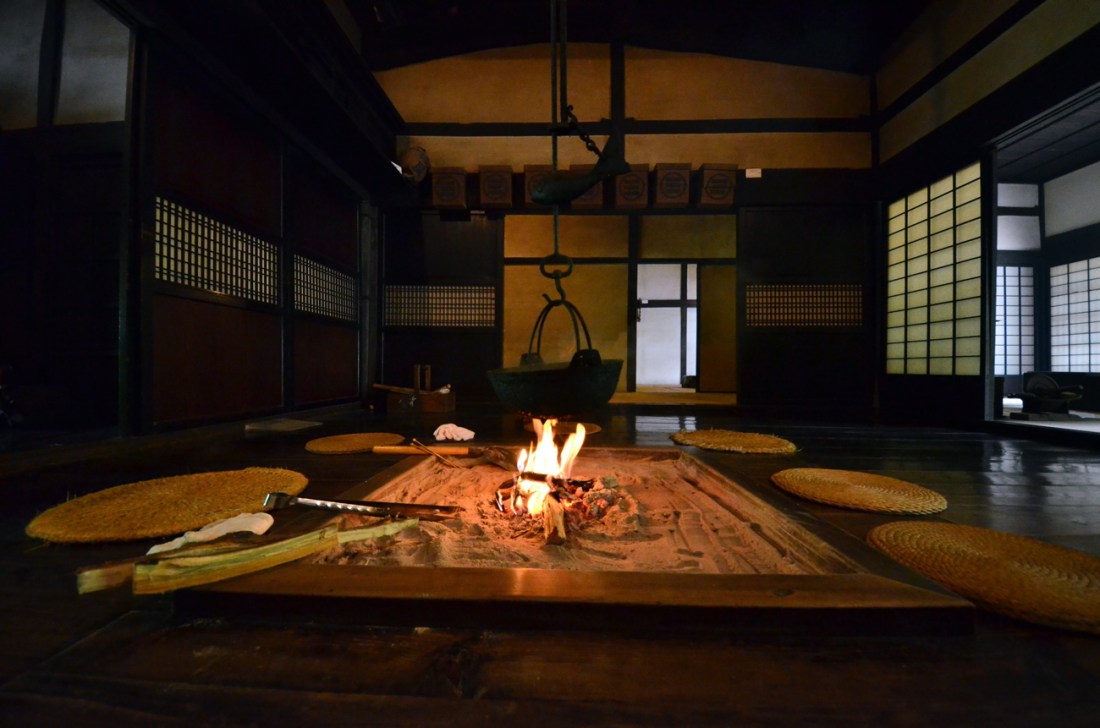
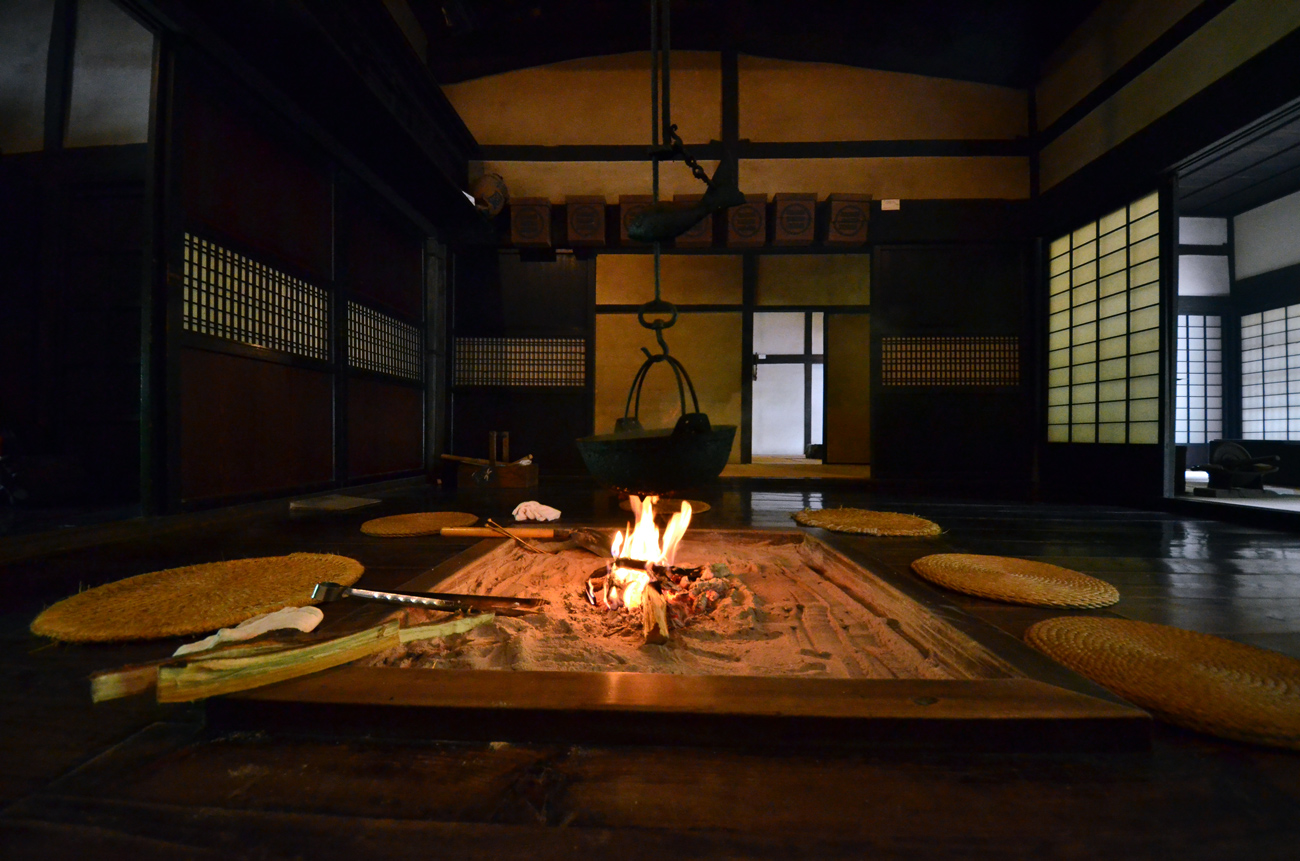
As you read it, imagine you are a little boy or girl in a dark and drafty room in an old farmhouse tight against a bamboo forest. Big smoke-blackened wooden beams twist through the space overhead. It’s dark outside and chilly; the wind is softly blowing outside making the bamboo and paper-covered shoji doors rattle, and the few remaining dry leaves rustle. Mother has just finished cleaning up after the simple evening meal. You’re still a little hungry, but it was enough. A small fire is burning in the square sand-filled irori in the center of the room where Mother and Grandmother cooked dinner. The family is relaxing around the fire, and you are leaning against your mother or father as Grandmother tells this old story. I won’t insist you enjoy it, but I hope you can grasp the atmosphere of rural Japan in past centuries.
An irori with a fire heating an iron cauldron for the evening meal. Woven rush mats are placed around the sand-filled depression in the floor for the family to sit together as they eat the evening meal. Maybe after dinner Granny will tell us some stories…
Long ago and far away there was a woman named Osei. She was 25 years old.
She had traveled from her home to visit her parents in a different village for several days. It was a half-day journey for a woman, normally one her husband or younger brother would have accompanied her on, but they were both too busy to travel with her this time.
Anyway, let’s walk along with Osei on her lonely path through a dim bamboo thicket at twilight.
Suddenly a man appeared by the side of the path, as if he had been waiting for her. Osei screamed in surprise.
The path through the bamboo forest
The bad guy
The man was huge and looked just like you would imagine a bandit would be with a long, unkempt beard and wearing a dirty sleeveless kimono. He grabbed Osei’s slender arm violently and dragged her in among the thick bamboo stalks. Osei screamed like a banshee on fire but the thick silent forest swallowed the sound without an echo. Only a fox and the mice he was hunting nearby heard Osei’s calls for help.
Osei struggled frantically to free herself from his iron grip, but without stopping the man just looked back at her admonishingly and said “Calm down, I’m not going to eat you! I just want you to be my wife.”
The large, dirty man held tightly to one of Osei’s arms, while Osei’s feet and free hand scrambled in the fallen leaves on the forest floor trying to get back to the path. Hearing his words, she managed to gasp out “Wait, wait! I can’t be your wife, I already have a husband and two small children waiting for me at home! Please let me go!”
Without releasing her the man stopped and with a puzzled expression said “Think about it. There is only endless drudgery waiting for you at your husband’s leaky hovel. And the best you will have to eat is rough barley rice and pickled greens, right?” “But if you come with me your life will be easy. You can relax indoors all day and eat delicious foods. That’s a lot better than your life now, I wager.” He made other strange arguments about nice clothes and servants, but Osei didn’t hear a single word, she just continued to scream and struggle.
Giving up on trying to convince Osei with words, the man tied her up, threw her over his shoulder, and strode purposefully away into the bamboo forest. After a while, the forest opened up to a clearing with a single house. The house was large and well made, like a Governor’s mansion.
The mansion in the woods
The man carried her into the house and lowered her onto the floor. Looking steadily into her eyes he firmly said “You are now the woman of this house. Your life here will be easy, so long as you don’t go outside. You will have delicious things to eat and a new silk kimono to wear everyday. Then you will understand that what I have said is true. Even if you think I am lying, stay here for just one month anyway, and after that you will be free to go. So stop all this hysterical wailing.”
Osei continued to cry, but after a while dinner appeared. It was everything the scruffy bandit said it would be.
Just a light snack
Osei grew up on a farm and was a poor farmer’s wife so she had never even seen such luxurious food before. But thoughts of her husband and children made it impossible to eat a morsel, so she just sat in a corner of the room and cried in despair.
But humans are calculating creatures unable to live on affection alone. After three days she became so hungry she finally relented and ate a mouthful of food.
There were foods from both the sea and the mountains, wonderful dishes she had never seen before much less tasted. She didn’t forget her husband or children for even a second, but rationalized that the separation would only be for a month. As the days passed she began to eat regularly a little at a time.
Four meals a day, nice clothes, servants to cook and clean, and no work. What more could a woman possibly want? Answer: She’s a woman so will find something to complain about.
Osei enjoying a picture book between meals
Osei spent each day alone in her room simply eating and reading picture books the man brought to her, so she was not especially bored.
Most importantly, the man did not pressure her for physical relations, so the tension between them gradually relaxed.
Eventually, however, Osei had read every picture book several times and was left with nothing to do. She was bored.
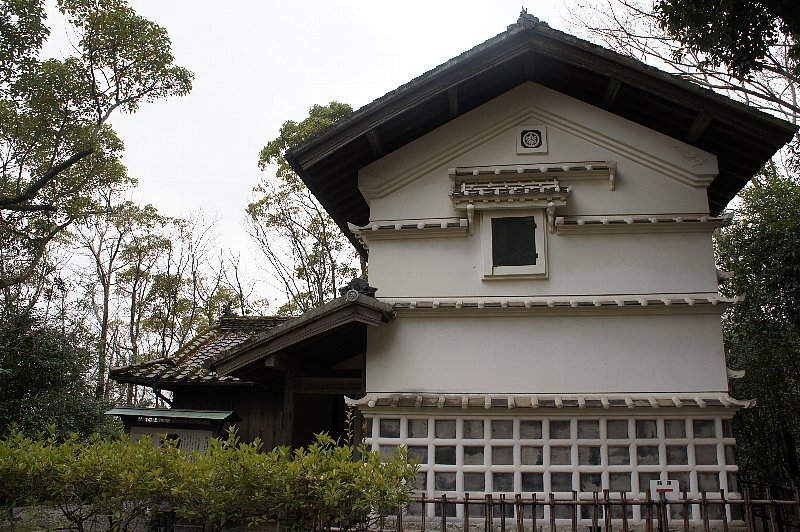
One day as the smelly bandit was taking his usual afternoon nap she snuck out of the house as quiet as a mouse wearing fuzzy pink slippers. She slipped from the veranda into a large garden with a big white kura warehouse off to the side. She heard voices from inside the warehouse, and what sounded like rain dripping from a leaky roof. Osei was curious and peeked into the warehouse’s open doors. What she saw inside shocked her so badly she had to kneel to keep from falling over.
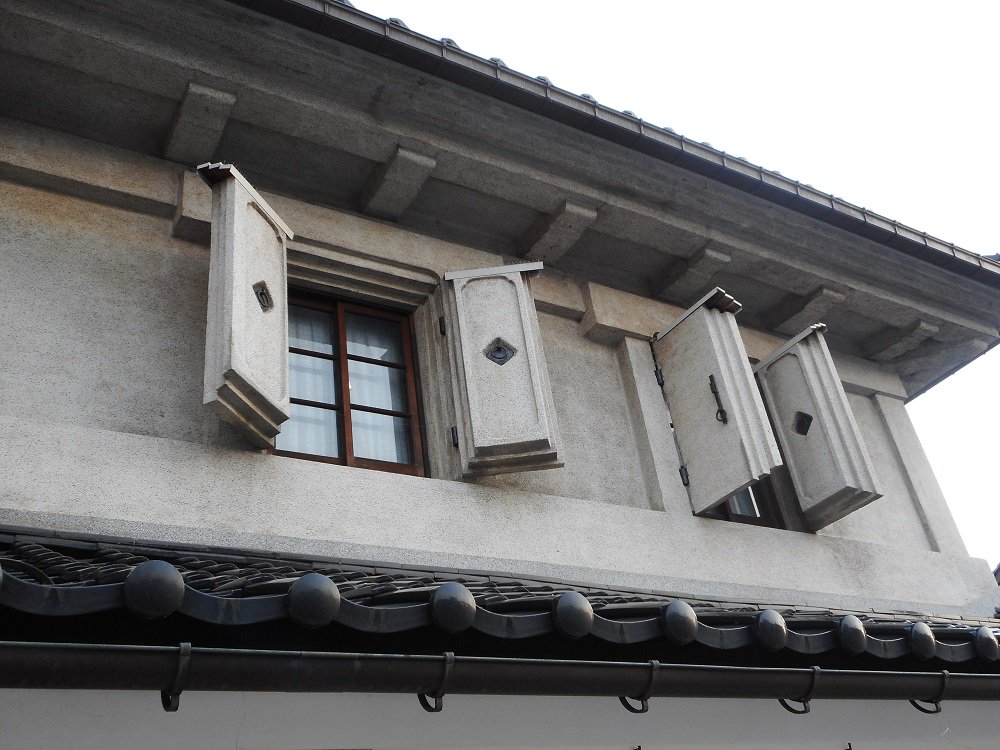
Japanese “Kura” (蔵) or “Dozo” (土蔵) are a type of warehouse building with a wooden structure and thick walls and ceiling of adobe plaster. The mass of the adobe moderates interior temperature changes helping to preserve foodstuffs and goods. More importantly, a well-built Kura will withstand a serious fire protecting the people and valuables inside, a tremendous benefit in light of the terrible fires that have historically and frequently ravaged Japan’s cities. Owning a Kura was not only a sign of wealth but was important to creating and protecting wealth.Dozo, being made of adobe, essentially clayey mud and straw, are vulnerable to damage from water and impacts. Two methods of protection traditionally employed were a fired-clay tile roof, interim eaves also with roof tiles, and a tall wainscot of fired-clay tiles, or even stone tiles as in this photo. Notice how thick the adobe walls are, and how all flammable building materials are protected behind adobe and plaster. The thick shutters too are filled and wrapped with adobe and a white plaster coat and have stepped edges that interlock to seal out smoke, fire, insects, rodents and thieves. I suspect the metal flashing on top of the shutters is a modern addition.The entry doors are also adobe and plaster over a wooden frame, often with metal panels to add further stiffness and security. The outer fireproof doors are left open during the day while the lighter and more easily-operated inner wooden doors are kept closed to keep out insects, rodents, and pilfering hands. At night, or during a fire, the heavy insulated doors are closed and locked. A well-made Kura will not only protect a family’s or business’s wealth, but is the perfect emergency refuge during fire or flood.
What Osei saw in the kura was dozens of bound women hanging upside down from the ceiling beams by ropes around their ankles as naked as the day they were born. Every single one of them was plump and sweating a yellowish liquid from their hair follicles and face which fell into a clay pot placed on the floor below each woman making a “drip, drip, drip” sound.
Osei was deeply ashamed at her indolence while these women had been suffering so close by. She began to cry at the sight. One of the women noticed Osei and whispered “Run! Hurry run away! If you don’t escape you too will end up hanging here with us while he steals your body’s oil!” With that all the hanging women looked at Osei pitifully and said as one “Run and bring us help!”
Osei was so shocked at first she couldn’t respond to the women’s pleas, but after a few minutes she did manage to stand and run away like a scared rabbit as fast as she could. As she fled through the forest and thickets daylight failed and she became even more fearful, but she continued running until at last she saw a light in the distance. It was an old farmhouse. She ran to the door and banged on it loudly until an old snaggle-toothed white-haired woman slid open the door.
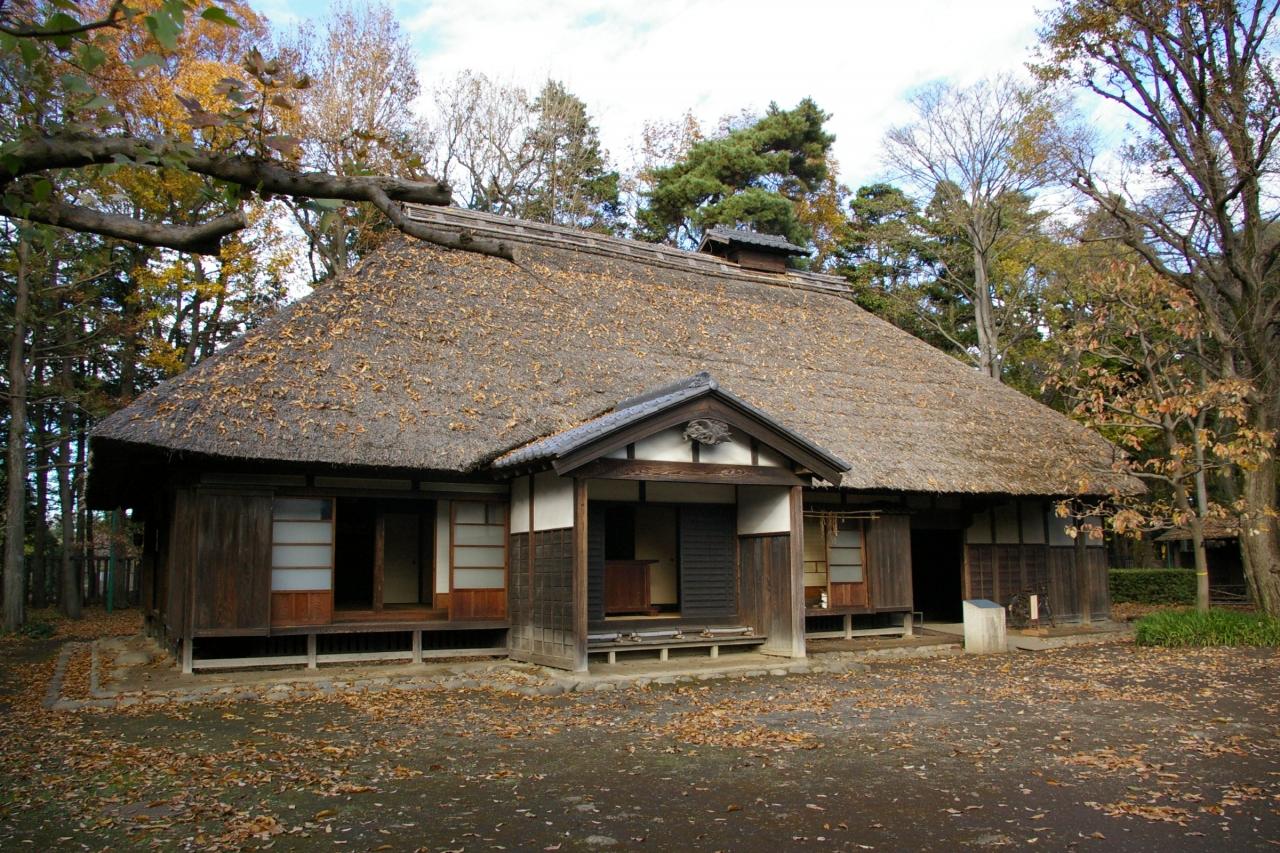
A traditional country farmhouse with a straw-thatched roof and smoke hole above the kitchen located towards the building’s right side. Notice that the right third of the building, including what would serve as the kitchen, is not raised. This area has an earthen floor and serves as workshop, storage shed, or even animal shed, depending on the farm’s needs. No glass windows, of course, just paper shoji doors and sliding wooden shutter doors at the perimeter.
“What’s the matter; why are you so panicked?” the old woman asked Osei. Reassured by the old woman’s concern Osei quickly explained what had happened.
“Well, come inside dear. I had no idea such a scary ruffian was skulking around these mountains,” said the old woman. “Oh no, I hear someone coming!” she suddenly barked, and pulled Osei inside sliding the door closed with a loud “clack!” Osei peeked through a crack at the doorframe and indeed saw a large figure running through the dark bamboo forest towards the house. “That’s him! That’s the man! He’s coming!” she gibbered in a low panicked voice.
The old woman guided Osei to a ladder going up to the house’s attic. “Quickly now, climb this ladder and hide above. There is a pile of hemp bags in the corner. Climb inside one of them and stay very very quiet until I get rid of that animal. I will hide the ladder so he won’t find you.”
The roof structure of the farmhouse.
The corner of the farmhouse attic where Osei hid.
Osei climbed the ladder, found the pile of bags, and curled up inside one as small and quietly as a potato bug. She could hear someone banging on the door below, and the old woman saying “I’m coming, I’m coming! Wait a second!” As the door slid open she heard the large man’s voice saying “A woman just came here, didn’t she!”
The old woman responded “No one but you has come here today.” The man’s voice said “Don’t lie, I saw her!”
“How could you see anything in this darkness?” said the old woman.
“You have an oil lamp burning inside. I saw her shadow at this very door when you opened it just now!”
“You must have seen my shadow twice,“ the old woman argued.
The man was angry now and spit out “I’m no fool! No way I would mistake an old hag like you for a young woman even in the dark.” “You’re trying to steal the woman I was preparing!”
The old woman lowered her voice, but Osei could still hear her response “Haven’t you got enough women already? Couldn’t you share just one with your old mother?”
The man continued to argue with the old woman, but eventually he calmed down and spit out “ Just this once, then, mother.” “Where have you hidden her?”
“In the attic,” responded the snaggle-toothed old woman pointing upwards with a finger and grinning. “Inside one of the bags. And while your at it, would you be a good boy and hang a new rope for me?”
“You know, you’re a lot of trouble for such an ugly old hag!” responded the man’s voice.
Hearing this Osei tried to escape from the bag, but before she could get away the bag was lifted into the air. The bag was suddenly and powerfully torn open and she was pulled out, only to be tied with a thick, rough rope around her ankles and suspended through a hole cut in the ceiling above the hallway below. Clearly, the rope and hole had been prepared well in advance and used before.
Osei looked around and saw the ruffian and his mother looking back at her. Of course, they appeared to be upside down. Looking at the floor below, Osei noticed a large clay pot placed directly below her with what appeared to be some yellow oil in the bottom.
Before long, a slow drip, drip, drip, … of oily sweat fell from Osei into the pot.
A sad ending to an all too common story of suffering.
The End
(A folktale from the island of Kikaijima, located between Kyushu and Okinawa)
Happy Halloween from your friends at C&S Tools!
YMHOS
If you have questions or would like to learn mor
If you have questions or would like to learn more about our tools, please click the “Pricelist” link here or at the top of the page and use the “Contact Us” form located immediately below.
Please share your insights and comments with everyone in the form located further below labeled “Leave a Reply.” We aren’t evil Google, fascist facebook, or thuggish Twitter and so won’t sell, share, or profitably “misplace” your information. If I lie may I be hung by the toes for a week.













 Covington & Sons Tools
Leave a comment