
Here at C&S Tools we frequently use the term “Professional-grade” to describe our products. This is not a “term of art” sculpted from soggy newspaper and wallpaper paste for marketing purposes, but has an important meaning your humble servant will break down in this post so there is no confusion among our Beloved Customers and Gentle Readers.
The Definition of “Professional “
We live in a place and time when degreed fools, nitwit “experts,” and the smelly swarms of orcs they “influence” casually change the meaning of long-established words daily for their self-justification and profit. Just ask them the meaning of the word “woman” if you need confirmation of this trend. Here at C&S Tools, however, we beat the drummer of a different march, so to speak, and prefer words to have stable, useful meanings, including the term “Professional.”
The formal dictionary definition of the word, and the one we intend, is a person recognized by his peers as having received a certain amount of intensive, prolonged training and education in his chosen occupation, has achieved some minimum satisfactory level of skill in the performance of that occupation, and is paid for his work and work product. That’s five factors including education, training, skill, occupation, and financial compensation.
We accept as valid the premise that many individuals lacking trade-specific education or training or formal qualifications nonetheless develop professional-level skills through their diligence and OJT, especially in light of the current decrepit state of apprenticeship and training programs in most countries. If they then go on to make a living performing competent work for pay, then they certainly qualify as professionals in our opinion. However, we do not accept the self-aggrandizing theory some put forth that anyone with skill and an artistic flair qualifies as a professional even if they aren’t paid for their efforts. Money talks and BS walks.
Woodworking professionals are committed to their trade long-term, and use their skills, time and tools to earn a living by making things for clients, customers or employers in accordance with an agreed-to design, specifications, cost, and schedule, normally formalized in a written contract. Therefore, unlike the talented amateur or hobbyist, financial, schedule, and contractual factors place a professional under constant pressure; If he fails to deliver the promised work product consistent with his promised schedule he will suffer serious financial and reputational consequences.
By contrast, an amateur woodworker may be skilled and even routinely do museum-quality work, but lacking a legal commitment to a paying customer for cost, time and quality he has little at risk so tool inefficiency and failure to deliver on-time can only make things unpleasant, not catastrophic.
So what does this have to do with woodworking tools you say? Glad you asked.
While the professional woodworker too must resharpen the blades of his chisel and planes periodically, the sharper he can make them, the more wood he can cut between sharpening sessions, and the less time he expends sharpening and maintaining his tools, the more time and energy he can invest daily towards fulfilling his commitments and getting paid.
On the other hand the blade of a plane, chisel, knife or adze that can’t be made very sharp, dulls quickly, is easily damaged, or takes a long time to sharpen impedes the progress of the professional’s efforts thereby reducing his income and potentially harming his reputation. It’s a simple calculation, but one most people, especially amateurs, scribes and keyboard warriors who do not face the same pressures as the professional woodworker, neglect to perform, partly because they are never called upon to assign a monetary value to the time expended sharpening tools, something professionals do everyday when preparing legally-binding bids and cost estimates.
These are by no means new expectations, but in a time when amperage is more important than sharpness, dull blades go into the garbage to be replaced by factory-sharpened new ones, and precision is built-into the machinery used, many craftsmen have forgotten them.
The Japanese professional woodworkers I have worked with during my career spanning 45 years have been uncompromising regarding quality and schedule. And they are obsessed with sharpness. I’m convinced it’s in their DNA. This is the same DNA that for millennia have compelled Japanese blacksmiths to always make better, sharper tools.
Although there are a few Japanese blacksmiths who have “gone Hollywood,” using publicity from their public exposure on Japanese television shows about traditional crafts to justify tripling and quadrupling the prices of their otherwise ordinary products, professional woodworkers disdain such self-aggrandizement and remain focused on real-world performance above all else. Not artful camera shots or fancy names. Not visual appearance. Certainly not some silly sense of oriental “mystery” of the sort implied outside of Japan by the tool distributor’s marketing pukes. In other words, high-performance tools made by Japanese professionals for other Japanese professionals, not shiny sharpened screwdrivers and gasket scrapers made for export to foreign amateur woodworkers.
A “professional-grade tool” therefore is one that will work long and hard for its master. It must become unusually sharp, retain that sharp edge for a long time, and be quicker and easier to sharpen than a screwdriver sold as a chisel or a gasket scraper shaped like a plane blade.
But what should Gentle Reader expect from a “Professional-grade” woodworking tool?
Performance Criteria 1: Sharpness
The primary performance criteria of a professional-grade plane, chisel, or handsaw is not the name of the manufacturer, how it looks, or even how much it costs but rather that it cut extraordinarily well. This high degree of sharpness depends on the following three factors:
1.1 Crystalline Structure of the Steel: The crystalline structure of the completed blade’s steel is the primary determining factor in sharpness since a blade cannot be made sharper than the carbide crystals exposed at the cutting edge will permit. If the crystals are large and isolated, instead of small and evenly distributed, sharpness will suffer. Impurities like sulfur, phosphorus and silica harm crystal formation. Chemicals such as chrome and molybdenum are added to most tool steels nowadays to overcome the negative effects of these impurities, to decrease manufacturing costs, and to eliminate the need for advanced blacksmithing skills. But an unfortunate side effect of these additives is the tendency to develop large clumps of carbide crystal in the steel reducing sharpness.
Consequently, a professional-grade Japanese blade will be made from a pure high-carbon steel like Hitachi Metal’s Shirogami (White-label steel) No.1 and No.2, Aogami (Blue-label steel) No.1 and No.2, or Sweden’s Assab K120 steel. See this post for more details.
1.2 Skills of the Blacksmith: The manufacturer of a chisel or plane blade can use the best steel in the world, but if he doesn’t have the skills and dogged perseverance to work it properly, the crystalline structure of the finished blade and the degree of sharpness it can accept will suffer, even if it survives forging and heat treatment. All our blacksmiths, without exception, are masters at using Shirogami No.1 steel, an unusually pure and plain high-carbon steel. Indeed, they have used it every working day over their entire 40~60 year careers. All of them are self-employed and work in their own one-man smithies. Their skills are not suited to mass-production, nor can they be learned in a few weeks or even a few years by factory workers in China, Vietnam, Cambodia, India, Mexico or Ohio. It doesn’t take fancy equipment, but simply feeding materials into a production line won’t cut it.


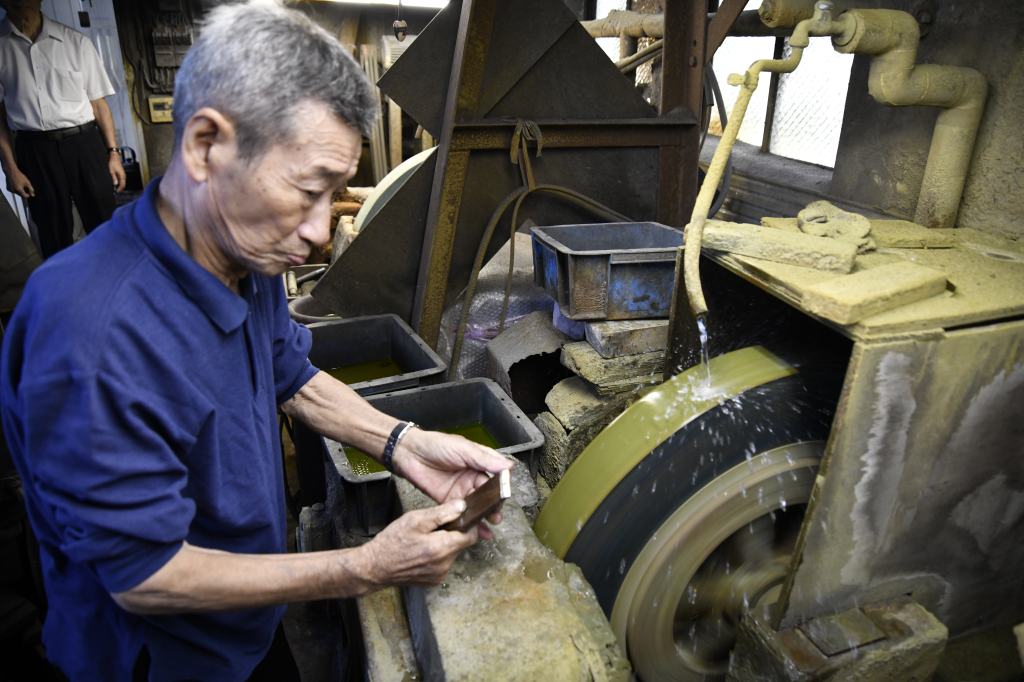
1.3 Skills of the Sharpener: The finest blade forged by the world’s best blacksmith will become no sharper than the physical skills and diligence of the person who maintains and sharpens it. There are no shortcuts, tricks, books, videos or classes that can transfer such skills. I have shared information through the series of 30 articles on this blog that will help, but the end-user must develop the skills in their own eye and hands through their own efforts. Fortunately, anyone with two hands, at least one eye and some determination can obtain professional-level sharpening skills. Please do it.

Performance Criteria 2: Cutting Longevity
Time is money, so a professional-grade tool must remain usefully sharp a relatively long time in order to precisely cut more wood between sharpening sessions. Indeed, this is the most significant difference between Western and Japanese woodworking tools. A blade that dulls quickly is inefficient, irritating and makes the workman look lazy. A professional in Japan can’t allow such poor-quality tools a home in his toolbox. What are the factors govern cutting edge longevity?
2.1 Excellent Crystalline Structure: This factor is directly influenced by Nos 1.1 and 1.2 listed above. A blade with poor crystalline structure will dull quickly and may even fail.
2.2 Hardness: Be not deceived: a blade may have excellent crystalline structure, but if it is too soft, it will dull quickly, regardless of marketing claims. Professional-grade Japanese planes, chisels, kiridashi kogatana knives, and carving chisels should measure in the neighborhood of 65~66 on the Rockwell C scale, as do all our chisel and plane blades. The hardness of Western chisel and plane blades nowadays is typically Rc55~60, with a few going as high as Rc62, the nature of their relatively unsophisticated design making greater hardness likely fatal to the blade.
At an average hardness of Rc60~63, consumer-grade Japanese chisels and planes are harder than their Western counterparts, but are still softer than our professional-grade tools. Indeed this extraordinary hardness in a Western-style chisel or plane blade would not only make it extremely difficult to maintain but would certainly cause it to self-destruct. These extra degrees of hardness are practical in Japanese chisel and planes blades, on the other hand, due to their laminated construction and hollow-ground ura , features essential to make them easy to sharpen and to ensure chisel blades will thrive even if motivated with a steel hammer. These details do, however, require the user to employ a few professional-grade skills, which is why tools purveyed by others targeting amateurs, or intended for export to markets where consumers typically lack these skills, always have blades intentionally made softer.
Indeed, as the number of professional users of planes and chisels has decreased in recent decades, what were once well-respected Japanese tool brands have intentionally reduced the hardness of their blades to reduce both warranty issues and manufacturing costs, and to appeal to an inexperienced amateur market. Tools with these softer blades are not bad or useless, but neither are they “professional-grade.”
What has always bothered your humble servant about the way famous makers purvey their softer, amateur-grade blades nowadays is the deceptive way they are marketed. In my humble opinion a beautiful dress, heels, lipstick and a sandwich sign with colorful graphics advertising available services do not make a pig an elegant woman, much less a lady .

Performance Criteria 3: Easily & Quickly Sharpened
If used, eventually all blades must either be resharpened or replaced. But if a woodworking blade takes a long time to sharpen, if it takes special equipment to sharpen, or if it is unpleasant to sharpen, not only is it uneconomical but it will not be loved. Professional-grade Japanese chisels and planes are easily and quickly sharpened despite the hardness of the steel. Indeed, they are a pleasure to sharpen. There are reasons for this:
3.1 Nature of the Steel: Steels that contain alloys such as chrome, molybdenum, vanadium and/ or tungsten are ideal for mass-production by untrained factory workers and are constantly praised in marketing sprays as “ tough” and “ abrasion resistant,” but experienced professionals know that tools made from such “tough” and “sticky” steels are a time-wasting pain in the neck to sharpen.
Our blacksmiths do not use such adulterated, uncooperative steels. The blades of professional-grade planes, chisels and knives will ride sharpening stones gleefully, can be quickly sharpened, and indeed are a pleasure to sharpen.
3.2 Blade Design – The Ura: A professional-grade Japanese chisel or plane blade has a well-shaped hollow-ground area on the blade called the “ura.” This detail makes it easy to sharpen the extra-hard steel used in our plane and chisel blades while maintaining the ura in a flat plane. The importance of a properly ground ura cannot be overstated.
3.3 Blade Design – Laminated Construction: While extra-hard steel cuts a long time, it can be brittle making a blade fragile, which is why Western chisels, with their homogeneous construction, must be made softer to prevent them from rupturing. In professional-grade Japanese chisels, the hard steel cutting layer is skillfully forge-weld laminated by hand to the blade’s body comprised of a softer low-carbon steel or iron called “jigane” that protects the extra-hard steel cutting layer from snapping in half while still being easy to sharpen.
Our blacksmiths do not use the inferior pre-laminated steel products developed for the mass-production of economy kitchen knives, despite the undeniable profitability of such materials
There are other design and fabrication details characteristic of professional-grade tools which we will not delve into here, but the most important thing to grasp is that the person ordering the tools (that’s YMHOS in the case of C&S Tools) must have specific quality and performance expectations he can communicate to the blacksmith. He must also have experience and discerning eyes and hands to confirm those expectations have been satisfied. More importantly, the blacksmith he assigns the work must have the skill, experience, determination and self-respect necessary to forge and heat-treat blades in accordance with those expectations.
Very much a personal, man-to-man relationship.
The Amateur and the Professional-grade Tool
Don’t let the discussion above discourage you from using our tools even if you aren’t a professional woodworker because, while tools are terribly vain and frequently gossips, so long as you let them cut wood, they are happy regardless of the user’s day job. And for those who use chisels, planes and knives for the joy it brings, as your humble servant does now, the extra sharpness and edge-retention capability, and the satisfying feeling sharpening them produces will increase the pleasure you enjoy while woodworking.
When using professional-grade Japanese woodworking tools, there a few things you should keep in mind. The first thing is that, since their steel is harder than that found in tools intended for amateur use, you mustn’t use them to lever wood, open paint cans or shave concrete. They are not sharpened screwdrivers or extra-thick gasket scrapers stamped out in lots of thousands by peasant farmers in Guangzhou, but elite tools born to cut wood. They simply won’t tolerate such amateurish abuse.
The second thing to keep in mind is that you need to develop the skills to sharpen and maintain them properly. This includes using flat sharpening stones and maintaining a proper bevel angle. Sharpening is the first, foremost, and most ancient woodworking skill, one that all true woodworkers must master. More details are available in our Sharpening Series of posts.
If you can show the tools the same respect the blacksmiths that forged them did, then you are well on your way to becoming professional-grade yourself, regardless of your day job. We see it as our duty to help Beloved Customer along that path.
The Future of Professional-Grade Tools
As we look to the future, please note that it has sadly become common practice by some manufacturers in Japan to mass-produce blades for chisels and planes from inferior materials with mediocre crystalline structure and lesser hardness, but identical in appearance to professional-grade tools, and sold at high prices to uninformed consumers who are none the wiser. These modern corporations cleverly use dubious marketing techniques that invoke “mystery” and “ancient traditions” when the fact is they have replaced traditional materials and techniques with modern mass-production materials and techniques developed during the last 3 decades specifically for mass-producing inexpensive consumer-grade kitchen knives. After all, one can’t tell the quality of a steel blade’s crystalline structure by looking at photographs or even sitting on the blade (ツ).
While lower-quality tools purveyed using deceptive marketing strategies will no doubt continue to be profitable for some, our Beloved Customers know how to sharpen and how to properly evaluate a blade. They appreciate honest value more than artful marketing with high heels and lipstick and so we refuse to insult the intelligence of the professionals that are the majority of our clientele through such shabby nonsense.
The demand for professional-grade chisels and planes has decreased dramatically among modern consumers in Japan at the same time those master blacksmiths with the skills and determination to make them are either retiring or relocating to the big lumberyard in the sky. And with the decreased demand for such tools, Hitachi Metals has ceased production of Shirogami and Aogami steels. Truly, the strongmen holding up the veranda (縁の下の力持ち)are gradually disappearing.
The future supply off these excellent tools looks bleak, but we hope to continue to be able to provide them to our Beloved Customers for a few more years, God willing and the creek don’t rise.
YMHOS
Relevant Articles
The Mystery of the Brittle Blade

If you have questions or would like to learn more about our tools, please click the see the “Pricelist” link here or at the top of the page and use the “Contact Us” form located immediately below.
Please share your insights and comments with everyone in the form located further below labeled “Leave a Reply.” We aren’t evil Google, fascist facebook, or the Black Lives Matter Inc. IT department and so won’t sell, share, or profitably “misplace” your information. May all my blades snap in half if I lie!


 Covington & Sons Tools
Leave a comment