
Certainty of death. Small chance of success. What are we waiting for?
– Gimli son of Glóin, “The Lord of the Rings”
In previous posts your humble servant wrote about a traditional Japanese handsaw called the bukkiri gagari. This rip saw was a standard tool prior to the proliferation of electrical-powered circular saws, but is no longer produced commercially anywhere and is seldom seen nowadays. Detailed information about this tool can be found at the following links:
For those who enjoy using their own internal power pack, this saw is as useful now as it was back in its heyday.
My first hands-on experience with the bukkiri gagari was an antique example I purchased in 1987 at an outdoor flea market held monthly adjacent Iidabashi station in Tokyo. Judging from the markings and patina, and after consulting with a specialist in antique tools, I concluded it was most likely forged around 1910 of a British tool steel called “Togo Steel” produced by the Andrews Steel mill of Sheffield, England and sold in Japan by the Kawai Steel Company. This steel was named after a famous Japanese Admiral who kicked Russki patootie in the Russo-Japanese War (1904 to 1905).

Despite a cracked tooth, this old saw served me well and without complaint for many years. When I sent it to Master Nakaya Takijiro for a routine sharpening one day, he also repaired the crack, trued the plate, and reworked the teeth all without being asked. He’s subsequently resharpened it for me several times, and with each ministration of his tiny files, its performance has improved incrementally. He’s a magician.
About 14 years ago I found myself suffering an insatiable itch for a bigger, newer more refined bukkiri gagari saw, so I visited Takijiro’s forge to procure some medicine. After much back and forth he agreed to reproduce of one of his own master’s saws, a style once very popular with temple carpenters (Miyadaiku 宮大工). The final product is a thing of great beauty and serious purpose.
Over the years Takijiro has been kind enough to forge a few bukkiri gagari saws for Beloved Customers, but the wait time has always been long. This article is about the latest order he completed recently, similar in shape to his Master’s old pattern. Photos can be seen at the link below.
Working alone and without any electrical equipment other than a motor to spin the flywheel of his spring hammer, a grinder, a fan to force-feed his forge, and a few bare lightbulbs overhead, it takes Takijiro a while to make these large saws, but he delivered on our latest order a few weeks ago. It included four sizes:
- 9-sun (九寸 240mm/ 9.4”),
- Shakurei (尺0 270mm/10.6”)
- Shakuni (尺二 310mm/12.2”)
- Shakusan (尺三 330mm/13”)
The 330mm shakusan saw is the largest practical size for standard purposes IMHO, and the largest blade Takijiro can heat in his forge (originally built by his master for forging swords).
The smaller 240mm saw, called a kyusun (meaning “9 sun) in Japanese, is a handy size, especially for the workshop and workbench.
Takijiro makes these saws by hand from Hitachi Yasugi Shirogami No.2 (aka “white label” steel #2), a relatively pure high-carbon steel that makes an excellent saw blade, but which is difficult to work due to its marked tendency to warp and crack during heat treat. Unfortunately, Hitachi no longer produces this steel.
Of course, he used hammers and scrapers to apply a double-taper-grind to the blades, then hammer-tensioned and trued them. He also hand-cut, hand-sharpened, and set their teeth in a progressive pattern (increasing in size approaching the toe) specifically for ripping Western cabinet hardwoods.
Each saw has an angled handle in the style called “shumoku,” made of plain hinoki cypress wood.
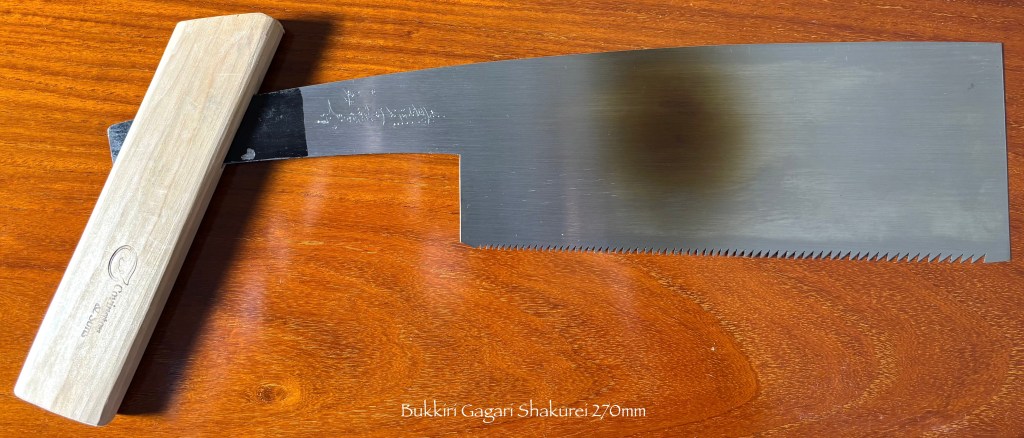
This style of handle is seldom seen anymore, but it has several significant advantages. First, it makes the saw much shorter than one with the more common, straight stick handle, so it’s more convenient for carrying in the field and using in tight places such as construction projects. Second, the angled handle provides an improved grip for powerful two-handed cuts. And third, it makes the saw easier to use from various angles, such as on the workbench, and when making overhead cuts where a long, straight handle tends to get in the way, a common situation in construction work.
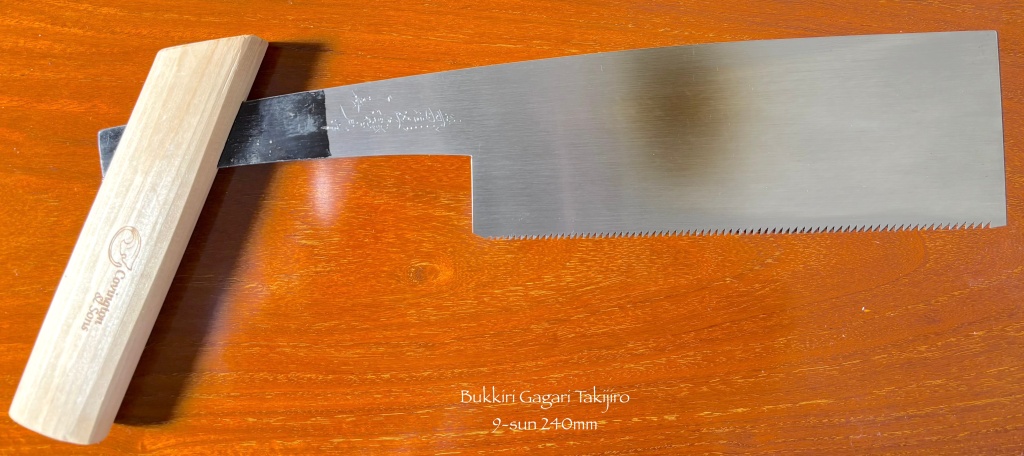
Each handle was shaped with handplanes and does not have an applied finish such as varnish or polyurethane.
Nakaya Takijiro Masayuki (“Takijiro”) is one of the last two or three master sawsmiths remaining in the waking world with the skills and willingness to make handsaws of this utility and quality, so this is a rare opportunity for discerning Beloved Customers to obtain one of his marvelous saws. They are a joy to use.
Contact us using the contact form below if you are interested in learning how to purchase one of these rare tools.
YMHOS
If you have questions or would like to learn more about our tools, please click the “Pricelist” link here or at the top of the page and use the “Contact Us” form located immediately below.
Please share your insights and comments with all Gentle Readers using the form located further below labeled “Leave a Reply.” We aren’t evil Google, fascist facebook, or the Chinese Communist Party’s coordinator for blackmail, and so won’t sell, share, or profitably “misplace” your information. If I lie, may my all my saw teeth break.
Related Articles:
- Japanese Handsaws: The Hozohiki Precision Rip Saw
- Japanese Handsaws: The Dozuki Precision Crosscut Saw
- Japanese Saws: The Carpenter’s Dozuki & Hozohiki
- Japanese Handsaws: The Twins
- Japanese Handsaws: The Maebiki Oga
- Japanese Handsaws: The Bukkiri Gagari
- A Guest Reviews 3 Handsaws
- The Mystery of the Burnt Blade
- Handsaws: Some Guidelines to Aid Precision


 Covington & Sons Tools
Leave a comment