
Danger gathers upon our path. We cannot afford – we have not right – to look back. We must look forward.
– Winston Churchill
Your most humble and obedient servant published a well-received article on this website earlier about the safe use of sharp handtools. In this follow-up article we’ll extend that discussion to safety on construction jobsites. Never fear, unlike many bloggers desperate for content, any content at all dammit, I won’t be posting more, increasingly-stupid additions on this subject forever.
But why bother at all with such a tedious subject on a blog about tools and woodworking? Glad you asked! First, and foremost are my personal motivations. For you see despite attestations from the Mistress of the Blue Horizons to the contrary, I have a healthy conscience and want Beloved Customers who use our tools in the field to return home safely everyday without leaking any red sticky stuff.
A related motivation is regret for the past, because, like many older guys with scars (Beloved Customer is a miraculous exception, of course), I’m beginning to suspect I just may not be immortal. No, no, seriously. Sometimes I even get the niggling feeling that the light at the end of tunnel I sense is not the Road Runner with a headlamp, but is actually an approaching, but silent, freight train.
At such times I feel regret for not learning and applying these lessons sooner. But mostly I regret not doing a better job of sharing them with those around me back in the day.
Alas, if I could only use my tardis to redress past oversights, but who knows when the repair shop on Gallifrey will have it fixed. I need to call them using an official tardis telephone to check on progress. Do you have one I can borrow, please??

Scars and regrets aside, my primary objective in all this scribbling is to help as many Beloved Customers as possible live healthy, productive lives surrounded by fragrant sawdust and shimmering shavings.
Disclaimer
First, I must begin by clearly stating that the suggestions presented herein were not taken from a training manual, or scrounged from the infallible internet, or formulated by a half-wit, AI oven toaster, but are based entirely on my personal, often painful, and occasionally bloody, experiences. Moreover, I am not a professional safety consultant looking for the next gig, a “Slippin’ Jimmy” style labor attorney sneaking around hospitals, nor a representative of any legal entity or bloated government agency. Accordingly I accept no liability whatsoever, so when your ambulance-chaser cousin expresses concern, please tell him for me to suck the yellow off a lemon.

Second, these suggestions are neither comprehensive nor complete, much less all that one needs to know to work safely, but are just a few of the many safety procedures and rules you would be wise to learn and follow.
And third, I am thoroughly aware that safety professionals everywhere will heap teetering piles of odoriferous scorn on what I write here. They will say it is dangerously incomplete, or that some details are wildly inaccurate, or that they are completely inapplicable to the country and area they were trained in. One motivation for this scorn may be the fact that they didn’t make any money from writing it. Or it may be they think OSHA’s rules should govern the entire world. In any case, I don’t work for them, nor do they control my actions, much less my conscience, so I will give them all the careful inattention they deserve.
But as I mentioned in point No. 1 above, unlike the “experts,” “safety professionals,” and liability lawyers that may object, in publishing this I am intentionally neither seeking nor receiving compensation of any kind, not even clicks. Moreover, it is not among my objectives to provide complete, much less universally, legally correct, training. Indeed, please do not confuse this with training at all, for it it is only a list of a few cautionary examples, often taught and more often ignored, from my direct experience, that may benefit Beloved Customer.
Despite what some nazgul-ridden shysters will screech to the contrary, in the end it’s your body, and its safety is ultimately your responsibility. Accordingly, it behooves you to gain comprehensive knowledge and training in safety and to understand all your legal and statutory obligations related to safety compliance where you work. There are tons of free resources available nowadays if you don’t require formal certification.
So let’s dig into some details
Safety Specifics
I hate the nanny state and won’t bore Gentle Reader with a list of the myriad safety do’s and don’ts bureaucrats have imposed, but there are a few precautions which receive scant attention even in formal training classes of which you should be aware.
Trips & Falls
Cuts and sprains to the hands are the most common jobsite injuries, but are seldom fatal. Trips and falls are the real killers. They’re easily avoided, but usually occur through negligent housekeeping and/or stupidity. Please don’t be stupid. Keep your jobsite clean, orderly, and free of trip and fall hazards.
Ladders

Without exception, the misuse of ladders is the most common source of fall-related injuries and deaths on construction jobsites. This is not conjecture.
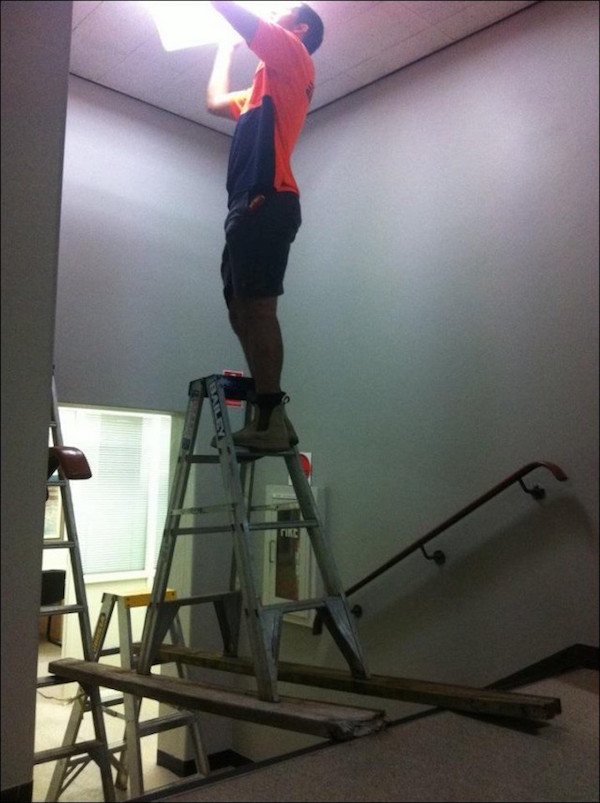
Accordingly, you should view every ladder as a death trap. Seriously. Never say I didn’t warn you.
Here in Japan the better large general contractors (aka “Super Zencon”) forbid the use of ladders over 1 meter high on their jobsites. Extreme? Unwarranted? Death and injury statistics say no. Where possible please use well-constructed scaffolding or a certified manlift instead of a ladder.
When I was a boy of 14 working my first jobsite in the Nevada desert, my foreman had me working on the underside of the eaves of a 2 story house from a ladder perched on the elevated forks of the forklift he operated. Exciting times! I didn’t know any better at the time, but the foreman who assigned me that job later put several other workers in the hospital through similar negligent behavior. Back in those days, if a worker fell and broke his fool neck, it was his fault, you see, not his supervisor’s.
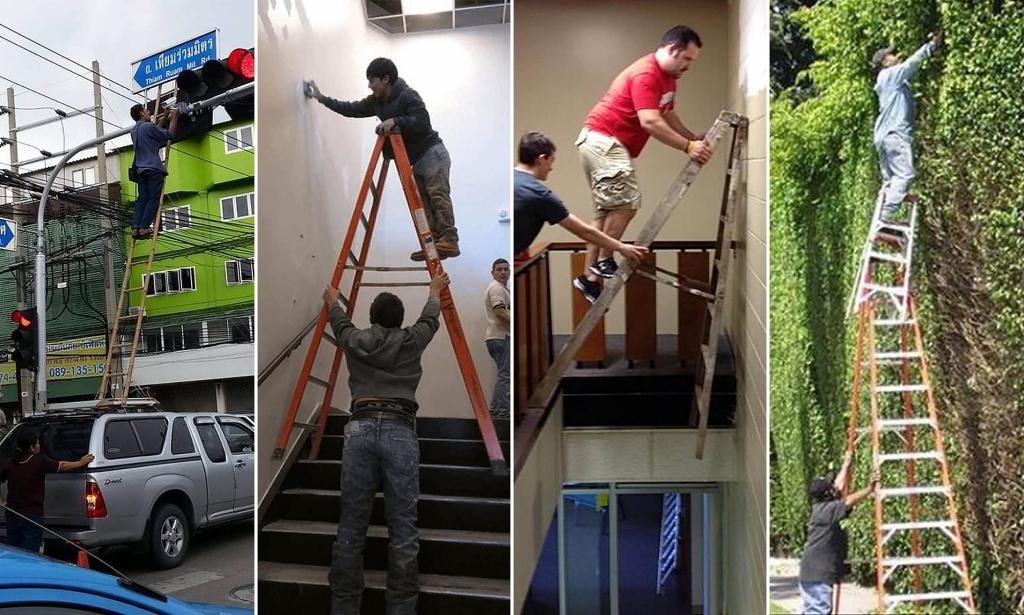
If you must use a ladder of any height, make sure it’s braced solidly at both its top and bottom ends. By “solidly” I mean it can’t be made to wiggle, and it’s impossible for even Murphy to knock over.
Never stand on the top rung of a ladder even if it’s solidly braced. Easy to say, but the irresistible Darwinian compulsion to climb to the top rung, fall off, and die in agony with unsightly bone splinters poking out everywhere and red sticky stuff making a mess all over the place overcomes thousands of guys every year. How unfashionable!
Ladders truly excel at skimming floaters from the gene pool, especially when combined with forklifts. Don’t you be one of them!
Fire Hazards
Jobsite fires are extremely common because of the garbage and flammable material that careless fools leave scattered around. All it takes is one idiot to toss a cigarette butt. Or one spark from a welder, torch, grinder or cutoff saw. Or one short in a damaged extension cord.

Garbage and clutter aside, construction sites are always at high risk for fire because for months they have only temporary power which is frequently not compliant with code, miles of extension cords strung everywhere, and careless workers with welders, cutting torches, electrical grinders and tobacco incinerators wandering everywhere. And depending on where that fire starts, the fuel available to it, the amount of time it’s allowed to grow, and the difficulty of emergency egress, too often people get toasted. I know this from direct experience.
So keep your jobsite clean and clutter-free.
Inspect your extension cords daily.
Strictly forbid smoking on your jobsites.
And for heaven’s sake, please be sure to establish and strictly enforce “hot work” rules, provide related essential equipment, and inspect that equipment daily to ensure it works or hasn’t tottered off on Darwinian adventures. Your life may depend on it.
So let’s next consider why hot work safety procedures are important.
Hot Work
“Hot work” such as welding, cutting metal with oxyacetelene torches, grinding, or using cutoff saws, etc. etc. is dangerous as I know from direct, personal experience of starting a fire in a pile of discarded cement sacks on a construction site in Las Vegas many years ago. Fortunately, while I was a stupid kid at the time directed by a drunk to do something stupid, I was also paying attention and put out the fire quickly. But that’s no excuse for not creating and not following hotwork rules.
More recently a subcontractor started a fire with his welder on my jobsite in Yokohama in a similar manner. Four fire trucks arrived. Because of the location and time of day human life was not at high risk, but it could easily have been a financial and PR disaster for my high-profile international client (one you know). Fortunately, while the GC violated housekeeping rules and the steel fabrication subcontractor blithely ignored mandatory hot work rules, it didn’t get too badly out of control because the GC had established a high-quality safety plan in-advance, fire extinguishers were staged in appropriate locations, and responsible people were more-or-less paying attention.
It wasn’t my fault, but I ended up having to apologize to both my client and the Mayor of the City of Yokohama for this embarrassing blunder in company with the GC. I tell you, it was a heavy blow to my towering humility.
But hot work violations are not always so harmless. Another ironworker started a fire in the basement of a data center owned by a big company (another one you know) under construction in Tokyo some years back. I did not manage the jobsite but only supplied heat-exchange equipment.
Molten metal sprayed by an ironworker’s oxyacetylene cutting torch landed on a stack of urethane concrete insulation blankets stored 3 stories underground and melted its way to the bottom where it smoldered unseen. After an hour or so went by fire and volcanic levels of toxic smoke suddenly exploded from the stack into the dark, cluttered underground spaces quickly killing 2 workers and 3 firemen.

Reports submitted by police and fire departments attributed the deaths to a series of criminally incompetent violations of obvious, well-known safety laws. But I would wager that none of the workers or supervisors involved even considered the possibility of dying in smoke and flame beforehand. And obviously they didn’t have a proper fire watch. Murphy was a whimsical killer that day.
I really need to get my Tardis working again.
A jobsite I managed in Japan a couple of years ago was owned by a British company that had lost 2 entire buildings outside of Japan stuffed to the rafters with very flammable retail product and robotic material handling equipment containing literally tons of lithium-ion batteries. Needless to say, that company was sensitive to fire hazards, so their safety rules permitted zero hotwork on their jobsite in Japan. Welding, cutting, grinding, soldering or any other activity that might throw a spark was absolutely prohibited inside the jobsite fence. No exceptions. With lots of steel to erect and equipment to install, these uncommunicated, unanticipated safety measures made it difficult to complete the project on-schedule and within budget. There were injuries on the jobsite caused by stupidity, but we experienced no incidents of fire.
That’s an extreme example, and your workplace or jobsite is probably not at such a high risk, but nonetheless I strongly encourage you to scrupulously plan and meticulously follow competent “Hot Work” rules even if it means having guys standing around simply watching welding, cutting and grinding operations with fire extinguishers resting on their toes (smartphone use should be banned entirely while on fire-watch).
By “plan” I mean produce a thorough, professional-grade, site-specific, activity-specific RAMS (Risk Assessment Method Statement) and getting written buyoff from everyone on the team. If you don’t know how, you must learn. Yes, it’s a pain in the butt, but educational and much less painful than 5th degree burns to the same.
It can get expensive, but don’t neglect to assign a dedicated human fire watch with no other job while hot work is underway. Allow me to reemphasize: forbid smartphone use during fire watches!

Using solvent-based finish materials brings the risk of fire. Keep your workplace clean, don’t smoke a bong when working wood, and always have a working, charged fire extinguisher located near where you are working, even if you must supply it yourself, after all the proceeds for a lawsuit for criminal neglect might make some lawyers rich, but it’s no consolation if you’re dead.
Always provide fire extinguishers, emergency lighting, and emergency alarm systems wherever hot work is undertaken and at several locations around the jobsite so that one can be grabbed and deployed in under 30 seconds from anywhere on your jobsite. Not two minutes, 30 seconds. Excessive? Not in the least.
Fire extinguishers make perfect sense, of course, but why lights? We tend to think that fire produces lots of light, but that’s not the case at all. In fact, smoke makes everything dark and confusing. And what if you are working in a basement or attic or other enclosed space without lights? Without exception, the smoke and confusion of a fire immediately disorients everyone to one degree or another, so that they can’t locate an extinguisher or the exit in time. If this confusion continues for more than two or three minutes people will die of smoke inhalation long before they are toasted.
And why alarms? Won’t screaming and running around like a chicken that’s misplaced its head suffice to warn everyone?
When a fire breaks out, things go bad at warp speed, so if you have any conscience, you will want to make everyone in the vicinity aware of the danger quickly so they can evacuate and/or deal with the danger immediately in an orderly manner. But running around screaming like a scalded chihuahua will needlessly burn both time and people. Besides, when you discover a fire, your time is best spent deploying a fire extinguisher to put it out quickly and completely and then evacuate instead of running around screaming. Right? Right.
It’s an ancient truth that to survive an emergency one must make physical preparations in advance, so please provide the appropriate number of fire extinguisher stands housing a range of useful and fully-charged extinguishers, emergency lights and a push button alarm placed in critical locations. Easy to make them yourself.

If you are not directly responsible for safety, loudly and incessantly insist the safety dude/ dudette prepare this equipment, create a distribution plan, and conducts frequent inspections to ensure the fire extinguishers are always fully functional and haven’t sprouted legs and walked away, as they are wont to do.

Fire stands are important because extinguishers left sitting on the floor are a trip hazard and are easily “misplaced.” A better solution is to place multiple fire extinguisher stands with alarms linked by radio so if one is tripped, all of the linked alarms go off warning everyone quickly. They can also have a red strobe to guide people to escape routes. In the case of a fire, not just flame and smoke, but confusion and time are killers too.
When you or your safety inspector conduct their daily safety rounds, demand they check and document that each fire extinguisher stand is in its assigned place and completely stocked with the appropriate and fully-charged fire extinguishers. It only takes a few minutes.
PPE (Personal Protective Equipment)
Fall Prevention Equipment
If you need to work at a height greater than 2 meters, and there is any possibility way you might fall, please wear a full safety harness, one that straps around legs, torso and shoulders with a lanyard connection at the center of the back. Be sure to tie it off so it will prevent even a single limb on the stoopid tree from hitting you on your way down to kiss the concrete floor.

Please, don’t try to get by with a cheaper safety belt instead of a full harness because a belt alone will break your back if you fall. I’ve seen it.


Full safety harnesses along with their dual lanyards, hooks, reels and shock absorbers are not cheap to buy or comfortable to wear, but they are worth every penny of cost and minute of inconvenience unless you actively want an image of the Darwin Award etched on your headstone.
Hardhats
I hate hardhats. They’re hot, get in the way, diminish the heroic elegance of my supermodel profile (ツ) and hide the saintly glow emanating from my noble noggin! But whenever I think of not wearing one on a construction site or in a factory, I glance at the scars on my left hand and forearm, try to fully flex my left middle finger, and painfully recall the gouges carved into my arm and back when an ironworker installing corrugated metal decking on a jobsite at the El Cortez Hotel and Casino in Las Vegas pushed sharp cuttoffs off the edge of the 14th floor slab striking your humble servant as I was erecting concrete forms in the basement. In deference to Beloved Customer’s refined sensibilities I will not repeat the inelegant sentiments I voiced at the time!
My injuries from this incident were serious, but could have been much worse as witnessed by the damage to my hardhat. The sharp sheet metal decking shredded it leaving it hanging around my ears and shoulders. And while it didn’t protect the rest of me from cuts, it did save my face, head, neck and most of my shoulders. That hardhat saved my life. And the Project Superintendent and my foreman both helped to save my life by insisting I wear that plastic chapeau.
The lesson? Please wear a good hardhat every second you are on an active construction site even if there aren’t any drug-addled ironworkers with bombsights supplied by Murphy hovering overhead. Nowadays you can even buy hardhats with fans to cool off your hot head.
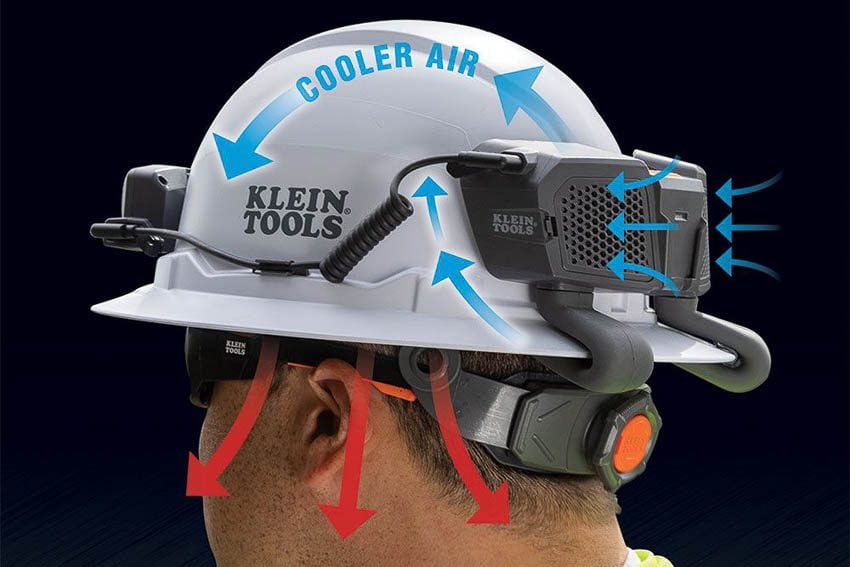
Over the years hardhats have changed. My first was made of fiberglass, and my second of aluminum. The rest have all been plastic. I’ve thought about getting one made of carbon fiber, but the cost/performance benefits are unclear to me.
But the most important recent improvement in hardhats has been increased protection against side impacts, a damage mode for which older models don’t account but which is critical in the case of blows to the head occurring during trips and falls. European industrial safety regs takes this into account with a special certification, and hardhats complying with EU rules look more like climbing or military helmets. Just something to consider.
Headlamps which can be attached to one’s hardhat are available too. As I get older and my eyes weaker I find these lights extremely helpful during quality control inspections. In fact, my headlamp is almost always mounted on my hardhat not only because it’s safer, but because it helps me do better, more accurate work in the less-than-perfect light conditions frequently found on construction jobsites allow. A word to the wise.
My point is you would be foolish to not own a quality hardhat, and to not wear it whenever you are on a construction jobsite, even if it is uncomfortable and may reduce your chances of getting your pic in GQ magazine.
I have more true bloody stories about eye protection and safety gloves too but won’t bore you with details. Use them.
Allergies
A subject many never consider when working wood is dust inhalation, especially in the case of toxic woods or those that might cause allergies.Yes, many varieties of rosewood, many varieties of cedar, and many other woods will cause respiratory problems and allergic reactions in most people. For those with asthma, the results can be serious. If you don’t know, be cautious, pay attention, and make corrections immediately.
During the Covid-19 scam Fake Faucci forced us all to purchase and wear those goofy, useless masks everywhere. Heck, here in Tokyo I know many guys who wore them all day when driving their private cars on sunny days with the windows rolled up. But woodworking entails not fake risks but real ones, so you would be wise consider what dust and fumes you will be exposed to, and perhaps plan to have on hand a real respirator with real rated filters to deal with real dust, and real fumes, especially when sanding and finishing.
Conclusion
The key takeaways can be summarized as follows:
- Ladders are death traps;
- Wear a full safety harness, with lanyard(s), hook(s) and reel(s), when working over 6 feet high.
- A cluttered jobsite can injure and too often kill;
- Hot work kills;
- Fire extinguishers have legs, and must be able to scream;
- Always wear a quality hardhat when on the job.
- Create a plan, and be prepared. Don’t rely on safety dudes, lawyers or bureaucrats to keep you safe.
Take note; take heed: these words are a gift freely given without let, lien or loan.

If you have questions or would like to learn more about our tools, please click the “Pricelist” link here or at the top of the page and use the “Contact Us” form located immediately below.
Please share your insights and comments with everyone in the form located further below labeled “Leave a Reply.” We aren’t evil Google, fascist facebook, or the IT Manager of the DNC and so won’t sell, share, or profitably “misplace” your information. May I fall from a dozen stacked ladders if I lie.


 Covington & Sons Tools
Leave a comment