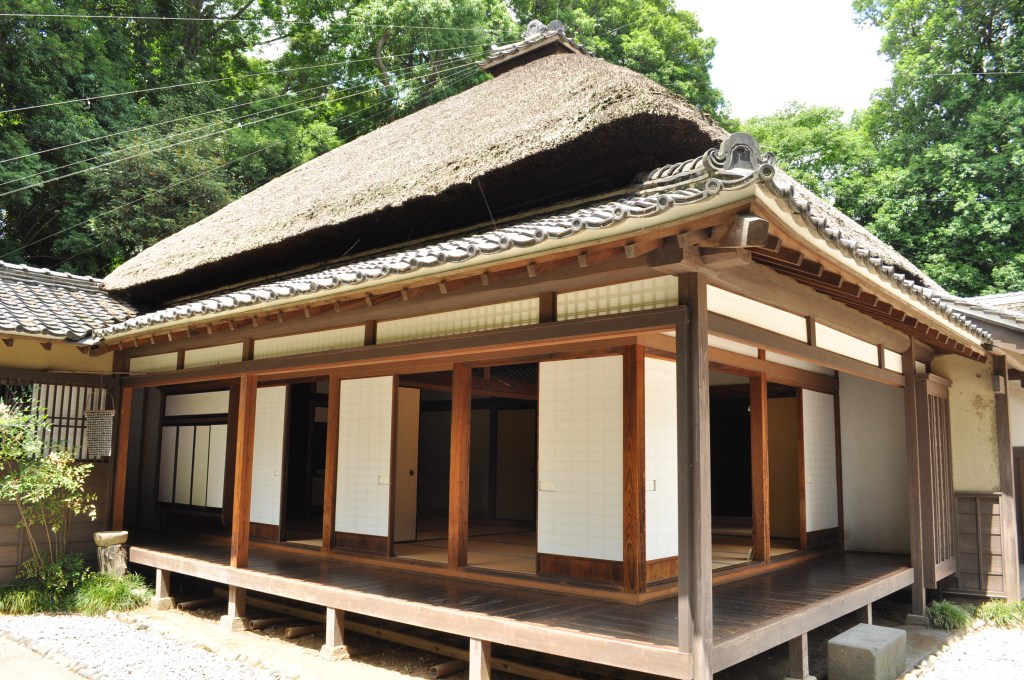
The Strongmen Under the Veranda

Art is born of craftsmen. Art is not born of those called artists.

Tsunekazu Nishioka and Horin Matsuhisa “The Heart of Trees, the Heart of Buddha”

Having worked in architecture and construction in Japan for more than half of my life, your humble servant is fond of Japanese traditional wooden architecture. It has much to recommend it, not only for the visual beauty of the designs and the spacial experiences it often provides, but also the excellence of much of it’s execution, made possible through craftsmen’s skill with Japan’s excellent woodworking tools.

In this post we will examine a few details of Japanese traditional architecture, and the Japanese language phrase one structural member engendered, the origin of which even most Japanese are unaware. Perhaps Gentle Readers will find this obscure phrase as interesting as your humble servant does.

The linguistically-intriguing architectural detail that is the primary subject of this article is a wooden structural member called the “en no shita no chikara mochi.”(縁の下の力持ち)which translates to “Strongman under the veranda.”

Some background is called for. As you can see from the photo at the top of this page, traditional wooden Japanese buildings are raised above the surrounding ground by a step or three with an ventilated crawl space beneath the floor. This is a practical feature commonly found in many countries, especially those with high groundwater levels, where it serves to keep soil dampness from penetrating the interior spaces thereby forestalling mold and wood rot.

In Japan, where exterior spaces, such as gardens, landscapes and even celestial spaces (e.g. moon viewing platforms) have been incorporated into buildings, the step up into the building is an important division between interior and exterior spaces. One may wear shoes into the entryway “genkan” of a building, but they must be removed before stepping up and entering the building proper. The genkan, therefore, being behind doors, is both an interior and exterior space. The wooden elevated veranda walkway around the perimeter of the building, called the “engawa” 縁側 in traditional Japanese architecture even moreso.

An engawa veranda in a traditional wooden structure. Notice the step-up from the ground level to the wooden veranda and an additional elevation change when entering the building’s interior with tatami-mat floors. Notice also the worse-for-wear sliding shoji screen doors to the left which separate interior and exterior spaces when closed, but expand the room into the garden when open. Please also notice, if you can, the groove cut into the floor of the veranda near the exterior edge in which lightweight wooden sliding doors called “amado,” meaning “rain doors” slide to enclose and protect the veranda when necessary. To the right of the veranda you can see a gravel-filled drainage trench constructed to receive rainwater dripping from the eaves instead of obtrusive, rudely gurgling rain gutters and pipes. Sitting on fragrant tatami mats, or on the wooden engawa floor with the shoji screens open of a spring evening or autumn afternoon while gazing out at a beautiful garden and listening to the sound of rainwater gently pattering on this gravel is a combination of sensory delights with which I hope Gentle Readers will someday be blessed.
Sorakuen in Kobe, Japan

The floor of the building is supported by a series of beams and purlins called “ Strongmen.” Those at the veranda are called “en no shita no chikaramochi” 縁の下の力持ち meaning “strongmen under the veranda.” In traditional Japanese architecture the veranda structure is designed so that these beams are both cantilevered and partially concealed creating a lightweight feeling, even giving the impression that the veranda floor is almost floating in air when viewed from some angles. The chikaramochi (chee/kah/rah/moh/chee) beams are seldom seen by the building’s residents, but without them, a building could not have a raised floor and would inevitably fail.
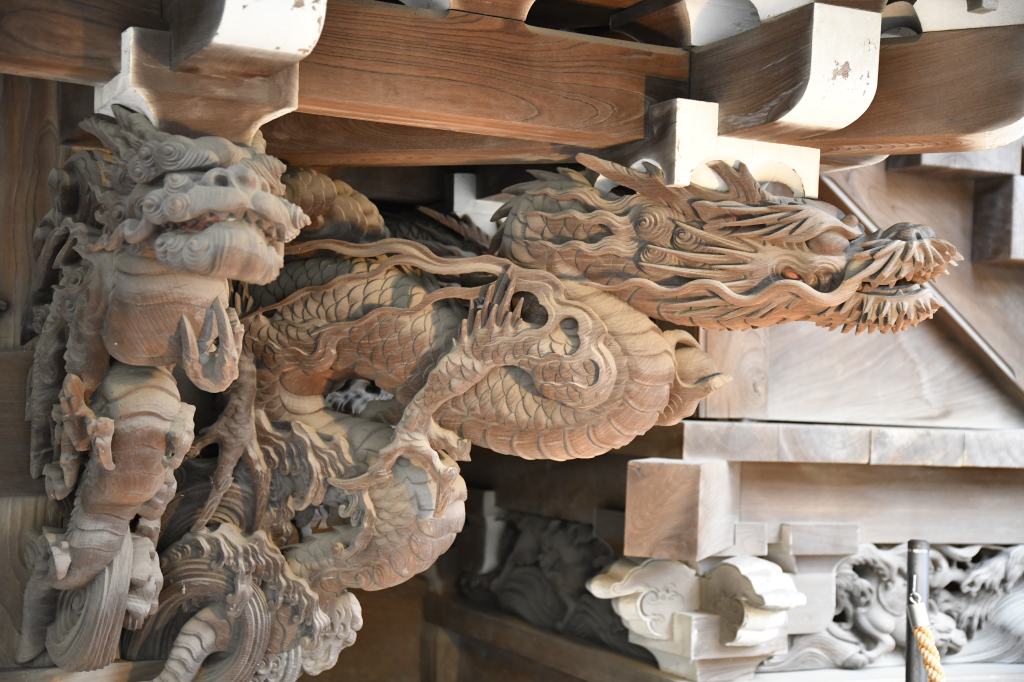
A phalanx of noble dragons supporting the first floor of the Taishakuten temple in Tokyo. In traditional Japanese architecture, ordinary uncarved beams supporting the floor in this way are called “En no shita no chikara mochi.”(縁の下の力持ち)which translates to “Strongman under the floor.” In the Japanese tradition, the dragon is a benevolent, noble creature that travels between oceans and heaven. The brackets supported on each dragon’s head in this photo represent clouds, as if the dragon team of strongmen are carrying the building through the heavens. In this case, the dragons have three toes on each foot, indicating that this is a private temple. Only dragons in imperial temples were allowed five toes.
Another noble dragon with waves at his feet and the kumimono clouds on his head. Amazing carving work.

Most Japanese people know and use the idiom without realizing it refers to this structural support.

To refer to someone as being a “Strongman Under the Floor” is to imply they are an “unsung hero,” or a person who quietly, selflessly and competently serves society and others by performing important but unseen tasks as a member of a team. From the Japanese dictionary it means “someone who toils diligently to support others in unseen ways and without recognition.” I salute all such strongmen, especially in the crafts and construction industry.

In our times we see an increasing trend for people in the public eye, especially actors, artists, musicians, politicians, journalists and the so-called “influencers” to display ghastly and even pyrotechnic levels of psychotic narcissism, the less talent and fewer accomplishments possessed the greater their frenzy to attract attention. These foul-mouthed, low-intelligence, often wealthy sociopaths, devoted to self-aggrandizement and the debasement of anything truly admirable, demand not only our unreserved celebration of their psychosis, but compliance with their ever-changing immoral opinions.

In situations in recorded history, where individuals with a similar psychosis have managed to grab unlimited power, they have shed rivers of innocent blood. A former leader of the Soviet Union, himself a remorseless dictator dedicated to the destruction of Western democracies, enslavement of entire nations, and with the blood of millions on his hands once called such narcissists “useful idiots,” and made a science of how to foster and effectively use them to destroy entire nations. His work continues even today.

But while narcissists, sociopaths and their sycophant useful idiots receive all the attention, and sadly, praise, it is the stable, moral, selfless, hard-working common people that build, renew, defend and perpetuate decent societies. In your humble servant’s opinion it is these good people that are the “Strongmen Under the Vernda” that deserve our true respect.

The photos above and below show a happy team of noble three-toed dragons serving as “en no shita no chikara mochi” supporting the first floor of the Taishakuten Buddhist temple in Tokyo. A thankless but important task these several-dozen hand-carved zelkova-wood dragons perform with energetic poise and a toothy grin. Bravo!

{D8E32672-70C5-4FEC-A49A-BAAE900538A2}
A phalanx of noble “strongmen” supporting a lavish veranda. These brave dragons straddle the waves of the oceans below them, and support wooden kumimono brackets which represent the clouds of heaven, on their prickly heads. The symbolism of these intricate carvings and complicated structural details is by no means haphazard.

Many professional woodworkers and blacksmiths are much the same as these dragons: inconspicuous, honest, hard-working, competently supporting the world within their scope without complaint, often with understated style.

YMHOS

The main entry into the Taishakuten temple. The carved figures at the top of the columns facing outwards to the left are Chinese Lions whose job it is to protect the holy precinct from demons and evil spirits. The figure with the elephant-like nose carved into the beam-end facing Gentle Reader is a mythical creature called a “Baku” 貘, a generally benevolent creature that eats bad dreams. The complicated brackets (called “kumimono”) supported on the columns have a structural purpose, of course, but in traditional Buddhist architecture they represent clouds, reflecting the link between the building and the heavens. Can’t have demons, evil spirits or bad dreams nesting up in there! Notice that, while the ends of the kumimono brackets have been painted white, the carved beams and columns are unvarnished, hand-planed, never-sanded Zelkova wood. Counter-intuitive though it may seem, hand-planed wood exposed to the environment lasts longer than if it was finished with abrasives and varnished or painted.

If you have questions or would like to learn more about our tools, please click the see the “Pricelist” link here or at the top of the page and use the “Contact Us” form located immediately below.

Please share your insights and comments with everyone in the form located further below labeled “Leave a Reply.” We aren’t evil Google, fascist facebook, or treacherous TikTok and so won’t sell, share, or profitably “misplace” your information. If I lie may Mama Shishi bite my head off.

Just ask the next baku you meet if it ain’t so. They can’t tell a lie you know.

Go back

Your message has been sent

Warning
Warning
Warning
Warning.

Leave a comment

4 thoughts on “The Strongmen Under the Veranda

  1. I joyfully read so many of your tool writings while home with a cold. I think I could trust you as a quality tool source.

    In the mid-90s I apprenticed to a NJ-born and western carpentry based cabinetmaker high in the Rockies… he was also a talented Aikido practitioner…and mixed Japanese hand tools into our projects. It stuck. I own a scattering of decent chisels and 1 regular production saw that has been a sharp part time workhorse through two home builds.

    (Considering that I’m not writing a public plea for recognition but a simple lead in to a question, here is said question) :

    Once I decide to purchase a solid, carefully cuddleable saw or plane from your stores, how is the shipping and tariffs world going along at this time?

    I truly thank you for the care and detail in your writing, and hope for a response.

    C Renfrew, Minnesota

    Like

    1. Dear Mr. Renfrew:

      When the time comes to purchase a loving handplane, the cost of shipping charged by the shipping company at that time will apply (no markup). The options for shipping edged tools from Japan to the USA and Europe are few nowadays. In the case of Europe, the impact of the drug-induced insanity that overshadows the nearly-failed and despotic UK government, which makes it illegal to import even a dull-edged, round nosed butterknife for fear of its being used for mass-murder (UKGov’s official words, not mine), make it difficult to ship many products. Consequently, the most prominent Japanese common carrier refuses to ship edged tools anywhere overseas at all.

      The recent tariff storm kicked up by President Trump has resulted in Japan Post refusing to ship anything but documents to the USA, killing the most economical, if slowest, option. That leaves DHL, the largest carrier in the world. Very speedy, but expensive and not very reliable in the USA lately due to a nasty habit of covering-up, and not compensating for, package theft.

      I’m not sure how much tariffs will cost. On July 30, 2025, the U.S. government issued an executive order titled “Termination of De Minimis Treatment for All Countries.” This cancelled a US$100 exemption across the board for imports to the US, and has resulted in all packages being charged. Tremendous time delays have resulted for every carrier except DHL. The rate for tools imported from Japan to the USA was 6.5%, but now it appears to be around 18%. We shall see where it ends up. https://covingtonandsons.com/2025/02/24/tariffs-taxes/ . I hope this is clear as mud. Stan

      Like

      1. Mr Covington-

        Your reply is unfulfilling but realistic. I will have to decide on exorbitant shipping, or wait out a potential change in policy (a common enough occurrence in fitful babies). I see so many adjective-engorged tool descriptions selling kanna as secret keys to pure wisdom but rarely a detail or even name of the blade maker. Dammit. I will wait and test my patience…. knowing my self well, you will probably see an order by next month!

        Happy autumn. And Thank You. C Renfrew

        Like

        1. Sorry my reply was less than fulfilling, but I answered all your questions as fully as possible in light of my failings as a mind reader. I’m confident I have no BS answers but I can’t write a book to answer all potential questions that haven’t been asked. Happy Autumn.

          Like

Leave a comment